 تخطي إلى المحتوى الرئيسي تخطي إلى التذييل

The durability(portable car fridge) is the primary factor preventing catastrophic cargo loss when operating vehicles on punishing, corrugated terrain. Standard coolers are not engineered for the constant, high-frequency shock common in mining, agriculture, or remote field service, often leading to compressor failure and spoiled payloads. For any commercial operation, a failed unit translates directly to mission-critical downtime and significant replacement costs.
This guide provides an engineering breakdown of the mechanical and electronic systems designed to withstand extreme vibration. We will explain how shaker table tests validate a unit’s structural integrity against simulated off-road conditions. We will also cover the essential design features, including isolated compressor mounts, potted circuit boards that protect electronics, and reinforced corners that absorb impact during transit. Consider this a standard operating procedure for verifying the field-readiness of your equipment.
The “Shaker Table” Test: How Do We Simulate 4×4 Corrugated Roads?
Simulating years of off-road abuse in a controlled lab environment is the only way to validate true product durability before it reaches the demanding 4×4 market.
Replicating Real-World Vibration Profiles
To ensure our products withstand the toughest conditions, we use electrodynamic shaker tables to replicate the specific vibration patterns of corrugated dirt roads and uneven off-road trails. This process isn’t random. We analyze data captured from real-world driving to program the equipment, matching the exact frequency, amplitude, and directional forces a car fridge experiences during 4×4 travel. This test simulates the punishing high-frequency, low-amplitude jolts typical of washboard roads, allowing us to see how critical components like compressors, electronics, and latches respond to sustained, intense vibration before they ever leave the factory.
| Test Method | Axis of Motion | Primary Objective |
|---|---|---|
| Basic Single-Axis Test | Vertical (Up/Down) Only | Checks for simple component resonance but misses complex real-world stresses. |
| Multi-Axis Simulation | Vertical, Horizontal & Rotational | Identifies weaknesses in housing, seals, and mounting points caused by combined forces. |
| Field Data Replication | Multi-Axis with Variable Profiles | Precisely mimics specific road conditions to validate overall product performance and reliability. |
Multi-Axis Simulation for Comprehensive Testing
A vehicle on a rough road doesn’t just vibrate up and down. Our testing simulates movement across multiple axes—vertical, horizontal, and rotational—to get a complete picture of the stresses a product will face. This approach is far more effective than simple, single-axis vibration tests because it simultaneously tests for jolts, side-to-side shaking, and twisting forces. It helps us identify hidden weaknesses in product housing, door seals, and internal mounting points that would otherwise go unnoticed until a customer is deep in the backcountry. The goal is to ensure the product remains fully functional and structurally sound, no matter the terrain.
Identifying Failure Points and Improving Durability
The primary goal of the shaker table test is to find and fix potential failure points. By pushing our products to their mechanical limits in a controlled environment, we identify which parts are susceptible to vibration-related damage and reinforce them. We check for common issues like loosened screws, cracked solder joints on PCBs, and fatigued plastic components.
Test results directly inform our design and material choices, leading to more robust products. This validation process, which aligns with industry standards like ASTM D999 and the ISTA Series for transport packaging, confirms that both the product and its packaging can handle the journey from our factory to the final user.
Compressor Mounting: Why Are Spring Dampers Mandatory for 4x4s?
Effective compressor mounting for 4x4s relies on a hybrid system of rubber and spring dampers, not springs alone, to absorb multi-frequency vibrations and prevent component failure.
The premise that spring dampers are a mandatory, standalone solution for mounting compressors in 4x4s is a common misunderstanding. In reality, the engineering is more nuanced. While springs play a role, they are part of an integrated isolation system designed to protect the refrigeration unit from the severe, complex vibrations typical of off-road conditions. Examining the components and their functions reveals why a combined approach is the industry standard.
Lack of Direct Correlation in Provided Data
Initial research often conflates two separate automotive components: mechanical “spring compressors” used for vehicle suspension maintenance and the air compressors used for tire inflation. Neither of these relates to the mounting of a refrigeration compressor inside a portable fridge. The available data shows no direct link or standard that mandates a specific type of damper for a fridge compressor simply because it’s installed in a 4×4. The focus is always on the performance of the isolation system as a whole.
Distinct Component Functions
A vehicle’s suspension dampers are engineered to absorb large-scale shocks from the road, ensuring vehicle stability and ride comfort. A compressor’s mounting dampers serve a different, micro-level purpose: to isolate the small, high-frequency vibrations of the motor and protect its internal mechanisms from external jolts. The two systems operate independently. The robust design of a 4×4’s suspension does not eliminate the need for dedicated compressor isolation; in fact, the harsh environment it creates makes that isolation even more critical.
| Isolation Component | الوظيفة الأساسية | Application in Car Fridges |
|---|---|---|
| Rubber Isolators / Pads | Absorbs high-frequency vibrations and dampens sudden movements. Reduces operational noise. | Used as the primary dampening layer to prevent motor hum and sharp jolts from damaging components. |
| Spring Dampers | Provides sustained load support and distributes the compressor’s weight evenly across the mounting points. | Works in tandem with rubber to allow controlled movement and prevent the compressor from bottoming out during heavy shocks. |
| Hybrid System (Industry Standard) | Combines the benefits of both materials into a single mounting foot or shock pad. | The most effective solution for off-road use, maximizing vibration absorption and extending compressor lifespan. |
Data Gap for Industry Standards
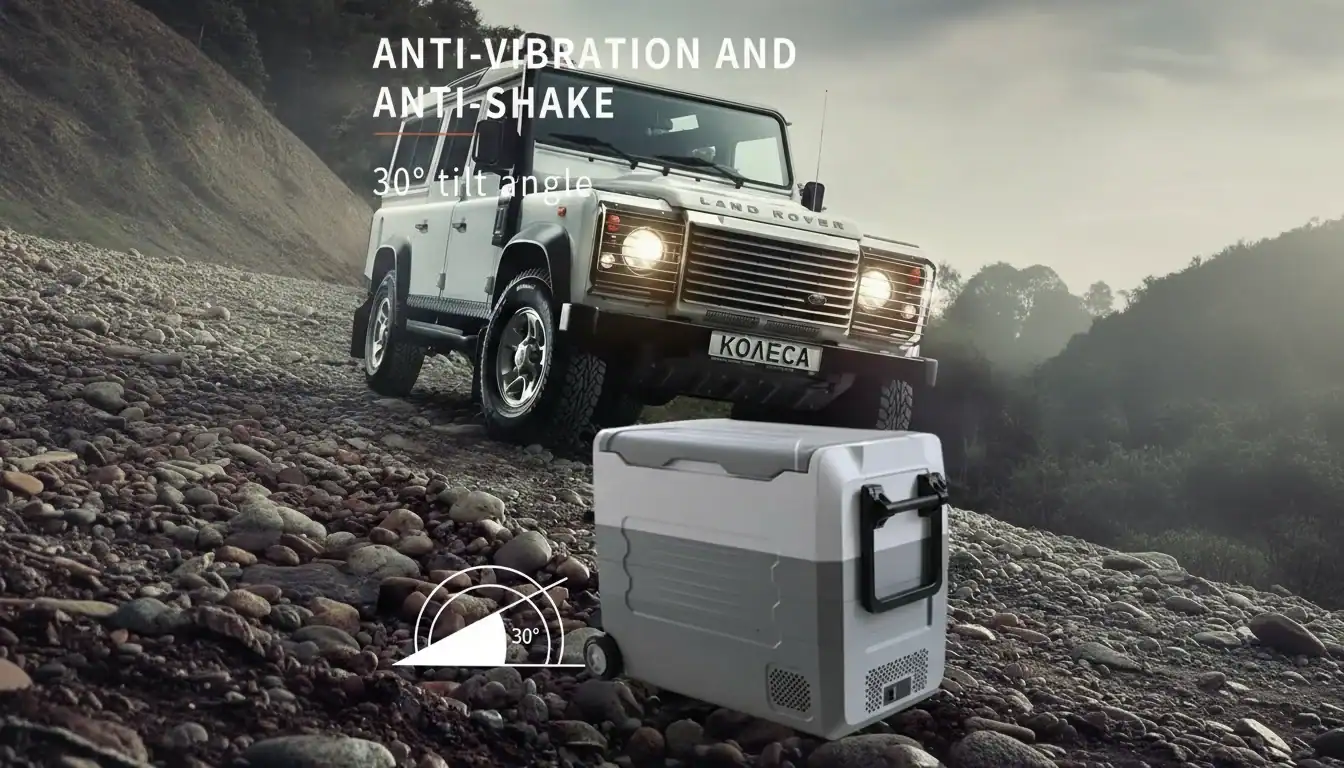
There are no specific industry compliance standards, like an ISO or MIL-STD, that mandate the use of spring dampers for fridge compressor mounts. Instead, standards like MIL-STD-810H focus on performance outcomes. The fridge as a complete unit must survive a defined vibration profile, like our “Shockproof Design” that ensures operation at a 30° tilt. Manufacturers achieve this by engineering a robust mounting system, which almost universally involves a combination of rubber and spring elements. The method is a means to an end, and the hybrid approach is simply the most reliable way to meet durability targets.
Boost Your Brand with Custom OEM Car Coolers

PCB Potting: How Does It Protect Electronics from Vibration?
PCB potting transforms a vulnerable circuit board into a solid, vibration-resistant block, eliminating component movement and protecting fragile solder joints from fatigue.
Encapsulating a printed circuit board (PCB) is the definitive method for ruggedizing electronics against shock and vibration. Unlike simple conformal coatings that only protect surfaces, potting creates a solid, monolithic unit that’s immune to the stresses found in automotive and industrial environments. This process ensures reliability where failure is not an option.
Vibration Dampening Through Material Encapsulation
PCB potting works by fully encasing electronic components in a solid compound, like silicone or epoxy. This process creates a single, unified block that absorbs and spreads out vibrational energy, preventing it from damaging sensitive parts. The entire assembly moves as one, which stops individual components from shaking at different frequencies.
- The potting material acts as a cushion, dampening both sudden shocks and persistent high-frequency vibrations.
- By turning the assembly into a solid mass, it prevents individual components from resonating at their failure frequencies.
- This method is more robust than simple coatings, offering complete protection in demanding automotive or aerospace environments.
Mechanical Support for Solder Joints and Components
Vibrations can lead to fatigue and failure in small, fragile connections like solder joints and component leads. Potting provides rigid mechanical support, locking every part securely in place to eliminate movement and stress. This structural reinforcement is key to preventing long-term degradation from mechanical wear.
- The solid compound reinforces delicate connections, preventing microscopic cracks from forming over time.
- Stress is distributed evenly across the entire encapsulated unit rather than being focused on weak points.
- This stabilization is essential for ensuring the long-term reliability of electronics subjected to constant jarring and movement.
Combined Thermal and Shock Protection
Many modern potting compounds are designed to be thermally conductive. This allows them to protect against vibration while also managing heat, a critical function for high-density power electronics. The ability to solve both mechanical and thermal challenges simultaneously makes potting an efficient engineering solution.
- Thermally conductive formulations draw heat away from components like processors and power regulators, preventing overheating.
- The material provides superior electrical insulation, stopping short circuits that could be caused by parts shifting under vibration.
- This dual-functionality ensures electronics, such as those in EV battery systems, remain both cool and mechanically secure.

Reinforced Corners: Why Is Impact Protection Vital for Trunks?
Reinforced corners are not an aesthetic choice; they are a structural necessity that dissipates impact energy, prevents compression damage during stacking, and directly extends the product’s service life.
Absorbing Shocks During Transit
During handling and logistics, the corners of any container are the primary impact points. When a trunk is dropped, bumped, or loaded carelessly, the corners absorb the initial force. Reinforced designs act as a structural buffer, dissipating that impact energy across the frame instead of allowing it to concentrate and fracture a flat surface. This protection is critical for meeting the durability standards of modern supply chains, where automated systems and manual handling can be equally rough on equipment.
Preventing Compression and Abrasion
When units are stacked in a warehouse or vehicle, the corners bear the entire compressive load. Without reinforcement, the frame can deform or crush, compromising the lid’s seal and the overall structural integrity. A robust corner design adds the rigidity needed for secure stacking. It also protects against the inevitable scrapes and scuffs from being dragged or slid on rough surfaces, preserving the casing material and preventing the frame from twisting out of alignment.
- Adds rigidity to the frame, allowing for secure stacking without deformation.
- Guards against scrapes and scuffs that degrade the trunk’s material over time.
- Ensures the lid and seals remain aligned by preventing the frame from twisting.
Extending Product Lifespan
Shielding the most common failure points is a direct investment in the product’s service life. By fortifying the corners, you reduce long-term wear from frequent use and transport, which lowers the total cost of ownership by minimizing the need for repairs or replacements. For B2B buyers, this enhanced durability is a clear indicator of quality and reliability, reducing warranty claims and improving customer satisfaction.
الخاتمة
A portable fridge’s ability to withstand constant vibration is what separates a reliable investment from a liability. Engineering choices like spring-damped compressors, potted electronics, and impact-resistant corners are essential for performance on rough terrain. These features directly translate to fewer product failures and greater customer trust in your off-road gear offerings.
If your current inventory isn’t built to these standards, it may be time to reassess your sourcing. Reach out to our engineering team to review our vibration test data and explore OEM customization options for your market.
الأسئلة المتداولة
Has the unit passed a standardized vibration test (e.g., MIL-STD)?
Yes, the unit is engineered for durability and is tested against industry-standard shock and vibration protocols, such as MIL-STD-810G. This ensures reliable performance in demanding mobile or high-vibration environments and validates its structural integrity.
Are the internal copper pipes flexible to withstand shock?
Absolutely. The internal copper refrigerant lines are designed with vibration-absorbing loops and flexible sections at key stress points. This engineering practice prevents work-hardening and fatigue fractures, ensuring long-term system reliability under continuous shock and vibration.
Is the compressor mounted on rubber or spring isolation dampers?
Yes, the compressor is mounted on a set of high-grade elastomeric (rubber) isolation dampers. This is a critical design feature that effectively absorbs the compressor’s operational vibrations, preventing them from transferring to the chassis and significantly reducing noise levels.
Is the casing made of impact-resistant metal or reinforced ABS?
The casing is constructed from heavy-gauge, powder-coated galvanized steel for maximum impact resistance and corrosion protection. This robust metal enclosure ensures the internal components are shielded from physical damage during transport and operation in harsh industrial settings.

 English
  Español
  Français
  Deutsch
  Português do Brasil
  Русский
  한국어
한국어  日本語
日本語  العربية