 تخطي إلى المحتوى الرئيسي تخطي إلى التذييل

Integrating UI & IoT Customization(smart travel kettle) dictates your exact hardware development costs and directly influences user retention rates. Generic interfaces confuse users and degrade the perceived value of your consumer electronics. Relying on off-the-shelf display modules without bespoke software features limits your pricing power and risks losing tech-savvy buyers to competitors who prioritize seamless digital experiences.
This document serves as your technical standard operating procedure for evaluating hardware upgrades and software integrations. We analyze the functional differences between stepless touch controls and traditional mechanical buttons to guide your manufacturing decisions. You will review a precise breakdown of tooling costs for custom glass touch panels, the engineering requirements for embedding corporate logos into LED boot screens, and the deployment steps for launching a white-label Bluetooth application.
Can We Add Our Corporate Brand Logo to the LED Boot Screen?
Integrating a corporate logo into the appliance boot sequence requires direct firmware modification at the factory level to ensure immediate, high-resolution brand visibility upon power-up.
Firmware and UI Customization Capabilities
KelyLands integrates digital branding directly into the device’s software sequence during the OEM/ODM manufacturing process. Our engineering team programs your provided corporate logo files straight into the appliance firmware, overriding standard startup graphics.
- Developers adjust the boot screen sequence to trigger the logo display the exact millisecond the user powers on the device.
- Quality control inspectors verify the boot sequence speed and display resolution during final hardware testing.
Minimum Order Quantities for Digital Branding
Adding custom software features requires specific B2B volume thresholds to maintain manufacturing efficiency and keep unit costs viable. Custom digital boot screens represent an advanced OEM service that relies on dedicated engineering hours.
- The 12V/24V car kettles carry a standard MOQ of 1,000 units for this level of hardware and software integration.
- Hitting these volume thresholds allows KelyLands to fully absorb the initial software development and digital rendering costs.
Hardware Display Specifications
The underlying screen hardware dictates exactly how your corporate logo renders during the startup process. Premium models support advanced visual interfaces, utilizing customized LED matrices or compact LCD screens depending on the specific product line requirements.
- Engineers match the digital logo colors using Pantone standards to align strictly with your corporate identity guidelines.
- The factory applies a triple-layer inspection system to guarantee flawless digital screen function across varying vehicle voltage inputs.
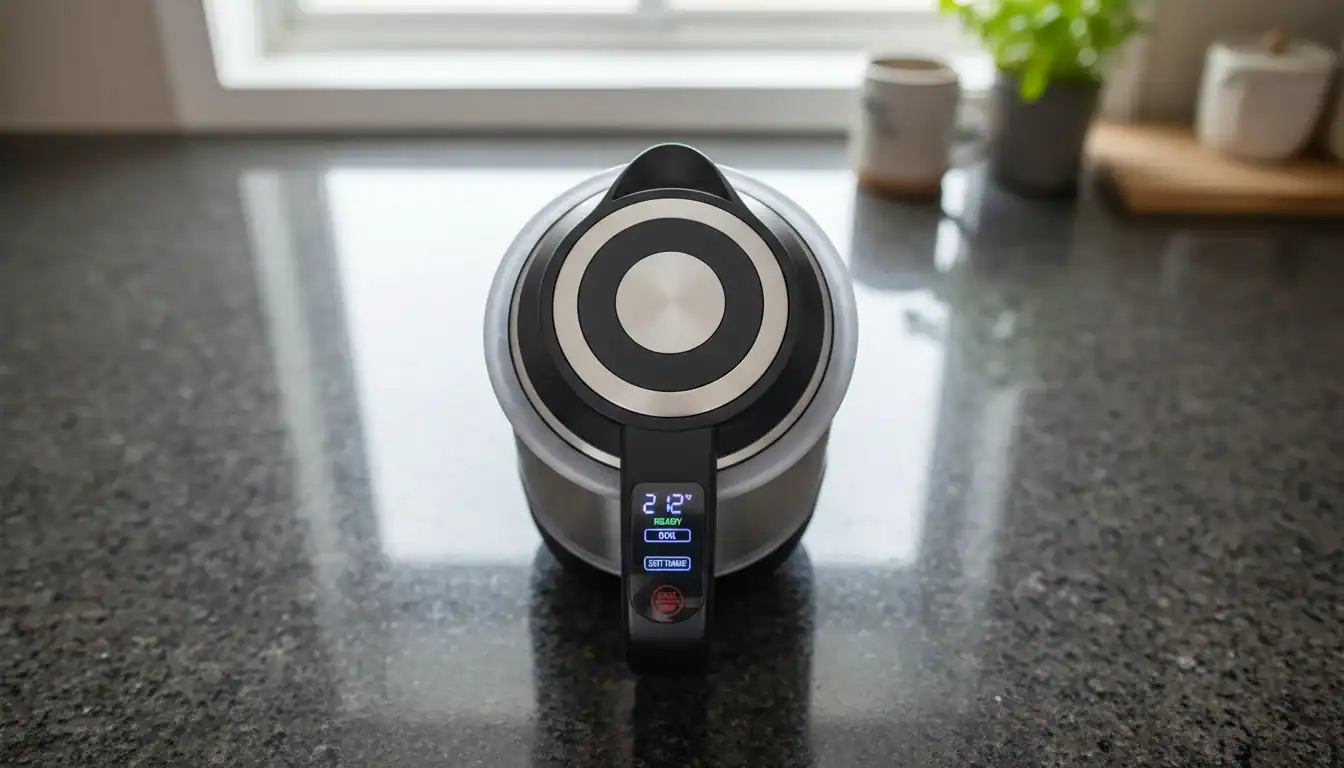
Is Stepless Touch Temperature Control Better Than Mechanical Buttons?
The optimal interface depends entirely on the end-user environment: touch controls dominate consumer precision brewing, while mechanical switches remain the undisputed standard for rugged, high-vibration commercial applications.
Precision and Safety Features of Touch Controls
Stepless touch controls allow users to adjust heating parameters in exact 1–5°C increments, catering directly to specialty beverage requirements. Modern digital panels integrate memory functions that save preferred heating profiles for consistent daily use. Engineers embed safety mechanisms, such as auto-shutoff and boil-dry protection, directly into these digital interfaces to prevent overheating. Consumer-focused brands favor these touch panels to align with sleek, modern product designs and smart home integrations.
Durability and Tactile Feedback in Mechanical Buttons
Physical buttons give users instant tactile confirmation, helping them operate the kettle quickly without looking at a screen. Mechanical systems resist moisture degradation better than touch panels, reducing failure rates in damp, humid, or high-vibration settings. Commercial operators prefer physical switches because they withstand repetitive, heavy-duty physical stress. Manufacturers outfit rugged 12V/24V car kettles, like the KelyLands fleet series, with durable physical controls to ensure consistent performance during off-grid travel and long-haul transport.
| فئة الميزة | Stepless Touch Panel | Mechanical Switch |
|---|---|---|
| Temperature Precision | Exact 1–5°C increments | Fixed boiling point activation |
| Environmental Tolerance | Requires clean, dry surfaces | Resists moisture and high vibration |
| التطبيق المستهدف | Smart homes and specialty coffee | Logistics fleets and commercial kitchens |
Selecting the Right Interface for Your Market
Market segmentation data for 2026 shows a clear split, guiding B2B procurement managers to select the interface that matches their specific operational needs. Analyzing the end-user environment ensures the hardware delivers maximum reliability and lifespan.
- Touch temperature controls suit lifestyle consumers and specialty coffee enthusiasts who require precise heat adjustments and programmable memory profiles.
- Mechanical buttons dominate logistics fleets, RV outfitters, and professional environments where operators face time pressure, physical stress, and rugged conditions.
Boost Profits with Certified 12V/24V Car Kettles
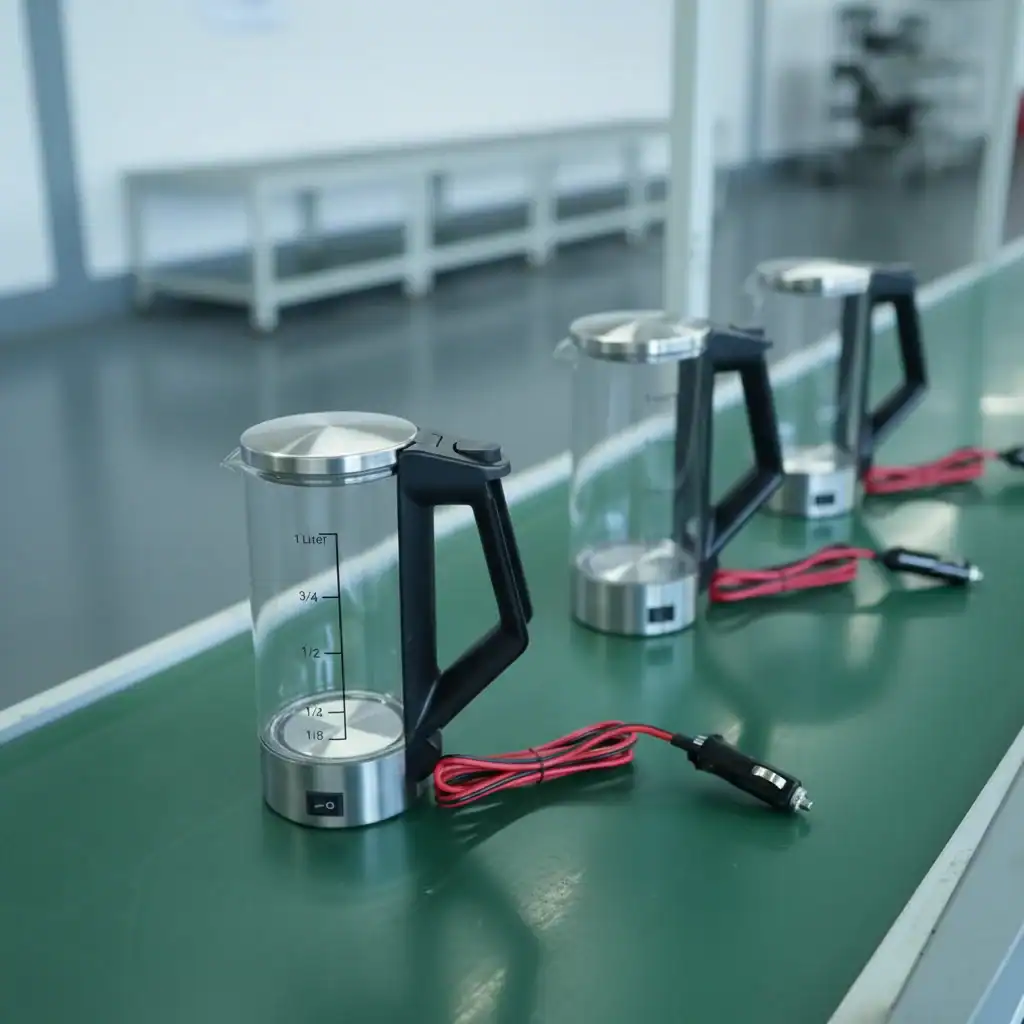
Can Your Factory Develop a White-Label Bluetooth App for the Kettle?
Deploying a white-label Bluetooth application for 12V/24V travel kettles using modular IoT SDKs accelerates time-to-market while giving fleet managers a secure, fully branded digital ecosystem.
Leveraging Modular IoT Platforms for Rapid Deployment
KelyLands integrates Bluetooth Low Energy (Bluetooth LE) connectivity into our 12V/24V kettle control boards using platform-agnostic frameworks. Building a proprietary application from the ground up demands massive engineering capital and severely delays product launches. We bypass this bottleneck by deploying established, pre-built IoT software development kits (SDKs). This modular approach drastically reduces the time-to-market for your smart travel kettles while guaranteeing stable, low-latency communication between the physical heating base and the user’s smartphone.
White-Label Interface Customization
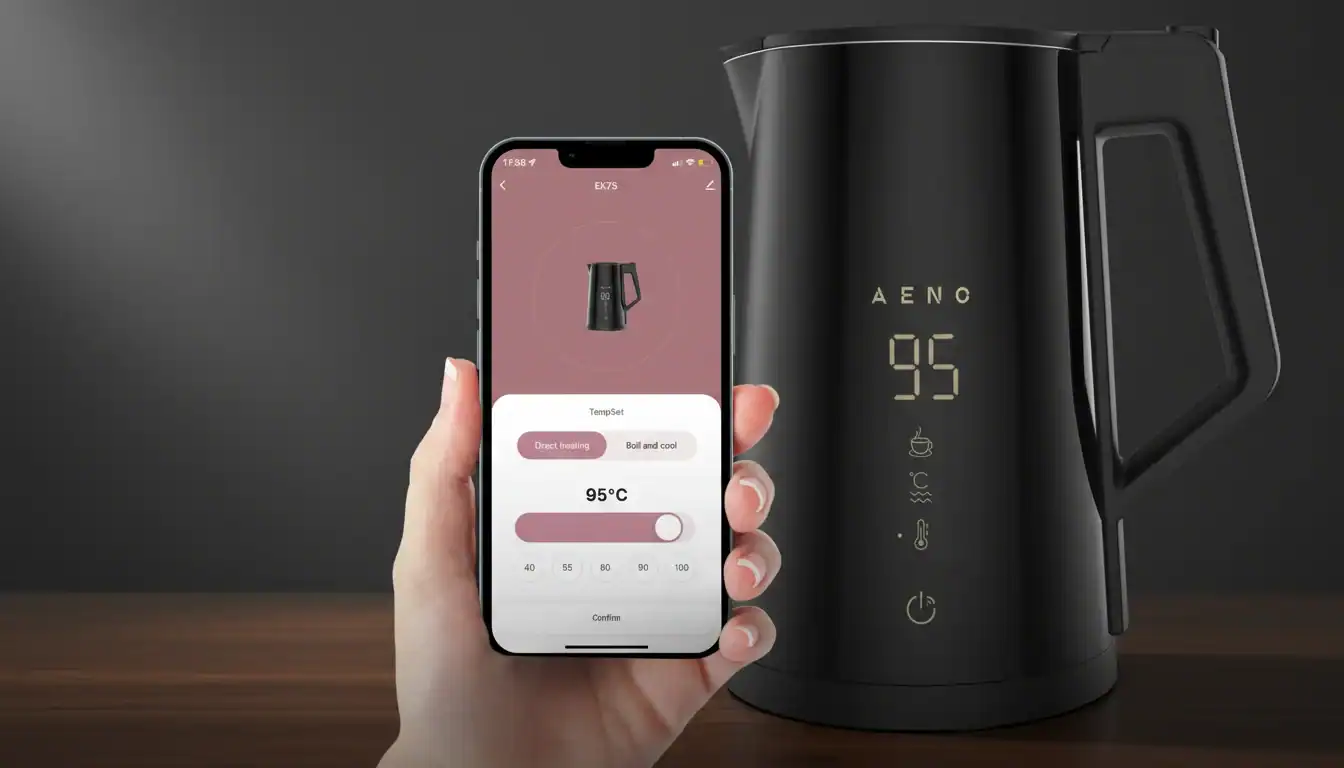
Adapting the mobile application interface to match your exact B2B brand guidelines creates a cohesive user experience. Our development team embeds your corporate logos, precise Pantone color schemes, and custom control layouts directly into the app infrastructure. Fleet managers and RV outfitters receive a fully branded digital ecosystem that mirrors their customized physical hardware. Through this tailored interface, end-users can seamlessly adjust temperature presets ranging from 70°C to 100°C, schedule delayed boiling times, and monitor real-time heating status via software that looks entirely proprietary to your brand.
Managed Services for Security and Compliance
Maintaining a smart appliance application requires constant adaptation to rolling iOS and Android operating system updates. KelyLands coordinates with specialized development partners to implement strict data security measures and smartphone battery optimization protocols for your connected kettles. Outsourcing the application backend to our managed services eliminates the heavy technical overhead from your internal engineering teams. We ensure your software maintains global regulatory compliance, keeps user data encrypted, and functions flawlessly without requiring dedicated, in-house maintenance resources.
What Is the Tooling Cost for Developing a Custom Glass Touch Panel?
Initial tooling investments for custom glass touch panels directly correlate with interface complexity, ranging from accessible sub-$1,000 baseline fees to higher tiers for heavy-duty industrial specifications.
Standard vs. Complex Configuration Costs
Custom glass touch panel tooling fees vary based on the specific complexity and technical requirements of the design. Tooling fees for standard panel configurations generally remain under $1,000 USD. Pricing escalates for non-standard requirements, such as unique shapes, glass thickness exceeding 3mm, or industrial-grade panels built to withstand the harsh environments of long-haul fleet operations. Customized electrical specifications, special optical coatings, and specialized interface layouts increase the initial setup investment.
KelyLands provides clear OEM/ODM development support, helping B2B clients evaluate exact tooling costs when integrating custom interfaces into 12V and 24V in-car appliances. By consulting directly with manufacturing engineers, procurement teams map out the exact cost-to-feature ratio before initiating production.
| Configuration Level | Estimated Tooling Cost | Technical Characteristics |
|---|---|---|
| Standard Commercial | Under $1,000 USD | Standard geometry, ≤3mm glass thickness, basic layout |
| Moderate Customization | Approx. $6,400 USD | Specialized optical coatings, custom UI layouts, polarizers |
| Heavy-Duty Industrial | Custom Assessment | >3mm thickness, low-speed data (<30MHz), high vibration resistance |
Manufacturing and Labor Requirements
Initial tooling charges cover the rigorous, multi-step production processes required to build custom touch panels from scratch. Developing a responsive, reliable touch interface demands substantial labor and high-end manufacturing equipment investments. Creating a single customized unit requires the collaboration of more than 10 specialized workers operating 10 different precision machines.
The complete production cycle involves over 10 precise optical bonding and assembly steps before reaching final quality assurance testing. Operating from an advanced facility in Yuyao, KelyLands handles these intricate production steps efficiently to deliver high-quality, fully tested components that integrate seamlessly with high-borosilicate glass and stainless steel appliance bodies.
Regional Advantages and Supply Chain Value
Partnering with established manufacturing hubs helps optimize both initial tooling and long-term production expenses. Regional manufacturing hubs in China have standardized the cost structure for glass touch panels, keeping initial tooling fees accessible while maintaining the sophisticated equipment required for precision bonding.
These industrial centers offer highly competitive pricing for bulk B2B orders while maintaining strict international quality certifications. KelyLands leverages its extensive Ningbo-based infrastructure to provide flexible MOQs and competitive factory-direct pricing. This regional alignment maximizes ROI for global procurement managers expanding their inventory of high-performance 12V/24V travel appliances.
الخاتمة
Integrating custom LED boot screens and responsive touch controls allows tech brands to elevate the standard travel kettle into a premium ecosystem device. Upgrading from mechanical buttons to smart interfaces ensures a seamless user experience while differentiating your product in a competitive retail landscape. Evaluating tooling costs early in the design phase helps keep your project on budget during mass production.
Review your current product specifications and reach out to our engineering team to discuss custom touch panel tooling estimates. We can provide a detailed OEM roadmap to align your smartphone app requirements with our hardware manufacturing capabilities.
الأسئلة المتداولة
Can the LED display show our brand logo when turned on?
Yes, we can fully customize the firmware to display your brand logo on the LED boot screen during startup. This is achieved by flashing a custom image onto the microcontroller’s memory, ensuring your corporate branding is immediately visible to the end-user every time the smart kettle powers on.
Do you offer Bluetooth connectivity for smart kettles?
Absolutely. We integrate low-energy Bluetooth (BLE 5.0+) modules into our smart kettles. This allows seamless pairing with mobile devices for real-time temperature monitoring, remote activation, and custom boiling profiles without heavily draining the appliance’s power supply.
How much does it cost to develop a custom touch panel?
The cost to develop a custom capacitive touch panel typically ranges from $2,000 to $5,000 for the initial tooling and PCB design, depending on the complexity of the UI, the number of touch zones, and the display type (e.g., TFT, OLED, or basic LED segments). Per-unit costs scale down significantly during mass production runs.
Can the kettle be controlled via a smartphone app?
Yes, our smart kettles can be fully controlled via a dedicated iOS and Android smartphone app. We provide secure API endpoints and cloud integration (via Wi-Fi or Bluetooth) so users can schedule heating times, adjust temperature settings precisely, and receive push notifications when their water is ready.

 English
  Español
  Français
  Deutsch
  Português do Brasil
  Русский
  한국어
한국어  日本語
日本語  العربية