 跳转到主要内容 跳转到页脚

Reliable Heating & Cooling (car cooler warmer) functionality is the single barrier between a successful all-season product and a device plagued by winter-season returns and food safety complaints. Most dual-function units treat the warming feature as an afterthought, failing to meet the demands of professional users like truckers who depend on it for a hot meal. This performance gap creates a significant business risk, from negative reviews to liability concerns if the unit cannot hold food above the 60°C bacterial danger zone.
This technical brief examines the core components that deliver on the promise of year-round versatility. We will analyze how the dual-chip system switches between cooling and a stable 65°C heating mode, focusing on its ability to maintain safe temperatures for food storage. We’ll also address critical safety engineering, from the switch logic that prevents accidental mode changes to the power consumption differences and the inclusion of a neutral-off position to protect the thermoelectric chip.
From 15°C to 65°C: How Does the Dual-Chip Switch Work?
A single semiconductor chip provides both cooling and heating by reversing electrical polarity, offering a reliable, solid-state temperature control solution without compressors or refrigerants.
Cooling Mode: Peltier Effect for Temperature Reduction
Thermoelectric coolers use a solid-state Peltier module, a semiconductor chip that creates a temperature difference when DC electricity passes through it. The “cold” side of the module faces the unit’s interior, absorbing heat and transferring it to the exterior heat sink. This process cools the internal temperature to 15–20°C below the surrounding ambient temperature, a performance metric known as Delta T (ΔT). Because this system has no moving parts, refrigerant, or a compressor, it operates silently and without vibration, making it ideal for in-vehicle use.
Warming Mode: Reversing Current for Heat Generation
To switch to warming mode, the system reverses the polarity of the electrical current sent to the same Peltier module. This action flips the chip’s function, causing the interior plate to generate heat while the exterior radiates cold. An internal thermostat regulates the process, maintaining a stable warming temperature between 50–65°C. This range is optimal for keeping pre-heated food and beverages warm during transport, holding them safely above the 60°C (140°F) threshold that prevents rapid bacterial growth. These units are designed for maintaining heat, not for cooking raw food.
Power Source and Mode Selection
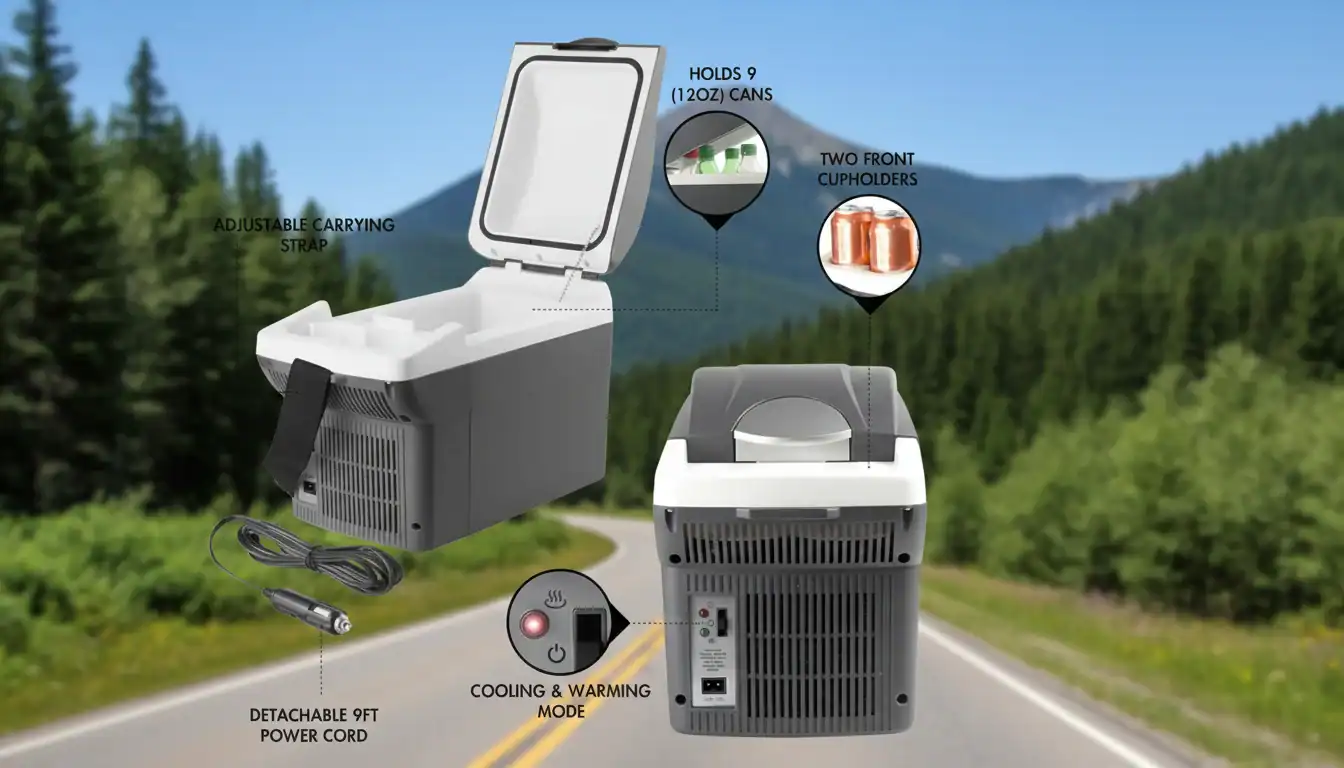
A physical switch on the unit controls the mode by toggling the electrical current’s polarity between HOT, COLD, and OFF. This simple, robust mechanism prevents accidental changes during vehicle movement. The coolers are built for versatility, running on a 12V/24V DC power cord that plugs directly into a vehicle’s cigarette lighter. For use outside the vehicle, every unit includes a separate AC power adapter compatible with standard 110V-240V wall outlets.
Winter Sales: Can It Keep Lunch Warm for Truckers?
Thermoelectric warmers use a solid-state Peltier module and foam insulation to maintain a food-safe 50–65°C, making them a practical winter tool for professional drivers.
Peltier Module: The Semiconductor Core for Heating
The core of the warming function is a solid-state Peltier module. This semiconductor chip generates heat by simply reversing the electrical current—the same principle used for cooling, just inverted. This design eliminates the need for freon or mechanical compressors, resulting in completely vibration-free operation. That stability is a critical feature for reliable performance inside a moving truck cab.
Achieving a Consistent 50–65°C Warming Temperature
These units heat and maintain a stable internal temperature between 50°C and 65°C. This range is specifically chosen to keep pre-cooked meals hot and ready to eat, safely outside the bacterial growth “danger zone” that ends around 60°C. An integrated thermostat manages the heating element, preventing the unit from overheating and ensuring consistent, food-safe temperatures without manual adjustment.
Insulation’s Role in Cold Weather Performance
Effective heating in a cold truck cab depends heavily on insulation. The units are constructed with high-density EPS or polyurethane (PU) foam, which minimizes thermal loss to the cold ambient air. This robust insulation is key to performance, as it allows the Peltier module to work more efficiently. By retaining heat for longer periods, the unit reduces power consumption from the vehicle’s battery.
Powering the Warmer via 12V/24V DC Systems
Each warmer is equipped for direct use in commercial trucks and passenger vehicles. The kit includes a 2.5m to 3.5m DC power cord that plugs into standard 12V and 24V cigarette lighter sockets, requiring no electrical modifications. A separate AC adapter is also provided for convenience. This allows a driver to pre-heat the unit and its contents from a standard wall outlet before starting a trip, ensuring the meal is already hot when they get on the road.
Sizing and Capacity for a Trucker’s Needs
Thermoelectric models are available in capacities ranging from a compact 8L to a larger 50L. The most common choice for long-haul drivers is the Classic 24L unit, which offers ample space for multiple food containers and can fit standard 2L bottles upright. For drivers who need easy access without leaving their seat, the 8L console model is designed to fit securely between the front seats, functioning as both a warmer and an armrest.
Source Custom, Certified Coolers For Your Brand

Safety Switches: Does It Prevent Accidental Mode Changes?
Standard mechanical switches offer basic protection, but for rugged applications, OEM-specified physical guards are the only reliable way to prevent accidental mode changes from physical impact.
Mode Switch Operation in Thermoelectric Coolers
Mode selection in a KelyLands thermoelectric cooler relies on a physical, three-position toggle switch: COOL/OFF/WARM. This is not a digital input. When an operator moves the switch, it mechanically reverses the DC current’s polarity flowing through the internal Peltier module. This polarity reversal is what changes the semiconductor’s function from absorbing heat (cooling) to emitting heat (warming). The design provides unambiguous tactile feedback, so the operator knows the unit’s exact state just by feeling the switch position.
Internal Circuit Protection for the Peltier Module
While the switch itself is mechanical, the control board PCB provides an essential layer of hardware protection. If a user switches directly from COOL to WARM, the circuit introduces a momentary power-off delay. This brief interruption prevents the Peltier semiconductor from experiencing immediate thermal shock—a rapid temperature swing that could cause microfractures and lead to premature failure. This is an automatic, built-in safeguard for the component’s longevity. It is not a user-facing lock designed to prevent accidental input, but rather a hardware-level defense against operational stress.
Customizable Switch Guards for OEM Clients
For commercial and industrial applications where equipment is subject to vibration or shifting cargo, we offer OEM customizations to physically prevent accidental switch activation. These solutions directly address the risk of unintended mode changes from bumps or impact.
- Recessed Switch Designs: The switch is mounted deeper than the surrounding casing, making it impossible to activate without a deliberate finger press.
- Flip-Up Safety Covers: A spring-loaded or hinged physical cover must be manually lifted before the operator can access the switch. This is a common specification for units installed in commercial vehicles or used by outdoor brands where durability is paramount.
These physical modifications create a necessary barrier, ensuring the cooler’s operating mode remains exactly as intended during transport and use in demanding environments.

Food Safety: Does It Hold Temp Above 60°C (Bacteria Zone)?
Thermoelectric warmers maintain 50–65°C, keeping pre-cooked food safely above the critical 60°C bacterial growth threshold when used correctly.
Thermoelectric Warming Mode: 50–65°C Operating Range
Our thermoelectric units use a thermostat-controlled system to maintain a stable internal temperature between 50°C and 65°C. This range is engineered specifically for food safety. The widely recognized food temperature “danger zone,” where bacteria multiply rapidly, is between 5°C and 60°C. By holding food consistently above 60°C, the warming function effectively halts this bacterial growth, ensuring meals remain safe to eat for hours.
Heating Capability Exclusive to Thermoelectric Models
The ability to warm food is a feature found only in our thermoelectric models, which use a Peltier semiconductor chip. This technology can reverse its function from cooling to heating with a simple switch. Compressor-based car fridges, on the other hand, are pure refrigeration systems. They are designed for high-performance cooling and true freezing down to -20°C and do not include a warming function.
Best Practices for Maintaining Safe Food Temperatures
To guarantee food safety and optimal performance, follow these operational guidelines:
- Load Pre-Heated Food Only: The warming function is designed to maintain heat, not to cook raw food. Always heat meals to the proper temperature before placing them inside the unit.
- Ensure Proper Ventilation: The unit dissipates heat from its external fins to regulate internal temperature. Blocked vents will compromise performance, so always leave several inches of clear space around the cooler.
- Pre-Warm the Unit: For best results, run the warmer empty for 10-15 minutes before loading your hot food. This minimizes the initial temperature drop and helps maintain a stable environment.
Conclusion
The dual-chip heating function extends the cooler’s utility far beyond summer trips. Understanding how it safely maintains warm temperatures allows your business to market these units as year-round accessories. This versatility opens up new sales opportunities for promotional campaigns during colder months.
Contact our team to discuss private label options or to request a sample for your own evaluation. We can help you build a product offering that captures both summer and winter market demand.
Frequently Asked Questions
Is the heating mode temperature regulated to prevent melting plastic?
Automotive intelligent switches can have built-in overtemperature protection and that temperature controllers exist for heating systems. However, it does not specify the exact regulation mechanism or temperature limits for this particular switch.
Can we add a “Hot Surface” warning label?
Regarding the addition of custom warning labels is ok, but no need to add a ”hot surface” label.

 English
  Español
  Français
  Deutsch
  Português do Brasil
  Русский
  한국어
한국어  日本語
日本語  العربية