 Passer au contenu principal Passer au pied de page

Une certification inadéquate des réfrigérateurs de voiture est la principale raison pour laquelle un conteneur de produits est rejeté au port ou déréférencé par un grand détaillant. Le paysage de la conformité est fragmenté ; un produit doté d'une marque électronique valide pour l'installation dans un véhicule européen peut ne pas porter la marque UL requise pour les canaux de vente au détail américains. Ce décalage entre la documentation de l'usine et les exigences du marché crée un risque important, conduisant souvent à des erreurs d'approvisionnement coûteuses et à des stocks bloqués qui ne peuvent pas être vendus légalement.
Ce guide sert de procédure opérationnelle standard pour vérifier la documentation essentielle pour votre marché cible. Nous analyserons les différences spécifiques entre E-Mark pour l'automobile, les normes UL et ETL pour les détaillants américains et l'étiquetage énergétique ERP requis par les réglementations européennes en matière d'éco-conception. Nous aborderons également les rapports d'essai UN38.3 nécessaires pour expédier légalement des produits contenant des batteries lithium-ion.
Marque électronique (E13/E24) : Est-il obligatoire pour les installations automobiles ?
La certification E-Mark est obligatoire pour les systèmes intégrés des véhicules, mais le e-mark minuscule pour les accessoires de seconde monte tels que les réfrigérateurs portables est facultatif ; ces produits relèvent généralement de la norme CE/EN 50498.
E-Mark pour les systèmes intégrés par rapport aux pièces de rechange
Il existe une distinction essentielle entre le marquage électronique obligatoire en majuscules et le marquage électronique facultatif en minuscules. Le marquage électronique en majuscules est une obligation légale pour les véhicules complets et leurs sous-ensembles électroniques de base (ESA) vendus dans l'Union européenne. Il garantit que les systèmes intégrés tels que les unités de contrôle du moteur ou les systèmes de freinage répondent à des normes strictes de compatibilité électromagnétique (CEM). En revanche, la marque e minuscule s'applique aux composants du marché secondaire et aux accessoires montés a posteriori. Ce cadre offre une certaine souplesse pour les ajouts non critiques tout en maintenant une conformité stricte pour les pièces essentielles au fonctionnement et à la sécurité du véhicule.
| Type de certification | Champ d'application | État de conformité |
|---|---|---|
| Marque électronique (en majuscules) | Véhicules complets et sous-ensembles électroniques intégrés (ESA) qui affectent la sécurité du véhicule. | Homologation obligatoire |
| e-mark (minuscule) | Composants du marché secondaire, pièces de rechange et accessoires adaptés. | En option |
| CE (EN 50498) | L'électronique automobile grand public, comme les réfrigérateurs portables, les GPS et les chargeurs. | Autodéclaration obligatoire |
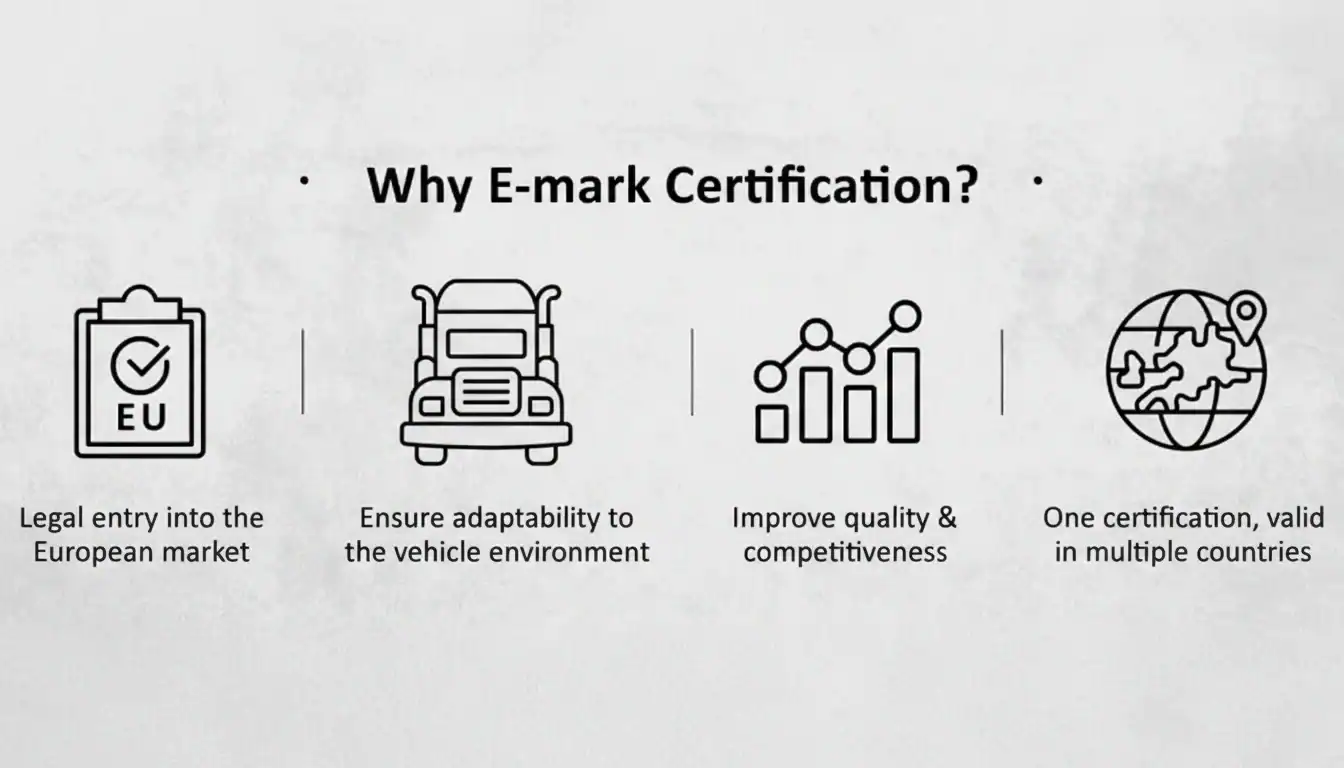
Le règlement 10 de la CEE-ONU comme norme de base
À partir de 2026, les exigences de l'Union européenne en matière de compatibilité électromagnétique automobile sont entièrement alignées sur le règlement 10 de la CEE-ONU (UNECE R10). Ce règlement établit des spécifications techniques uniformes pour vérifier l'immunité d'un produit aux interférences électromagnétiques et s'assurer qu'il ne perturbe pas les autres systèmes du véhicule. La conformité exige une documentation complète de l'architecture électrique d'un véhicule et la preuve qu'elle peut résister aux champs électromagnétiques externes. Cette norme crée une approche unique et harmonisée de la sécurité CEM sur l'ensemble du marché européen.
Homologation et marques des autorités nationales
Les fabricants obtiennent l'homologation d'une autorité nationale désignée dans un pays membre de la CEE-ONU. Lorsque les essais et la validation sont conformes à la norme R10 de la CEE-ONU, l'autorité attribue un numéro unique qui est affiché sur le produit. Cette marque sert de certificat de conformité. Par exemple, le numéro E13 signifie que le produit a été approuvé par l'autorité luxembourgeoise, tandis que le numéro E24 indique que le produit a été approuvé par l'autorité irlandaise. La présence de cette marque confirme que le produit a passé avec succès tous les essais d'homologation requis.
UL ou ETL : quelles sont les exigences des principaux détaillants américains ?
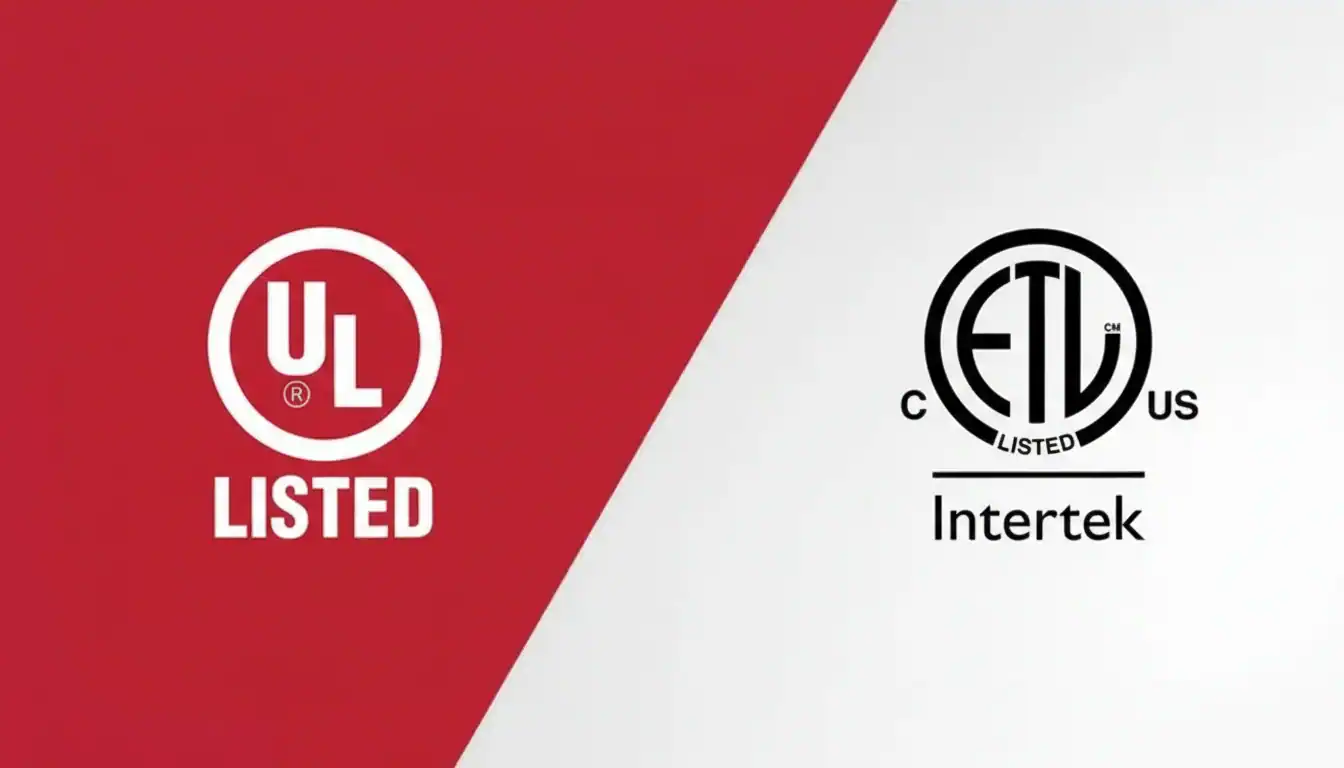
Pour le marché américain, les principaux détaillants acceptent indifféremment les certifications UL et ETL, car les deux laboratoires testent les produits en fonction des mêmes normes de sécurité nord-américaines reconnues par l'OSHA.
Acceptation égale par les principaux détaillants
Pour tout produit vendu aux États-Unis, les grands détaillants tels que Walmart, Home Depot et Best Buy acceptent les certifications UL et ETL sans préférence. Ces marques confirment qu'un produit répond aux normes de sécurité minimales requises pour la vente en Amérique du Nord. Le choix entre les deux ne crée pas de barrière à l'entrée pour les principaux canaux de vente au détail.
| Facteur | Certification UL | Certification ETL |
|---|---|---|
| Acceptation par les détaillants | Entièrement accepté par les principaux détaillants d'Amérique du Nord. | Entièrement accepté par les principaux détaillants d'Amérique du Nord. |
| Reconnaissance des consommateurs | Très élevé en raison de sa longue histoire et du marketing de la marque. | Plus faible que l'UL, mais dont la visibilité s'accroît rapidement. |
| Le point sur le fabricant | Souvent choisi en raison de la forte notoriété de sa marque. | Souvent choisi pour ses délais d'exécution plus rapides et ses coûts compétitifs. |
- UL et ETL sont officiellement reconnus par l'Occupational Safety and Health Administration (OSHA) en tant que laboratoires d'essai reconnus au niveau national (NRTL).
- À partir de 2026, les exigences de conformité pour la plupart des appareils électroniques et électroménagers grand public seront satisfaites par l'une ou l'autre certification.
- La présence de l'une ou l'autre de ces marques permet de satisfaire aux exigences de base en matière de sécurité que doivent respecter les partenaires de la vente au détail.
Normes de sécurité et conformité identiques
La principale raison de l'égalité d'acceptation est que UL et ETL testent les produits en fonction du même ensemble de normes de sécurité consensuelles. Par exemple, si un produit est testé selon une norme UL spécifique, ETL utilisera exactement la même norme pour son propre processus de test. Un produit certifié par ETL a été soumis au même protocole de test de sécurité qu'un produit certifié par UL, ce qui garantit qu'il est sûr pour l'usage auquel il est destiné.
- Les produits portant l'une ou l'autre de ces marques répondent aux mêmes critères de sécurité nord-américains.
- Le processus de certification valide la sécurité du produit et la qualité de la construction, et non les performances ou les caractéristiques.
Dynamique du marché et choix du fabricant
Alors que UL maintient une reconnaissance de la marque plus forte parmi les consommateurs finaux, de nombreux fabricants choisissent ETL pour ses avantages opérationnels. L'ETL offre souvent des délais d'exécution plus courts et des prix plus compétitifs, ce qui aide les marques à commercialiser leurs produits plus rapidement et de manière plus rentable. Cela a conduit à une augmentation significative de la présence de la marque ETL dans les rayons des magasins. La décision d'utiliser l'une ou l'autre marque relève d'une stratégie commerciale, qui consiste à trouver un équilibre entre la rapidité de mise sur le marché et la notoriété de la marque.
- L'ETL est souvent choisi pour son efficacité, qui permet de réduire les délais dans la chaîne d'approvisionnement.
- La longue histoire d'UL lui confère un léger avantage en matière de sensibilisation des consommateurs, mais cet écart tend à se réduire.
- Pour les acheteurs B2B, les deux marques sont fonctionnellement interchangeables.
Source : Refroidisseurs de voiture OEM certifiés pour votre marque

Étiquetage énergétique : Le produit est-il conforme à l'écoconception de l'UE (classe C) ?
Dans l'UE, les règlements relatifs à l'écoconception fixent les performances minimales obligatoires pour l'entrée légale sur le marché, tandis que l'étiquette énergétique correspondante offre au consommateur la transparence nécessaire aux décisions d'achat.
L'éco-conception comme condition d'entrée sur le marché
Les règlements de l'UE en matière d'éco-conception ne sont pas facultatifs ; ils établissent les normes minimales d'efficacité énergétique et de performance qu'un produit doit respecter pour être vendu légalement sur le marché européen. Ce cadre permet de filtrer efficacement les produits les moins durables.
- La conformité est une condition préalable obligatoire pour l'accès au marché.
- Les règlements visent à réduire l'impact environnemental des produits tout au long de leur cycle de vie.
- Les normes sont régulièrement mises à jour et rendues plus strictes, ce qui pousse les fabricants à s'améliorer en permanence.
L'étiquetage énergétique pour la transparence des consommateurs
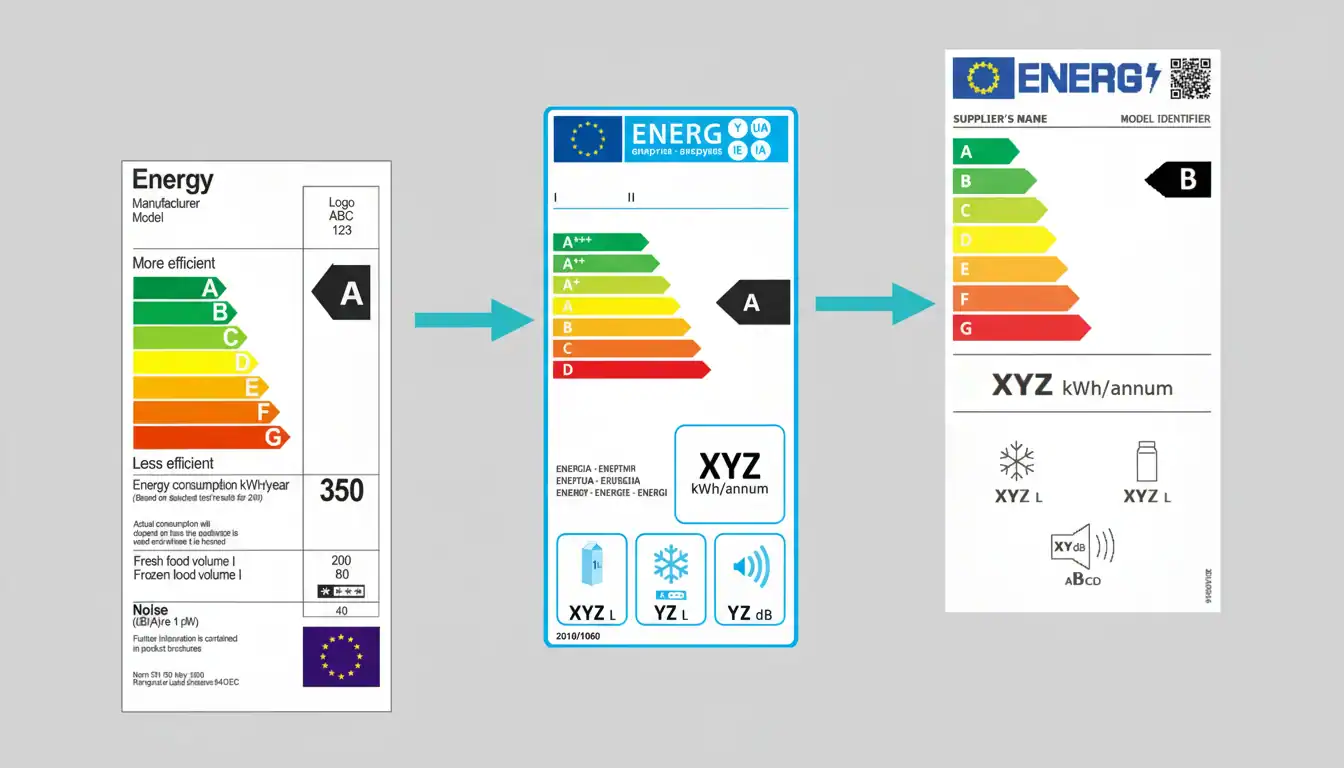
Parallèlement à l'éco-conception, le label énergétique de l'UE fournit des informations claires et normalisées directement aux consommateurs. Il est conçu pour aider les acheteurs à comparer les produits en fonction de leur efficacité énergétique et d'autres paramètres de performance clés sur le lieu de vente.
- Les produits sont classés sur une échelle simple de A à G, ‘A’ étant le plus efficace.
- Le label doit être clairement affiché sur tous les produits concernés vendus en ligne et dans les magasins physiques.
- Il comprend également d'autres données essentielles telles que la consommation d'eau, les niveaux sonores ou la capacité, en fonction de la catégorie de produit.
Ce que signifie un classement en classe C en 2026
La classe C signifie qu'un produit répond aux exigences d'éco-conception nécessaires pour être vendu légalement dans l'UE. Elle représente un niveau d'efficacité solide et intermédiaire sur l'échelle A-G actuelle, mais n'est pas considérée comme un niveau de performance de premier plan sur le marché.
- Les produits de classe C sont entièrement conformes et largement disponibles.
- L'échelle d'étiquetage est délibérément conçue pour être exigeante, laissant les classes A et B ouvertes aux progrès technologiques futurs.
- Cette note indique généralement un bon équilibre entre les performances, les caractéristiques et la consommation d'énergie du produit.
Importance stratégique pour le développement des produits
Pour tout fabricant, il est essentiel d'atteindre au moins la classe C pour accéder au marché de l'UE. Cibler des classes d'efficacité plus élevées, comme A ou B, peut créer un avantage concurrentiel fort et attirer les consommateurs soucieux de durabilité.
- L'efficacité énergétique doit être au cœur des préoccupations dès les premières étapes de la conception d'un produit.
- La recherche et le développement continus sont essentiels pour s'aligner sur l'évolution des normes et des attentes des consommateurs.
- Une cote d'efficacité énergétique élevée est un puissant outil de marketing qui renforce la réputation de la marque.
Réglementation sur les piles : Avez-vous des documents UN38.3 pour l'expédition ?
La certification UN38.3 est une norme mondiale non négociable pour l'expédition de tout produit contenant une batterie au lithium, garantissant la sécurité du transport et l'accès au marché.
Si votre produit comprend une batterie au lithium amovible en option, l'obtention d'une documentation appropriée pour le transport est une étape cruciale. Il ne s'agit pas d'une préférence régionale, mais d'un mandat mondial appliqué par tous les transporteurs afin de réduire les risques d'incendie associés aux piles au lithium.
Obligatoire pour tous les produits à base de lithium
La certification UN38.3 est une exigence mondiale obligatoire pour l'expédition de toute marchandise contenant des batteries au lithium-ion ou au lithium-métal. Cette règle s'applique à tous les modes de transport - aérien, maritime, routier et ferroviaire. La conformité est la base de l'accès aux marchés internationaux et permet d'éviter des retards coûteux ou des expéditions rejetées. Chez KelyLands, nous nous assurons que tous les produits dotés d'une batterie au lithium en option, comme nos réfrigérateurs à compresseur portables, répondent à cette norme avant de quitter notre usine. La réglementation vise strictement à garantir la sécurité et à prévenir les incidents thermiques pendant le transport.
Tests clés de conformité
Pour obtenir la certification UN38.3, une batterie doit passer huit tests rigoureux de sécurité et de conception. Ces tests simulent une série de conditions de transport potentielles afin de vérifier la stabilité, la durabilité et la résistance de la batterie face aux risques courants liés au transport. La réussite de ces tests confirme que le produit est sûr dans des conditions normales et stressantes.
- Simulation de hauteur (basse pression)
- Contrainte thermique et cyclisme
- Vibrations et chocs
- Court-circuit externe
- Essais d'impact et d'écrasement
- Surcharge
- Décharge forcée
Exemptions pour les piles non lithium
Les produits qui n'utilisent pas de produits chimiques à base de lithium ne sont pas soumis à la réglementation UN38.3. Nos glacières et réfrigérateurs de voiture standard, qui fonctionnent directement à partir de la batterie au plomb d'un véhicule, n'ont pas besoin de cette certification. D'autres types de batteries, comme les batteries à hydrure métallique de nickel (NiMH) et les batteries alcalines, en sont également exemptées. Cette distinction est importante pour les clients qui s'approvisionnent en produits divers, car elle simplifie la logistique pour les articles dépourvus de blocs d'alimentation au lithium.
Mises à jour réglementaires récentes
Le paysage du transport de batteries évolue constamment pour améliorer la sécurité. À partir de 2026, plusieurs exigences clés entreront en vigueur et auront un impact sur l'ensemble de la chaîne d'approvisionnement. Ces changements améliorent la transparence et ajoutent des niveaux de sécurité supplémentaires, en particulier pour le fret aérien.
- Les fabricants doivent désormais fournir aux expéditeurs ou aux autorités de réglementation qui en font la demande un document normalisé résumant les essais.
- Pour le fret aérien, les batteries lithium-ion doivent être expédiées à un état de charge de 30% ou moins.
- Le délai de certification typique est de 4 à 6 semaines, un facteur que KelyLands incorpore dans la planification de la production pour toutes les commandes comprenant des blocs-batteries.
Conclusion
La vérification des certifications E-Mark, UL et UN38.3 est une étape essentielle pour accéder au marché. Ces documents garantissent que vos produits répondent aux normes de sécurité et d'énergie obligatoires en Europe et en Amérique du Nord. Une conformité adéquate permet d'éviter les retenues douanières, les refus de vente au détail et les restrictions d'expédition pour les appareils équipés de batteries.
Examinez les exigences de certification spécifiques à vos canaux de distribution. Notre équipe peut vous fournir une documentation complète pour soutenir votre processus d'importation et de vente.
Questions fréquemment posées
Le réfrigérateur est-il certifié E-mark pour l'installation dans un véhicule ?
Oui, en tant qu'accessoire électronique du marché secondaire, le réfrigérateur est certifié e-mark. Cette certification confirme sa conformité avec la réglementation CEE R10 relative à la compatibilité électromagnétique (CEM), garantissant qu'il n'interfère pas avec les systèmes électroniques essentiels du véhicule et qu'il peut résister à l'environnement électromagnétique de ce dernier.
L'adaptateur CA est-il certifié UL ?
Absolument. L'adaptateur CA fourni pour le marché nord-américain est homologué UL (ou équivalent, tel que ETL). Cette certification atteste qu'il répond à des normes rigoureuses, reconnues au niveau national, en matière de sécurité électrique et qu'il peut être utilisé en toute sécurité par les consommateurs.
Quel est l'indice d'efficacité énergétique (EEE) en Europe ?
L'appareil est entièrement conforme à la dernière directive européenne sur les produits liés à l'énergie (ErP). Il atteint un niveau d'efficacité élevé, se situant généralement dans la classe C sur l'échelle A-G actuelle, ce qui reflète une performance énergétique supérieure et une faible consommation d'énergie.
Disposez-vous de rapports d'essai UN38.3 pour l'expédition de batteries ?
Oui, la batterie au lithium intégrée a passé tous les tests UN38.3 requis pour un transport en toute sécurité. Nous pouvons fournir le rapport de test UN38.3 complet et la fiche de données de sécurité (MSDS) sur demande pour répondre à vos besoins de conformité en matière d'expédition et de logistique.

 English
  Español
  Français
  Deutsch
  Português do Brasil
  Русский
  한국어
한국어  日本語
日本語  العربية