 Passer au contenu principal Passer au pied de page

A Dual Power(12V / 110-240V fridge) with a non-compliant AC adapter isn’t just a performance risk; it’s a direct liability that can lead to equipment damage or vehicle fire. Many procurement managers overlook the external power supply, focusing only on the cooler’s internal specs. This gap creates a significant operational vulnerability, where uncertified electronics introduce an unpredictable point of failure into mobile workflows, jeopardizing both assets and safety records.
This guide provides a technical breakdown of the AC/DC power system. We will cover the standard operating procedure for pre-cooling on AC power, decode the safety and legal importance of UL, CE, and GS certifications on adapters, and analyze how seamless auto-switching between wall and vehicle power actually works. Consider this the definitive brief for vetting the electrical integrity and operational flexibility of a dual power unit.
The “Pre-Cooling” Strategy: Why Should Users Plug in at Home First?
Pre-cooling a portable fridge on a home AC outlet shifts the most demanding energy cycle off the vehicle’s battery, ensuring maximum cooling efficiency, battery preservation, and immediate food safety for the road.
Many users assume a portable fridge should be loaded and started at the beginning of a trip, but this overlooks a critical efficiency step. The initial cool-down is the most power-intensive part of the refrigeration cycle. By performing this step at home using a standard wall outlet, you set the unit up for optimal performance once it’s moved to the vehicle. This strategy is not just about convenience; it’s about managing power, protecting your equipment, and ensuring your contents are kept safe from the moment you leave.
Maximize Cooling Performance for the Road
Bringing a car fridge to its target temperature from a warm start is the most demanding phase of its operational cycle. Performing this initial cool-down at home, in a stable environment, means the unit isn’t fighting against the high ambient heat of a parked vehicle. Once it’s in the car, the compressor’s job shifts from aggressive cooling to simple temperature maintenance, which is a much lighter workload.
- The initial cool-down is the compressor’s most demanding phase, consuming the most energy.
- Pre-cooling at home lets the unit reach its lowest temperature without battling the high heat inside a parked car.
- Once moved to the vehicle, the fridge only needs to maintain temperature, not create it, leading to more consistent performance.
Conserve Your Vehicle’s Battery
The highest power draw a portable fridge experiences is during its initial pull-down cycle. Running this cycle on a household AC outlet completely offloads the energy demand from the vehicle’s battery. This preserves the starter battery for its primary function and for maintaining the fridge’s temperature on the road. It also prevents the fridge’s built-in 3-stage battery protection system from needing to trigger a low-voltage cutoff before your trip even begins.
- A pre-cooled fridge cycles its compressor less often, significantly reducing its power draw from your car’s electrical system.
- This approach protects your starter battery, which is especially important for long trips or when running the fridge while the engine is off.
- It avoids the risk of draining your car battery before your journey even starts.
Ensure Immediate Food and Drink Safety
Loading perishables like meat, dairy, or medications into a warm fridge creates a window of risk where food can enter the temperature danger zone. Pre-cooling the unit ensures that from the moment you load it, your items are in a stable, chilled environment. This eliminates the delay where food sits in a warming box, preserving freshness and preventing spoilage right from the start of your journey.
- Loading food into a pre-chilled space ensures it stays within a safe temperature range from the start.
- This provides immediate and reliable cold storage, which is critical for sensitive items on hot days.
- It helps keep your food fresh and safe to consume throughout your entire trip.
Take Advantage of Lower Home Energy Costs
From an economic standpoint, leveraging household electricity is more efficient. The initial, power-hungry cooling cycle can be timed to coincide with lower off-peak utility rates, often overnight. This simple step leverages a stable and more affordable power grid before transitioning to the vehicle’s limited DC power system. It’s a practical way to make trip preparations more budget-friendly.
- You can schedule the pre-cooling phase to align with cheaper electricity hours to reduce your household utility bill.
- This strategy leverages your home’s stable and cost-effective power supply before switching to your car’s system.
- It’s a simple way to make your trip preparations more economical.
AC Adapter Certification: Why Do UL/CE/GS Certificates Matter?
AC adapter certifications are not optional badges; they are mandatory proof of safety testing, legal market access, and electromagnetic compatibility.
For any electronic device, the external AC adapter is a critical point of failure and a potential safety hazard. Certifications from recognized bodies like UL, CE, and GS confirm that the power supply has passed rigorous, standardized tests. These marks guarantee user safety, provide legal access to global markets, and ensure the device will not interfere with other electronics.
The Core Functions of Safety Certification
A certification mark from a Nationally Recognized Testing Laboratory (NRTL) serves three primary functions. It validates that an adapter is safe for consumer use, meets the legal import requirements for a specific economic zone, and operates within acceptable electromagnetic emission limits.
- Safety Assurance: Marks like UL and CE verify that an adapter meets stringent electrical safety, fire resistance, and durability standards. This testing covers everything from insulation quality to overheating prevention under load.
- Market Access: Obtaining the correct certification is a legal requirement for sales. The CE mark is mandatory for market entry into the European Union, while UL is the de facto standard for the U.S. market. Without these, customs will reject the shipment.
- Electromagnetic Compatibility (EMC): Certifications like FCC in North America and KCC in South Korea ensure an adapter’s electronic emissions will not disrupt the function of nearby devices, from radios to medical equipment.
Key Global Certifications by Market
Different economic regions have their own mandatory and recognized certifications. Understanding these is vital for any manufacturer, importer, or brand aiming for a global sales footprint. While some standards overlap, each region has unique requirements that must be met before a product can be legally sold.
| Certification | Region/Market | Objectif principal |
|---|---|---|
| CE (Conformité Européenne) | European Union (Mandatory) | General Health, Safety & Environmental Protection |
| GS (Geprüfte Sicherheit) | Germany / EU (Voluntary) | Enhanced Safety Testing (Exceeds CE) |
| UL (Underwriters Laboratories) | North America (USA/Canada) | Electrical Safety & Fire Prevention |
| FCC (Federal Communications Commission) | North America (USA) | Electromagnetic Interference (EMC) |
| PSE (Product Safety Electrical) | Japan | Insulation, Heat & Flame Resistance |
| KCC (Korea Certification) | South Korea | Compatibilité électromagnétique (CEM) |
Reducing Risks with Certified Adapters
Using a certified AC adapter directly mitigates hazards and liabilities. These products contain verified safety components like fuses and thermal sensors that are often absent in cheap, non-certified generic alternatives. The testing process also validates the adapter’s durability and long-term performance, protecting both the end-user and the device it powers.
- Built-in Protections: Certified adapters integrate components like thermal fuses and temperature sensors to prevent overheating. They have also passed durability tests involving thousands of plug insertion and removal cycles to ensure mechanical reliability.
- Liability Reduction: For businesses, schools, and other organizations, exclusively using certified electronics is a crucial step in meeting industry safety standards. It demonstrates due diligence and significantly reduces liability risks in case of an incident.
- Reliable Performance: Certification verifies that the adapter provides consistent power output as specified. Non-certified adapters often fail to deliver stable voltage, which can damage sensitive electronics or simply fail to function correctly.
Source Certified OEM Car Coolers Directly

Auto-Switching: How Seamless Is the Transition from Garage to Car?
A reliable transition from household AC to vehicle DC power depends on three factors: intelligent AC-priority logic, multi-stage battery protection, and high-density foam insulation that maintains temperature during the switch.
How Automatic Power Switching Works
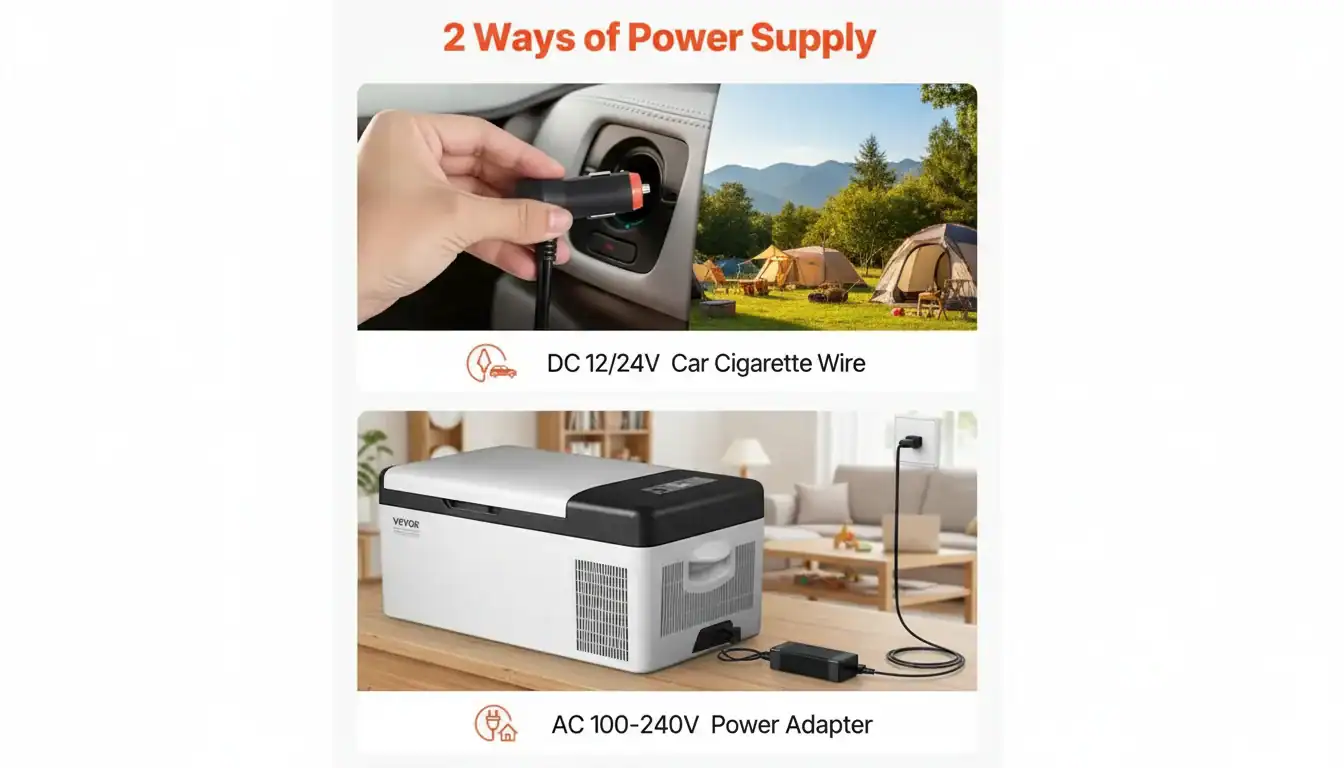
Modern compressor refrigerators with dual-power capability are engineered to select the optimal power source automatically. When the unit is connected to both a 120V/240V wall outlet and a 12V vehicle socket, its internal logic board prioritizes the AC input. This design is intentional; it draws power from the grid instead of the vehicle’s battery while pre-cooling in a garage. Once the AC cord is unplugged, the system instantly switches to the 12V DC source, provided the vehicle is running and supplying power. This eliminates the need for any manual adjustments by the user.
- The system defaults to 120V AC power when both sources are connected, preserving vehicle battery life.
- The transition to 12V DC power is automatic and immediate upon unplugging from the wall.
- While this feature is standard in most 2026 compressor models, some budget or older units might still require manual switching. Always verify the specifications.
Built-In Battery Protection
A critical feature for any in-vehicle appliance is the 3-stage battery protection system. This technology actively monitors the vehicle’s battery voltage. If the voltage drops below a preset threshold, the refrigerator’s compressor will automatically shut off. This function is non-negotiable for practical use, as it guarantees the vehicle will always have sufficient power to start its engine. Users can typically select from three protection levels (High, Medium, or Low) via the control panel to match their vehicle’s battery health and usage scenario.
| Niveau de protection | Cut-Off Voltage (12V System) | Cut-Off Voltage (24V System) |
|---|---|---|
| High (H) | 11.3V | 24.4V |
| Medium (M) | 10.1V | 21.3V |
| Faible (L) | 9.6V | 20.8V |
Maintaining Temperature During the Switch
The primary goal of auto-switching is to preserve the internal temperature. High-density PU foam insulation is the key component here. It minimizes thermal loss during the brief moment it takes to unplug the fridge from the wall and connect it inside the vehicle. Once DC power is engaged, the efficient compressor quickly recovers any minor temperature increase. This ensures that food, drinks, or medicines remain at a stable, safe temperature from the moment you leave your garage to your final destination.

Hotel Use Scenarios: Why Bring the Fridge into the Room?
Bringing a portable fridge into a hotel room provides immediate, reliable cooling that standard mini-fridges often fail to deliver, giving travelers control over food safety, personal costs, and medical storage.
While hotels provide mini-fridges, their performance and availability are inconsistent. For travelers who rely on specific food, drinks, or medications, a personal portable fridge is not a luxury—it’s a tool for control and convenience. It eliminates the high costs of hotel minibars and ensures that personal items are kept at the correct, safe temperature from the moment of check-in.
Keeping Personal Food and Drinks Chilled
Bringing your own beverages and snacks is a practical way to avoid inflated hotel minibar prices. A portable fridge ensures that everything from water bottles to baby food stays cold and ready for consumption, giving you access to your preferred items whenever you need them.
- Store drinks, yogurt, and fruit for quick breakfasts or snacks.
- Keep baby formula or milk at a safe, consistent temperature.
- Have chilled water available after a long day of meetings or sightseeing.
Storing Temperature-Sensitive Medications
For guests with medical needs, a personal fridge offers a reliable and private space to store temperature-sensitive medications like insulin. This removes any uncertainty about a hotel room’s mini-fridge temperature settings, cleanliness, or shared use. It’s a critical tool for maintaining health and privacy on the road.
- Maintenir les médicaments dans la plage de température requise.
- Garantir la confidentialité et éviter les confusions avec d'autres articles.
- Offre un espace de rangement dédié et propre pour les objets liés à la santé.
Conserver les restes des repas pris au restaurant
Les repas au restaurant font partie intégrante des voyages, et conserver les restes est un moyen pratique de gérer son budget et de réduire le gaspillage alimentaire. Un réfrigérateur portable vous permet de conserver en toute sécurité les repas pris au restaurant pour plus tard, transformant ainsi une dépense en deux repas et évitant d'avoir recours au service d'étage en fin de soirée.
- Conservez les restes pour un deuxième repas et économisez ainsi de l'argent sur les coûts alimentaires.
- Profitez d'une collation en fin de soirée sans avoir à commander à l'hôtel.
- Conservez les produits des marchés locaux ou des charcuteries pour créer vos propres repas.
Refroidissement immédiat sans attente
Les mini-réfrigérateurs des hôtels sont souvent éteints entre les clients pour économiser de l'énergie et peuvent mettre des heures à atteindre une température utile. En apportant un réfrigérateur portable pré-réfrigéré dans la voiture, vous bénéficiez d'un accès immédiat à une chambre froide. Vos denrées périssables sont ainsi conservées en toute sécurité dès votre arrivée.
- Transférez les articles de la glacière de votre voiture directement dans le réfrigérateur de la chambre.
- Pas besoin d'attendre que l'appareil de l'hôtel refroidisse.
- Veille à ce que les denrées périssables restent froides pendant le passage du véhicule à la chambre.
Conclusion
Un système d'alimentation CA/CC bien conçu est plus qu'une simple commodité ; c'est une caractéristique essentielle qui améliore la sécurité, la polyvalence et la satisfaction du client. La possibilité de pré-refroidir à domicile, de s'appuyer sur des adaptateurs certifiés et de passer en toute transparence d'une source d'alimentation à l'autre confère aux utilisateurs une véritable portabilité. Cette solution complète de la maison au véhicule rend le produit pratique pour un plus grand nombre de scénarios, des voyages en voiture aux séjours à l'hôtel.
Pour découvrir comment nos réfrigérateurs à compresseur à double alimentation peuvent répondre aux exigences spécifiques de votre marché, contactez notre équipe. Nous pouvons vous fournir des spécifications détaillées et discuter des options de personnalisation OEM pour votre marque.
Questions fréquemment posées
Les cordons d'alimentation CA (murale) et CC (voiture) sont-ils inclus ?
Oui, nos appareils sont livrés avec un adaptateur mural CA et un cordon d'alimentation 12V CC pour voiture afin de garantir une portabilité et une commodité maximales pour une utilisation à la maison ou en déplacement.
Votre adaptateur secteur externe est-il certifié UL/ETL pour la sécurité ?
Absolument. L'adaptateur secteur externe est certifié par un laboratoire d'essai reconnu au niveau national (tel que UL ou ETL) pour répondre aux normes nord-américaines rigoureuses en matière de sécurité et de conformité des appareils électroniques.
L'appareil peut-il fonctionner sur 240V (Global Voltage) sans transformateur ?
Oui, l'adaptateur CA inclus prend en charge la tension d'entrée universelle (100-240V, 50/60Hz). Il peut être utilisé dans le monde entier avec l'adaptateur de prise approprié, sans nécessiter de transformateur de tension séparé.

 English
  Español
  Français
  Deutsch
  Português do Brasil
  Русский
  한국어
한국어  日本語
日本語  العربية