 Passer au contenu principal Passer au pied de page

Un approvisionnement efficace en produits d'hygiène portables dépend d'une ingénierie éprouvée, et non de gadgets marketing tels que les UV-C ou les revendications de filtres H14 gonflés. Le fait de baser les commandes d'achat sur ces caractéristiques non vérifiées entraîne directement une augmentation des retours clients, ce qui nuit à la réputation de la marque pour les détaillants de produits pour bébés et les distributeurs axés sur la santé.
Cette analyse évalue les performances sur la base de paramètres importants : un double système de filtration étanche et un centre de gravité ergonomique. Nous expliquons comment ces facteurs réduisent la fatigue du poignet et contiennent correctement les allergènes, en fournissant un guide d'approvisionnement technique pour construire une ligne de produits fiable.
La lumière UV-C tue-t-elle réellement les acariens dans les matelas ?
La lumière UV-C tue les acariens en laboratoire en détruisant leur ADN. Mais sur un vrai matelas, c'est inutile car la lumière ne peut pas pénétrer le tissu où vivent les acariens.
La science : Comment les UV-C endommagent l'ADN des acariens
En laboratoire, le rayonnement UV-C d'une longueur d'onde de 254 nanomètres pénètre dans les cellules des acariens. Cette énergie détruit leur ADN et leur structure cellulaire, ce qui les empêche de se reproduire et finit par les tuer. Des études contrôlées montrent qu'une exposition directe peut éliminer plus de 98% d'acariens en quelques secondes.
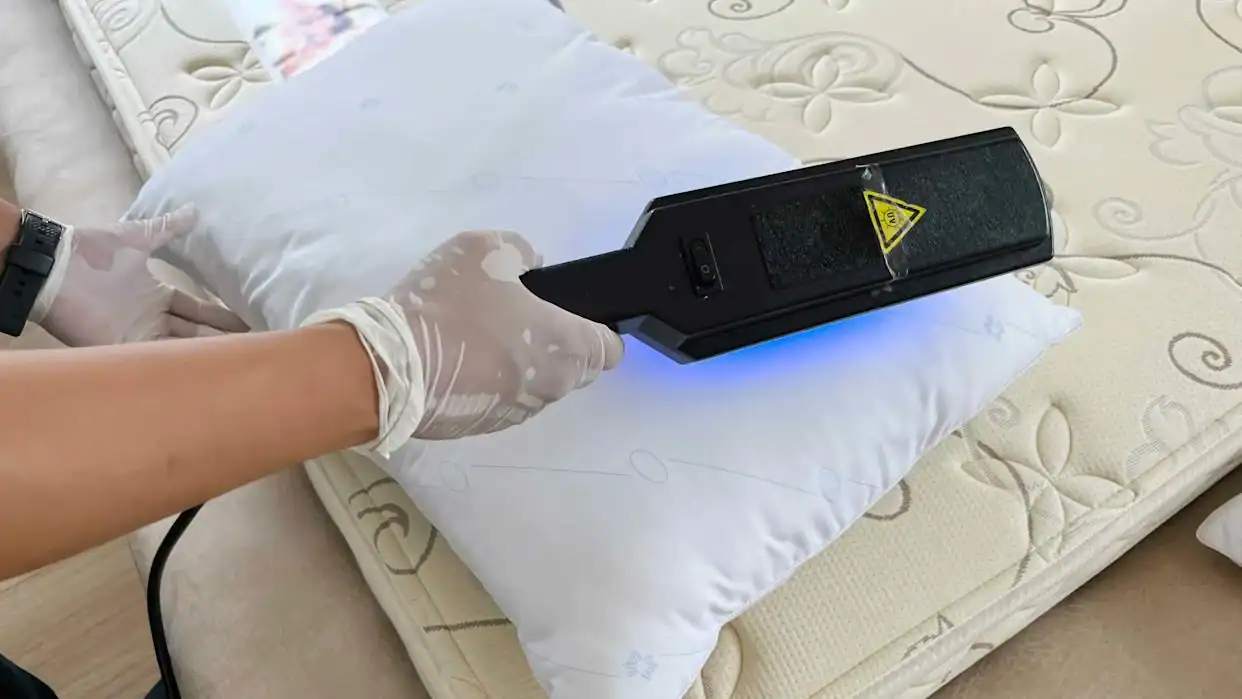
Limites pratiques : Pourquoi il est inefficace sur les matelas
Le problème est que la lumière UV-C a une très faible pénétration. Elle n'agit que sur la surface absolue du tissu. Les acariens vivent dans les profondeurs du rembourrage du matelas, où il fait sombre et humide, et ne sont donc pas du tout affectés. Même une fine couche de poussière ou de cellules cutanées à la surface peut bloquer les rayons, protégeant ainsi les acariens qui se trouvent en dessous.
Pourquoi la norme H14 HEPA est-elle obligatoire pour les allégations “sans risque d'allergie” ?
Le filtre HEPA H14 n'est pas obligatoire. Les certifications telles que l'AAFA accordent la priorité au système d'étanchéité de l'aspirateur et à ses performances globales en matière de capture des allergènes, et non à une qualité de filtre spécifique.
On croit souvent à tort qu'un aspirateur doit être équipé d'un filtre HEPA H14 pour être considéré comme “compatible avec les allergies”. C'est faux. Les organismes de certification, tels que l'Asthma & Allergy Friendly® Certification Program (AAFA), ne précisent pas la qualité du filtre. Ils se concentrent sur l'essentiel : l'appareil capture-t-il efficacement les allergènes et les maintient-il piégés sans rejeter de poussière dans l'air ?
Pour les entreprises qui achètent des aspirateurs de voiture, se concentrer sur une spécification H14 arbitraire est une distraction. La véritable valeur réside dans un système de filtration bien conçu et étanche qui fonctionne de manière fiable. La différence entre H13 et H14 est souvent négligeable dans un environnement automobile réel.
| Standard | H13 HEPA | H14 HEPA | Certification AAFA “Allergy-Friendly |
|---|---|---|---|
| Taux de capture des particules | ≥ 99.95% à 0.2 microns | ≥ 99.995% à 0.2 microns | Basé sur la performance (non spécifique à une année d'études) |
| Objectif principal | Efficacité du média filtrant | Efficacité maximale du média filtrant | Performance de l'ensemble du système et conception étanche |
| Exigence clé | Réussir un test de filtration spécifique | Réussit un test de filtration plus strict | Réduction prouvée des allergènes sans fuite |
Ce qu'exige réellement la certification ‘ami des allergies
Les programmes de certification testent l'ensemble de la machine, et pas seulement un de ses composants. Ils mesurent si l'aspirateur réduit réellement les niveaux d'allergènes dans un environnement de test et si le système est correctement scellé. Un aspirateur équipé d'un filtre H14 mais dont les joints ne sont pas étanches échouera à la certification, tandis qu'un appareil bien construit équipé d'un filtre H13 la réussira facilement. L'objectif est de s'assurer que la poussière et les allergènes capturés par l'aspirateur restent à l'intérieur de celui-ci.

L'avantage d'un système de filtration HEPA lavable
Chez KelyLands, nous concevons nos aspirateurs de voiture selon une approche pratique et efficace. Nos appareils utilisent un filtre HEPA lavable conçu pour retenir les particules fines comme la poussière, le pollen et les squames d'animaux. Ce filtre est souvent intégré à notre **Système de filtration double**, qui associe le filtre HEPA à un pré-filtre en acier inoxydable durable pour traiter les débris plus importants. Cette conception permet de capturer les allergènes de manière fiable et suffisante pour créer un intérieur de véhicule propre. Pour nos clients B2B, cela signifie offrir une solution rentable et respectueuse de l'environnement qui fonctionne là où cela compte, sans se laisser entraîner dans des batailles de fiches techniques qui ne reflètent pas les avantages du monde réel.
Des aspirateurs de voiture très demandés, conçus pour votre marque

Comment le centre de gravité (COG) affecte-t-il la fatigue du poignet ?
Un centre de gravité bas donne à l'aspirateur une impression de légèreté et d'équilibre, en réduisant la force de rotation exercée sur le poignet. Cela réduit considérablement les tensions musculaires lors de l'utilisation.
La mécanique de l'équilibre et de la tension du poignet
L'équilibre d'un outil portatif a une incidence directe sur le travail que doit effectuer le poignet. Un centre de gravité élevé ou mal placé crée une plus grande force de rotation, ou couple. Les muscles du poignet doivent constamment contrer ce couple pour maintenir l'aspirateur à niveau et stable, ce qui entraîne de la fatigue.
Le fait de placer les composants lourds tels que le moteur et la batterie plus près de la poignée permet d'abaisser le centre de gravité. Cette conception améliore considérablement l'équilibre de l'appareil, minimise l'effet de levier et réduit l'effort musculaire nécessaire pour contrôler l'outil.
Conception ergonomique pour un fonctionnement sans fatigue
Nous appliquons ce principe directement à la conception de nos produits. Les aspirateurs à main KelyLands présentent une construction ergonomique et ne pèsent que 400 à 800 g pour minimiser la charge globale de l'utilisateur. Cette construction légère et équilibrée est spécialement conçue pour une utilisation confortable et sans fatigue d'une seule main, même lors de séances de nettoyage prolongées.

Les capteurs de gravité peuvent-ils empêcher une exposition accidentelle aux UV ?
Les capteurs Gravity UV Index n'empêchent pas l'exposition aux UV. Ce sont des outils de surveillance qui mesurent le rayonnement et alertent les utilisateurs, leur permettant ainsi de prendre eux-mêmes des mesures de protection.
Le rôle des capteurs de gravité dans la surveillance des UV
Ces capteurs sont conçus dans un seul but : la mesure. Ils fonctionnent comme un système d'alerte précoce en fournissant des données sur le rayonnement ultraviolet ambiant, et non comme un bouclier physique contre ce rayonnement.
- Détecte le rayonnement ultraviolet dans le spectre UVA, UVB et UVC (240-370nm).
- Fournit des valeurs d'indice UV en temps réel (0-11) pour informer les utilisateurs sur leur risque d'exposition actuel.
- Il s'agit d'un outil de détection et d'alerte, et non d'une barrière physique qui bloque les rayons UV.
Distinction par rapport à la technologie de filtration des appareils ménagers
Il est facile de confondre les différents types de technologie de “protection”, mais les capteurs environnementaux appartiennent à une catégorie totalement distincte de la mécanique des appareils. Les capteurs UV à gravité sont utilisés dans des appareils tels que les vêtements ou les stations météorologiques pour suivre les radiations. Il s'agit d'une fonction de surveillance. En revanche, les appareils de nettoyage s'appuient sur des systèmes physiques pour capturer les particules. Nos aspirateurs, par exemple, utilisent un filtre HEPA lavable pour piéger physiquement la poussière et les allergènes, un processus totalement différent de la détection des rayons UV invisibles.
Questions fréquemment posées
Quel est le niveau de bruit de vos aspirateurs de voiture portables ?
Nos aspirateurs sont conçus pour fonctionner à faible bruit, avec des performances égales ou inférieures à 75 dB. Cela garantit un nettoyage plus silencieux sans causer de perturbations importantes, ce qui les rend adaptés à un usage quotidien.
Quel est le type de système de filtration utilisé ?
Nous utilisons un système de double filtration qui comprend un filtre HEPA lavable. Ce système retient efficacement les poussières fines, les squames d'animaux et autres allergènes. Le filtre peut être facilement lavé et réutilisé, ce qui le rend à la fois rentable et écologique.
Les aspirateurs à main sont-ils lourds ou difficiles à utiliser pendant de longues périodes ?
Non, ils sont spécifiquement conçus pour être ergonomiques et légers, avec un poids compris entre 400 et 800 grammes. Cette attention particulière à la conception permet une utilisation confortable, sans fatigue et d'une seule main pendant les séances de nettoyage.
Quelle est la quantité minimale de commande (MOQ) pour une commande personnalisée ?
Nous offrons une personnalisation complète OEM et ODM pour la puissance du moteur, les couleurs Pantone et l'emballage avec une quantité minimale de commande standard à partir de 500 unités. Cela vous permet d'adapter le produit spécifiquement à votre marque et à votre marché.
Quelles sont les certifications de vos produits pour les marchés internationaux ?
Nos produits possèdent toutes les certifications mondiales nécessaires pour garantir un dédouanement sans problème, notamment CE, RoHS et UKCA pour l'Europe, FCC pour les États-Unis et PSE pour le Japon. Nous veillons à ce que nos aspirateurs répondent aux normes internationales de sécurité et de qualité.
Conclusions finales
Si les aspirateurs dotés de filtres UV-C ou H14 attirent l'attention, ils échouent souvent dans le monde réel. En se concentrant sur une ingénierie éprouvée, comme un système de filtration étanche et un équilibre ergonomique, on évite les plaintes des clients et les retours coûteux. Des performances fiables sont la garantie d'une clientèle fidèle à votre marque.
Ne devinez pas les performances - vérifiez-les. Demandez un échantillon pour tester par vous-même notre conception ergonomique et l'efficacité de notre filtration. Contactez notre équipe pour discuter des options OEM et construire un produit qui réponde aux exigences spécifiques de votre marché.

 English
  Español
  Français
  Deutsch
  Português do Brasil
  Русский
  한국어
한국어  日本語
日本語  العربية