 メインコンテンツへスキップ フッターへスキップ

Finding the best solar car fridge for remote field operations is a critical decision that directly impacts asset integrity, where a power failure can lead to thousands in spoiled medical supplies or compromised biological samples. Standard coolers rely on a constant supply of ice, and generator-powered units introduce noise, fuel logistics, and mechanical failure points into the cold chain. For any team deployed off-grid, maintaining a stable temperature for sensitive cargo is a non-negotiable operational requirement, not a convenience.
This analysis serves as a technical benchmark for selecting a suitable solar-ready refrigerator. We will evaluate the key engineering specifications that determine field reliability, including the real-world duration of integrated batteries without any external power source. We’ll also examine the efficiency of direct solar inputs for charging, the true power consumption of low-draw eco modes on overcast days, and how these units pair with portable power stations to build a redundant power system for mission-critical cooling.
Integrated Battery: Can It Cool for 4 Hours Without External Power?
The 4-hour powerless cooling benchmark is less about battery size and more about thermal efficiency. By 2026, the leading models achieve this by combining high-density insulation with phase-change materials that passively absorb heat, a fundamental shift from brute-force compressor power.
Yes, a modern compressor car fridge with an integrated battery can reliably maintain its temperature for 4 hours or more without external power. This capability isn’t just a function of the battery’s watt-hour rating; it’s a result of a systems-based approach to energy efficiency. The compressor only runs intermittently, so the real work is done by the unit’s ability to resist temperature change. This is where advanced materials make the difference.
The Role of Insulation and Advanced Materials
Modern portable fridges in 2026 leverage a hybrid passive-active cooling architecture. The battery provides the active power, but high-quality insulation and phase-change materials (PCMs) deliver the passive thermal resilience needed to extend off-grid time. These materials absorb and release thermal energy to keep internal temperatures stable long after the compressor cycles off.
- High-density foam insulation minimizes thermal leakage, creating a strong barrier against ambient heat.
- Phase-change materials (PCMs) function as a thermal battery. They absorb heat as they transition from solid to liquid, effectively locking the internal temperature in place for hours.
- This hybrid approach makes extended off-grid cooling practical, turning the integrated battery into a power source for occasional temperature top-ups rather than continuous, energy-intensive operation.
| Model Example | バッテリー構成 | Stated Powerless Runtime |
|---|---|---|
| Anker EverFrost Series | Removable 299 Wh | Up to 42 hours |
| ACOPOWER LiONCooler Mini | Removable 193 Wh | Up to 10 hours |
| Vitrifrigo VFREE Plus | Removable Lithium-ion | 4-6 hours |
Key Factors Affecting Off-Grid Performance
Achieving or exceeding the 4-hour benchmark depends heavily on real-world conditions and usage patterns. The advertised runtime is based on specific test parameters, and actual performance will vary. How you prepare and use the fridge is just as important as its technical specifications.
- 周囲温度: A fridge operating in 35°C (95°F) heat will drain its battery faster than one in a 20°C (68°F) environment.
- Initial Temperature: Pre-cooling the fridge and its contents using AC or vehicle power before going off-grid is critical. Starting with a warm interior and contents forces the compressor to run hard, consuming significant battery life upfront.
- Fridge Load: A full fridge packed with cold items acts as a thermal mass, helping to maintain its temperature for longer. An empty or half-empty fridge has more air to cool and is less efficient.
The Shift Towards Thermal Resilience
The industry’s focus has moved from sheer compressor power to overall thermal resilience. The objective is to build systems that operate reliably in off-grid scenarios with minimal energy consumption. Manufacturers now compete on the quality of their insulation and the effectiveness of their PCM integration, not just the cooling speed of their compressor. This shift makes integrated batteries a practical solution for solar and portable power applications, enabling systems to maintain stable temperatures anywhere from 4 to over 24 hours, depending on the model and external conditions.
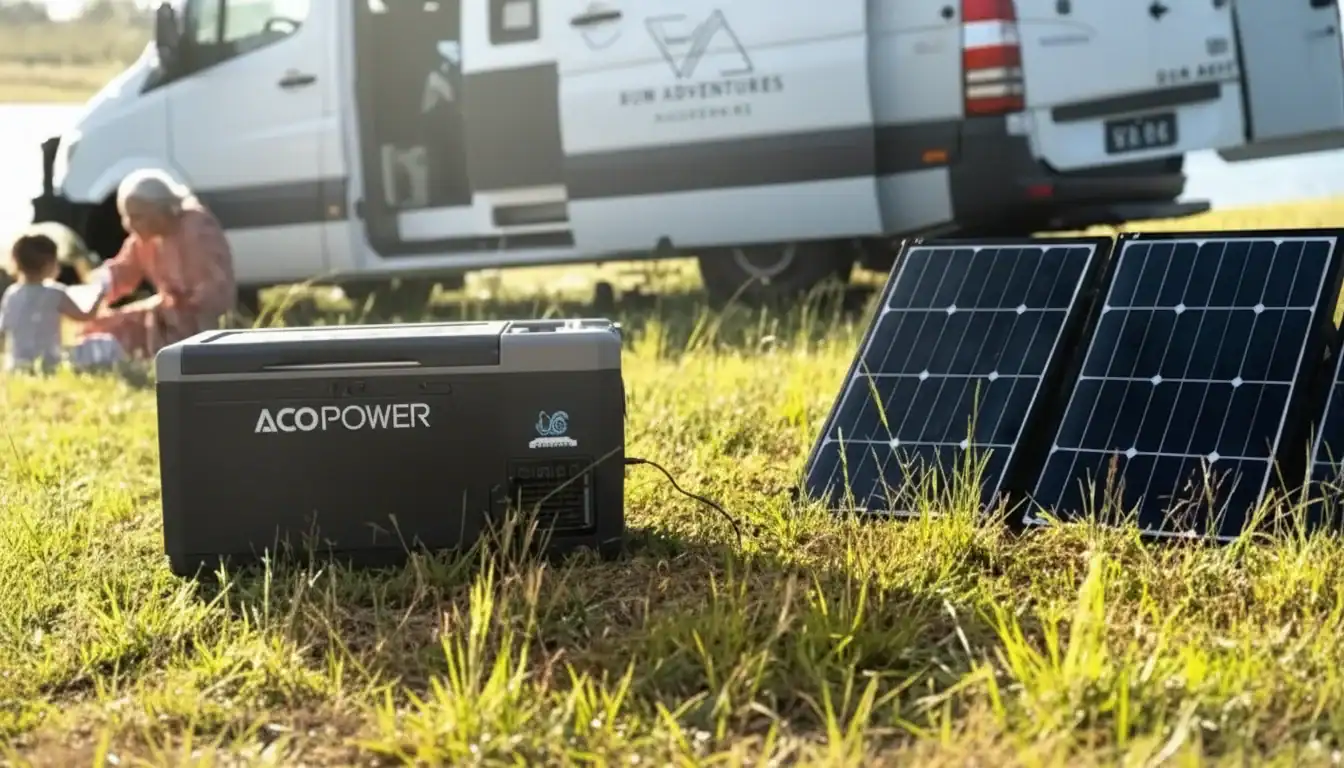
Direct Solar Input: Can You Plug Panels Directly into the Fridge?
Plugging a solar panel directly into a portable fridge is generally not feasible. The fluctuating power from a panel can damage sensitive electronics, so a system with a charge controller and battery is required to deliver stable DC voltage.
The Standard Setup: Why Most Fridges Need More Than a Panel
For most portable compressor fridges on the market in 2026, a direct solar connection is not an option. These units are engineered for a stable power supply, something a solar panel alone cannot guarantee. The raw output from a panel fluctuates constantly with sun intensity, clouds, and panel angle. An intermediate system is essential to buffer and regulate this variable energy.
- A solar charge controller is the non-negotiable first step. It regulates the voltage from the panels, preventing spikes that would destroy the fridge’s compressor and control board.
- A battery acts as an energy reservoir. It stores power collected during peak sunlight and delivers a steady current to the fridge, keeping it running through the night or on overcast days.
- An inverter is only needed if the fridge runs on AC power. It converts the battery’s DC power to usable AC, though this process introduces energy loss. Most modern portable fridges are DC-native.
| コンポーネント | Standard Fridge Setup | Solar-Ready Fridge Setup |
|---|---|---|
| Charge Controller | Required (External Component) | Often Built-In (MPPT) |
| Battery | Required (External) | Required (External or Integrated/Removable) |
| Inverter | Only for AC-powered models | Not Needed (Native DC Operation) |

Emerging Solar-Ready DC Fridges
A growing niche of purpose-built DC refrigerators is simplifying off-grid cooling. These advanced models integrate the necessary technology to allow a more direct solar connection, reducing the need for a complex and bulky Balance of System (BOS) infrastructure.
- Many of these fridges have built-in Maximum Power Point Tracking (MPPT) charge controllers, which actively find the optimal voltage and current to maximize energy harvested from the panel.
- They are engineered to run efficiently on direct DC power, eliminating the 10-15% energy loss that typically occurs when converting DC to AC through an inverter.
- This integrated design simplifies the setup, making solar-powered refrigeration more practical for mobile and remote applications where space and weight are concerns.
Key Technical Hurdles for Direct Connection
Even with these new solar-ready appliances, some technical challenges must be managed to maintain a reliable system. These factors are critical for the long-term performance of both the fridge and the solar panels.
- Voltage matching is crucial. The panel’s output voltage must fall within the fridge’s acceptable input range. A mismatch can easily damage the unit’s internal electronics.
- Intermittent sunlight remains the biggest challenge. Without a battery, the fridge compressor would constantly start and stop as clouds pass, leading to extreme inefficiency and accelerated mechanical wear.
- Proper battery integration is still the most robust solution. It provides the stable, uninterrupted power supply needed for consistent cooling performance, regardless of weather conditions.
Your Brand on Globally Certified Car Coolers

Eco Mode: Is Sipping 45 Watts Efficient Enough for Cloudy Days?
A 45-watt Eco mode isn’t just a power-saving feature; it’s a strategic necessity designed to keep a compressor fridge running when solar input plummets during overcast weather, extending critical battery reserves.
The efficiency of a portable fridge is tested not on a perfect sunny day, but during a string of cloudy ones. An energy-sipping “Eco” or low-power mode, typically rated around 45 watts, is the core technology that makes off-grid refrigeration viable through variable weather. This low draw is the difference between a depleted battery and continuous cooling.
Solar Panel Output on Overcast Days
Solar panels perform poorly under heavy cloud cover, making low-consumption appliance modes essential for system survival. When solar input is compromised, the fridge must run almost entirely off stored battery power. A low-wattage mode directly extends the runtime of those reserves.
- On overcast days, solar panels typically generate only 10–25% of their rated capacity. A 100W panel might only produce 10-25 watts.
- A sub-50-watt consumption rate ensures the fridge draws less power than a panel might still generate, or at least minimizes the deficit drawn from the battery.
Compressor Cycling and Power Conservation
The 45-watt rating is an average, not a constant draw. Modern DC compressor fridges achieve this efficiency through intelligent cycling. The compressor runs in short, powerful bursts to lower the temperature, then shuts off completely, relying on the unit’s insulation. This method is far more efficient than trying to run the compressor continuously at a very low power.
- Optimized algorithms monitor the internal temperature and activate the compressor only when it rises past a set threshold.
- This on-off cycle drastically reduces the total energy consumed over 24 hours, making the 45-watt average achievable.
Role of Battery Reserves in Bridging Gaps
While 45 watts is efficient, it cannot create energy out of thin air. Surviving multiple days of low light depends entirely on the capacity of a connected battery or portable power station. The primary function of Eco mode is to make that stored energy last as long as possible.
- Power stations with 1200–2400 Wh capacities are the industry standard for reliable, multi-day off-grid refrigeration.
- Eco mode’s low draw extends the runtime of these batteries, ensuring the fridge can operate through extended periods of insufficient solar charging.
Balancing Low Power with Cooling Reliability
The fundamental engineering challenge is to save power without letting the internal temperature rise to unsafe levels. The 45-watt mode represents the balance point where manufacturers have optimized compressor efficiency and insulation to maintain stable cooling, even with limited energy input. It ensures the fridge can keep contents safely chilled during variable weather without quickly draining its power source.
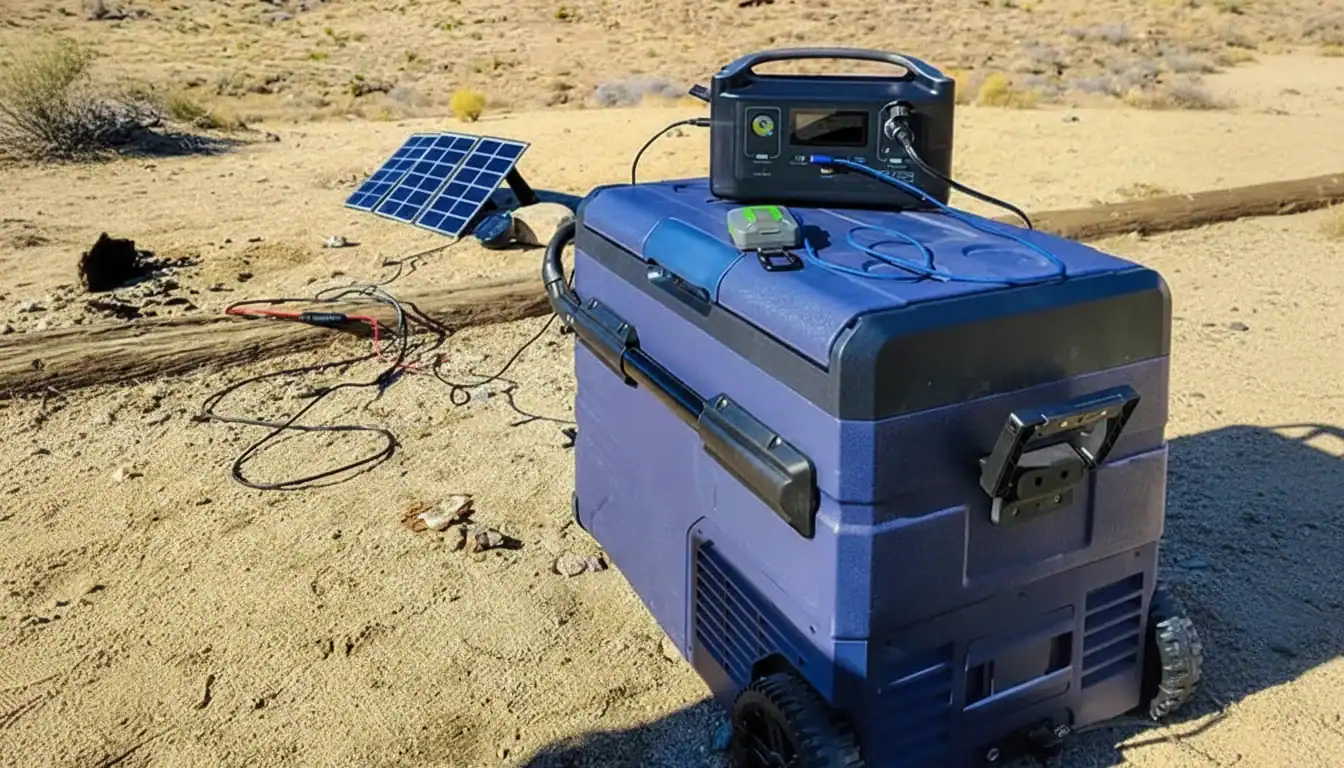
The Combo: Why Pair It with a Portable Power Station?
Pairing a portable fridge with a power station shifts the setup from a simple solar connection to a complete, modular energy system. It introduces energy storage and power regulation, which are critical for multi-day autonomy and equipment longevity.
While a dedicated battery or direct vehicle connection works for short trips, a portable power station provides the energy independence required for serious off-grid use. This combination is becoming the standard for camping, RV, and emergency preparedness markets because it solves the core problems of intermittent power and limited runtime.
Extend Off-Grid Runtime for Multiple Days
Connecting a solar fridge to a portable power station builds a robust energy reserve. This setup allows for continuous cooling for several days, even when sunlight is inconsistent. It’s a practical solution for extended camping trips or situations where reliable, long-term refrigeration is non-negotiable.
- A power station effectively stores surplus solar energy gathered during peak sunlight, saving it for overnight use or cloudy days.
- This combination provides multi-day independence from a vehicle’s starting battery or the electrical grid.
- It ensures food, drinks, or medications stay cold and safe during prolonged off-grid use, removing the uncertainty of relying on weather alone.
Create a Flexible, Modular Power System
A portable power station functions as a central energy hub, delivering more flexibility than a direct solar-to-fridge connection. You can charge the power station from multiple inputs—solar panels, a standard wall outlet, or a car’s 12V DC socket—and power several devices simultaneously.
- It supplies various outputs (AC, DC, USB) to run the fridge while also charging phones, laptops, and other essential electronics.
- Users can scale their system by selecting a power station with a battery capacity that matches their specific energy needs.
- This modular design offers superior versatility for different uses, from weekend trips to home power backup during an outage.
Ensure Uninterrupted Cooling Reliability
Depending only on solar panels creates intermittent power flow, causing the fridge’s compressor to cycle on and off improperly. A power station smooths out this energy delivery. It provides a steady, regulated power source that protects the compressor from damage and maintains a consistent internal temperature.
- The power station acts as a buffer, delivering clean and consistent voltage even when solar input fluctuates due to passing clouds.
- It removes the risk of the fridge shutting down during periods of low light, which safeguards its contents from spoilage.
- This reliability is essential for preserving temperature-sensitive items like insulin or perishable foods where temperature stability is critical.
結論
内蔵バッテリー、ソーラー直接入力、効率的なエコモードを備えたポータブル冷蔵庫は、グリッドに依存しない信頼性の高い冷却を実現します。この組み合わせは、週末のキャンプから長期の陸路旅行まで、遠隔地での用途に必要な電力の柔軟性を提供します。車両や主電源に常時接続しなくても、生鮮品の鮮度を保つことができます。.
アウトドア用品の小売業者や自動車用品の輸入業者にとって、これらの機能は顧客にとって価値の高い製品を生み出します。OEMのカスタマイズやコンプレッサー式冷蔵庫の全カタログをご覧になりたい場合は、当社のエンジニアリングチームまでお問い合わせください。.
よくある質問
ソーラーパネルで12Vの冷蔵庫を直接動かせますか?
12Vの冷蔵庫を動かすためにソーラーパネルを直接使うべきではありません。パネルの出力は、日射量の変化により安定せず、冷蔵庫のコンプレッサーを損傷する可能性があるからだ。業界標準のセットアップでは、ソーラーパネルをチャージコントローラーに接続し、ディープサイクルバッテリーを安全に充電する必要がある。その後、冷蔵庫はバッテリーから安定した信頼性の高い電力を得て、長寿命と適切な動作を保証します。.
バッテリーの取り外しが可能なポータブル冷蔵庫は?
オフグリッド家電市場のいくつかの主要ブランドは、取り外し可能または交換可能なバッテリーパックを備えたポータブル冷蔵庫を提供しています。主な例としては、Anker EverFrost、EcoFlow Glacier、DometicとJackeryの一部のモデルなどがある。この機能は、ユーザーが主電源なしで継続的な冷却のために余分なバッテリーを携帯し、交換することを可能にすることにより、長期旅行のための柔軟性を提供します。.
リモート・キャンプに最適なオフグリッド冷蔵庫は?
遠隔地でのキャンプに最適なオフグリッド冷蔵庫は、高効率の消費電力と堅牢な耐久性を兼ね備えています。可変速コンプレッサー(Secopなど)、優れた断熱性、低い平均消費電力(12Vで2アンペア以下)を特徴とするモデルを探そう。Dometic CFX3シリーズ、ARB ZEROシリーズ、EcoFlow Glacierなど、業界をリードするオプションは、熱性能、頑丈な構造、デュアルゾーン冷却やスマートコントロールなどの高度な機能で高く評価されています。.
着脱式バッテリーの寿命は?
取り外し可能な冷蔵庫用バッテリーの稼働時間は、通常1回の充電で6時間から24時間以上です。この持続時間は、バッテリーの容量(ワット時で測定)、周囲温度、冷蔵庫の設定温度、断熱材の質に大きく影響される。ハイブリッド・パッシブ・アクティブ・システムのような高度な温度管理を備えた最新のユニットは、コンプレッサー・サイクルを大幅に削減し、バッテリー寿命を最大化し、オフグリッドの性能を延長します。.

 English
  Español
  Français
  Deutsch
  Português do Brasil
  Русский
  한국어
한국어  日本語
日本語  العربية