...

最高の12V RV冷蔵庫の調達:プロパンとの “グリーン・スワップ

12V RV Fridge Retrofit guide for OEM buyers. Fit standard Dometic cutouts with DC compressor units offering -20°C freezing. Factory direct.

読書時間: 8分  |  単語数 2099

A proper RV Retrofit(best 12V fridge for rv) is the critical step that separates a safe, modern electrical system from the inherent liability of an aging propane appliance. Propane absorption units present persistent operational challenges, including slow cooling cycles, mandatory level parking, and the constant, silent risk of carbon monoxide leaks from a failed burner. For service centers and fleet managers, these issues translate directly into customer complaints, diagnostic downtime, and significant safety liabilities.

This guide serves as a standard operating procedure for executing a propane-to-12V compressor fridge conversion. We will cover the most important technical validation: confirming fitment for standard Dometic and Norcold cabinet cutouts to avoid custom carpentry. We will also detail the simplified wiring requirements for the 12V system, explain the efficiency metrics behind faster cooling, and validate the safety case for removing a combustion appliance from the living space.

KelyLands Car Accessory Refrigerator Series NRX for Vehicles.
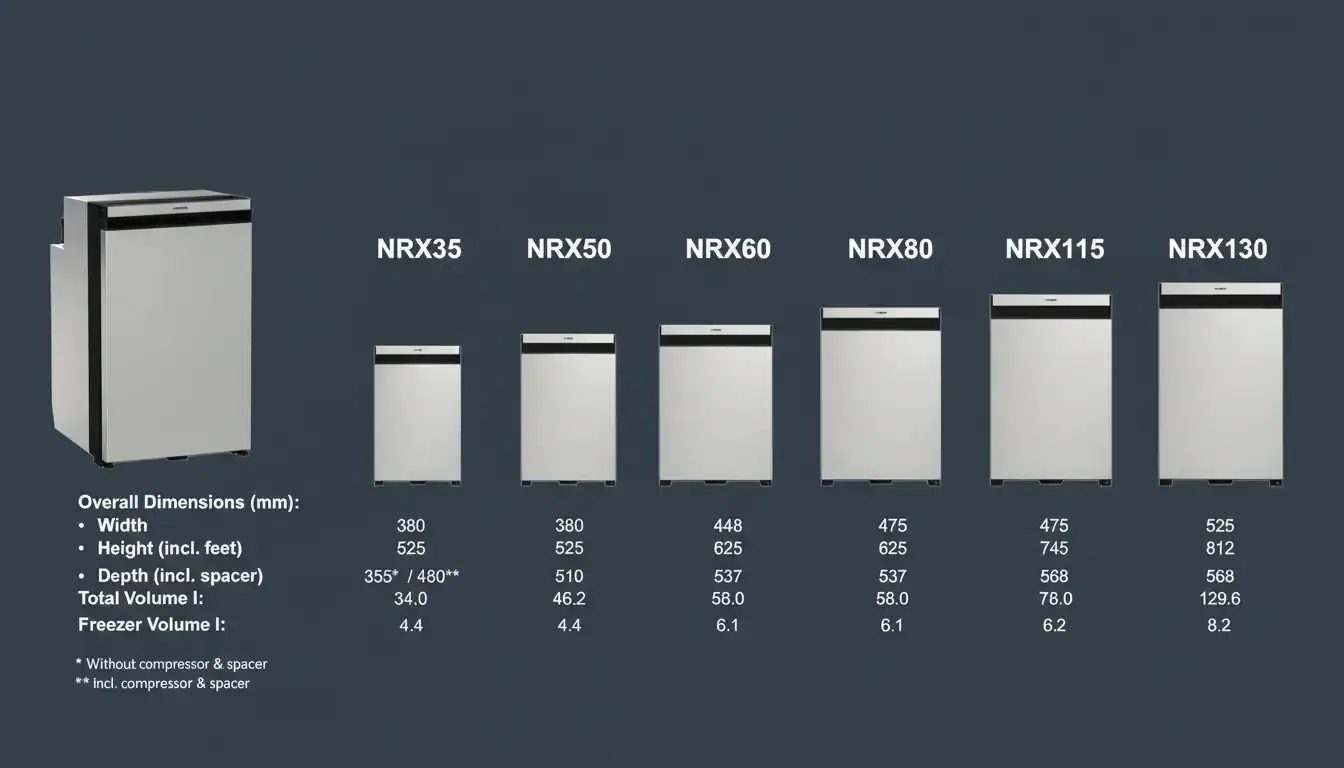
Norcold refrigerator models with dimensions and volumes for NRX35 to NRX130.

Fitment Check: Does It Fit Standard Dometic Cutout Dimensions?

Dometic’s cutout dimensions became the unofficial industry standard, streamlining the upgrade path from older absorption units to modern 12V compressor refrigerators.

Standardization Around Dometic Cutouts

The RV refrigeration market relies on established cutout dimensions to ensure appliances are interchangeable. Dometic’s specifications serve as a critical reference point, allowing manufacturers to design new 12V DC electric models that fit directly into spaces once occupied by legacy absorption units. This standardization is key to simplifying retrofits, as it reduces the need for extensive and costly cabinetry modifications during an upgrade.

Model Class Reference Typical Cutout Dimensions (H x W x D) Common Application
Compact (e.g., DM23xx Series) 30″ x 21″ x 22″ Truck campers, conversion vans
Mid-Size (e.g., DM26xx Series) 55″ x 24″ x 24″ Travel trailers & small fifth wheels
Large Capacity (e.g., RM1350 Series) 64″ x 33″ x 26″ Large motorhomes & luxury fifth wheels

Key Cutout Dimensions to Verify

While standardization helps, you must measure your specific cutout before buying a replacement. A new refrigerator’s compatibility depends entirely on whether its height, width, and depth fit into the existing cabinetry. Always consult the appliance manufacturer’s documentation for precise dimensional requirements to confirm a successful installation.

  • Height: The most variable dimension, typically ranging from 20 to 72 inches depending on the RV model and original appliance.
  • Width: This measurement dictates if the unit will slide into the space without interference from side panels.
  • Depth: Crucial for ensuring the unit sits flush with cabinetry and has adequate rear ventilation space.

Cross-Brand Compatibility and Retrofitting

Other brands like Nova Kool, Vitrifrigo, and Norcold often engineer their products to match common Dometic cutouts, giving you more flexibility when selecting a replacement. Many modern 12V compressor refrigerators are specifically sized to replace older, inefficient absorption models. Even with this industry alignment, minor variations in RV construction can sometimes require custom frames or small enclosure adjustments to achieve a perfect fit. Modular and space-efficient designs are becoming more common to better accommodate the diverse floor plans found across different RVs.

Diagram illustrating ventilation requirements for a refrigerator, showing zero clearance on sides, top view, and side view with measurements.
Diagram showcasing proper ventilation and clearance for refrigerator installation.

Efficiency: Why Is 12V Compressor 5x Faster Than Propane?

A 12V compressor fridge uses direct mechanical force to circulate refrigerant, achieving target temperatures rapidly, whereas a propane absorption unit depends on a slow, passive chemical reaction initiated by heat.

Compressor-Driven Cooling vs. Propane Absorption

The speed difference comes down to the core cooling technology. A 12V compressor system functions like a residential refrigerator, actively circulating a refrigerant to pull heat directly and rapidly from the interior. Propane absorption models use a fundamentally slower, passive process. They apply heat from a propane flame to initiate a chemical reaction that eventually produces a cooling effect, but this entire cycle takes hours to stabilize and reach the target temperature.

  • 12V compressor systems use mechanical force for an immediate and powerful cooling response, often chilling contents in under 2-3 hours.
  • Propane fridges rely on a heat-exchange cycle with no moving parts, which can take 8-12 hours to reach a stable, cold temperature.

Superior Energy Efficiency

Modern 12V compressor units are engineered for high efficiency, consuming around 200W per hour during an active cooling cycle. Absorption units are much less efficient, often requiring 400-500W to run their heating element. This lower power draw allows a 12V fridge to run effective cooling cycles powered by battery systems without significant energy waste, contributing to faster net cooling and better off-grid performance.

  • The system integrates seamlessly with solar panels and lithium batteries, leveraging stored power for quick, intermittent cooling cycles.
  • Propane models consume more energy overall just to maintain temperature, making their cooling process less direct and more wasteful.
Graphic comparing propane and electric refrigerators for RVs, highlighting benefits like low electric draw and efficient cooling.
Choose between propane and electric RV refrigerators for optimal performance.

Reliable Performance in Any Environment

Compressor refrigerators deliver consistent performance regardless of external conditions. They are unaffected by high ambient temperatures or the angle of the vehicle. Propane refrigerators, on the other hand, must be perfectly level to allow the chemical process to function correctly, and their cooling efficiency drops sharply in hot weather, further extending cool-down times.

  • 12V compressor units maintain their cooling speed and efficiency even when the vehicle is parked on uneven ground or a steep incline.
  • They are not impacted by high external heat, ensuring fast cool-down times in all climates from desert to alpine environments.

Expand Your Brand with Custom OEM Coolers

We provide complete OEM/ODM solutions, from design to mass production, ensuring every unit meets global standards. Partner with us for flexible MOQs and a reliable supply chain to stock your inventory with high-demand, custom-branded car coolers.

カスタマイズ・オプションの探求

CTAイメージ

Safety: Eliminating Carbon Monoxide Risks for Safer Sleeping.

Eliminating fuel-burning appliances like propane refrigerators is the most direct way to remove the source of carbon monoxide, a colorless and odorless gas that poses a lethal risk in enclosed spaces like RVs.

Understanding the ‘Silent Killer’ in Confined Spaces

Carbon monoxide (CO) is a byproduct of fuel-burning equipment. In a confined space like an RV or tent, it can accumulate to dangerous levels very quickly. Because the gas is odorless and colorless, occupants can be overcome during sleep without any warning. This makes it impossible to detect with human senses alone, turning common appliances like generators, portable heaters, and propane systems into significant hazards if not managed correctly.

The Critical Role of Carbon Monoxide Detectors

A functional CO detector is the only reliable defense against carbon monoxide poisoning. These alarms are not optional; they are a critical piece of safety equipment. Proper installation and maintenance are essential for ensuring they work when needed.

  • Install detectors near sleeping areas, following the manufacturer’s specific height and location guidelines.
  • Test the alarm’s functionality monthly and replace batteries at least once a year, or as recommended.
  • Some modern heating appliances now include built-in Oxygen Depletion Sensors (ODS) that shut the unit off if oxygen levels become unsafe, offering an additional layer of protection.

Safe Practices to Prevent CO Buildup

While detectors are crucial for alerting you to danger, the best strategy is to prevent CO from accumulating in the first place. This involves strict adherence to proper equipment use and ventilation protocols.

  • Never operate generators or any unvented fuel-burning devices inside an RV, tent, or other enclosed area.
  • Always ensure adequate ventilation. Slightly opening a roof vent or a window allows fresh air to circulate, preventing gas buildup.
  • Position external emission sources, like a generator, at least 20 feet away from your vehicle and any open windows or vents.

Installation: Is Wiring Difficult for a 12V Conversion?

The primary challenge in a 12V conversion isn’t the basic wiring concept, but correctly sizing the wire gauge to prevent voltage drop and ensure both performance and safety.

Converting an RV’s refrigeration system from propane to 12V is a manageable project for DIY builders in 2026, provided they follow proper electrical guidance. The difficulty is not in connecting the wires, but in ensuring the specifications are correct for safety and long-term performance. A successful installation depends on understanding the core electrical principles before starting the work, not improvising during the process. With a structured approach, the task becomes much more straightforward.

Wiring Complexity: Manageable for DIY Builders

For anyone comfortable with basic vehicle electronics, the wiring for a 12V compressor fridge is not overly complex. The main goal is to deliver clean, stable power from the battery bank to the appliance. The key to a successful installation is planning the wire run, calculating the correct wire gauge, and using a dedicated, properly fused circuit. This avoids common pitfalls that can lead to poor performance or electrical hazards down the road.

Key Challenges: Cable Sizing and Load Management

The most critical and challenging parts of a 12V conversion are selecting the correct cable size and managing the electrical load. Using an undersized wire is a significant risk; it causes voltage drop that can prevent the fridge compressor from starting and, in worse cases, lead to overheating and potential fire. You must calculate the required wire gauge based on the fridge’s amperage draw and the total length of the wire run from the power source. When running multiple accessories on a single circuit, their combined amperage must be used to size the wire based on the furthest device in the chain.

Circuit Load (Amps) Max Wire Length for 12 AWG (ft) Max Wire Length for 10 AWG (ft)
5 Amps 20 ft 32 ft
10 Amps 10 ft 16 ft
15 Amps 6 ft 10 ft

Practical Solutions for a Simpler Setup

You can simplify the wiring process significantly by adopting a few standard best practices. Using a 12-gauge stranded duplex wire is sufficient for about 95% of typical accessory circuits, keeping the installation within acceptable voltage drop limits. The most effective and organized approach is to run one dedicated 12V outlet per fused circuit directly from a central distribution block or fuse panel. This isolates each high-draw appliance, makes troubleshooting easier, and ensures each device gets the stable power it needs to operate efficiently.

結論

Upgrading from a propane to a 12V compressor fridge offers a direct path to better safety, efficiency, and reliability. These units are engineered to fit standard Dometic cutouts, simplifying the installation process. The result is a modern appliance that eliminates carbon monoxide risks and provides five times faster cooling for your customers.

Contact our specialists to get full technical specifications and discuss OEM options for your product line. We can provide detailed schematics to ensure a perfect fit for your RV renovation or manufacturing projects.

よくある質問

What is the best 12v replacement for a propane fridge?

The “best” 12V replacement depends on your specific needs, but top-tier brands like Vitrifrigo and Nova Kool are known for their high efficiency and robust build quality, making them ideal for serious off-grid use. For a balance of performance and value, brands like Norcold and Dometic offer reliable 12V compressor models that are often designed as direct-fit replacements for their older propane units. The key is to select a model with the right internal capacity, low amperage draw, and physical dimensions for your RV.

Will this fridge fit in my existing cabinet space?

Most likely, yes. The RV industry relies on standardized cutout dimensions, largely based on legacy Dometic and Norcold specifications, to make retrofitting easier. Manufacturers design their new 12V models to fit these common openings. However, you must measure your cabinet’s height, width, and depth and compare them to the new unit’s required cutout dimensions listed in its technical specifications. While many fit perfectly, some installations may require minor custom frame adaptations.

Do I need to upgrade my RV battery for a 12V fridge?

Yes, a battery system evaluation and likely upgrade are essential. While 12V compressor fridges are very efficient, they run exclusively on battery power. A standard factory-installed lead-acid battery is insufficient for running a 12V fridge for more than a few hours. For reliable off-grid performance, we recommend a minimum of 200 amp-hours (Ah) of lithium (LiFePO4) batteries, paired with a solar charging system of at least 300-400 watts to keep the system charged.

Is it safer to replace my propane fridge?

Yes, replacing a propane absorption fridge with a 12V DC compressor model is considered a significant safety upgrade. A 12V fridge eliminates the risks associated with propane, including potential gas leaks, fire from the open flame burner, and carbon monoxide (CO) production. It also removes the need for complex exterior wall vents and the requirement to be perfectly level for proper operation, simplifying the system and removing multiple points of potential failure.