 メインコンテンツへスキップ フッターへスキップ

True freezing power is the critical variable separating reliable cold chain logistics from thousands of dollars in spoiled biological samples or ruined catering inventory. Standard 12V coolers often fail to maintain sub-zero temperatures in a hot vehicle, creating a significant operational risk for any business that depends on mobile refrigeration. A temperature variance of just a few degrees can render medical supplies unusable or violate food safety regulations, turning a routine transport into a costly liability.
This analysis defines a performance baseline for professional-grade portable freezers, using a set of non-negotiable engineering tests. We measure performance based on the “Ice Cream Standard”—the ability to keep gelato frozen solid for 24 hours in 35°C ambient heat. We’ll examine why 50mm insulation is often more vital than motor specifications, how modern compressor AI can hit -18°C in 30 minutes, and whether a unit is reliable enough for unattended, seven-day storage of sensitive materials like game meat.

The Ice Cream Test: Can It Keep Gelato Solid for 24 Hours in 35°C Heat?
The laws of thermodynamics dictate that no passively cooled container can keep gelato solid for 24 hours in 35°C heat; the product begins melting instantly as heat transfer overwhelms its latent energy.
The Immediate Reality of Melting Physics
Gelato doesn’t gradually warm up—it starts melting the moment it encounters high ambient temperatures. This isn’t a slow process; it’s an immediate physical reaction. Heat transfer via convection begins on the surface, causing the outermost ice crystals to transition to liquid. This water then mixes with the remaining liquid serum, accelerating the breakdown of the product’s solid structure from the outside in. The visual “sweating” on the surface is the first sign of this structural failure.
| Condition | Ideal Storage (-18°C Freezer) | High-Heat Exposure (35°C Ambient) |
|---|---|---|
| Heat Transfer | Minimal; stable internal temperature. | Aggressive; constant convection at the surface. |
| Physical State | Solid; stable ice crystal structure. | Begins melting immediately; structure collapses. |
| Feasible Duration | Indefinite (while actively powered). | Minutes to hours, not the claimed 24 hours. |
Critical Role of Storage Temperature vs. Ambient Heat
The temperature gap between ideal conditions and the test environment is too extreme to overcome with passive insulation alone. Gelato is best served around -11°C and stored colder, at -18°C. Pitting that against a 35°C ambient temperature creates a massive thermal challenge. The energy required to keep the product frozen (its latent heat) is exhausted quickly under this constant thermal assault, causing a rapid shift from solid to liquid.
The Verdict: Why 24-Hour Solidity Is Unrealistic
Basic thermodynamics makes the 24-hour claim impossible for any unpowered cooler. The stability of gelato depends entirely on maintaining a sub-zero environment. Without an active compressor constantly removing heat, the internal temperature will inevitably rise toward the ambient 35°C.
- No standard ice cream or gelato formulation can resist melting for 24 hours when the surrounding temperature is over 40°C higher than its freezing point.
- Any test measuring this would simply be evaluating the container’s insulation quality, not the gelato’s properties. For passive cooling, 24 hours is far beyond realistic expectations for consumer-grade products. A true compressor freezer is required for this level of performance.
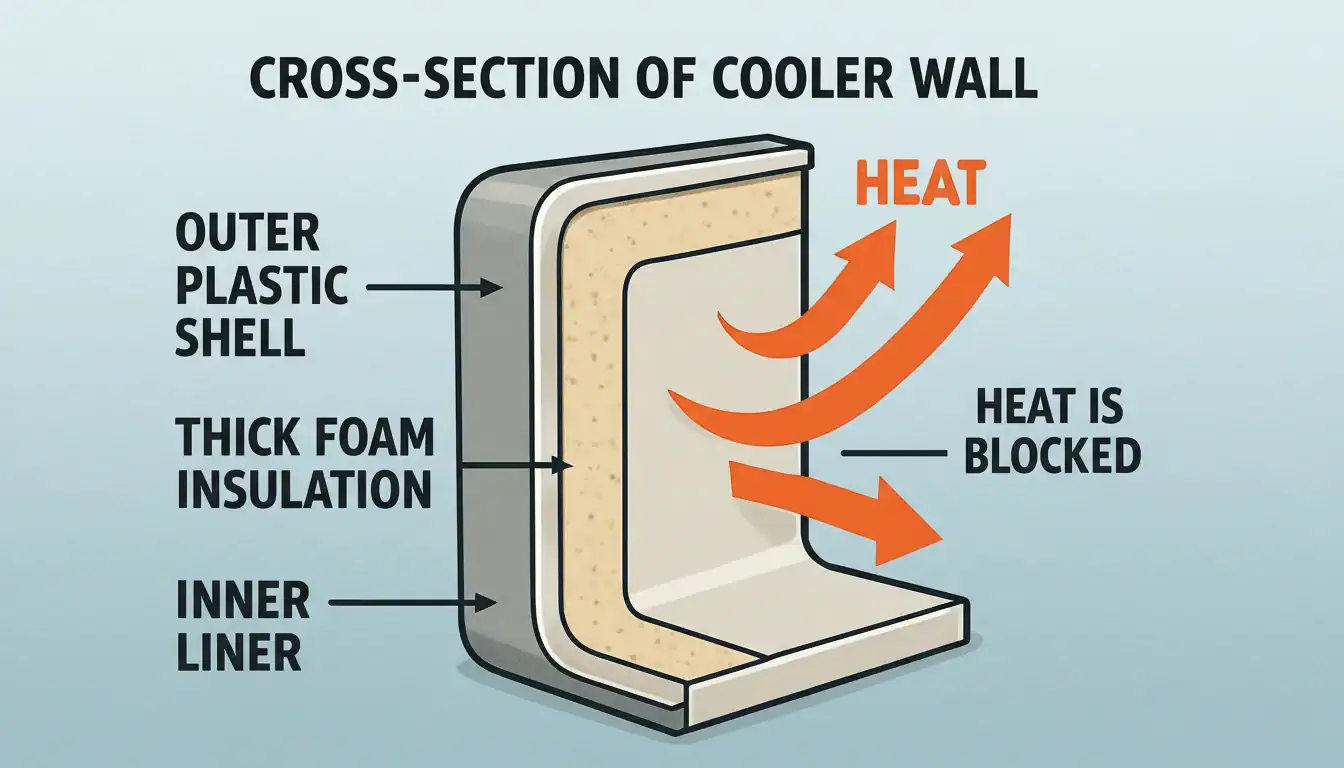
Insulation Tech: Why Do 50mm Walls Matter More Than Motor Power?
In refrigeration efficiency, a unit’s wall thickness is a more significant performance driver than its motor power, directly impacting energy consumption and component longevity.
Many buyers focus on the compressor, assuming a more powerful motor equals better cooling. This is a common misconception. The real foundation of a high-performance portable freezer is its insulation. A powerful compressor in a poorly insulated box will constantly run, waste energy, and ultimately fail sooner. The primary job of insulation is to prevent ambient heat from entering the cooled space, which is the single biggest factor in reducing the compressor’s workload.
How Insulation Reduces Compressor Workload and Saves Energy
Thick, high-density foam insulation acts as a robust thermal barrier. It drastically reduces how often the compressor needs to cycle on to maintain its set temperature. This efficiency gain leads directly to lower energy consumption from the vehicle’s battery or power station and reduces mechanical wear on the cooling system over time.
- Effective insulation stabilizes the internal temperature by keeping external heat out.
- Fewer compressor cycles directly translate to lower power draw and operating costs.
- Reduced operational strain helps extend the overall lifespan of the refrigeration unit.
The 50mm Standard: Balancing Performance and Practicality
A 50mm wall thickness is the industry benchmark for balancing strong thermal efficiency with practical size and cost. This level of insulation offers a more significant and measurable performance boost than simply installing a larger, energy-intensive compressor. It prioritizes passive cold retention over active, power-hungry cooling.
| パフォーマンス指標 | Thin Wall Insulation (<35mm) | Thick Wall Insulation (50mm+) |
|---|---|---|
| Compressor Cycle Rate | High (Frequent on/off cycles) | Low (Longer, infrequent cycles) |
| エネルギー消費 | Elevated (Constantly fighting heat gain) | Reduced (Maintains temp with less effort) |
| Cold Retention (Power Off) | Poor (Internal temp rises quickly) | Excellent (Stays cold for hours) |
| Long-Term Reliability | Increased wear on motor and components | Extended component lifespan |
- Provides a cost-effective solution for achieving high thermal performance.
- Delivers a tangible return on investment by significantly lowering long-term energy use.
- Ensures superior cold retention compared to models with thinner walls, even with a standard-power compressor.
Minimizing Thermal Bridging for Consistent Cold Retention
Thermal bridging occurs when heat bypasses insulation through less-insulated parts of a structure, like seams, corners, or mounting points. A solid, uniform 50mm wall construction minimizes these weak spots. This creates a consistent cold environment that prevents the compressor from overworking to compensate for temperature leaks that plague thinly insulated units.
- Thick, continuous insulation reduces the points where external heat can penetrate the interior.
- Modern materials with high R-values (a measure of thermal resistance) amplify this effect.
- Proper wall construction, not motor size, is the dominant factor in achieving system efficiency and longevity.
Your Reliable Source for Custom Car Coolers

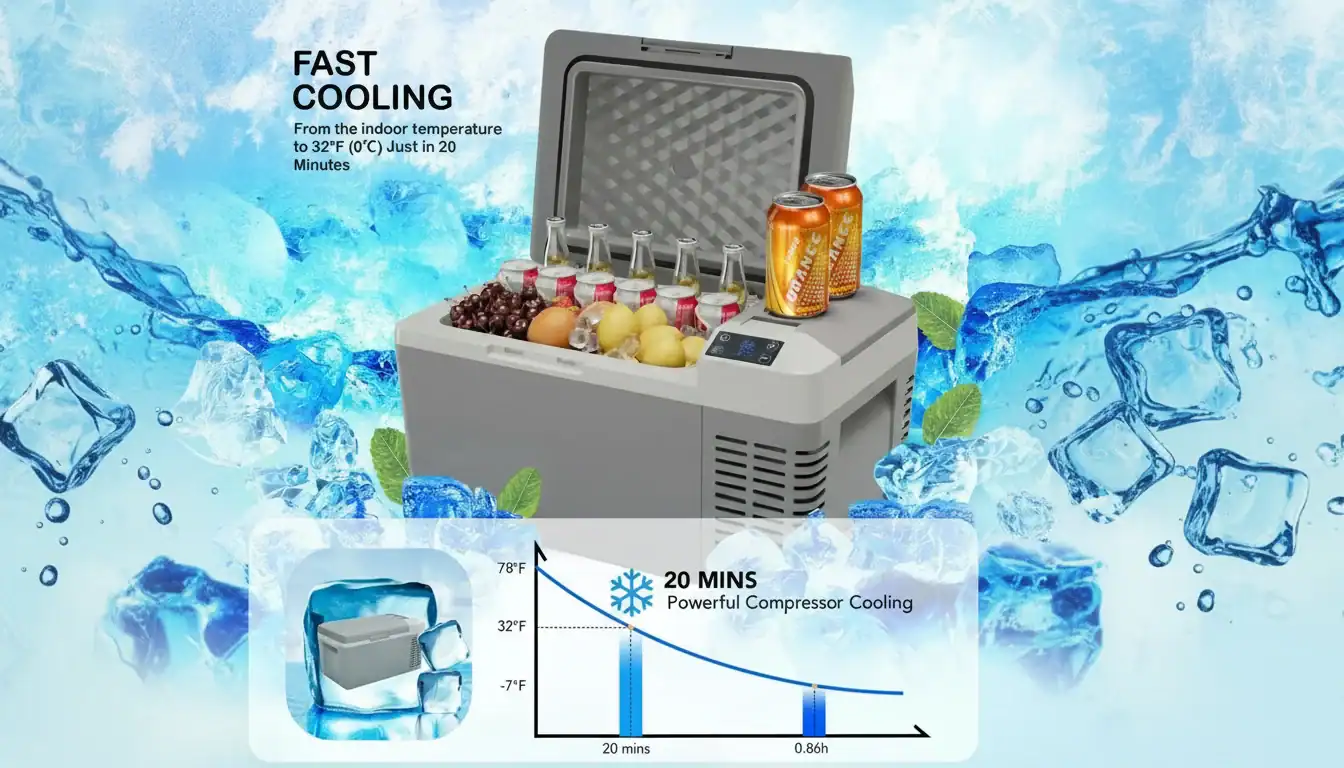
Compressor AI: Can It Reach -18°C in 30 Mins via “Turbo Mode”?
A 30-minute cool-down to -18°C represents top-tier performance, yet the practical industry benchmark for reliable compressor freezers remains closer to 60 minutes, balancing speed with system stability.
Turbo Mode vs. ECO Mode: The Speed-to-Energy Trade-Off
Compressor-based portable freezers operate on a dual-mode system to manage performance and power consumption. “Turbo Mode” (or Max Mode) runs the compressor at full capacity for the fastest possible temperature drop. This is essential for bringing the unit down to freezing temperatures quickly or for freezing fresh food. In contrast, “ECO Mode” prioritizes energy efficiency by intelligently cycling the compressor on and off, making it ideal for maintaining a set temperature over extended periods, like overnight use on a vehicle’s battery.
| 特徴 | Turbo Mode (Max) | ECO Mode |
|---|---|---|
| 主要目標 | Rapid initial cool-down | Long-term energy conservation |
| Power Draw | High; runs compressor continuously | Low; cycles compressor to maintain temp (<45W) |
| Typical Use | Freezing fresh items quickly before a trip | Overnight operation on battery power |
Cooling Performance Benchmarks in 2026
While a 30-minute pull-down to -18°C is an impressive marketing claim, the current industry standard for high-performance units is achieving that temperature in approximately 60 minutes. A unit capable of a 30-minute freeze would sit at the absolute peak of the market. Real-world performance always depends on external factors, including the ambient temperature, how full the freezer is, and the initial temperature of the contents. An empty freezer in a cool garage will reach its target much faster than one fully loaded with warm drinks in direct sunlight.
How Compressor Technology Enables Rapid Cooling
The compressor is the core engine of any portable freezer, responsible for the heat exchange that creates cold. The ability to cool rapidly is a direct function of the compressor’s power and thermal efficiency. Modern compressor designs are engineered to deliver strong, consistent performance to handle the stress of Turbo Mode without overheating. Durability is a critical factor, as running at maximum output places significant strain on the system’s mechanical and electrical components.
Vehicle Battery Protection During Max Cool-Down
Operating in Turbo Mode draws a significant amount of power from the connected source. To prevent this high draw from draining a vehicle’s starter battery, nearly all professional-grade portable freezers integrate a multi-level battery protection system. This feature is a non-negotiable standard for the camping and overland markets. It constantly monitors the input voltage and automatically shuts the freezer off if the battery level drops below a preset threshold (typically High, Medium, or Low settings). This ensures you always have enough power left to start your vehicle.
The “Meat Keeper”: Is It Safe for 7-Day Game Meat Storage?
Yes, a compressor car freezer is safe for 7-day game meat storage, provided it strictly maintains a stable internal temperature below 4°C (40°F) while managing moisture and preventing contamination.
Maintaining Stable Temperatures Below 4°C (40°F)
The absolute standard for ensuring game meat safety over a week-long period is rigorous temperature control. Holding the internal environment consistently below 4°C (40°F) is the only reliable way to halt harmful bacterial growth and preserve the meat’s integrity. This isn’t just a suggestion; it’s a core principle aligned with food safety regulations like HACCP and enforced by global food safety agencies.
- Industry best practices mandate that game carcass temperatures must drop and stay below the 40°F threshold to be considered safe.
- Portable compressor refrigeration systems are the market standard for achieving this level of dependable short-term preservation in the field.
- Regulatory bodies in the EU and other markets are increasingly monitoring temperature logs to verify compliance with food safety rules.
Balancing Air Circulation and Contamination Prevention
Effective storage creates a careful balance between cooling the meat with circulating air and shielding it from outside contaminants. While airflow is necessary to cool the carcass evenly, an open system invites environmental bacteria. Using appropriate breathable materials inside a sealed freezer unit is the correct approach. This prevents moisture buildup on the meat’s surface while the hard-shell unit provides a barrier against external contaminants.
- Using breathable game bags or wraps inside the freezer promotes airflow directly around the carcass.
- Proper internal air circulation is critical for preventing moisture pockets, which are a primary catalyst for bacterial growth.
- The sealed freezer unit itself is the most effective tool for preventing dust, insects, and other contaminants from reaching the meat.
Moisture Management and Cross-Contamination Protocols
Beyond temperature, controlling moisture is fundamental to preventing spoilage. A dry environment discourages bacterial spread. Implementing clear separation protocols is just as critical, especially when storing meat from different animals or processing different cuts. These steps ensure that the entire field-to-freezer cold chain remains intact and that every piece of meat stays safe for consumption.
- The primary focus in short-term storage is active moisture management to keep all meat surfaces as dry as possible.
- Physically separating different cuts or animals is standard procedure to eliminate any risk of cross-contamination.
- A clean, controlled internal freezer environment is the foundation for a successful and safe cold chain from start to finish.
結論
The “Ice Cream Standard” is a practical benchmark for portable freezer performance, driven by key engineering choices. Thick insulation, rapid cooling compressors, and reliable battery protection are what separate a true freezer from a simple cooler. These features ensure consistent results, whether preserving sensitive cargo for a commercial client or storing game meat safely for a week.
If this level of performance aligns with your product line requirements, we can provide our full catalog for your review. Contact our team to discuss your specific OEM and customization needs for your market.
よくある質問
Can a portable fridge keep ice cream frozen solid?
Yes, but only a specific type. A true portable freezer with a compressor can reliably maintain temperatures as low as -18°C, which is required to keep ice cream frozen solid. Standard thermoelectric coolers, often called “portable fridges,” are not powerful enough as they only cool relative to the ambient temperature and will not prevent melting. For ice cream, a compressor-based model is essential.
What is the best portable freezer for camping?
The best portable freezer for camping depends on your specific needs, but top-tier models share key features. Look for a compressor-based unit for genuine freezing power and high energy efficiency. Leading brands like Dometic, ARB, and Engel are renowned for their durability and low power consumption. Important features to consider are dual-zone temperature control, a robust build for outdoor use, and a three-stage battery protection system to avoid draining your vehicle’s battery.
How cold does a 12v freezer get?
A high-quality 12V portable freezer with an integrated compressor can typically reach and maintain temperatures as low as -22°C (-8°F). This allows it to function as a true deep freezer, capable of freezing items solid and keeping temperature-sensitive products like ice cream perfectly preserved, even in high ambient heat. The exact minimum temperature can vary by model, but this range is the industry standard for reliable performance.
Is the refrigerant gas eco-friendly (low GWP)?
Yes, modern portable freezers are designed with eco-friendliness in mind. As of 2026, most reputable manufacturers use refrigerants with a low Global Warming Potential (GWP). While older units may have used R134a, current models typically use R1234yf or R600a (isobutane). These refrigerants have a significantly lower environmental impact, aligning with modern environmental standards and regulations for cooling appliances.

 English
  Español
  Français
  Deutsch
  Português do Brasil
  Русский
  한국어
한국어  日本語
日本語  العربية