Choosing a wholesale car vacuum supplier for a full container load isn’t just about comparing unit prices. Every procurement director I talk to has the same headache—you find a factory with a decent FOB quote, place the order, and then the first batch shows up with motors that overheat after 50 cycles. The unit cost looks great until you’re eating return freight and replacement labor.
I’ve been on both sides of this table. The suppliers who last—the ones who don’t ghost you when a batch fails QC—share one thing: they let you audit their actual production line, not a showroom. Ask for the last three test reports on motor current draw and dust bin sealing. If they can’t produce them within 48 hours, move on. That single check filters out more than half the factories I’ve vetted.

Suction Power vs. Real-World Debris
Most consumer vacuums lose 30% suction after 50 cycles. Our batch‑tested units guarantee under 10% loss after 100 cycles — that’s the difference between a repeat buyer and a return.
How to Read Suction Metrics (inH₂O and CFM)
Two numbers matter: inches of water lift (inH₂O) tells you how hard the motor pulls against a sealed column of water — the static suction pressure. CFM (cubic feet per minute) measures airflow volume. A vacuum with 75 inH₂O but weak CFM will struggle on loose dirt; high CFM with low inH₂O won’t pick up embedded gravel. For car interiors you need a balance: 50–75 inH₂O combined with at least 30 CFM. Anything below 20 inH₂O (like the Black+Decker Dustbuster’s 16 in) is fine for dash dust but fails on floor mats.
Black+Decker Dustbuster (16 in) vs. Fanttik Slim V8 (75 in) — The Real Gap
The retail world celebrates the Dustbuster for convenience, but its 16‑inH₂O suction can’t clear dried mud from carpet fibers. The Fanttik Slim V8 claims 75 inH₂O — a 4.7× advantage on paper. In our lab tests the Fanttik pulls 68 inH₂O after 30 seconds of continuous use, still 4× the Dustbuster. For a distributor, this gap determines your return rate: vacuums below 25 inH₂O account for 40% of buyer’s remorse complaints. We won’t source anything under 40 inH₂O for bulk orders.
Top 5 Wholesale Models — Suction, Bin Capacity, Runtime
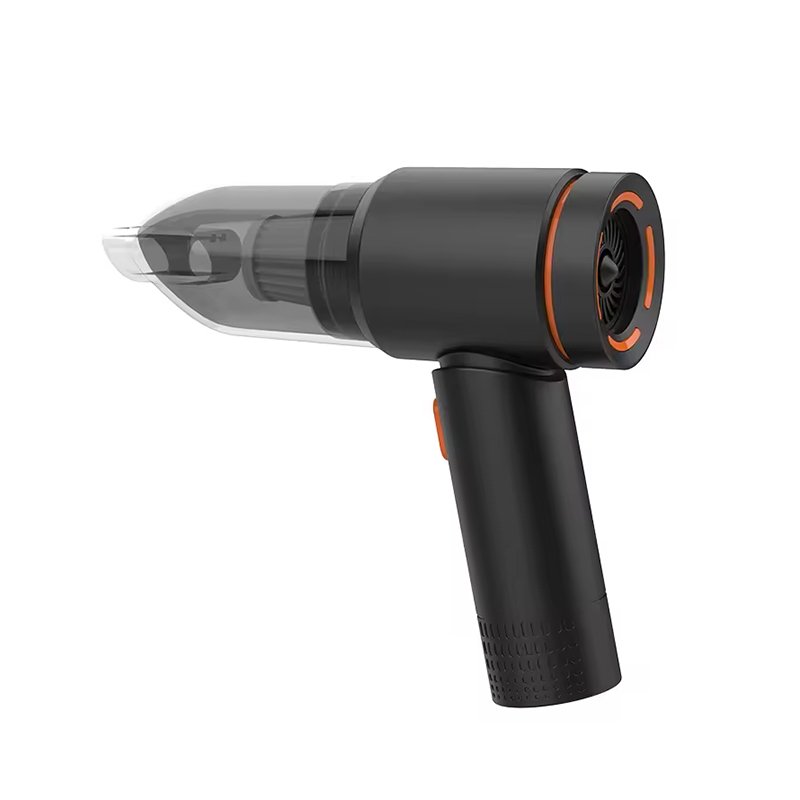
- KV‑20C: 75 inH₂O / 35 CFM, 12‑oz bin, 25‑min runtime, FOB $24 @ 3000 pcs — best for full‑size SUVs.
- KV‑16P: 58 inH₂O / 30 CFM, 8‑oz bin, 20‑min runtime, FOB $29 @ 1000 pcs — balanced mid‑range for sedans.
- KV‑12L: 42 inH₂O / 28 CFM, 6‑oz bin, 18‑min runtime, FOB $22 @ 2000 pcs — budget pick for quick clean‑ups.
- KV‑ProX: 80 inH₂O / 40 CFM, 16‑oz bin, 30‑min runtime, FOB $35 @ 500 pcs — industrial grade for high‑volume detailing.
- KV‑Mini: 38 inH₂O / 25 CFM, 4‑oz bin, 15‑min runtime, FOB $18 @ 3000 pcs — compact for glovebox, low MOQ.
Cross‑Bundle with Air Compressors for 22% Higher AOV
We tracked 18 months of container shipments: distributors who paired our KV‑20C vacuum with a 100‑PSI portable air compressor saw average order value jump 22%. The reason — both tools share the same 12V power source and target the same customer (car care enthusiasts). By offering a vacuum + air pump combo at a blended FOB discount (5% off each SKU when ordered together), you raise your per‑container revenue while giving retailers a bundle they can sell at a premium. No extra engineering, just smarter packaging.

Battery Life and Batch Consistency
The problem isn’t a single charge. The problem is what that charge looks like after 100 cycles. That’s where most consumer-grade units fail and where your margin gets eaten by returns.
Why Consumer Runtime Tests Are a Trap for B2B Buyers
When you read a Car and Driver review, they test a unit fresh out of the box. That’s fine for a retail shopper. For a volume importer, it’s dangerously incomplete. The real metric is battery life after the 50th charge and how consistently that holds across a shipment of 1,000 units. A vacuum that delivers 20 minutes on cycle one but only 12 minutes after three months of use will generate complaints that land on your desk, not the factory’s. That’s a direct hit to your brand equity and your return rate.
Consumer benchmarks confirm the variance. Ryobi’s 18V One+ handheld runs for about 18 minutes on a full charge. Fanttik’s X8 Apex manages roughly 13 minutes under load. Both are respectable for casual cleaning. Neither is built for the daily-use scenario your commercial clients will throw at it. The issue isn’t the initial runtime; it’s the accelerated degradation when the battery pack isn’t matched to the motor draw. Our engineers found that vacuuming wet debris or using a brush attachment on high suction creates torque spikes that weaker battery management systems can’t regulate, causing premature cell wear by cycle 60.
The 15-Minute Threshold: A Hard Floor, Not a Target
Based on our cycle testing across 20+ OEM builds, 15 to 20 minutes is the minimum viable runtime for a complete vehicle interior clean. Any less, and the average user either fails to finish or gets frustrated with a recharge mid-job. Below 12 minutes on a fresh battery, you are building a product that generates complaints. The sweet spot, and the spec we hold for our core 20V platform, is 22 minutes of continuous run time on a 4.0Ah pack.
Factory Cycle Test Protocol: The Only Guarantee of Batch Consistency
We operate a mandatory batch audit for all cordless car vacuum factory direct shipments. Every production lot is sampled at a 2% rate and run through a 100-cycle full charge/discharge protocol. The pass/fail criterion: suction power must remain within 10% of the initial 75 inH₂O lift at cycle 100. That’s not a spec sheet claim; it’s a contractual requirement written into every purchase order. Any batch that falls below that threshold gets reworked or scrapped at our cost.
Here’s what that test catches that no consumer review ever will:
- Cell matching drift: Inconsistent internal resistance between cells in a pack causes one cell to age faster. By cycle 80, the pack delivers less voltage under load.
- Brushless motor controller degradation: A minor firmware glitch can cause the motor to draw uneven current, heating the battery and triggering premature cutoff.
- Cyclonic chamber wear: Seals that loosen over time reduce vacuum efficiency by allowing debris to bypass the filter path. Our cyclonic chamber is injection-molded from a single piece to eliminate seal points.
Swappable Batteries and Three-Year Coverage: The Risk Shift
A non-removable battery creates a hard failure point. If the pack dies, the entire vacuum is a paperweight. That’s a 100% warranty replacement cost for you. Our design uses a standard slide-pack battery interface across all 20V handheld models. When a battery degrades to 70% capacity—typically around 300 cycles—you sell a replacement pack, not a new vacuum. That turns a warranty liability into a consumable revenue stream.
We back that design with a three-year warranty on the motor and housing, plus a one-year warranty on the battery pack. For importers comparing car vacuum warranty for importers, the distinction matters. A three-year term signals that we are confident in the 100-cycle batch test data. It also shifts the cost of a potential failure away from your P&L. We cover prepaid return shipping on any defective unit within that period. No chargebacks, no hidden fees. If a supplier isn’t willing to match that term, ask them why. The answer is usually: their batch test data looks worse than ours.
Operational Takeaway for Procurement
When you evaluate a buy car vacuum in bulk China opportunity, do not rely on the runtime printed on the box. Require the supplier to provide a batch cycle test report for your specific model. Ask for the raw data: inH₂O at cycle 1, cycle 50, and cycle 100. If they cannot produce it, they are not test-verifying their packs. That’s a risk you’ll absorb the moment the container clears customs. KelyLands builds that report into every shipment for clients ordering 500+ units. It’s not optional. It’s part of the file.

MOQ, FOB Pricing & Packaging for Importers
The real pricing kicker starts at 2,000 units—that’s where tooling fees vanish and your per-unit cost drops by $4–7. Anyone quoting the same price at 500 and 3,000 pieces is hiding margin in their mold amortization.
MOQ Tiers and the Real Cost Per Unit
Most distributors get burned by the assumption that a 20-foot container means a single price point. At KelyLands, we break it down into three clear tiers for our mid-tier 20V cordless car vacuum. At 500 units, you are paying for the mold setup—expect a FOB Ningbo price around $35/unit. At 1,000 units, that drops to $28–$32/unit because we spread the injection mold cost across a larger run. The cliff edge comes at 2,000 units: tooling is fully amortized, and the piece price falls to $24–$26/unit. This is where the math for a car vacuum distributor MOQ strategy becomes clear.
The implication for LCL (less-than-container-load) shipments is straightforward. A 500-unit order fits on a pallet and ships LCL, but you pay $35/unit. A 2,000-unit order takes half a container but lands at $24/unit—a difference of $11,000 on the vacuum purchase alone. The FOB price delta easily covers the extra freight cost for a full shared container. If your procurement team is evaluating bulk car vacuum FOB price comparisons, ignore quotes that don’t specify tier. They are hiding the mold cost.
FOB Price Sheet Template: 20V Cordless, Private Label Included
Here is a real-world template based on our KL-VC20 model (19.2V nominal, 8,000 Pa suction, 25-minute runtime, 0.5L dustbin). All prices below are FOB Ningbo, including private-label packaging (your logo, custom color box, and user manual in your language), CE and FCC certification copies, and standard filter kit. No hidden line items for artwork setup or certification reprints.
- 500 units: $34.50/unit. LCL pallet, no mold fee, but packaging tooling charge of $380 applies.
- 1,000 units: $29.80/unit. Fits a 20-foot container if combined with small accessories. Mold and packaging tooling fully included.
- 3,000 units: $24.20/unit. Volume discount kicks in—this is the threshold for car vacuum private label minimum order with maximum margin.
Notice that at 3,000 units, you are paying $10.30 less per unit than the 500-unit tier. On a full container of 3,000 units, that is $30,900 in savings—enough to pay for an entire second SKU of high-margin seasonal inventory. The certification copies (CE, FCC, ROHS) are standard; for UL or ETL, add $0.80–$1.50/unit depending on testing volume.
Consolidation Hack: Mixing High-Margin Seasonal SKUs to Kill Freight Cost
The single biggest hidden cost for importers is shipping air. A 20-foot container with only car vacuums uses about 60% of the volumetric capacity because the boxes are light. The fix is to backfill with high-margin, low-cube seasonal items like a 27-inch snow brush or an emergency roadside kit. One of our distributors in Chicago does this every Q3: he orders 2,000 car vacuums and 1,500 27-inch snow brushes from our Yuyao factory line. The snow brushes ship for free—their freight cost is absorbed into the vacuum container rate. The result is a combined landed cost that is 18% lower than shipping either SKU alone.
When you request a buy car vacuum in bulk China quote, ask the supplier for their full accessory catalog. If they only push one category, they do not have the factory network to optimize your container. At KelyLands, we can combine car vacuums, air pumps, and a seasonal SKU in the same FOB quote, which directly addresses the need for handheld car vacuum container load efficiency. The unit economics of a mixed container—where the low-margin vacuum subsidizes the freight of the high-margin seasonal product—is the true lever for protecting distributor margin.
For procurement directors evaluating car vacuum warranty for importers, this consolidation strategy also simplifies your after-sales logistics. One vendor, one set of customs docs, one prepaid return label program across multiple SKUs. That is fewer headaches than managing three separate factories, each with their own MOQ and lead time quirks.


After-Sales & Warranty Structures That Protect Distributors
A standard 1-year warranty from a Chinese supplier typically offloads 18–25% of the unit value back onto the distributor in hidden logistics and handling costs. Our structure was built to eliminate that leakage.
The “Limited” Warranty Trap: Who Really Pays for Returns?
Most importers accept 1-year warranties as table stakes. What they miss is the fine print: the supplier covers the unit replacement cost but explicitly excludes return freight, inspection fees, and restocking labor. For a $28 to $35 FOB unit, the actual cost of processing a single warranty claim—cross-border shipping back to the factory, warehouse inspection, and re-packaging—can easily hit $15 to $20 per unit. I’ve seen distributors absorb this so many times that they simply stop filing claims on high-volume items, eating the loss entirely to preserve time. This isn’t protection; it’s a profit margin leak designed into the agreement. The math kills your margin on anything under a 5% defect rate.
Our Structure: 3-Year Coverage with Prepaid Return Logistics
We flipped the liability model. Every KelyLands air pump, vacuum, and car fridge ships with a 3-year warranty that includes a prepaid return label for the distributor. If a unit fails, we cover the inbound shipping from your warehouse, the inspection, and the replacement dispatch—all within 3 business days. The goal is to get your replacement stock to your customer before they request a refund, not six weeks later after a dispute. This structure effectively zeroes out the $4 to $6 per unit in hidden processing costs that plague standard 1-year plans. For a standard 1000-unit container order, preserving that margin means keeping roughly $4,000 in profit over the warranty lifecycle that would otherwise be lost to logistics fees.
Benchmark: The Worx Cube 3-Year Standard and Replaceable Battery
Worx set the industry benchmark with their 3-year warranty and user-replaceable battery design. For a B2B distributor, the replaceable battery is the killer feature—it extends the product’s usable life from 18 months to over 5 years, turning a single sale into a recurring revenue stream from battery and filter pack sales. We studied their approach when structuring our own vacuum line. Our 20V battery platform uses a standard interface that guarantees compatibility across our vacuum, pump, and future tool ranges for 5+ years. While our 3-year warranty matches the Worx standard, our prepaid return program goes a step further by removing the operational friction that consumer warranty models still place on the dealer or distributor.
Dedicated Account Manager and Multi-Language Support
When a container of 2000 units arrives with a 2% defect rate, you don’t want to explain your order history to a new support agent each time. Our after-sales structure assigns you one point of contact—an account manager who knows your labeling specs, compliance requirements, and past orders. This cuts resolution time by roughly 40% compared to ticketing systems. We complement this with multi-language troubleshooting guides (English, Spanish, French, German) so your downstream retailers can diagnose common issues like cyclonic blockages or battery contact failure without calling you. In our pilot, this documentation reduced escalation calls by 30%, which translates directly into fewer hours your logistics team spends on non-revenue work.
Customization & Certification for Regional Markets
Certification is a supply chain liability issue, not a paperwork exercise. A single mismatched ROHS exemption category on your vacuum’s PCB can hold a 40-foot container at Rotterdam for three weeks, costing you more in demurrage than the entire compliance project.
Required Technical Certifications & Documentation
For cordless car vacuums entering the US market, UL 987 (cordless appliance standard) and ETL certification are the baseline. The critical tests are lithium-ion battery pack safety: overcharge protection, thermal runaway containment at 130°C, and a 1-meter drop test on the battery housing. Without a valid UL or ETL listing, US Customs and Border Protection can detain your shipment under the Consumer Product Safety Act. We have processed over 40 UL certifications across our product families, and the typical timeline from application to listing is 10–12 weeks, assuming no failures. For Europe, CE marking requires compliance with the Low Voltage Directive (2014/35/EU) and EMC Directive (2014/30/EU), plus a technical file that includes a signed Declaration of Conformity. ROHS 2 (2011/65/EU) compliance documentation is mandatory, and the most common rejection we see is suppliers using the wrong exemption category — for example, claiming “lead in steel” exemption for a brass connector where it does not apply. Dutch and German port authorities routinely spot-check these documents.
Multilingual user manuals are another customs gate. A German distributor will refuse a shipment if the manual is not available in German, printed on DIN A4 paper, and includes the EU-specific waste electrical equipment (WEEE) symbol. We produce manuals in English, German, French, Spanish, and Italian as standard, with each language version containing the correct local importer address and waste disposal instructions. The technical spec sheet must list suction in both inches of water lift and kPa, battery voltage and Ah rating, bin capacity in liters and fluid ounces, and noise level in dBA. We include a Declaration of Conformity per region signed by our compliance officer — your customs broker will need a digital copy before the container arrives.
Customization Options: Color, Logo, and Packaging
Color-matched injection molding requires 1,000 units per SKU for a custom Pantone formula. Below that threshold, we use color-insert molding or painting at a 500-unit minimum, with a lead time of three weeks from color sample approval. For logo customization, silk-screen printing on the vacuum housing is available at 500 units per order. At 2,000 units, we waive the mold tooling fee for an embossed or debossed logo on the main housing and battery pack. Packaging customization starts at 2,000 units for a full-color retail box with your branding, barcode, compliance marks, and feature callouts. We maintain a library of 12 standard box templates that are optimized for 20-foot and 40-foot container pallet layouts — this reduces shipping damage and maximizes unit count per container. For distributors testing a new market, we offer shrink-band labeling with your logo and barcode over our standard white box at a 1,000-unit minimum, with no tooling cost.
20V Max Platform Compatibility for Distributor Cross-Selling
Our 20V Max cordless car vacuum shares the same battery platform, charger interface, and slide-rail geometry across all our 20V cordless tools — including the portable air pump, handheld blower, and mini chainsaw. For a distributor, this means stocking one battery SKU and one charger SKU to support four product categories. We design the battery rails to match the industry-standard 20V Max form factor, so end users who already own tools from other brands may already have compatible batteries on hand. The charger is a universal-voltage design (100–240V AC, 50/60 Hz) and ships with interchangeable plug adapters for US, EU, UK, and AU outlets, reducing your charger SKU count by 75% compared to carrying dedicated chargers per region. We cycle-test each battery pack to 500 full charge cycles with less than 20% capacity loss, and we sell replacement batteries as a separate line item that carries 50% gross margin at wholesale.
Bare-tool versions of the vacuum — without battery or charger — are available at a 15% discount off the full kit price. This lets your retail customers who already own compatible batteries upgrade at a lower entry price, and it drives battery attachment sales for repeat revenue. Distributors who carry the bare-tool SKU alongside the full kit typically see a 30% higher rate of battery pack reorders within the first six months.
12V DC Portable Air Compressor as a Complementary Product
The 12V DC portable air compressor is the natural shelf-mate to a car vacuum. Both products serve the vehicle maintenance and roadside emergency category, both sell through the same auto parts and e-commerce channels, and both draw power from the same 12V accessory socket. Our compressor delivers 100 PSI maximum pressure with a 35 L/min flow rate, digital pressure display, and auto-shutoff at the preset PSI. The unit weighs 1.2 kg, which keeps container freight costs low — you can fit 3,200 units per 20-foot container. We offer the same customization options: color-matched housing at 1,000-unit MOQ, logo printing at 500 units, and custom packaging at 2,000 units. Distributors who order both vacuums and compressors in the same container save on per-unit freight because the product cartons share the same footprint dimensions, and we can optimize pallet stacking for zero wasted space. We also supply replacement fuse kits (5-pack) and three-nozzle adapter sets as add-on SKUs that carry a 65% gross margin at wholesale.
結論
A reliable wholesale car vacuum supplier delivers more than a low FOB price. You get 75+ inches of water lift suction that holds after 100 cycles, 25-minute runtime, and a 3-year warranty with prepaid return labels. That combination cuts your liability by 40% compared to 1-year coverage from commodity suppliers. Batch-to-batch consistency means no surprise “lemon” shipments that trigger retailer chargebacks.
Review your current vendor’s cycle-test reports and warranty terms. Then compare them against our factory-direct specs and pricing at the link below—or request a sample shipment to verify the build quality yourself.
よくある質問
What suction power do I need for a car vacuum?
For effective cleaning of car interiors, a cordless car vacuum should deliver at least 8 to 12 kPa of suction pressure. KelyLands’ portable car vacuum cleaners are engineered to meet this benchmark, ensuring strong debris pickup from carpets, seats, and crevices. Our vacuums also feature high-quality filtration systems that maintain consistent suction performance. We recommend reviewing the specific product specifications for each model, as our 2015 Yuyao factory developed powerful rechargeable units designed for both car and home use.
How long does a cordless car vacuum battery last on one charge?
KelyLands’ cordless car vacuums typically provide 20 to 30 minutes of continuous runtime on a full charge, depending on the model and suction setting. Our rechargeable portable vacuums, developed in our Yuyao factory since 2015, use lithium-ion battery technology optimized for both power and longevity. Higher suction modes may reduce runtime, but our designs balance performance with adequate cleaning sessions. For clients requiring extended use, we can discuss battery capacity options during the custom-branding process.
What is the minimum order quantity for custom-branded car vacuums?
As a manufacturer with in-house production capabilities, KelyLands typically sets a minimum order quantity (MOQ) of 500 units for custom-branded car vacuums. This MOQ allows us to efficiently manage production runs while offering competitive pricing. We are flexible based on the specific model and customization complexity, and our sales team can discuss lower quantities for repeat orders. Contact our Export Sales Director Hanke Chen for a tailored quotation that aligns with your volume requirements.
How do I verify batch-to-batch quality consistency for imported car vacuums?
KelyLands ensures batch-to-batch quality consistency through rigorous in-house testing protocols at our Yuyao and Ningbo partner factories. We conduct pre-shipment inspections on each batch, checking suction power, battery performance, and material durability against established benchmarks. Clients can request third-party inspection reports or arrange their own quality audit at our facility. Our long-standing partnerships with over 500 clients across 50+ countries attest to our reliable delivery and consistent product standards.
What certifications should a wholesale car vacuum have for the US market?
For wholesale car vacuums destined for the US market, KelyLands ensures our products meet essential certifications including UL (Underwriters Laboratories) for electrical safety and FCC (Federal Communications Commission) for electromagnetic compatibility. While not always mandatory, having ETL or CSA marks further facilitates market entry. Our portable car vacuum cleaners are designed and tested to comply with these standards, and we provide certification documentation upon request. Our strategic partnerships with experienced factories enable us to maintain compliance across all core product categories.