 メインコンテンツへスキップ フッターへスキップ

Misunderstanding Peltier Tech (thermoelectric cooler 12v) is what separates a properly cooled electronics enclosure from one risking thermal shutdown and costly operational downtime. Many teams adopt this solid-state technology expecting compressor-level performance, only to face component failure when ambient temperatures rise. The core issue isn’t the technology itself, but a critical gap in understanding its operational limits, particularly its cooling capacity relative to the surrounding environment.
This guide serves as a technical standard operating procedure for evaluating these units. We will explain the physics behind the Peltier effect and demystify the most important specification: Delta T. We will analyze why a 20°C cooling limit is a hard physical boundary, review the validity of 30,000-hour lifespan claims for continuous operation, and address whether the lack of vibration is a meaningful advantage for sensitive equipment.
The Peltier Effect: How Does Cooling Happen Without Moving Parts?
Thermoelectric cooling uses a solid-state semiconductor to transfer heat, providing a silent, vibration-free alternative to traditional compressors for specific temperature control applications.
The Semiconductor Junction: Creating a Cold and Hot Side
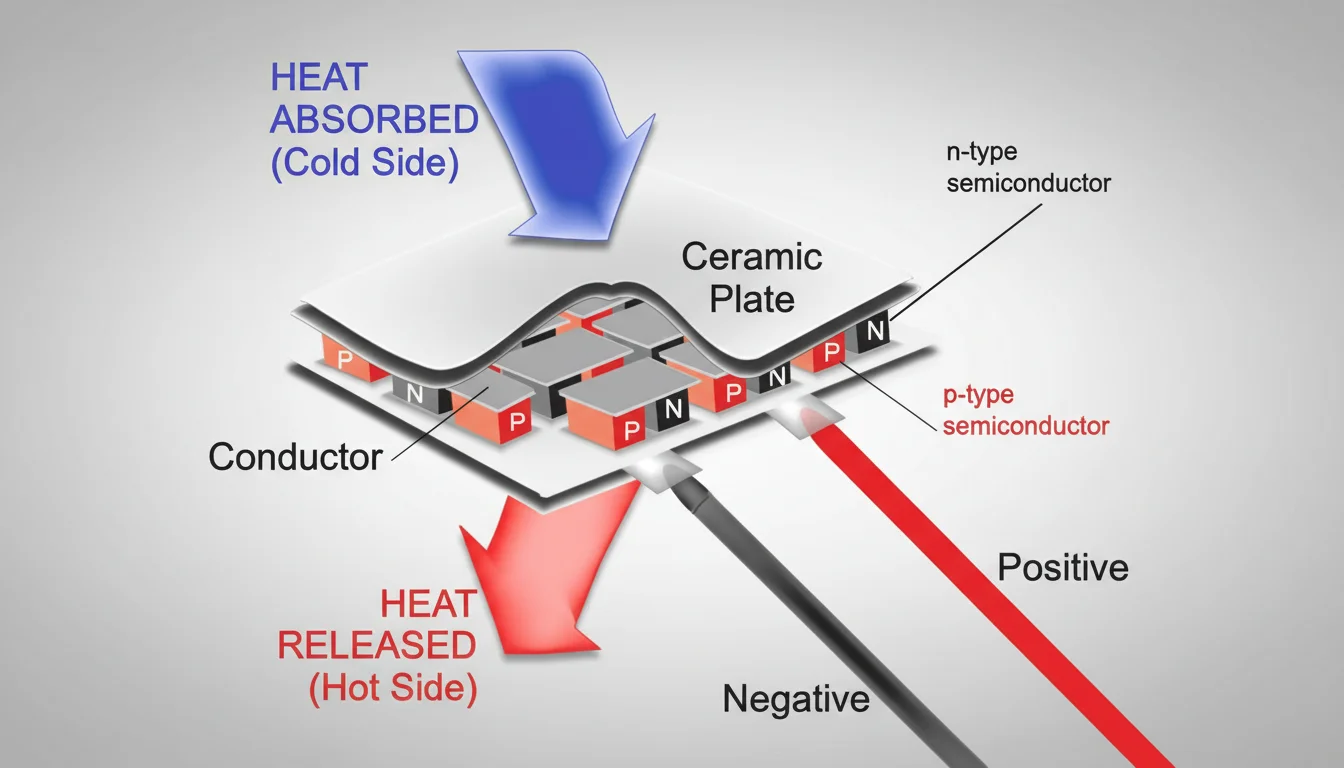
Thermoelectric cooling is driven by the Peltier effect. When a direct current (DC) is applied to a module, it flows through paired n-type and p-type semiconductor materials, most commonly bismuth telluride. This electrical current forces charge carriers—electrons and holes—to move heat energy from one junction to the other. Heat is actively absorbed on one side, creating a cold surface, while simultaneously being expelled on the opposite side, creating a hot surface. This establishes a stable temperature differential without any pumps or fluids.
Operational Advantages of Solid-State Cooling
The primary advantage of Peltier technology is its solid-state design. It completely eliminates the need for mechanical compressors and chemical refrigerants like Freon. This results in an operation that is silent and free from vibrations, a critical feature for passenger comfort and sensitive electronics. The cooling and heating functions are also fully reversible. By simply changing the polarity of the DC input, the hot and cold sides switch, allowing a single device to function as both a cooler and a warmer capable of reaching 50–65°C.
Efficiency Factors and Performance Limits
The net cooling power of a Peltier module is a balance of three competing effects: the primary cooling from the Peltier effect, heat conducting back from the hot side to the cold side, and internal heat generated from electrical resistance (Joule heating). The system’s efficiency, measured as its Coefficient of Performance (COP), degrades significantly as the temperature difference between the hot and cold sides increases. This is the physical reason why thermoelectric coolers are limited to a practical cooling capacity of 15–20°C below ambient temperature and are not suitable for deep-freezing applications which require a compressor system.
“Delta T” Explained: Why Is 20°C Below Ambient the Limit?
The 15–20°C cooling limit is a physical equilibrium, not a flaw, defining the proper application for thermoelectric coolers versus compressor models.
The Peltier Effect: Solid-State Heat Transfer
Thermoelectric cooling is a solid-state process driven by the Peltier effect. When a direct current flows across paired semiconductor materials—specifically n-type and p-type bismuth telluride—it forces heat to move from one side of the module to the other. This action creates a cold junction (inside the cooler) and a hot junction (outside) without any compressors, refrigerants, or moving parts.
The system’s cooling capacity is a direct function of two variables: the number of semiconductor couples built into the module and the amount of electrical current applied to it.
Heat Backflow: The Primary Performance Bottleneck
As the temperature difference (Delta T) between the cold interior and hot exterior increases, heat naturally conducts back from the hot side to the cold side through the semiconductor module itself. This thermal backflow is a fundamental physical property that directly counteracts the cooling process. The colder the inside gets relative to the outside, the stronger this counter-effect becomes.
While the cooler’s insulation (EPS or PU foam) effectively reduces heat gain from the external environment, it cannot stop this internal heat conduction through the core material of the cooling chip.
Joule Heating: Inefficiency from Electrical Resistance
The electrical current powering the Peltier module also generates its own heat. Due to the inherent electrical resistance of the semiconductor material, some energy is converted into heat within the module—a process called Joule heating. This internally generated heat adds to the total thermal load the cooler must manage, working against the cooling process and lowering overall efficiency.
This creates a situation of diminishing returns. Pushing more power through the module to increase cooling also increases this parasitic heat generation, which limits the net cooling effect.
Equilibrium Point: Where Cooling Rate Equals Heat Gain
The practical 15–20°C limit is the equilibrium point where the cooling power from the Peltier effect is completely canceled out by the combined heat gain from both thermal backflow and internal Joule heating. At this threshold, the system cannot pump heat out any faster than it flows back in, which prevents any further drop in temperature.
Achieving a larger Delta T is physically possible, but it would require exponentially more power and a far more robust heat dissipation system. For portable 12V coolers, this approach is impractical and not cost-effective, making the 20°C Delta T the accepted engineering limit for this technology.
Expand Your Brand with Custom Car Coolers

Silent Operation: Is No Compressor Vibration a Selling Point?
For specific applications, silent, vibration-free operation is not a luxury feature—it is a core functional requirement that directly impacts safety, comfort, and usability.
The Peltier Effect: Solid-State Cooling Without Moving Parts
Thermoelectric coolers operate on the Peltier effect, a solid-state process that transfers heat using semiconductor materials instead of mechanical parts. A direct electric current is passed through couples of n-type and p-type bismuth telluride semiconductors. This current forces heat to move from one side of the module to the other, creating a temperature difference without any pumps, motors, or compressors. The complete absence of moving mechanical components is what guarantees completely silent and vibration-free operation, a fundamental distinction from conventional refrigeration.
Noise and Vibration: Thermoelectric vs. Compressor Technology
The primary difference in user experience comes down to mechanics. A compressor fridge relies on a motor and piston to pressurize refrigerant, a process that inherently creates audible noise and physical vibration. In contrast, a thermoelectric cooler has no moving parts in its core cooling module, making it silent. This silence comes with a performance trade-off. Compressor technology can achieve true freezing temperatures of -20°C regardless of outside heat. Thermoelectric cooling performance is limited by the ambient temperature, typically achieving a Delta T of 15–20°C below the surrounding air.
Key Applications Where Silent Operation Is a Priority
While powerful, the noise from a compressor can be disruptive in certain environments. Silent thermoelectric technology is the superior choice in these specific use cases:
- In-Cabin Vehicle Use: For long-haul drivers or in passenger vehicles, any constant humming or vibration is a distraction. A product like the Mini 8L Console Cooler is designed for this environment, where silence is a safety and comfort feature.
- Quiet Interior Spaces: The constant cycling of a compressor is unacceptable in settings like offices, dormitories, hotel rooms, or medical clinics where low ambient noise is expected.
- Sensitive Contents: For storing sensitive electronics, lab samples, or certain medications, even minor mechanical vibrations from a compressor could potentially cause damage or interfere with delicate instruments over time.

Lifespan: Is 30,000 Hours Valid for Continuous Run?
Lifespan depends on technology; solid-state thermoelectric coolers degrade from heat, while mechanical compressors wear out from motor cycles, defining durability under continuous use.
Lifespan Factors: Thermoelectric vs. Compressor Technology
Thermoelectric coolers, built on the solid-state Peltier effect, have no moving mechanical parts. Their lifespan is determined by the gradual thermal degradation of their semiconductor materials, not by physical wear. In contrast, compressor units are mechanical systems. Their longevity is directly tied to motor cycles, lubrication status, and the integrity of the sealed refrigerant system. Running continuously subjects each to a different primary stressor: a constant, unwavering thermal load for a Peltier module and sustained mechanical fatigue for a compressor’s motor and pump.
Thermoelectric Longevity Under Constant Thermal Load
The primary factor limiting a thermoelectric cooler’s lifespan is heat dissipation. If the hot-side junction cannot effectively vent heat to the ambient environment, the semiconductor materials degrade over time. Continuous operation creates a constant thermal load, introducing persistent Joule heating from electrical resistance and heat backflow from the hot side. These factors accelerate material fatigue and steadily reduce the module’s cooling efficiency. A stable DC power supply from the vehicle is also essential; voltage spikes or ripples introduce electrical stress that shortens the life of the Peltier module. Manufacturer Mean Time Between Failures (MTBF) data often exceeds 100,000 hours, but this assumes stable thermal and electrical conditions.
Managing Compressor Health in Continuous Operation
Compressor systems are designed for duty cycles, not perpetual motion. Running one continuously, especially in high ambient temperatures, can lead to overheating and premature wear on the motor and pump. To manage this, our compressor fridges integrate two key features. The 3-Stage Battery Protection system prevents the unit from operating at a low voltage—a primary cause of motor failure—by automatically shutting off before the vehicle’s battery is drained. Additionally, using the built-in ‘Eco Mode’ reduces the compressor’s workload and runtime. This directly minimizes mechanical wear and extends the unit’s operational lifespan.
結論
Thermoelectric coolers offer a reliable, silent cooling solution without refrigerants. Understanding their core technology, including the 20°C Delta T limit, is key to positioning them correctly in the market. This ensures you meet customer expectations for affordable, portable cooling rather than true freezing.
If this efficient cooling technology fits your product lineup, our team can provide a full catalog with OEM options. Reach out to us to discuss your specific sourcing needs and get a custom quote.
よくある質問
What is the max “Delta T” (cooling capability below ambient)?
The cooling capability is not defined by a fixed maximum “Delta T,” but rather by the coefficient of performance (COP), which decreases significantly as the temperature difference increases. Larger temperature drops require disproportionately high electrical power inputs due to heat backflow and Joule heating losses. For example, cooling one watt across a 40 K (40°C) temperature difference requires 3.5 watts of heat to be dissipated from the hot side.
Does the unit contain any hazardous refrigerants (Freon)?
No, the unit is an environmentally friendly solid-state technology. It operates using the Peltier effect through semiconductor materials and does not require any refrigerants, greenhouse gases, or other chemicals used in traditional vapor-compression systems.
What is the MTBF (Mean Time Between Failures) for the chip?
The provided research data does not specify a Mean Time Between Failures (MTBF) value. However, it highlights that the thermoelectric cooling module is a solid-state device with no moving mechanical parts, a design characteristic that contributes to high reliability and a long operational lifespan.
Can the fan be easily replaced if it fails?
The core thermoelectric cooling module is a solid-state component that creates a temperature difference without any mechanical parts. As described in the research, the Peltier effect itself does not require pumps, compressors, or fans to function, making the module itself silent and vibration-free.

 English
  Español
  Français
  Deutsch
  Português do Brasil
  Русский
  한국어
한국어  日本語
日本語  العربية