 메인 콘텐츠로 건너뛰기 푸터로 건너뛰기

Sourcing reliable Deep Freeze Tech (portable freezer) is the primary defense against product spoilage in transit. Units that cannot maintain a true -20°C in high ambient heat—a common failure for thermoelectric models—lead directly to rejected medical shipments and unsaleable event inventory.
This technical analysis benchmarks performance based on core engineering. We evaluate the cooling capacity of DC compressor systems, the mandatory role of 50mm PU foam insulation, and the necessity of 3-stage battery protection for maintaining cold chain integrity without draining vehicle power.
The Ice Cream Test: Can It Hold -18°C in 32°C Heat?
The “Ice Cream Test” demands a freezer hold -18°C in 32°C heat. Only units with compressor technology can pass. Thermoelectric coolers will always fail this test.
| 성과 지표 | 켈리랜드 컴프레서 냉장고 | 열전 냉각기 |
|---|---|---|
| 냉각 기술 | High-Efficiency DC Compressor | 펠티에 모듈(반도체) |
| Performance in 32°C Heat | Maintains true -20°C freezing | Cools to 12°C–17°C at best |
| Passes Ice Cream Test? | 예 | 아니요 |
| 주요 기능 | True Refrigeration & Freezing | Keeping cool items cool |
Why Compressor Technology is Essential for True Freezing
Holding -18°C in 32°C ambient heat requires a powerful cooling system that can create a massive 50°C temperature differential. This isn’t about just keeping drinks cool; it’s about active refrigeration that works hard against external heat to maintain sub-zero temperatures reliably.
This is precisely where thermoelectric coolers fail. Their performance is defined by a “Delta T”—they can only cool about 15–20°C below the ambient temperature. In 32°C heat, a thermoelectric unit will struggle to get below 12°C. It physically cannot reach freezing, making it completely unsuitable for the Ice Cream Test or for storing anything frozen.
KelyLands Performance: Achieving -20°C in Any Environment
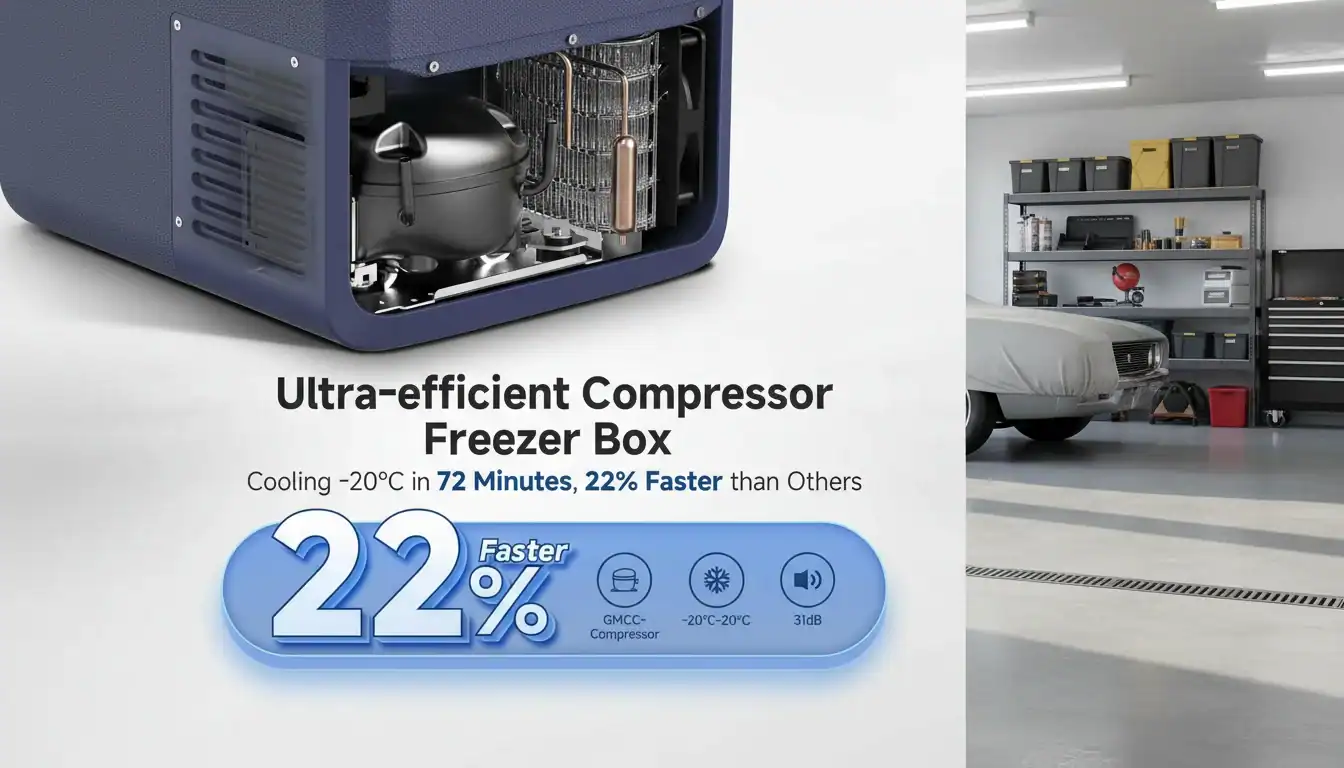
Our compressor car fridges are engineered specifically to pass this demanding test. They achieve a true freezing temperature of -20°C (-4°F), and this performance is independent of the outside heat. Whether it’s 20°C or 35°C outside, the inside stays at the temperature you set.
This reliability comes from using high-efficiency DC compressors paired with precise digital temperature controls. This combination ensures the unit has the power to pull heat out, even in a hot car, guaranteeing that sensitive contents like frozen food or medical supplies remain safely frozen.
Insulation Thickness: Why Is 50mm Wall Thickness Mandatory?
While not a legal mandate, 50mm wall thickness is a critical baseline for portable freezer efficiency. Thicker, high-density foam improves thermal resistance, reducing compressor runtime and saving battery power.
The Link Between Thickness and Thermal Performance
Thermal resistance increases directly with insulation thickness. A thicker wall simply slows down heat transfer more effectively. For portable coolers, 50mm represents a practical balance between maximizing internal storage volume and delivering the thermal performance needed for deep freezing.
Using thinner insulation would force the compressor to run constantly. This not only drains the vehicle’s battery but also makes it impossible for the unit to hold stable sub-zero temperatures in hot weather. The system just can’t keep up.
High-Density PU Foam in Compressor Car Fridges
Our compressor fridges use high-density Polyurethane (PU) foam, a superior material for thermal insulation. This dense foam structure is essential for reaching and maintaining true -20°C (-4°F) freezing temperatures, even in high ambient heat.
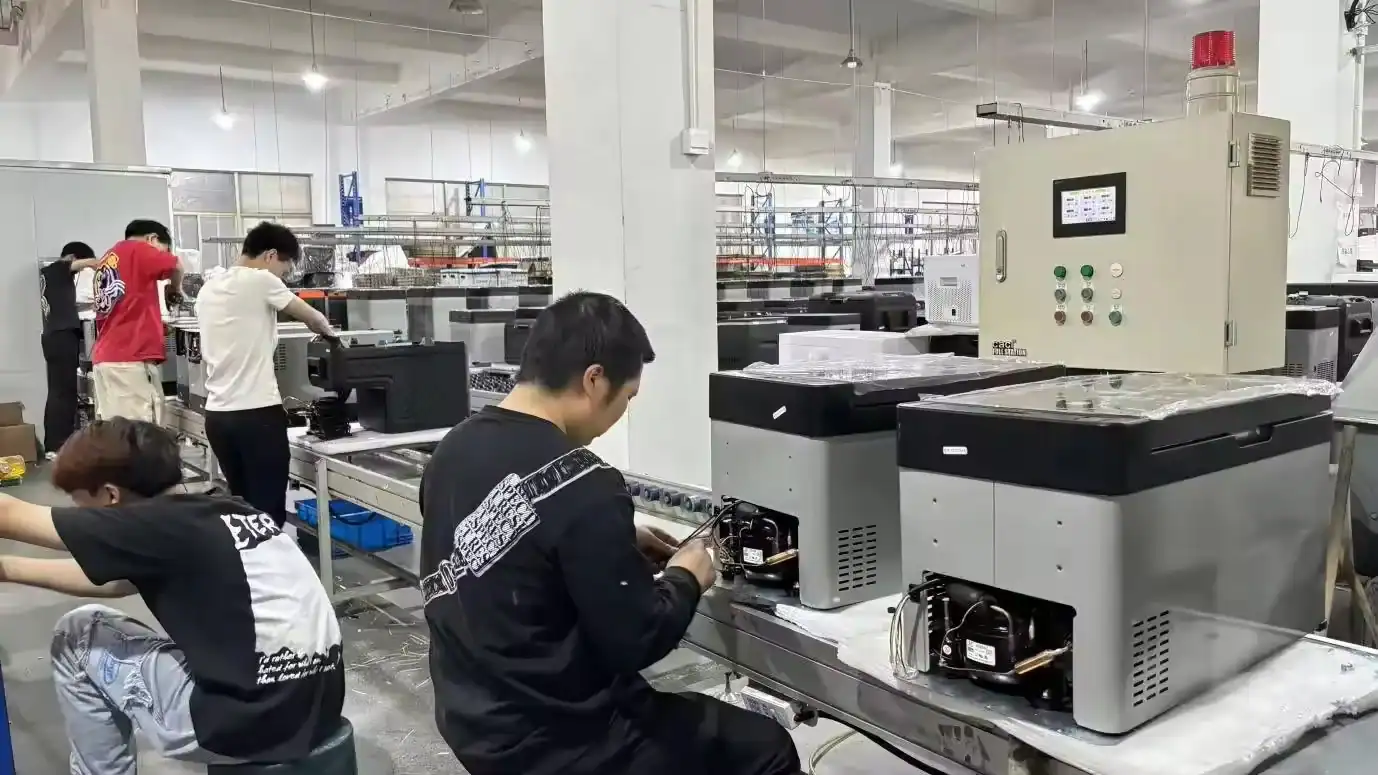
Our rigorous PU foaming process ensures there are no gaps or weak points in the insulation. This guarantees consistent performance and energy efficiency for every unit in a production run, which is a key factor in product reliability.
Source Top-Tier, Custom-Branded Car Coolers

Compressor Duty Cycle: How Hard Does It Run at Sub-Zero?
A compressor’s duty cycle is its active run time. In sub-zero weather, it runs longer to hold a freezing temperature. Eco and Max modes manage this workload.
How Ambient Temperature Affects Compressor Workload
A duty cycle is simply the percentage of time a compressor is actively running versus resting. In freezing environments, the compressor has to work for longer stretches to maintain the set internal temperature. This constant battle against the external cold increases its effective duty cycle.
Pushing a compressor beyond its designed operational cycle for too long isn’t a good idea. It generates excess heat and stress on the components, which can lead to premature wear and eventual failure. This is a critical factor for equipment reliability in harsh climates.
Managing Efficiency with Eco and Max Modes
To manage this workload, our compressor fridges include two distinct operational modes. Max Mode runs the compressor at full power for the fastest possible initial cooldown. It intentionally uses a high duty cycle to bring the internal temperature down quickly.
Once the target temperature is hit, Eco Mode takes over to optimize for energy efficiency. It reduces the compressor’s speed and power consumption to less than 45W, maintaining the temperature with minimal effort. This dual-mode system gives end-users direct control over the balance between cooling speed and long-term power preservation, which is essential when running on a vehicle’s battery.
Gasket Integrity: Does the Double-Seal Prevent Frost Build-up?
A double-seal gasket actually worsens frost. It traps moisture that freezes into ice, reducing efficiency and jamming the door. A high-quality single-seal is a more reliable solution.
The Moisture-Trap Problem in Double-Gasket Designs
It seems logical that two seals would be better than one, but in practice, it creates a significant failure point. Warm, humid air inevitably gets into the small gap between the two gaskets. Once trapped, that moisture condenses and freezes solid. This ice build-up not only ruins the thermal barrier but can physically jam the freezer lid shut, creating a serious operational problem.
Why a High-Integrity Single-Seal Is More Effective
A single, well-engineered gasket creates one airtight barrier. There’s no intermediate space for moisture to get trapped and freeze. This design works reliably with the freezer’s high-density PU foam insulation to block warm air intrusion. The result is a stable internal temperature and the prevention of the exact frost issues that plague double-gasket systems.
자주 묻는 질문
Can a KelyLands portable freezer maintain -20°C in hot weather?
Yes. Our Compressor Car Fridges are built to hold temperatures down to -20°C (-4°F), even when the outside air is 32°C (90°F). They use a genuine DC compressor system, which provides reliable freezing performance. This is completely different from a thermoelectric cooler, whose cooling ability drops as the ambient temperature rises.
How long does it take to freeze a bottle of water?
In one of our compressor fridges set to its coldest temperature, a standard 500ml water bottle will freeze solid in about 2 to 3 hours. This can change based on the water’s starting temperature and the bottle’s size. If you pre-chill the water in a regular fridge first, you can speed up the process.
What is the 3-Stage Battery Protection for?
This is a critical feature that prevents the fridge from draining your vehicle’s battery. You can set the voltage cut-off level to High, Medium, or Low. If the car’s battery voltage drops below that level, the fridge automatically shuts down. This makes sure you always have enough power left to start your engine.
What is the main difference between a thermoelectric cooler and a compressor fridge?
The technology is completely different. A thermoelectric cooler is good for keeping things cool, usually about 15–20°C below the outside temperature, and it can also warm things. A compressor fridge is a true portable freezer. It can reach -20°C to reliably freeze items like meat or ice cream, no matter how hot it is outside.
마지막 생각
Selling a thermoelectric cooler to a customer who needs a freezer creates costly returns and damages your brand. Our compressor fridges pass the -20°C test, guaranteeing the performance your customers depend on. This reliability protects your reputation and secures repeat business.
Verify the engineering quality for yourself. We recommend requesting a sample to conduct your own “Ice Cream Test” firsthand. Contact our team to get the full catalog or discuss your OEM requirements for your market.

 English
  Español
  Français
  Deutsch
  Português do Brasil
  Русский
  한국어
한국어  日本語
日本語  العربية