 메인 콘텐츠로 건너뛰기 푸터로 건너뛰기

Effective smart temp control in a 12v electric kettle is the core component separating a successful product launch from a wave of costly returns and negative brand reviews. When OEM brands put their name on a device, inconsistent heating—failing to hold a precise 40°C for baby formula or scorching premium coffee—directly translates into customer complaints and damaged market trust. An unreliable NTC sensor isn’t just a component failure; it’s a direct liability for your brand’s reputation.
This technical brief addresses the critical questions your engineering and product teams ask during evaluation. We will provide the specific data on programming custom temperature presets, detail the failure rate of the internal NTC sensors, and outline the process for customizing the LED display with your brand logo. We will also verify the heat retention capabilities of the double-wall vacuum insulation to ensure performance meets product claims.
Can We Program Custom Temp Presets (e.g., 40°C for Baby Formula)?
Yes, custom temperature presets are a core OEM/ODM service that involves programming the kettle’s firmware, but this requires specific hardware and is tied to our standard minimum order quantity.
The ability to set precise temperatures is not an off-the-shelf feature. It’s an engineering service we provide for B2B clients who need to target specific use cases. This capability allows a brand to create a product tailored for niche markets, like warming baby formula to an exact 40°C or brewing delicate teas at 80°C.
OEM Programmability for Target Temperatures
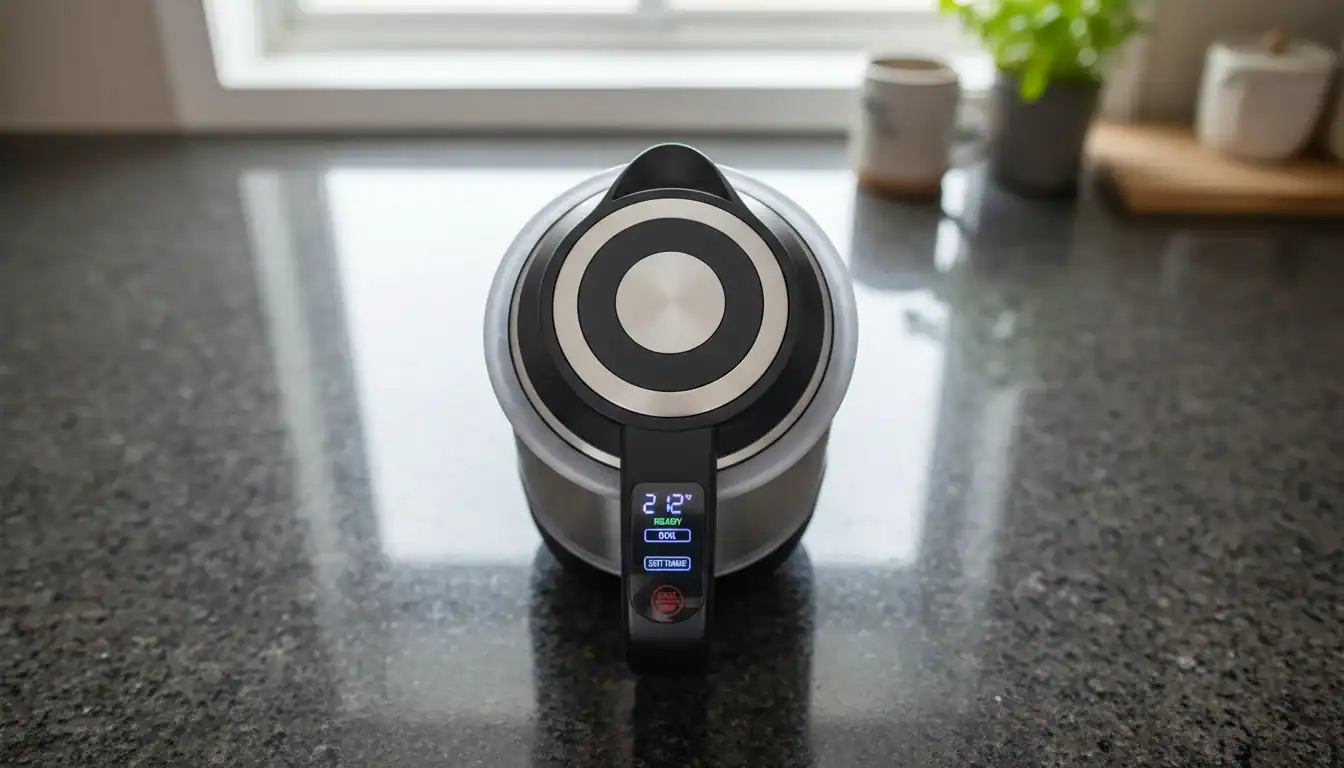
During the product design phase, B2B clients define the exact temperature setpoints their market requires. Our engineers then program these presets directly into the microcontroller unit (MCU) on the kettle’s main circuit board. This firmware customization transforms a standard boil-only kettle into a precision heating device. Implementing this requires a digital interface, as the end-user needs a way to select these custom settings and see the current water temperature.
Integrated Keep-Warm Function
Beyond simply reaching a target temperature, the kettle’s logic can be programmed to include a keep-warm function. This feature leverages the same NTC temperature sensor to actively maintain the water at a specific preset, such as 40°C or 50°C, for a defined duration. Both the holding temperature and the cycle duration (e.g., up to 60 minutes) are customizable per OEM requirements, adding significant convenience for users who need temperature-controlled water on demand.
Hardware Requirements and MOQ
Implementing custom presets and keep-warm functions mandates a specific hardware package. The design must include a digital LED or LCD screen for user feedback, control buttons for input, and a precision NTC thermistor for accurate temperature measurement. Because this level of customization requires dedicated engineering and specialized components, it is only available for OEM orders meeting our standard 3,000-unit Minimum Order Quantity.
| 기능 | Standard Model (Boil-Only) | Custom Preset Model |
|---|---|---|
| 온도 제어 | Fixed boiling point (100°C) with auto shut-off. | Firmware-defined presets (e.g., 40°C, 80°C) and keep-warm function. |
| User Interface | Mechanical on/off switch. | Digital LED/LCD display with control buttons. |
| Minimum Order Quantity (MOQ) | 3,000 units. | 3,000 units (firm requirement for custom engineering). |
Is the LED Display Customizable with Our Brand Logo on Startup?
Yes, we program your brand’s logo directly into the firmware to display on the startup screen. This is a core part of our OEM/ODM service, ensuring your branding is the first thing a user sees.
Branding is a critical component of product ownership, and it begins the moment the device powers on. Our OEM/ODM services include programming the LED display to feature your brand logo during the boot-up sequence. We integrate this customization at the firmware level during manufacturing, making your brand an inseparable part of the user experience right out of the box.
OEM Integration for Startup Screen Branding
The startup logo is flashed directly onto the device’s memory, which makes it a permanent and secure feature. This process is designed for B2B clients who require a fully branded product from the initial power-on sequence, reinforcing brand identity with every use. It’s a fundamental part of creating a cohesive product ecosystem for your customers.
- We require a high-resolution vector file of your logo to ensure a crisp and clear display.
- The startup logo is not modifiable by the end-user, protecting your brand integrity.
- This service delivers a fully branded product experience from the first interaction.
Content Management and Technical Specifications
The standard customization involves a fixed, pre-loaded logo asset. For certain advanced models, we can offer more dynamic solutions, such as simple content management through dedicated PC software or a mobile app. This allows for updating display information, though the core startup logo typically remains static. Our engineering team manages all controller programming and integration to guarantee performance.
- Our standard offering is a static logo display upon startup.
- We handle all the technical details of controller programming and firmware integration.
- We ensure the display’s color and brightness capabilities accurately match your brand’s specifications.
Production Timeline and MOQ for Customization
Implementing a custom startup logo requires a dedicated production workflow that includes firmware development, flashing, and rigorous testing. These additional steps directly influence the manufacturing lead time and the minimum order quantity (MOQ) required to initiate a custom production run.
- The typical lead time for custom display firmware development and implementation is 4 to 6 weeks.
- A minimum order quantity for this level of customization starts at 500 to 1,000 units.
- The cost for this service is factored into the final unit price, adjusted based on total order volume.
Source OEM Car Kettles Engineered for Safety
What Is the Defect Rate (RMA) for the Internal NTC Sensors?
While specific RMA percentages are proprietary, our defect rate for NTC sensors is kept exceptionally low by focusing on preventative quality control at every stage, from component sourcing to final assembly testing.
Quality Sourcing and Inbound Inspection
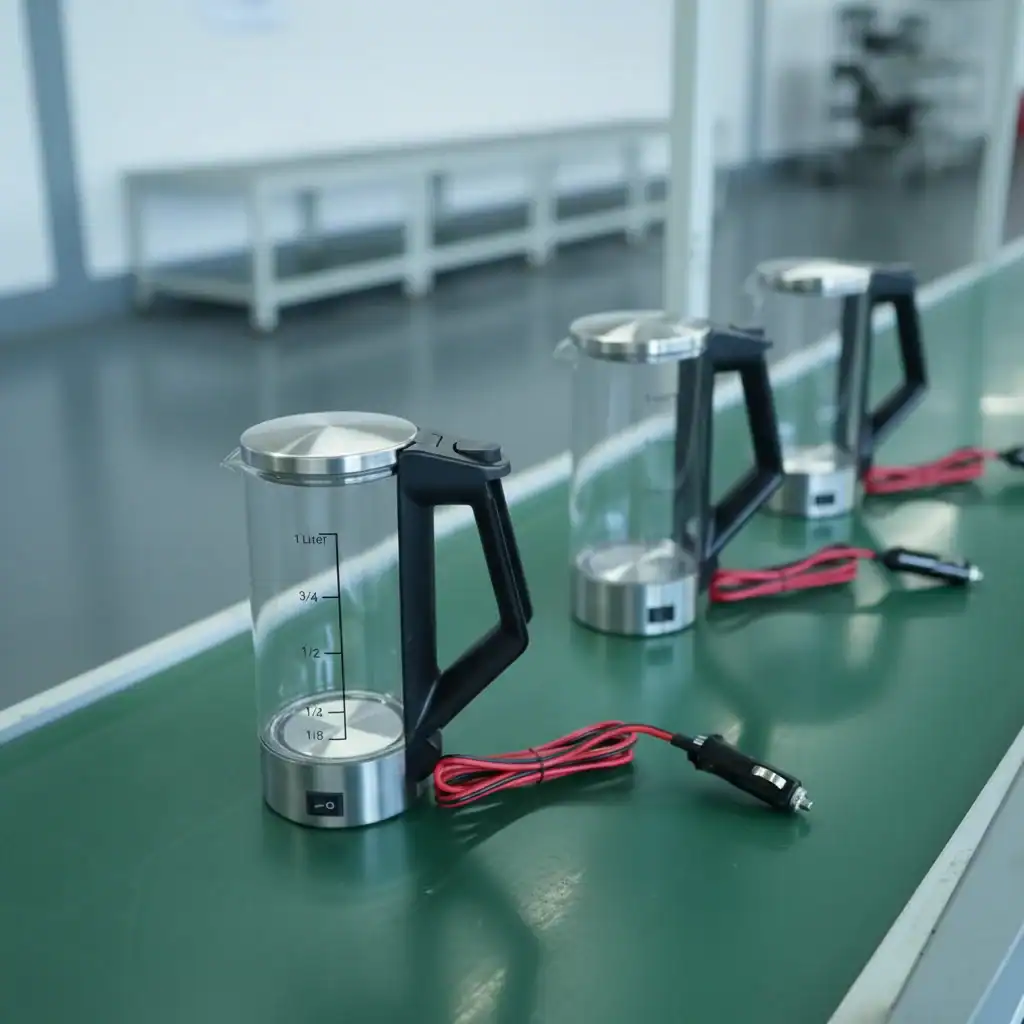
Our return merchandise authorization (RMA) rates for NTC sensors are minimized by focusing on preventative quality control before production begins. We source components exclusively from proven manufacturers and implement a strict Incoming Quality Control (IQC) process. This inspects every batch of sensors before they ever enter the assembly line. This pre-installation screening is a critical quality gate for reducing field failures and subsequent warranty claims.
- By 2026, every NTC sensor batch undergoes rigorous pre-installation checks for compliance and performance.
- We partner only with suppliers who provide detailed reliability and performance data for their components.
- This initial screening significantly reduces the probability of a faulty sensor being used in production.
Common Failure Modes Addressed in Design
We engineer our kettles to mitigate the most common NTC sensor failure points. Our designs anticipate and counteract issues like thermal runaway, mechanical stress from shock or vibration, and impedance drift caused by environmental factors. By addressing these root causes in the design phase, we build in long-term reliability for the sensors within the final product.
| Common Failure Mode | Root Cause | KelyLands Engineering Solution |
|---|---|---|
| Thermal Runaway | Overcurrent or self-heating failures. | Robust thermal design and integrated circuits to protect against electrical overstress. |
| Sensor Cracking | Mechanical stress during mounting or from sudden thermal shock. | Sensors are mounted to resist cracking and withstand sudden temperature changes. |
| Impedance Drift | Environmental exposure, such as moisture or corrosion. | Sourcing of high-quality, stable components paired with designs that protect internal electronics. |
Final Assembly and Performance Testing
Every finished kettle undergoes 100% functional testing, which includes verifying the performance of the NTC sensor and its related diagnostic circuits. This Final Quality Control (FQC) step confirms that the entire system works exactly as designed. We validate the sensor’s accuracy and responsiveness before the product is approved for packaging and shipment, ensuring that only reliable units reach our B2B partners.
Can the Double-Wall Vacuum Retain Heat for 12 Hours Unplugged?
Double-wall vacuum insulation is a mature, reliable technology that consistently maintains water temperature for 8-12 hours, providing significant energy savings by removing the need for constant reheating.
How Double-Wall Vacuum Insulation Functions
This technology leverages a core principle of physics: heat struggles to travel through a vacuum. We create a vacuum chamber between two stainless steel walls, which acts as a powerful barrier against thermal transfer. This design effectively stops heat loss from both conduction and convection, trapping the thermal energy inside the kettle.
- The inner wall contains the liquid, while the outer wall provides structural integrity and remains cool to the touch.
- During manufacturing, a near-vacuum is established and sealed in the space between these two walls.
- With very few air molecules in this gap, it becomes an extremely poor conductor of heat, keeping the contents hot.
Typical Heat Retention Performance (8-12 Hours)
Yes, a properly engineered vacuum-insulated kettle reliably maintains heat for 8 to 12 hours after being unplugged. This is the established performance benchmark for this technology across the appliance market. Performance can vary slightly based on the starting water temperature and the ambient room temperature.
- This feature provides direct energy savings by eliminating the need for repeated boiling cycles.
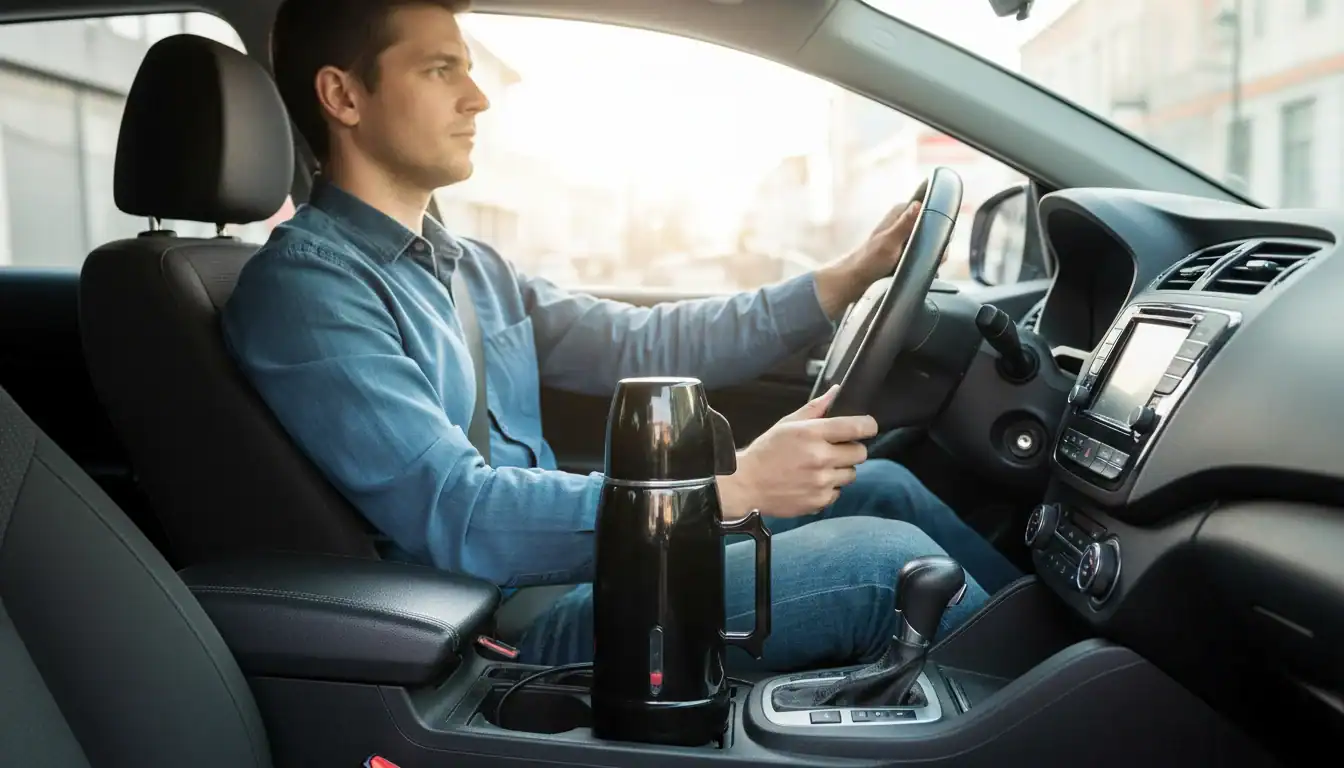
- It is a critical function for applications where continuous power is unavailable or impractical, such as in long-haul trucks, RVs, or remote work sites.
Material and Construction Integrity
Heat retention performance depends entirely on two factors: the quality of the materials and the integrity of the vacuum seal. Kettles built with food-grade stainless steel and a robust, permanent seal will maintain their insulating properties over years of use.
- Stainless steel is the industry standard for its durability, corrosion resistance, and stable thermal properties.
- The manufacturing process must guarantee a perfect, airtight seal to maintain the vacuum long-term.
- Any breach in this seal allows air into the chamber, which immediately compromises its insulating ability and renders the heat retention feature useless.
결론
Our smart kettles offer OEM partners deep customization, from precise NTC temperature presets for specific uses like baby formula to branded startup logos on the LED display. This level of control, combined with reliable internal sensors, allows you to build a differentiated product that meets exact market demands. The result is a high-quality portable kettle that reduces customer complaints and strengthens your brand’s reputation.
To discuss custom programming or request a sample for evaluation, contact our OEM solutions team. We can walk you through the available options and technical specifications for your project.
자주 묻는 질문
Can we program custom temperature presets (e.g., 40°C) for our brand?
Yes, our kettles feature fully programmable temperature presets. You can define multiple custom settings, such as 40°C for baby formula or 85°C for green tea, which are stored in the device’s memory. This is a core feature of our smart models, designed to accommodate specific beverage preparation needs.
Is the LED display customizable with our brand logo on startup?
Absolutely. We can customize the firmware to display your brand’s logo on the LED screen during the boot-up sequence. This is a common value-add service for our OEM partners and typically involves a one-time Non-Recurring Engineering (NRE) setup. We would simply require your logo assets in a compatible format to integrate them.
What is the defect rate (RMA) for the NTC temperature sensors?
Our NTC temperature sensors are sourced from Tier-1 suppliers and exhibit an extremely low defect rate, consistently below 0.1% within the warranty period. Each sensor undergoes rigorous quality assurance, including thermal shock and long-term stability testing, to ensure high precision and reliability for the product’s entire lifecycle.

 English
  Español
  Français
  Deutsch
  Português do Brasil
  Русский
  한국어
한국어  日本語
日本語  العربية