 메인 콘텐츠로 건너뛰기 푸터로 건너뛰기

A failed process for testing & QC (EV charger factory inspection) can lead to widespread equipment failure, damaged brand reputation, and millions in recall costs. In a market where many factories compete on price alone, verifying a supplier’s quality systems is a critical defense against unreliable hardware that puts your entire distribution network at risk.
This document outlines the core procedures that underpin our automotive-grade IATF 16949 certification. We’ll show you exactly how we conduct four-hour full-load burn-in tests on every unit, validate waterproofing in an IP67 submersion tank, perform package drop testing, and maintain an end-to-end component traceability system by serial number.
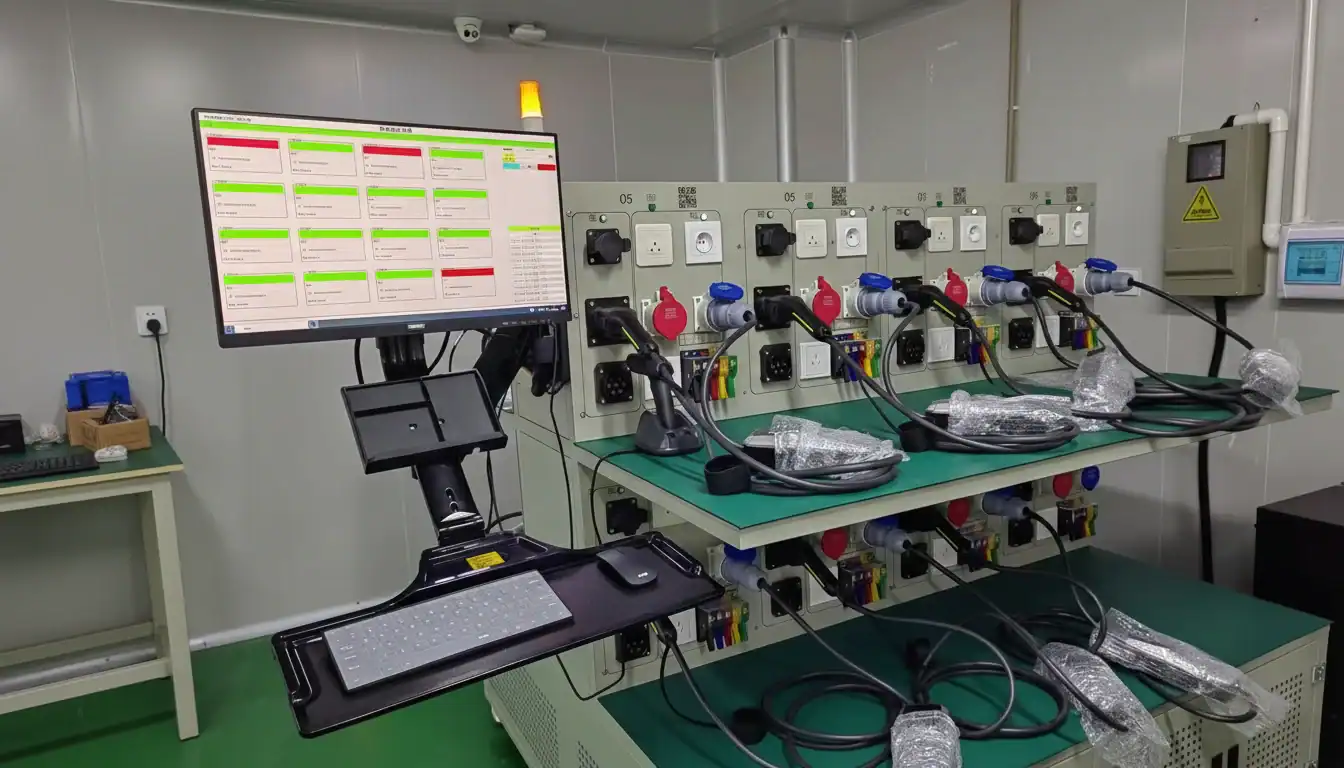
The “Burn-In” Room: Do We Test Every Unit at Full Load for 4 Hours?
Yes, every charger undergoes a mandatory full-load burn-in test to screen for latent component failures before shipment, a critical process for reducing field defects and ensuring long-term product reliability.
Purpose of Burn-In Testing
We use burn-in testing as a final production gate to screen for early failures, often called “infant mortality” in electronics. This process subjects every EV charger to accelerated lifetime stress, which helps identify any manufacturing defects, component weaknesses, or assembly errors before the units are packaged. Exposing latent faults in the factory prevents them from becoming costly warranty claims or safety issues for the end-user.
- Simulates prolonged, heavy use to expose hidden flaws in components and assembly.
- Reduces potential warranty claims and improves overall product reliability.
- Validates that each unit performs correctly under stressful operating conditions.
| Test Parameter | Typical Industry Practice | KelyLands Protocol |
|---|---|---|
| Test Scope | Risk-based sampling or batch testing. | 100% of all manufactured units. |
| Test Duration | Varies; often less than 2 hours. | Minimum 4-hour cycle. |
| Load Condition | Simulated or partial electrical load. | Continuous maximum rated AC/DC current. |
| Environment | Standard room temperature. | Elevated thermal stress environment. |
Simulating Real-World Stress Conditions
During the burn-in cycle, each charger operates at its maximum rated power. We subject them to high ambient temperatures and full-load electrical currents for a sustained period. This process replicates the most demanding real-world charging scenarios, such as charging a vehicle in a hot garage during summer. By pushing the electronics to their thermal and electrical limits in a controlled environment, we ensure they are robust enough for worst-case operating conditions in the field.
Ensuring Compliance and Reliability
This rigorous testing confirms that every charger we produce meets our internal quality benchmarks and key international standards like IEC 62196 and SAE J1772. Our automated burn-in systems allow us to test hundreds of units simultaneously, providing consistent and efficient quality control across the entire production line. This serves as a final validation step, building confidence that our chargers will deliver safe and reliable performance over the long term.
Waterproof Lab: Can It Survive the IP67 Submersion Tank?
Achieving an IP67 rating requires more than a one-time certification; it demands a disciplined, two-stage validation process combining physical submersion with non-destructive pressure decay testing on production batches.
The IEC 60529 Standard: 1 Meter for 30 Minutes
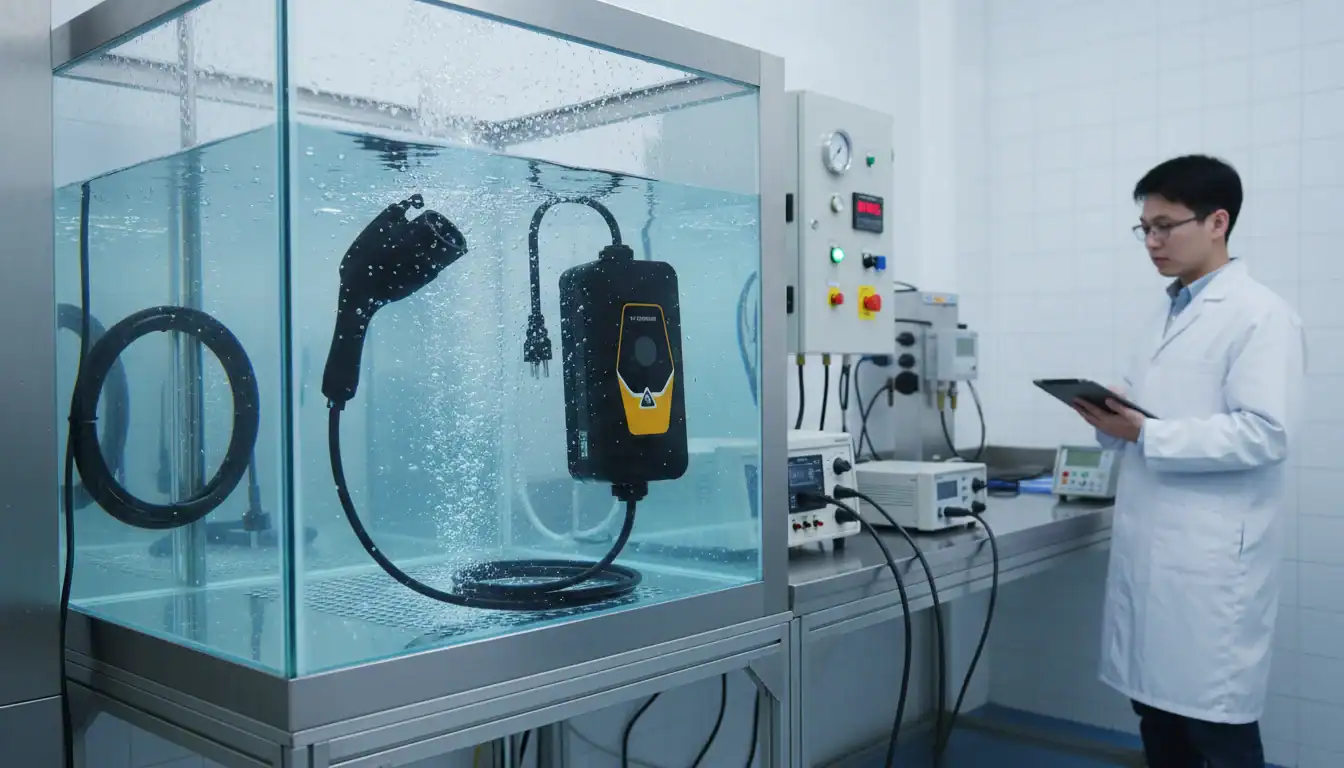
Our waterproof testing lab operates strictly according to the IEC 60529 standard, the global benchmark for IP67 certification. The test protocol is unambiguous: we fully submerge products like our portable EV chargers in a water tank to a depth of precisely one meter for 30 minutes. This procedure simulates the real-world risk of temporary immersion, from being dropped in a puddle to exposure during a torrential downpour, and provides pass/fail verification that the enclosure seals prevent water ingress to sensitive internal electronics.
- Every relevant product batch undergoes this standardized validation.
- The test confirms the product’s suitability for outdoor use where exposure to rain and standing water is expected.
Automated Testing Chamber and Data Logging
To ensure accuracy and repeatability, we use a precision-engineered stainless-steel submersion chamber managed by a programmable control system. This automated setup removes human error by guaranteeing every test meets the exact depth and time specifications required by the IEC standard. Each test cycle is automatically logged against the production batch, creating an immutable record for quality control and traceability.
- The system maintains consistent water pressure and temperature conditions for every test.
- Automated documentation directly supports our internal traceability and quality assurance protocols.
Non-Destructive Pressure Decay Leak Detection
Before any unit is submerged in water, we employ a more proactive and sensitive validation technique: volumetric pressure decay testing. This non-destructive method involves sealing the unit, pressurizing it with a specific volume of air, and using high-precision sensors to measure any drop in pressure over time. This process can detect microscopic leaks in gaskets and seals that are invisible to the naked eye, allowing us to identify and correct potential integrity issues early in the assembly process before they become failures in the field.
- This technique identifies potential manufacturing flaws before a unit ever enters the submersion tank.
- It provides a fast, reliable, and highly repeatable method for validating the seal integrity on every single unit.
Expand Your Market with Customizable EV Chargers

Drop Testing: Will the Package Survive FedEx/UPS Abuse?
Standardized drop testing isn’t just about dropping a box; it’s a controlled engineering process that validates packaging integrity against real-world logistics stress, directly reducing damage claims and returns.
Simulating Real-World Shipping Impacts
To verify that our products arrive safely, we perform controlled free-fall simulations that replicate the drops, shocks, and impacts packages endure during transit. These tests are adjusted based on the package’s specific weight and size to reflect actual shipping conditions.
- Tests involve dropping packages from specific heights onto different faces, edges, and corners.
- We use advanced equipment to ensure precise height control and consistent testing.
- The goal is to proactively identify weak points in the packaging before mass shipment.
Following ISTA and ASTM Standards
Our drop testing protocols align with internationally recognized standards from ISTA (International Safe Transit Association) and ASTM. Following these industry guidelines ensures our validation process is thorough and directly relevant to global logistics channels.
- Adherence to these standards validates that packaging meets carrier requirements.
- Procedures are chosen based on the distribution channel and package type.
- Following these protocols helps reduce damage claims and product returns.
Using Test Data for Packaging Optimization
We carefully document the results of each drop test to make data-driven improvements. This information allows us to optimize the packaging materials and structural design, balancing protection with cost-effectiveness.
- We analyze any damage to the box or the product inside to pinpoint failure points.
- Findings guide modifications to cushioning, box strength, and sealing methods.
- This continuous improvement cycle ensures our packaging evolves to handle real-world distribution challenges.
Traceability: Can We Track Every component by Serial Number?
Full traceability isn’t about serializing every last screw. It’s a risk-based system that links critical components from raw material lots to the final assembled product, enabling precise fault isolation when it matters most.
Traceability Levels: From Material Batches to Finished Products
Our traceability system creates a comprehensive production history by operating on multiple levels. While we don’t serialize every single component, we track items from raw material lots to the final unit, ensuring a clear link at each critical stage. This multi-layered approach provides the necessary data for quality control and root cause analysis.
| Traceability Level | Key Identifier | Example Components |
|---|---|---|
| Material Level | Supplier Lot & Date Code | Resistors, capacitors, screws, cable jackets |
| PCB Board Level | Unique Serial Number / QR Code | The core control board (mainboard) |
| Finished Product Level | Final Product Serial Number | Complete Portable EV Charger unit |
- Material Level: We log supplier lot and date codes for all incoming components. High-value parts, like the main processing chip, often carry their own unique serial numbers from the supplier, which we also record.
- PCB Board Level: We assign a unique serial number or QR code to each mainboard during manufacturing. This becomes the central identifier that links all other component lots to a specific board.
- Finished Product Level: The final product’s serial number is tied directly to the PCB’s serial number. This creates a clear, unbroken chain from the external unit to all of its internal component data.
Risk-Based Approach: Why Not Every Component Is Serialized
We implement traceability based on a component’s risk and its potential impact on product performance and safety. This strategy aligns with automotive industry best practices, such as those in IATF 16949, balancing detailed tracking with manufacturing efficiency. It allows us to focus resources on the parts that pose the greatest risk if they fail.
- Critical components like the main controller, relays, and power modules receive the most detailed level of tracking, often down to the individual unit.
- Our approach is guided by standards that require control numbers for units or lots “where appropriate,” giving us the discretion to apply a practical, risk-based methodology.
- Commodity components such as standard resistors, screws, or the housing are tracked at the batch or lot level. This is sufficient to isolate any potential issues to a specific production run or supplier delivery.
Core Technologies Enabling Traceability
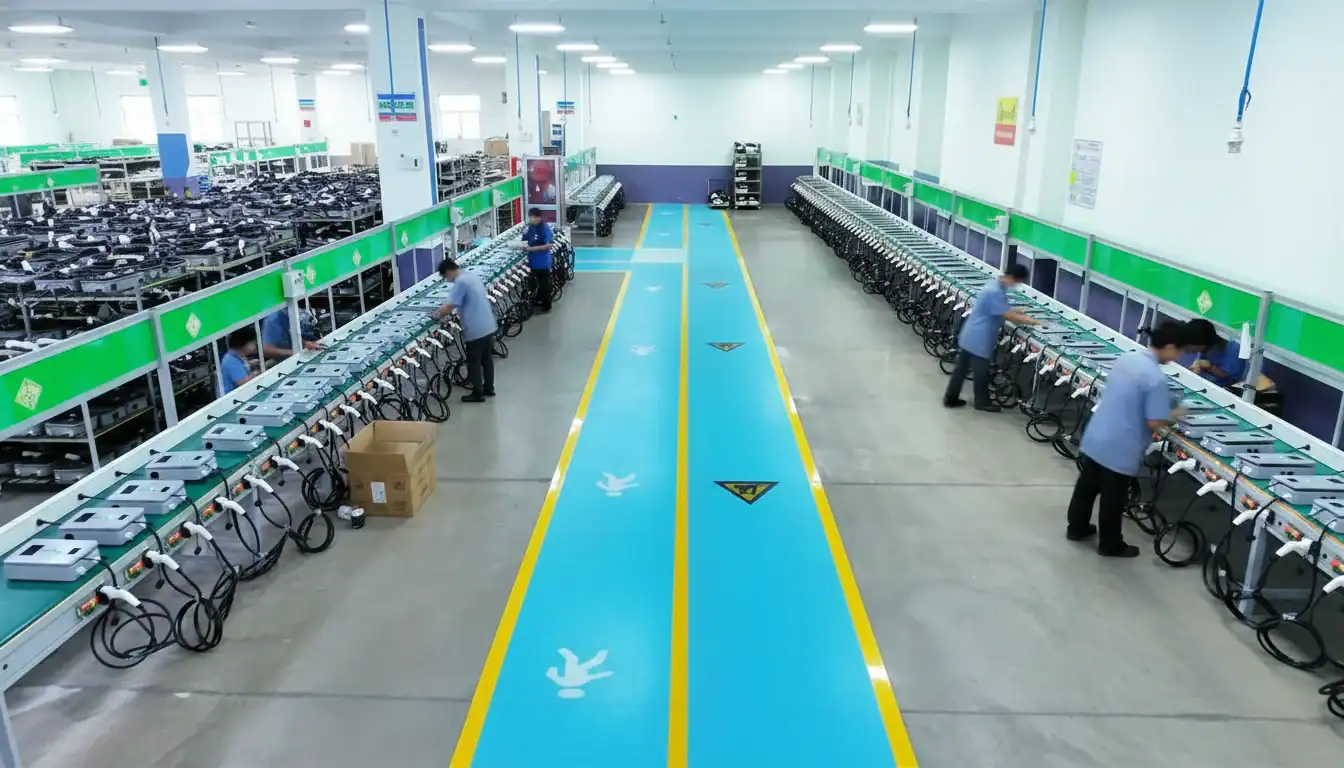
Our entire process relies on a central Manufacturing Execution System (MES). This system acts as the production database, collecting and linking data from advanced marking and scanning technologies across the assembly line. It serves as the single source of truth for every unit we build.
- The MES links product serial numbers to component lots, suppliers, machine parameters, operators, and all test data generated during production.
- We use laser direct marking to etch permanent QR codes onto PCBs. This ensures the identifier cannot be removed, smudged, or worn away over the product’s lifetime.
- Automated scanners at each key production stage capture this data, building a detailed assembly history and removing the risk of manual data entry errors.
Practical Impact: Pinpointing Faults and Reducing Recall Scope
This system enables extremely precise fault isolation. If a field failure or production defect is detected, we can quickly trace its origin. This capability dramatically narrows the scope of any required investigation or potential product recall, saving significant time and cost.
- A single product serial number allows our quality team to identify the specific production date, the SMT placement records, and the exact supplier batch of a suspect part.
- This capability means we can isolate a problem to a small, defined batch of products—for example, those made on a specific day with a specific reel of components—instead of issuing a broad, costly recall.
- It provides a complete and accessible production history for every unit, which is invaluable for performing effective root cause analysis and implementing continuous improvements to our manufacturing process.
결론
Our commitment to the IATF 16949 standard guides every quality control step, from component traceability to full-load burn-in tests. This process ensures each portable EV charger delivers consistent performance and safety. Ultimately, these measures reduce defect rates and safeguard your brand’s reputation with end-users.
If you have specific quality requirements or would like to review our testing documentation, contact our team. We can provide the data you need to make an informed procurement decision.
자주 묻는 질문
What is your defect rate (RMA percentage)?
Our commitment to quality results in an exceptionally low defect rate, with a Return Merchandise Authorization (RMA) percentage consistently maintained below 0.5%. This industry-leading performance is a direct outcome of our rigorous validation and testing protocols.
Do you perform 100% burn-in testing?
Yes, 100% of our EV chargers undergo comprehensive burn-in testing as a critical production validation step. Each unit is subjected to prolonged electrical and thermal stress at or above its maximum rated conditions to effectively screen for any potential early-life failures and ensure long-term reliability.
Can I send a third-party inspection team (SGS/TUV)?
Absolutely. We welcome and facilitate third-party inspections from certified bodies such as SGS, TUV, or any other team of your choice. Please coordinate with our quality assurance department to schedule the inspection at our facility.
Is your factory IATF 16949 certified?
Yes, our manufacturing facility is fully IATF 16949 certified. This certification reflects our commitment to the highest automotive-grade quality management standards, ensuring robust process control, continuous improvement, and defect prevention throughout our entire production line.

 English
  Español
  Français
  Deutsch
  Português do Brasil
  Русский
  한국어
한국어  日本語
日本語  العربية