 메인 콘텐츠로 건너뛰기 푸터로 건너뛰기

Sourcing cleaning equipment that prioritizes ergonomics reduces user fatigue and lower back strain, which are critical selling points for professional-grade vacuum models. While traditional rigid tubes force users to stoop at 45-60° angles to reach under low-clearance furniture, flex-tube technology uses articulated hinges to extend reach five times farther while keeping the operator upright. These components use 10 N pinching forces and TPU materials to achieve 90° rotation without compromising the structural integrity or airflow of the wand.
This technical overview examines the mechanical specifications and durability benchmarks of articulated wand systems. We cover the ISO testing protocols for 10,000-cycle hinge life, the engineering required to maintain electrical power through moving joints, and how collapsible truss geometry reduces storage footprints by 50%. Understanding these performance metrics helps procurement teams select hardware that balances maneuverability with long-term reliability in demanding environments.
The Ergonomic Pain: Bending Down to Vacuum
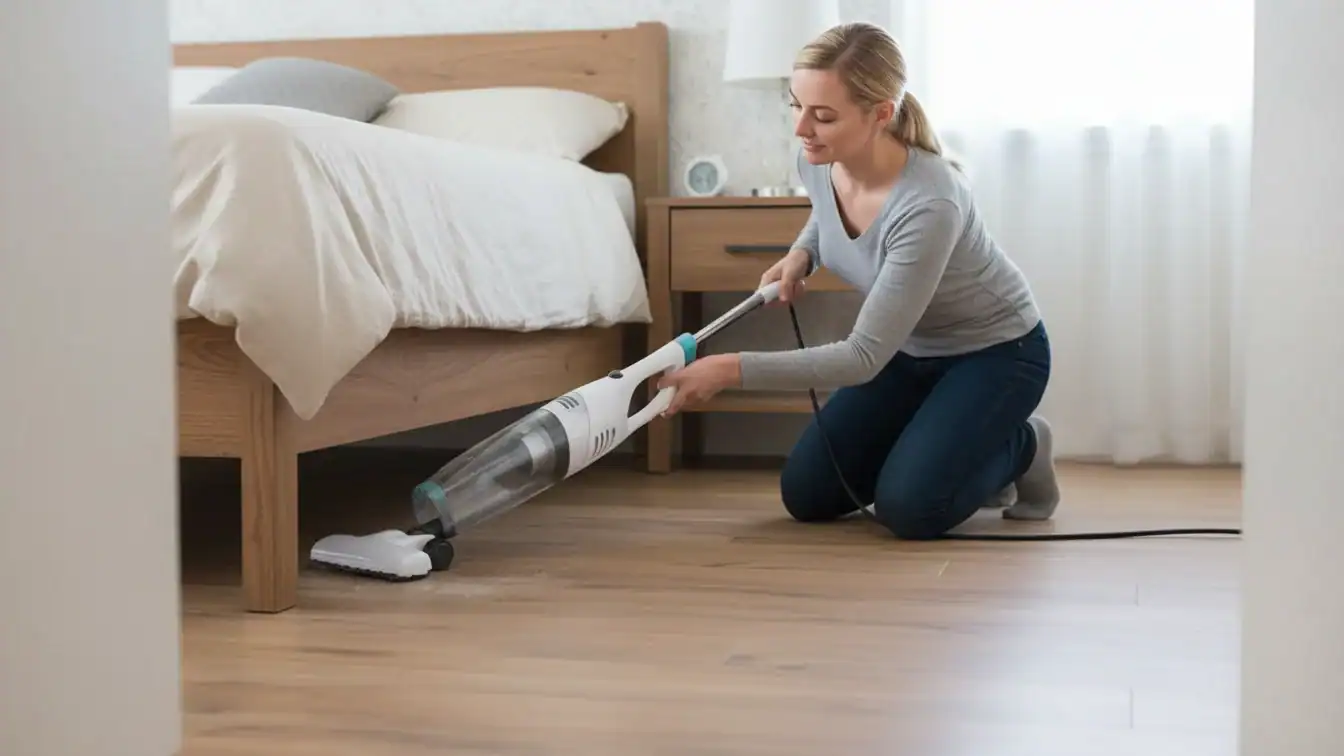
Traditional vacuuming requires users to stoop at 45-60° angles to reach under furniture, leading to significant lower back strain. Flex-tube technology uses an articulated hinge to reach five times farther under low clearances while the user remains upright. This design maintains a neutral spine, reducing torque and muscle fatigue during long cleaning sessions.
Biomechanical Impact of Lumbar Flexion During Cleaning
Traditional rigid-tube vacuums limit under-furniture access to 20-30 cm clearance, forcing users into repetitive lumbar flexion. Stooping at angles between 45° and 60° increases forward lean torque, placing excessive stress on the lower back muscles. Flex-tube technology, found in models like the Rowenta X-Force Flex, eliminates the need to bend by allowing the tube to articulate, which keeps the user’s spine in a neutral position. Maintaining an upright posture during 35-45 minute runtimes prevents the cumulative fatigue associated with standard upright vacuums.
Articulation Specs and Reach Performance Metrics
Modern hinge engineering enables the vacuum head to reach five times farther under sofas and beds than fixed-tube alternatives. Lightweight handheld configurations weighing approximately 1.1 kg reduce the physical effort required to maneuver the brush head in bent positions. Advanced suction systems deliver 100-150 Air Watts, reaching up to 45,000 Pa, without losing airflow efficiency through the articulated joint. Compact 2026 designs, such as the Tineco GO Flex, utilize high-efficiency HEPA filtration to capture 99.97% of particles while navigating sub-furniture paths as narrow as 9 inches.
Hinge Engineering: Locking Mechanisms & Airflow
Flex-tube engineering utilizes Thermoplastic Polyurethane (TPU) and monolithic flexure designs to create joints that bend 90° while maintaining structural integrity. By applying 10 N pinching forces, these hinges achieve controlled stiffness anisotropy, allowing the vacuum to lock in place or flex freely without obstructing internal airflow or exceeding 2.5% fiber strain limits.
| Mechanical Parameter | Engineering Specification | Operational Impact |
|---|---|---|
| Pinching Force | 10 N | Creates virtual joints with high compliance |
| Flexure Rotation | 90° (Flex-16 Design) | Enables large-displacement articulation |
| Fiber Strain Limit | 2.0% – 2.5% | Prevents material fatigue and structural failure |
| Angular Spacing | θ = 360° / (2n) | Eliminates self-interference during bending |
Flexure Joint Mechanics and Material Recovery
Thin-walled TPU tubes use 10 N pinching forces to create virtual joints with high hinge-direction compliance. This mechanical approach establishes controlled stiffness anisotropy, where the tube remains rigid in most directions but flexible at the pinch point. Monolithic Flex-16 designs enable 90° rotation through radial flexures and intermediate shuttles that stabilize the tube under load. These components work together to manage the distribution of stress across the joint, ensuring the hinge moves predictably during reconfiguration.
The system achieves full passive shape recovery to a circular cross-section once the pinching force is removed. This elastic behavior allows the tube to return to its original state without permanent deformation or structural damage. Mathematical spacing for multi-pair pinching follows the formula θ = 360° / (2n) to prevent self-interference. By calculating these angular intervals correctly, we ensure that perpendicular pairs or complex configurations do not obstruct the physical movement of the hinge or the integrity of the tube wall.

Airflow Dynamics and Structural Stress Limits
ABAQUS Standard 2003 models predict bending and stretching interactions to keep fiber strain within a 2.0% to 2.5% limit. Engineers use these simulations to optimize the thickness of the flexures, balancing the need for low bending resistance with the requirement for long-term durability. Internal flow resistance remains stable because elliptical tube deformation avoids the sharp corners that typically cause air turbulence. Maintaining a smooth internal profile ensures that suction power remains consistent even when the vacuum arm is fully articulated.
Structural testing uses 500 g end-loads to validate that the hinge remains rigid in orthogonal directions during high-suction operation. This test confirms that the revolute joint behavior aligns with the intended hinge vector, preventing the tube from collapsing or swaying under the weight of the nozzle. FEA optimization ensures smooth transitions between the flexible hinge zone and rigid tube sections. By eliminating sharp thickness changes and stress concentrations, the design extends the operational life of the flex-tube technology in demanding cleaning environments.
Durability: Testing the Hinge for 10k Cycles
Hinge durability testing utilizes ISO protocols where 10,000 cycles serve as a baseline for high-load performance. By applying 1.5x the rated weight during movement, engineers verify that folding mechanisms maintain structural integrity, smooth rotation, and electrical continuity without deformation or loosening over years of frequent household use.
| Testing Parameter | Standard/Protocol | Required Validation |
|---|---|---|
| Mechanical Load Cycles | ISO Hinge Standards | 10,000 cycles at 1.5x weight (no loosening) |
| Flex Durability | ASTM F392 (Condition A) | 27,000 twisting/crushing cycles (no pinholes) |
| Environmental Stability | Neutral Salt Spray | ≥96 hours without rust or corrosion |
| Hardware Precision | Mechanical Tolerance | Axis deviation ≤ 0.05mm; Noise < 40dB |
Mechanical Cycle Standards for Folding Vacuum Hinges
The 10,000 cycle benchmark establishes a rigorous load test for folding mechanisms. Engineers apply 1.5x the standard operating weight—for example, 45kg for a component rated for 30kg—to simulate heavy-duty usage and detect potential structural weaknesses. This elevated load ensures the hinge resists deformation even under accidental stress or improper handling during daily cleaning tasks.
ISO furniture hardware standards dictate that hinges must open and close smoothly without breaking or loosening mechanical fasteners. While 10,000 cycles provide a baseline for reliability, high-tier certifications often reach 100,000 cycles. This higher count equates to approximately 27 years of operation assuming ten uses per day, ensuring the vacuum joint survives well beyond the typical lifespan of the internal motor or battery.
Testing facilities maintain a controlled environment at 23±2°C and 50±5% relative humidity. These specific conditions ensure consistent material behavior across different test batches. By standardizing the atmosphere, engineers can accurately quantify how friction and repetitive movement affect the integrity of the plastic and metal alloys used in the folding joint.
Stress Metrics and Environmental Resistance Protocols
Material flex testing follows the ASTM F392 standard using Gelbo Flex Testers. At a rate of 45 cycles per minute, the equipment induces twisting and crushing motions on 200x280mm samples of the flexible tubing integrated within the hinge. This process allows technicians to detect pinhole formation or barrier loss, which could compromise the vacuum’s suction power if left unchecked.
Resistance to humid storage environments requires hinges to withstand a neutral salt spray test for at least 96 hours. This protocol prevents rust and corrosion from developing on internal pins or springs. Ensuring metallic components remain pristine in damp conditions, such as laundry rooms or basements, is critical for maintaining long-term rotation smoothness and aesthetic quality.
Post-test analysis focuses on precision hardware metrics to validate durability. The hinge axis must not deviate more than ±0.05mm from its original alignment, and operational noise must stay below 40dB. These tight tolerances ensure the folding mechanism does not develop a “wobble” over time, maintaining the sealed airflow path required for consistent floor cleaning performance.
Scale Your Brand with High-Performance Custom Vacuum Cleaners

Electrical Continuity: Conducting Power Through the Bend
Flex-tube technology maintains power through interlocked metallic cores or dedicated conductors that prevent circuit breaks during movement. By following standards like NEC Article 350 and UL 360, these systems provide a low-resistance path for grounding and fault current, ensuring the vacuum motor and powered brush heads operate safely regardless of the hinge angle.
Metallic Core Grounding and Wiring Integrity
Interlocked steel or aluminum strips create a protective flexible housing for internal power lines. This metallic core functions as an equipment grounding conductor to dissipate stray electrical charges safely. By using a conductive core, the system maintains a constant path to ground even as the vacuum arm articulates through its full range of motion.
The internal convolutions of the conduit absorb vibration and physical strain, which prevents wire fatigue during repetitive bending. Engineers design smooth internal raceways to protect insulated conductors from abrasion against the hinge walls. This configuration ensures that the electrical supply to the motor remains uninterrupted and the outer casing remains safe for the user to touch.
Compliance Standards and Fault Current Capacity
NEC Article 350 and UL 360 standards govern the electrical resistance and flexibility of liquid-tight metal conduits. These benchmarks ensure that the conduit remains conductive enough to trip a circuit breaker during a short circuit. Fault current testing validates that the system handles surges up to 1000 amps RMS for three cycles without mechanical or electrical failure.
Design specifications for 2026 require support within 12 inches of fittings to prevent joint stress and maintain the integrity of the electrical connection. Compliance with UL 1 further validates the crush resistance and tension strength of the interlocked strip materials. These rigorous requirements guarantee that the vacuum system stays operational and grounded during heavy residential or commercial use.

Storage Mode: Folding in Half for Compactness
The folding mechanism utilizes a collapsible truss system to reduce total length by approximately 50%. This design allows devices to retract from 44 inches to 33 inches, enabling compact storage in small spaces without requiring full disassembly or losing structural alignment.
Truss Geometry and Volume Reduction Metrics
The system replaces traditional solid center tubes with retractable struts that optimize the physical footprint of the telescope. This collapsible truss design effectively reduces the assembly length by 50%, allowing high-aperture instruments to occupy significantly less volume. By shrinking the longitudinal profile, the hardware fits into standard vehicle trunks and residential storage areas that cannot accommodate full-length optical tubes.
Data across different apertures confirms the efficiency of this reduction. An 8-inch model reaches a retracted profile of 33 inches, compared to its 44-inch operational length. Larger 16-inch versions utilize the same principle to retract from 66.5 inches down to 42.5 inches. These metrics allow for a two-piece transport configuration—the tube and the base—removing the need to break down the internal architecture into smaller, loose components.
Alignment Retention and Tension Control Systems
Engineering a folding joint requires high mechanical precision to ensure the device remains functional after repeated cycles. Tension control handles, protected under US Patent No. 6,940,642, utilize specific friction adjustments to stabilize the system. This mechanism prevents mechanical drift and secures the truss struts, maintaining a rigid structure whether the telescope is fully extended or stored.
Structural physics play a critical role in preserving the optical path. The assembly maintains precise alignment and collimation even after collapsing the struts for transport. High-quality components, including Radiant™ Aluminum Quartz coatings with 94% reflectivity and zero-backlash Crayford focusers, remain unaffected by the folding process. This stability ensures that the parabolic mirrors stay properly positioned, allowing for immediate use once the trusses are extended back to their operational height.
마지막 생각
Moving from rigid tubes to bendable wands shifts the physical burden from the user’s lower back to the machine’s mechanical joints. This shift allows for deep cleaning under low furniture without the typical 60-degree stoop that causes muscle fatigue. The engineering behind these hinges ensures that suction remains strong and the airflow path stays clear, even when the tube reaches its maximum 90-degree flex.
Investing in these designs means prioritizing components that meet ISO durability standards and ASTM flex ratings. A hinge that survives 10,000 cycles provides years of reliable service while protecting internal wiring and maintaining electrical safety. Choosing equipment with these specific mechanical tolerances ensures the tool remains a functional part of the cleaning routine for the long term.
자주 묻는 질문
Does the flexible joint maintain power to the floor head?
Yes. Flexible joints in vacuum hoses use integrated power transmission within the hose structure to supply electricity to the floor head. This setup ensures powered tools operate continuously even when the tube is bent, offering up to 180-degree flexibility at the hose ends.
What is the cycle life rating of the folding mechanism?
Standard industry specifications for 2026 do not list a universal cycle life rating for vacuum folding mechanisms. Manufacturers typically perform internal stress tests to ensure the hinge withstands repeated use over the product’s lifespan.
Can the vacuum stand on its own when folded?
Most industry standards do not require vacuums to be self-standing in a folded position. Whether a specific model remains upright when folded depends on its individual center of gravity and the presence of specialized locking feet.

 English
  Español
  Français
  Deutsch
  Português do Brasil
  Русский
  한국어
한국어  日本語
日本語  العربية