 Перейти к основному содержанию Перейти к нижнему колонтитулу

Proper Limitation Education(12v cooler fridge) is the primary defense against spiking product return rates and negative reviews that erode brand trust. Customers often expect a portable freezer, but the physics of thermoelectric cooling deliver a different result, leading to support tickets complaining that the unit can’t keep items cold on a hot day. This gap between expectation and reality creates a costly feedback loop of dissatisfied users, strained support teams, and logistical costs associated with managing returns and warranty claims.
This document serves as a technical standard operating procedure for aligning your marketing, documentation, and customer support teams with the product’s actual capabilities. We will analyze the core engineering principle of ambient temperature dependency, explain the operational logic behind pre-cooling with ice packs, and clarify why marketing language must shift from “freezes” to “chills.” The goal is to equip your teams with the precise information needed to set realistic customer expectations before the point of sale, not after a complaint is filed.
Ambient Dependent: Why Does 30°C Outside = 10°C Inside?
A cooler’s performance is a constant battle between its active heat extraction system and the passive, continuous infiltration of ambient heat, a process dictated by physical laws.
The Core Principle: Active Heat Extraction
A portable cooler doesn’t just passively resist heat; it contains a system that actively pumps thermal energy out of the internal chamber. The cooling rate is determined by the system’s capacity to remove this heat, not directly by the outside temperature. This mechanical process is what creates and sustains a significant temperature difference between the inside of the cooler and its external environment.
Ambient Heat Infiltration and Thermal Gradient
When the outside temperature is 30°C and the inside is 10°C, a steep 20°C thermal gradient exists. According to Newton’s law of cooling, heat naturally flows from warmer areas to cooler ones. The greater this temperature difference, the more aggressively ambient heat attempts to infiltrate the cooler through its walls and seals. This unwanted heat transfer is a constant physical pressure the system must overcome.
Insulation’s Function as a Thermal Barrier
The cooler’s main defense against heat infiltration is its insulation. High-density materials like Expanded Polystyrene (EPS) and Polyurethane (PU) foam act as a thermal barrier, slowing the rate at which external heat can penetrate the interior. By reducing this heat flow, the insulation lessens the workload on the cooling system, which directly improves its overall efficiency. The quality and thickness of the insulation are critical factors in maintaining the target internal temperature.
Energy Consumption to Maintain the Difference
To counteract the constant influx of heat, the cooling system must run continuously. In hotter ambient conditions, the steeper thermal gradient forces the system to work harder and consume more power to pump out the infiltrating heat. Maintaining that 20°C temperature drop requires a sustained energy investment from the 12V power source, with consumption increasing as the outside temperature rises.
Performance Limits of Thermoelectric Coolers (Delta T)
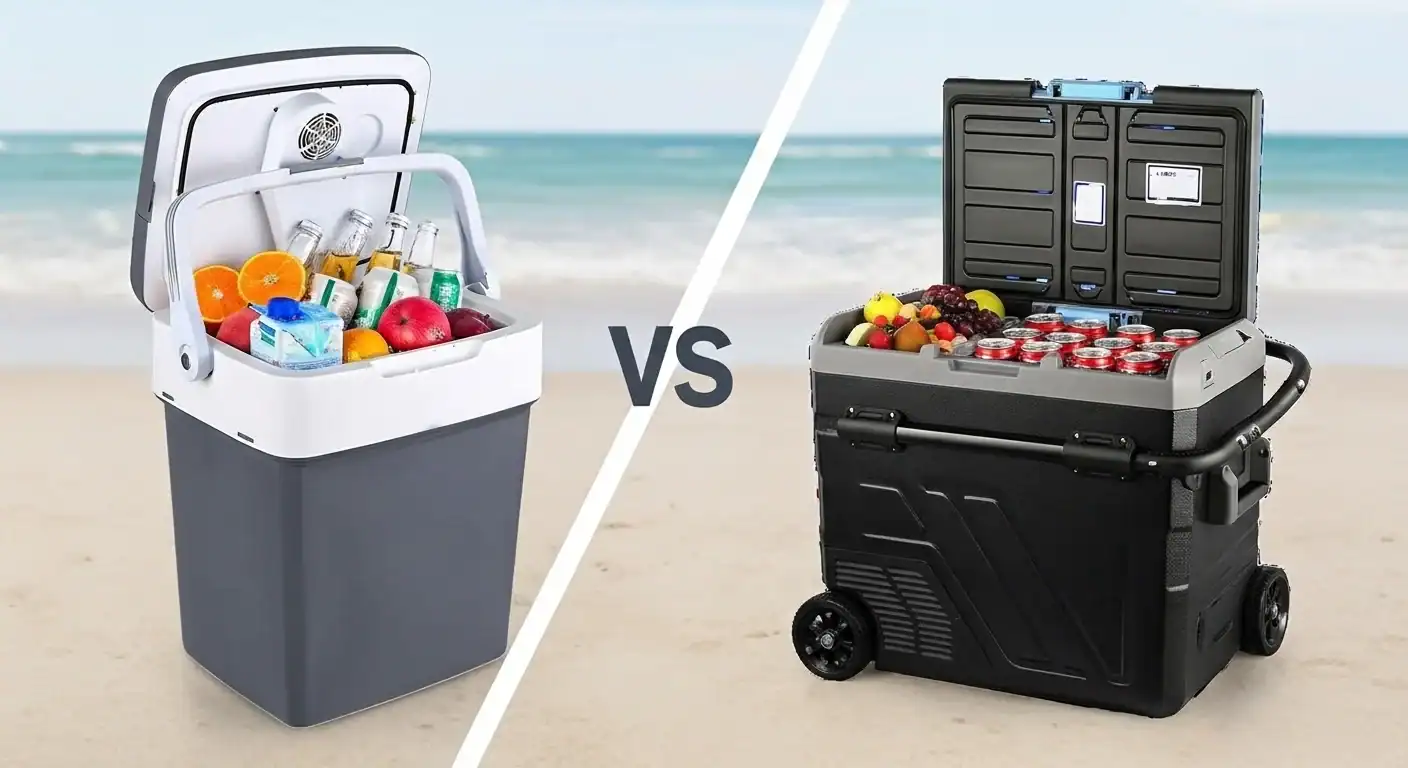
Thermoelectric cooler performance is measured by its Delta T (ΔT), which defines the maximum temperature reduction it can achieve below the ambient temperature. KelyLands thermoelectric units are rated for a ΔT of 15–20°C. This is a physical limitation of the Peltier module technology. It explains why these coolers can effectively chill contents on a warm day but cannot freeze items or make ice—they can only cool relative to their surroundings.
Compressor Systems: Overcoming Ambient Dependency
For performance that is independent of external conditions, a different technology is required. Compressor-based fridges use a refrigerant cycle, a far more powerful and efficient cooling method. This technology can achieve true freezing temperatures, reaching as low as -20°C regardless of how hot it is outside. If the goal is freezing or maintaining a precise low temperature in any environment, a compressor model is the necessary solution.
Pre-Cooling Logic: Why Use Ice Packs for Initial Help?
Using ice packs to absorb a cooler’s initial heat load reduces compressor run time, accelerates cooling to the target temperature, and lowers the immediate power draw on a 12V system.
Overcoming Initial Thermal Mass
When a portable fridge starts at ambient temperature, its internal walls, insulation, and the trapped air hold a significant amount of heat. This “thermal mass” must be removed before the unit can effectively cool its contents. The cooling system is forced to run at maximum capacity just to overcome this initial heat load. Ice packs work as a direct heat sink, absorbing this ambient energy passively. This allows the compressor or Peltier module to bypass the most energy-intensive part of the cool-down cycle and focus on maintaining the target temperature instead of fighting to reach it from a warm start.
Shortening the Time to Target Temperature
By offloading the initial heat removal to ice packs, the unit reaches its set point much faster. Getting a cooler from a hot 30°C down to a food-safe 4°C can take a long time for the system alone. With ice packs providing an initial cold source, that time is cut dramatically. This advantage is even more pronounced for compressor fridges aiming for deep-freeze temperatures. Reaching -20°C requires a sustained, high-power run, and pre-cooling with ice packs significantly reduces the duration of this initial, power-hungry phase.
Enhancing Power Efficiency and System Longevity
Reducing the initial workload directly lowers the immediate power consumption from the 12V or 24V source. For anyone running their unit off a vehicle’s battery, this initial power saving is critical. Less time spent in a high-stress, continuous cooling cycle also means less wear on the system’s core components. By minimizing the strain on the compressor or Peltier module during the most demanding phase of operation, you can help extend the overall lifespan of the portable fridge.
Source Reliable, Fully Customized Car Coolers

The “No Ice” Rule: Why You Don’t Need Ice (But It Helps)?
Compressor units don’t require ice to function, but using it as a thermal aid significantly reduces compressor workload, shortens pulldown times, and improves overall power efficiency.
How Compressor Systems Achieve True Freezing
A DC compressor fridge operates as an active heat pump. It uses a refrigerant cycle to continuously move thermal energy out of the insulated chamber, allowing it to reach true freezing temperatures as low as -20°C (-4°F). Unlike thermoelectric coolers that are limited by ambient conditions, a compressor’s performance is consistent. It will maintain its set temperature whether the outside air is 20°C or 40°C. The system relies on precise digital controls to monitor and maintain the internal temperature, completely eliminating the need for ice to create the cold environment.
Роль температуры окружающей среды и изоляции
The fundamental job of the cooling system is to remove heat faster than it can infiltrate the unit through its insulated walls. This relationship is governed by Newton’s law of cooling, which states that the rate of heat transfer is proportional to the temperature difference. A larger gap between the hot exterior and the cold interior increases the speed at which heat tries to enter. So, in hotter climates, the compressor must cycle more frequently to pump out this infiltrating heat and maintain its target temperature, consuming more power in the process. Good insulation slows this process, but it can’t stop it.
Using Ice as a Thermal Aid to Reduce Workload
While not necessary for cooling, adding ice or frozen packs is a smart strategy to improve efficiency. The block of ice acts as a thermal buffer, or “thermal mass,” which helps stabilize the internal temperature. This added mass absorbs heat that enters when the lid is opened and helps keep the air cold, reducing how often the compressor needs to turn on.
- Faster Pulldown: Pre-chilling the unit with frozen packs before loading it drastically cuts the initial time needed to get to the target temperature.
- Reduced Battery Drain: By shortening the initial cooling phase, especially when using MAX mode, you reduce the immediate high-current draw on the vehicle’s battery.
- Improved Efficiency: The thermal mass of the ice means the compressor cycles less frequently, saving energy and extending the life of both the compressor and the power source.

Marketing Language: Why Say “Chills” Instead of “Freezes”?
Using precise terms prevents mis-selling and reduces returns by aligning a product’s technical capabilities with a buyer’s expectations from the start.
Defining ‘Chilling’: Performance Tied to Ambient Temperature
The term “chills” accurately describes the function of thermoelectric coolers. These units operate with a Peltier module, a semiconductor technology whose performance is directly linked to the outside air temperature. Their cooling power is measured by Delta T (ΔT)—the temperature difference they can achieve relative to the environment. Our thermoelectric models are engineered to cool 15–20°C below ambient. This capability is perfect for keeping drinks and snacks cool on a warm day, but it cannot produce ice or maintain a frozen state, as the internal temperature will always fluctuate with the external heat.
Achieving ‘Freezing’: Compressor-Driven Temperature Control
“Freezing” describes a fundamentally different technology found in our compressor car fridges. These units use a DC compressor and refrigerant (like R134a or R600a) to actively extract heat, similar to a home refrigerator. This mechanical process allows them to achieve and hold precise temperatures down to -20°C (-4°F), regardless of how hot it is outside. This is the only technology that provides true freezing, making it the required solution for storing sensitive items like frozen meat, ice cream, or medical supplies.
Aligning Terminology with Product Capability
Distinguishing between these terms is a critical commercial strategy. It manages expectations throughout the supply chain and ensures the end-user gets the right product for their needs. The operational benefits are clear:
- Using “chills” for thermoelectric models correctly frames them as convenience coolers. This honesty helps B2B clients avoid customer complaints and significantly reduces product returns.
- Specifying “freezes” for compressor models equips your sales team to guide customers effectively. It immediately qualifies the unit for applications that demand reliable, deep-freezing performance.
- This precise language prevents mis-selling. It draws a hard line between a unit that keeps things cool and one that can safely store frozen goods, protecting your brand’s reputation for reliability.
Заключение
Clearly distinguishing between thermoelectric and compressor technology is essential for managing customer expectations. This technical honesty prevents negative reviews and reduces product returns by helping buyers select the right unit. Accurate marketing language that explains performance limits, like Delta T, protects brand reputation.
We encourage your team to review its product listings and support scripts to ensure these distinctions are clear. Contact us for updated performance data or custom marketing assets to support your sales efforts.
Часто задаваемые вопросы
Does the user manual explain “Delta T” limitations clearly?
While this research does not reference the user manual, it explains that the cooler’s performance is based on maintaining a temperature differential (“Delta T”). The system’s ability to maintain this difference is limited by its maximum cooling capacity, especially as higher ambient temperatures increase the rate of heat infiltration.
Can this unit freeze ice cubes? (Explicit “No” for training)
No, this unit is not designed to freeze ice cubes. The research indicates the cooling system is engineered to maintain an internal temperature of approximately 10°C, which is well above the 0°C freezing point of water.
Is it recommended to use ice packs for faster cooling?
The provided research focuses entirely on how the unit’s active cooling system removes heat and maintains a temperature differential. It does not contain any information or recommendations regarding the use of ice packs for faster or supplemental cooling.
Can we include a performance chart on the color box?
This technical document explains the principles of the cooler’s performance, such as its dependence on the ambient temperature gradient and Newton’s law of cooling. It does not make recommendations or provide details regarding marketing materials like performance charts for the color box.

 English
  Español
  Français
  Deutsch
  Português do Brasil
  Русский
  한국어
한국어  日本語
日本語  العربية