 Перейти к основному содержанию Перейти к нижнему колонтитулу
Substandard 7. Insulation Quality(electric cool box camping) is a primary driver of product returns and negative brand reviews, creating significant liability for your entire supply chain. The engineering choice between polyurethane (PU) injection foam and expanded polystyrene (EPS) sheets directly determines if a unit can withstand real-world use, particularly when power is disconnected. A cooler that fails this basic performance test undermines customer trust and leads to costly warranty claims.
This technical analysis serves as a procurement SOP, comparing the thermal efficiency and cost of PU versus EPS insulation. We’ll examine the results of a standardized unplugged test, identify common failure points like rubber lid gaskets, and verify the use of essential safety-compliant materials like BPA-free plastics. The goal is to provide a clear framework for evaluating the manufacturing integrity and field reliability of these products.
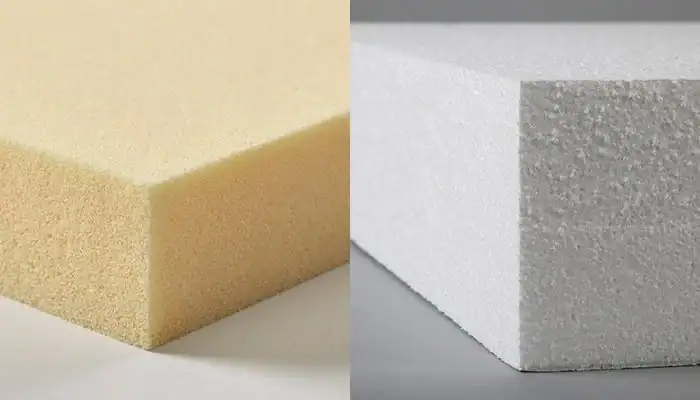
PU Injection (C-Pentane) vs. EPS: Is the Performance Worth the Cost?
Yes. Polyurethane foam justifies its higher price with measurably better thermal efficiency, structural integrity, and moisture resistance, ensuring a longer product life and superior performance.
Comparing Thermal Resistance and R-Value Metrics
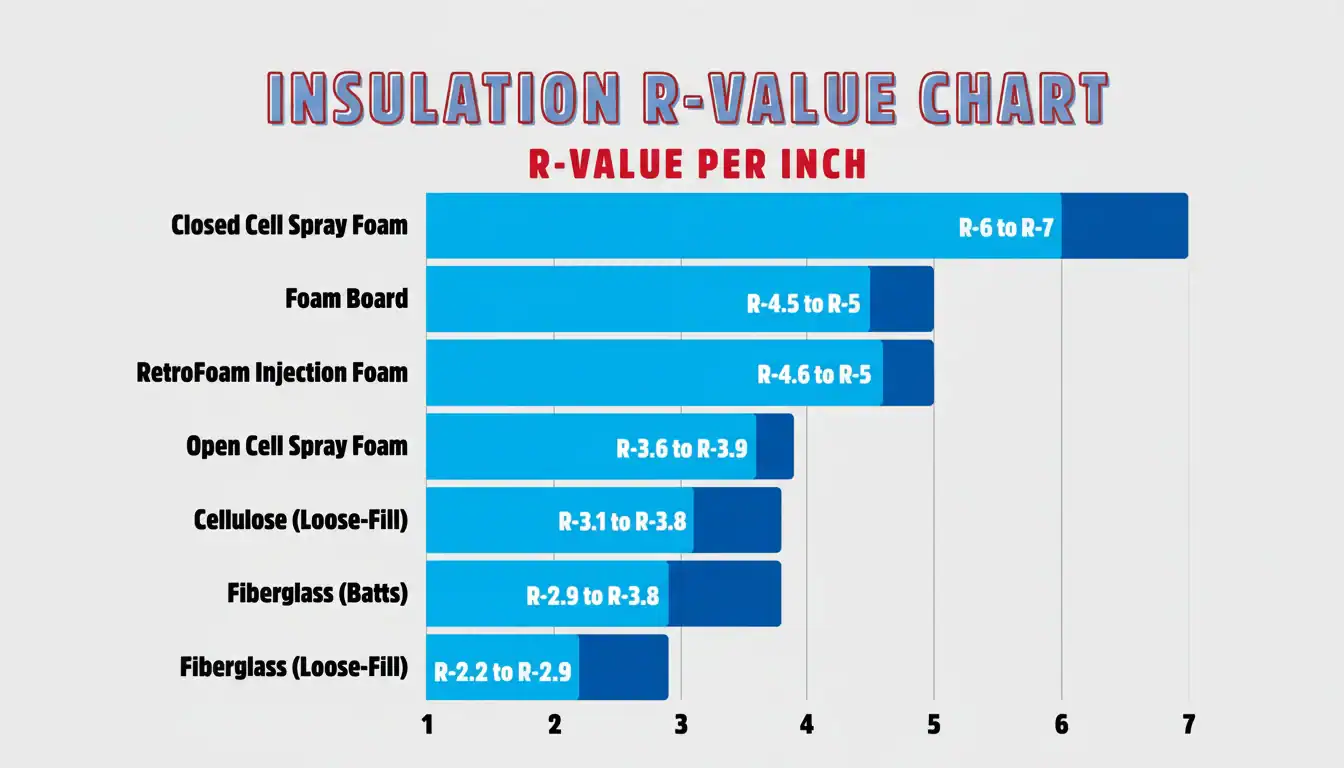
The primary performance difference lies in thermal resistance. Polyurethane (PU) foam provides a high R-value of R-6 to R-7 per inch, nearly double the R-3.8 to R-4 per inch offered by Expanded Polystyrene (EPS). This efficiency directly impacts product design. Because PU insulation is more effective, we can engineer cooler walls to be significantly thinner without sacrificing performance. This increases the usable internal storage capacity while maintaining the same external footprint, a critical advantage for portable equipment where space and volume are limited.
Analyzing Structural Integrity and Durability
PU foam creates a far more robust product. During manufacturing, the injected liquid PU chemically bonds to the inner and outer shell, forming a single, rigid structure. This unified construction is highly resistant to the vibration and stress of transport. EPS, in contrast, is simply a pre-formed sheet held in place with glue. This adhesive can delaminate over time, especially under physical impacts or repeated temperature cycling. With a minimum density of 2.2 lb., PU foam also provides superior compressive strength and load-bearing capacity compared to the standard 1.0 lb. density of EPS.
Evaluating Moisture Resistance and Performance Stability
Moisture is the enemy of insulation, and this is where PU demonstrates a clear advantage. Its closed-cell composition makes it inherently resistant to moisture absorption, so its R-value remains stable even in damp or humid conditions. EPS has an open-cell structure that can absorb and hold water, leading to a permanent degradation of its insulation capability. For thermoelectric coolers used in outdoor settings like camping, PU ensures consistent cooling performance, as it won’t be compromised by environmental humidity or internal condensation.
Calculating Total Cost of Ownership vs. Initial Price
While PU insulation carries a higher upfront material cost, it delivers a lower total cost of ownership. The initial investment is justified by a significantly longer product lifespan, sustained thermal efficiency that doesn’t degrade from moisture, and enhanced durability that reduces replacement cycles. For electric models, better insulation also means the cooling system runs for shorter periods to maintain the target temperature. This directly translates to lower energy consumption and extended battery life on portable units, providing tangible value to the end-user.
The “Unplugged” Test: Can It Keep Ice for 4 Hours Without Power?
Passive cold retention is a direct function of insulation quality and pre-cooling, determining a unit’s field reliability during inevitable power interruptions.
Insulation Material Defines Cold Retention
The single most critical factor in passive cold retention is the insulation material. High-density polyurethane (PU) foam provides superior thermal resistance, with an R-value of R-6 to R-7 per inch. This significantly outperforms the expanded polystyrene (EPS) foam used in budget models, which only achieves an R-value of around R-4 per inch. This gap in thermal resistance directly translates to how effectively the unit can combat heat transfer from the outside environment after power is cut. Furthermore, PU foam is moisture-resistant, ensuring its R-value remains stable when dealing with internal condensation from ice—a common failure point for porous EPS foam.
Impact of Ambient Temperature and Pre-Cooling
A cooler’s performance in an unplugged test is directly tied to the external environment. A unit operating in a 35°C ambient temperature faces a much higher thermal load than one in a 20°C environment and will lose its internal cold far more quickly. To conduct a valid test, the unit and its contents must first be pre-cooled to the target temperature while powered. Starting with a warm interior invalidates any results. This step is especially critical for thermoelectric coolers, whose performance is defined by Delta T (the temperature difference from ambient). Without pre-cooling, these units have no thermal reserve to draw from when unplugged.
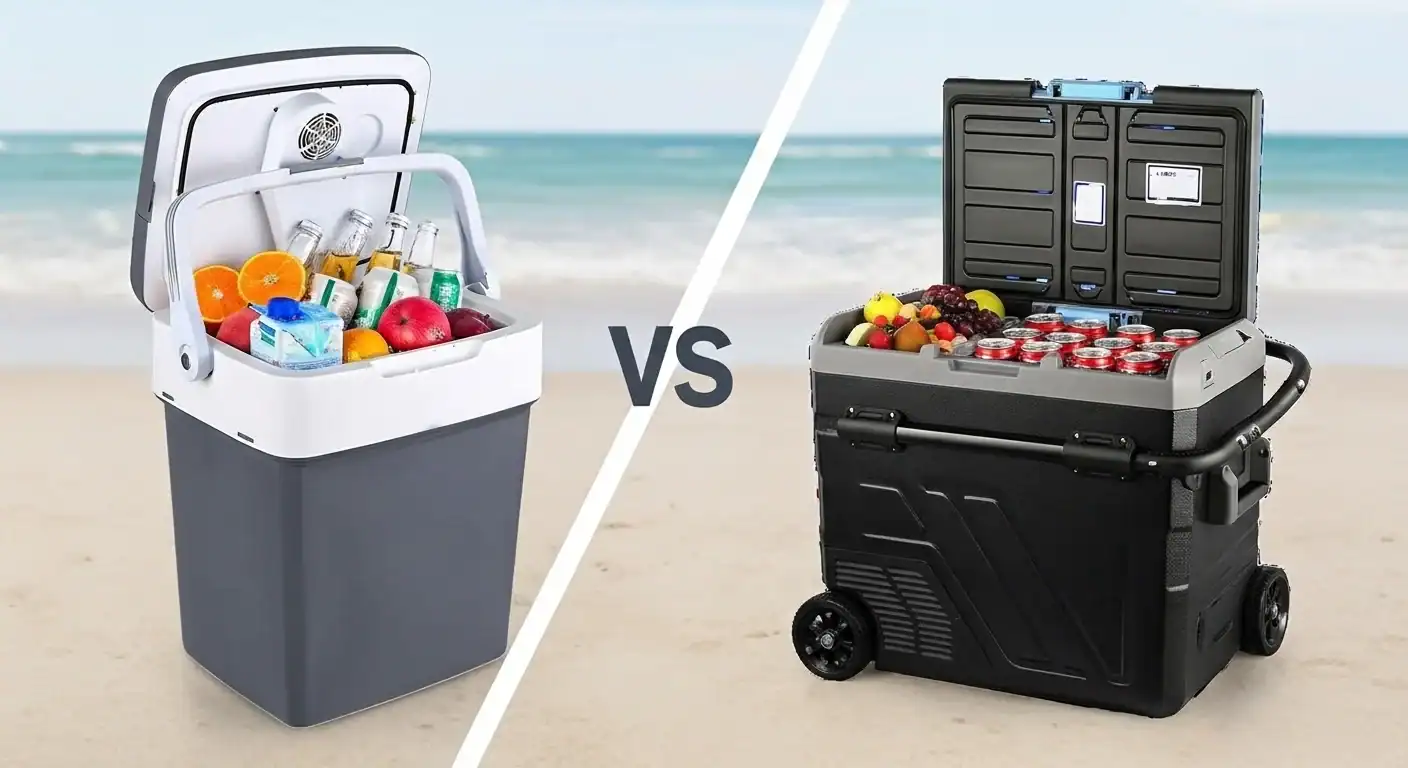
Expected Results: Compressor vs. Thermoelectric Units
Compressor and thermoelectric units perform very differently in this test. A compressor car fridge is engineered with thick, high-density insulation to maintain true freezing temperatures (down to -20°C). When properly pre-chilled, it will reliably keep ice frozen for four hours or more without power. The outcome for a thermoelectric cooler is less certain and depends entirely on its build quality. A premium model with injected PU foam has a strong chance of passing the test, while a basic model with thin EPS sheet insulation will likely fail. A compressor unit is built for this scenario; a thermoelectric unit’s success is conditional on its insulation and the surrounding heat.
Source Fully Certified, Custom Car Coolers

Lid Gaskets: Why Is the Rubber Seal the Leak Point?
A gasket fails from predictable material degradation, physical damage, and thermal stress, creating the primary air leak that undermines the cooler’s entire insulation system.
Material Compression Set and Fatigue
The rubber gasket on a cooler lid is under constant pressure when latched. Over time, this sustained force causes a “compression set,” where the material permanently deforms and loses its ability to rebound to its original shape. This memory loss creates gaps between the lid and the cooler body, breaking the airtight seal. Every time the lid is opened and closed, the gasket material flexes. This repeated mechanical stress leads to material fatigue, introducing micro-cracks that compromise its elasticity and allow for air exchange.
Contamination and Physical Damage
A perfect seal requires a perfectly clean surface. Debris like sand, dirt, or dried food residue caught in the seal channel physically prevents the gasket from making full contact with the cooler body. Even a single grain of sand can create a pathway for warm air to enter. Direct physical damage is just as critical. Small nicks, cuts, or abrasions from loading and unloading gear can create a direct channel for air to leak, completely negating the thermal benefits of high-performance PU foam insulation. A compromised gasket turns a premium cooler into a standard box.
Impact of Thermal Cycling and Moisture
Portable coolers constantly experience thermal cycling, moving from a hot vehicle interior to holding freezing contents. This causes the gasket material to repeatedly expand and contract, weakening its structural integrity over time. Moisture introduces another failure point. Condensation can collect in the gasket channel and, in a compressor fridge operating at sub-zero temperatures, this moisture can freeze. The expanding ice can physically dislodge the gasket from its channel or accelerate material degradation, leading to a seal failure.
Eco-Friendly Materials: Are We Using BPA-Free Plastics?
Clients often ask about food-contact materials, and our inner liners are indeed FDA-approved and BPA-free. For performance and durability, the most critical material specification is the insulation core. The choice between injected Polyurethane (PU) foam and Expanded Polystyrene (EPS) sheets directly determines thermal efficiency, structural integrity, and product lifespan.
While food-safe liners are a baseline requirement, the insulation material—PU foam versus EPS—is what defines a cooler’s actual performance, durability, and long-term value.
Thermal Efficiency: High-Density PU Foam for Stable Temperatures
The primary performance difference between insulation types comes down to thermal resistance, or R-value. Injected polyurethane (PU) foam provides a superior R-value of R-6 to R-7 per inch. This is nearly double the R-3.8 to R-4 per inch offered by Expanded Polystyrene (EPS) foam sheets. This efficiency means we can achieve the required insulation with much thinner walls, which reduces the cooler’s overall weight and external volume without sacrificing internal capacity. For electric models, better insulation means the cooling system runs less often, directly extending battery life and improving performance consistency.
Structural Durability for Off-Road and Transport Conditions
A cooler’s structure must withstand constant vibration, impacts, and stress during transport. When we inject high-density PU foam (minimum 2.2 lb density) into the cooler cavity, it chemically bonds to the inner and outer walls. This process creates a single, rigid monocoque structure that is far stronger than a shell filled with glued-in EPS sheets. This integrated construction provides higher compressive strength, resisting the daily abuse of commercial use or off-road travel. PU foam is also inherently resistant to UV radiation and common petrochemicals, ensuring a much longer operational lifespan.
Long-Term Performance: Moisture Resistance and R-Value Stability
Coolers operate in wet environments, making moisture resistance a critical factor for long-term performance. PU foam has a closed-cell structure that is impermeable to water. It will not absorb moisture, so its thermal resistance (R-value) remains stable for years, even in humid conditions. EPS foam, with its open-cell structure, can act like a sponge, absorbing water over time. This water-logging not only increases the cooler’s weight but severely degrades its insulation capability. Choosing PU foam prevents this common point of failure and ensures the cooler performs as expected throughout its entire service life.
Заключение
Choosing between PU injection and EPS foam is a defining factor in an electric cooler’s performance and market position. PU foam provides superior thermal retention ideal for premium compressor models that require long-term cooling. EPS sheets remain a cost-effective solution for high-volume thermoelectric coolers where budget is the primary driver.
Evaluate your product lineup to determine which insulation method aligns with your brand’s performance targets and cost structure. For detailed material specifications or to discuss custom OEM solutions, our engineering team is ready to assist.
Часто задаваемые вопросы
Is the insulation fully injected PU foam or EPS sheets?
The insulation is fully injected Polyurethane (PU) foam. This method is chosen for its superior performance in high-demand applications like electric cool boxes. PU foam offers significantly better thermal resistance (R-6 to R-7 per inch) compared to EPS, provides greater structural integrity by bonding chemically to the walls, and has excellent moisture resistance, ensuring consistent performance.
How many hours does it stay cold after being unplugged (25°C ambient)?
While specific time-based performance data at 25°C ambient is not available in the provided research, the unit is engineered for maximum thermal efficiency using high-density injected Polyurethane (PU) foam. This insulation provides an R-value of R-6 to R-7 per inch, significantly outperforming standard EPS and directly translating to extended cooling periods when off-power.
Is the inner liner BPA-free and FDA approved?
The provided research focuses on the thermal and structural properties of the external insulation (Polyurethane foam) and does not contain information regarding the material composition or food-safety certifications (BPA-free, FDA approval) of the inner liner.
Does the lid have a silicone gasket for a tight seal?
The provided technical documentation details the performance characteristics of the injected PU foam insulation but does not specify the materials or features of the lid, such as the presence of a silicone gasket for sealing.

 English
  Español
  Français
  Deutsch
  Português do Brasil
  Русский
  한국어
한국어  日本語
日本語  العربية