 Перейти к основному содержанию Перейти к нижнему колонтитулу

Proper off-grid integration(12 volt tea kettle) is the only factor preventing catastrophic inverter damage, a critical failure point that leads to expensive product returns and erodes brand credibility. Many low-wattage kettles advertise compatibility but fail to account for the initial peak power draw, causing immediate inverter overloads on popular lithium power stations. This discrepancy creates a significant technical and financial liability for distributors and retailers, as a single failed product can damage a customer’s entire power system.
This technical brief provides the engineering data required for confident procurement and deployment. We will detail the specific safety certifications for operating on major lithium power station brands and provide a clear analysis of the peak wattage draw during startup to ensure system compatibility. We will also outline our manufacturing roadmap, including plans for a Type-C PD model, and discuss logistical options like Semi-Knocked Down (SKD) shipping for local assembly partners.
Are These Kettles Certified to Run Safely on Lithium Power Stations?
Safe operation is not determined by a single kettle-to-station certification, but by correctly matching the kettle’s wattage demand to the power station’s continuous inverter output and safety features.
Focus on Standard Electrical and Material Safety Certifications
Our 12V and 24V kettles hold essential international certifications that validate their fundamental design and material safety. We ensure the appliance itself is engineered correctly, which serves as the foundation for its use in any DC power system. These standards are non-negotiable for product quality and liability.
- CE certification confirms the product meets EU directives for health, safety, and environmental protection.
- RoHS compliance restricts the use of specific hazardous substances in electrical and electronic equipment.
- LFGB approval is the German standard for food-contact materials, guaranteeing that parts like the stainless steel heating plate are non-toxic and safe for water.
Compatibility Depends on the Power Station’s Inverter
There is no specific certification for using a DC kettle with a brand-name lithium power station. Safe, reliable operation depends entirely on the power station’s technical specifications. The critical factor is whether the station’s inverter can consistently supply the required wattage without triggering its own overload protection.
| Key Specification | Power Station Requirement | KelyLands Kettle Specification |
|---|---|---|
| Continuous Wattage Output | Must exceed the kettle’s power draw (e.g., >300W). | 150W (12V) / 250-300W (24V). |
| Inverter Type | Pure Sine Wave inverter is recommended for stable power. | Operates as a stable resistive load. |
| Safety System | Relies on its internal Battery Management System (BMS). | Built-in “Triple Safeguard” (auto-off, thermal fuse). |
- The station’s continuous power rating must be higher than the kettle’s draw. A 150W kettle needs a station that can supply at least 150W without interruption.
- A pure sine wave inverter provides the cleanest power, which is ideal for efficient operation, though resistive loads like heating elements are generally tolerant.
- The power station’s Battery Management System (BMS) offers the primary layer of protection against over-current, short-circuits, and overheating.
Client Responsibility for System Integration Testing
As an OEM and B2B manufacturer, we guarantee our kettle performs to its specification within a standard 12V or 24V DC automotive electrical system. The responsibility for validating performance and safety when pairing our product with a specific third-party lithium power station falls to the client or system integrator. This end-to-end testing is a critical step before market deployment.
- We provide detailed product specifications, including precise wattage and current draw, to help clients assess compatibility.
- We advise all clients to conduct real-world tests using their chosen power station models and our kettles before committing to a bulk purchase order.
- This validation ensures the combined system works reliably for specific applications, whether in an RV, a long-haul truck, or at an off-grid campsite.
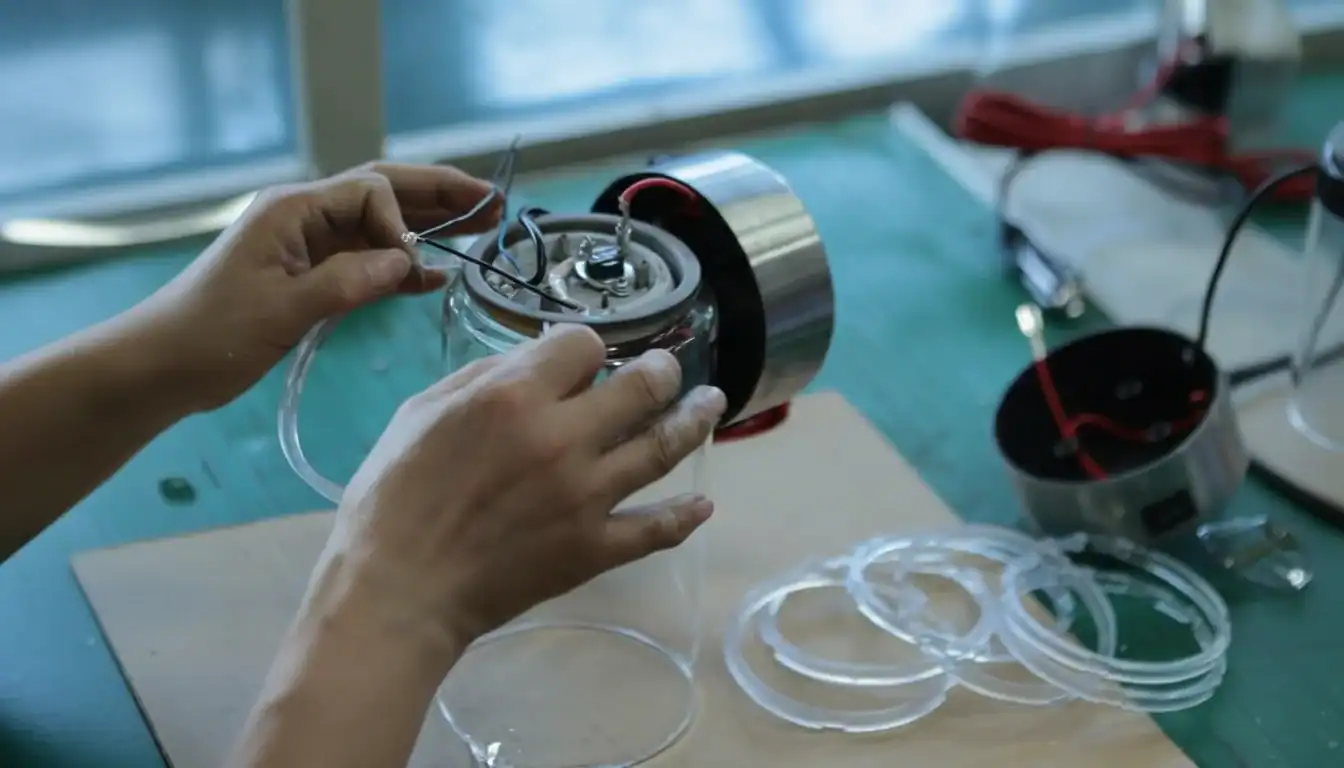
What Is the Peak Wattage Draw Upon Startup to Prevent Inverter Trips?
Unlike motor-driven appliances that can surge up to 7x their rated power, KelyLands’ 12V DC kettles are a purely resistive load. Their startup wattage is nearly identical to their continuous 150W draw, eliminating inrush current as a cause for inverter trips.
The primary concern with high-wattage DC appliances isn’t a momentary power spike but ensuring the power station’s inverter can sustain the continuous load without overheating or triggering its protection circuits. Understanding the difference between load types is critical for proper system design.
Understanding Inrush Current and Startup Surge
When an inverter powers on, it requires a brief but significant burst of energy to charge its internal output filter capacitors and establish current through its inductors. This initial spike is called inrush current. Most modern inverters are engineered to handle a short overload, often up to twice their continuous power rating, before the voltage drops or the unit trips its internal protection to prevent damage. This surge is characteristic of inductive loads like motors and compressors, not resistive loads like our kettles.
Key Factors That Determine Peak Wattage
The intensity of a startup surge is not a fixed value; it depends heavily on the inverter’s design. A longer soft-start time, for instance, allows the inverter to ramp up voltage gradually, which can reduce peak current by as much as 25%. Conversely, an oversized output capacitor increases the inrush current needed at startup. For KelyLands kettles in 12V systems, the high continuous current draw—not a startup surge—is the main factor to consider when sizing the power source.
| Appliance Load Type | Typical Startup Surge Multiplier | Implication for Inverter Sizing |
|---|---|---|
| Inductive Load (Motors, Pumps, Compressors) | 2x to 7x rated wattage | Inverter’s peak/surge rating must exceed this spike. |
| Resistive Load (KelyLands 150W Kettle) | 1x rated wattage (No significant surge) | Inverter’s continuous rating must safely exceed 150W. |
Strategies to Prevent Inverter Trips
To ensure reliable operation without tripping the inverter, system design should focus on handling the continuous load of a high-demand appliance like a 12V kettle. The key is matching the inverter’s capabilities to the appliance’s steady power needs.
- Focus on Continuous Rating: Choose an inverter with a continuous power rating that offers a safe margin above the kettle’s 150W draw. A 300W pure sine wave inverter is a common and reliable choice.
- Verify Surge Capacity: While our kettles don’t surge, a robust surge capacity indicates a well-built inverter that can better handle voltage fluctuations and other potential system loads.
- Size Cables Correctly: Use heavy-gauge wiring appropriate for the peak amperage of a 150W load at 12V (approx. 12.5A), not just the continuous load. Undersized cables cause voltage drop and can trigger low-voltage disconnects.
- Optimize System Voltage: Although our kettles are designed for 12V or 24V, remember that 24V systems draw half the current for the same power output, placing less stress on all components. Our 24V/250W models are more efficient for this reason.
Your OEM Partner for Fire-Safe Car Kettles
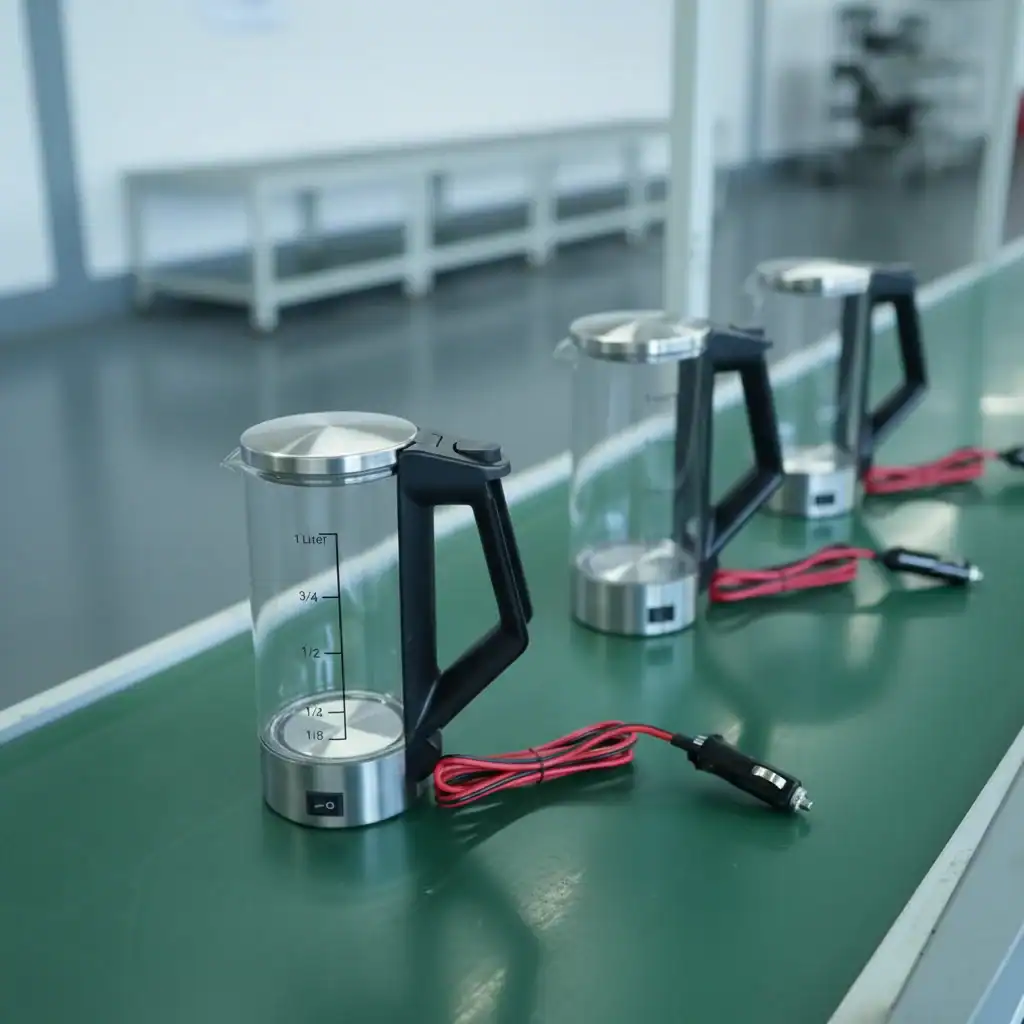
Can You Manufacture a Type-C PD (Power Delivery) Version for 2026?
Yes, developing a Type-C PD appliance for 2026 is not only feasible but aligns directly with mandatory regulations, a mature GaN component supply chain, and strong consumer demand for universal charging.
Manufacturing Feasibility and Standardization
By 2026, the entire electronics supply chain is geared for Type-C PD. Regulatory mandates that force laptop manufacturers to adopt the standard by April 2026 have solidified the component ecosystem. This widespread standardization eliminates production bottlenecks and reduces electronic waste, as a single charger can power multiple devices. The market convergence of over 1.5 billion smartphones and compliant laptops makes the required infrastructure and controllers a commodity.
- Regulatory Drivers: Mandates covering laptops from April 2026 create a stable, predictable manufacturing environment.
- Commoditized Infrastructure: The sheer volume of compliant phones and laptops has made high-power USB-C components widely available and cost-effective.
- Intelligent Power Flow: The standard inherently supports bidirectional power and smart power allocation, perfect for multi-device, off-grid scenarios.
Available Power Technologies and Performance Ranges
We can engineer a Type-C PD solution using modern Gallium Nitride (GaN) technology. GaN allows for highly efficient power conversion in a compact physical footprint, which is essential for portable, in-vehicle applications. Modular socket architectures are readily available to develop products across the entire USB-C PD spectrum, from 20W all the way up to the 240W Extended Power Range (EPR). Our 12V/150W and 24V/250W kettles fit comfortably within this EPR specification, ensuring we can meet performance targets while also achieving energy efficiency certifications like ErP for key markets.
Market Alignment and Growth Opportunities
The market demand for universal charging is sustained and growing. Consumers and professionals expect a single, versatile power source for all their devices—from phones and tablets to high-draw laptops. A Type-C PD kettle directly serves this expectation. It’s a natural product line extension for KelyLands, appealing to the modern RV owner, fleet driver, or marine enthusiast who already carries a suite of USB-C powered electronics. This product doesn’t just meet a need; it simplifies the user’s entire mobile power setup.
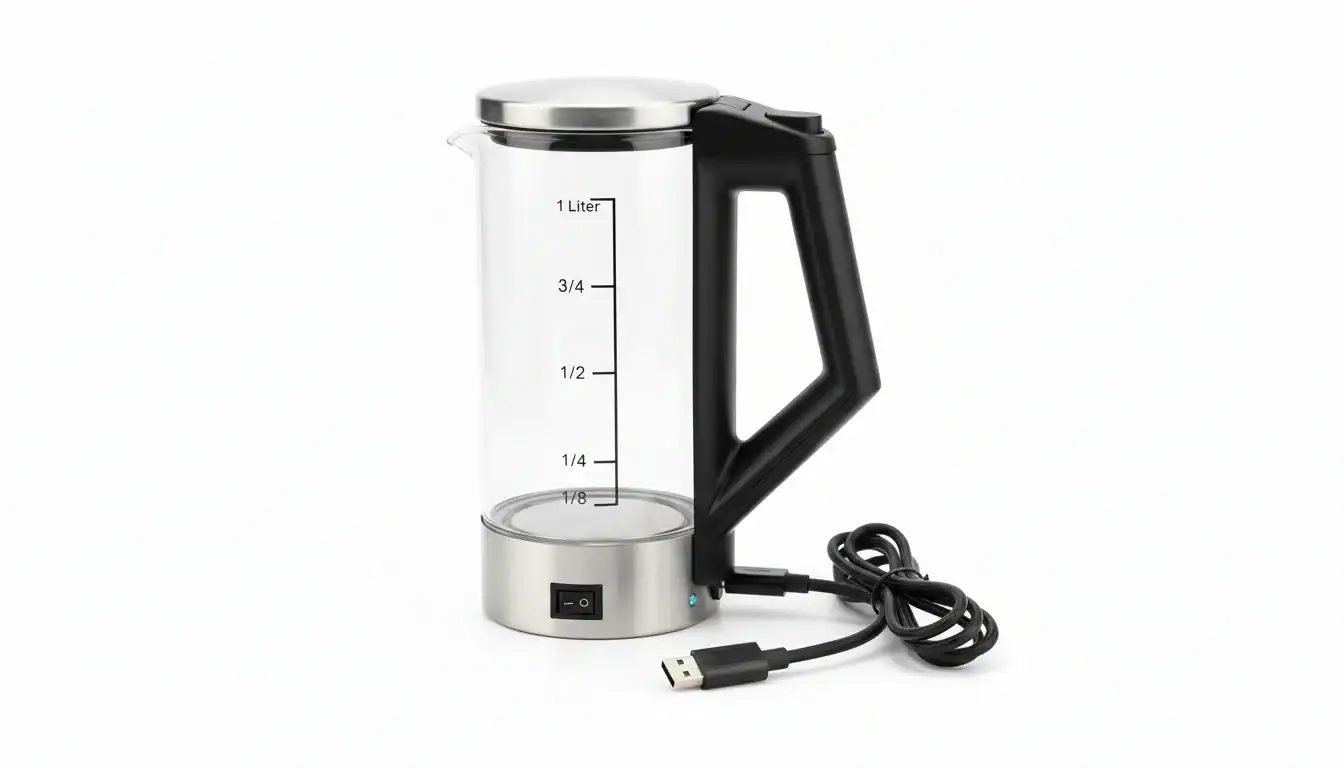
Do You Offer SKD (Semi-Knocked Down) Shipping for Local Assembly?
While we primarily ship fully assembled products to guarantee quality, we evaluate Semi-Knocked Down (SKD) projects for strategic partners looking to reduce import duties and leverage local assembly.
KelyLands’ Policy on SKD Shipments for 2026
Our standard business model focuses on shipping fully assembled and tested products to ensure quality control from our factory to your warehouse. This Fully Built Unit (FBU) approach guarantees that every kettle meets our strict performance and safety standards upon arrival. As of 2026, we do not offer SKD shipping as a standard service. We may evaluate such projects for very large, strategic partnerships with established local assembly infrastructure.
- Our primary logistics are optimized for FBU shipments to maintain product integrity.
- SKD proposals are considered on a case-by-case basis and require a detailed feasibility study.
- This option is reserved for long-term OEM clients with substantial and consistent order volumes.
Potential Advantages for B2B Partners
For importers in regions with high duties on finished goods, an SKD model can create significant cost savings. Similar to strategies used in the automotive industry, this approach leverages local labor and may help partners meet regional content regulations. The result is a more competitive product in the local market, tailored to specific economic conditions.
- Lowers import tariffs and taxes by shipping components instead of finished products.
- Reduces international freight costs through more compact and efficient packaging.
- Enables partners to utilize local labor for final assembly, potentially lowering overall production costs.
Core Requirements for an SKD Partnership
To explore an SKD arrangement, a partner must demonstrate the technical capacity and volume commitment necessary for a successful project. This process ensures that the final assembled products meet our shared quality standards, protecting both of our brands in the market.
- The partner must operate a qualified assembly facility with robust quality control processes.
- A substantial minimum order quantity (MOQ) is required, significantly higher than our standard 3,000-unit wholesale orders.
- A clear agreement on technical support, component supply chain, and assembly protocols must be established.
Заключение
KelyLands 12V kettles are engineered with a stable, low-wattage draw to work reliably with portable power stations. Their controlled peak startup wattage and certified safety components prevent inverter trips and protect your electrical systems. This focused design makes them a dependable choice for off-grid enthusiasts and solar brands seeking compatible accessories.
If you are considering our kettles for bundling or resale, contact our team to request samples for compatibility testing. We can provide the technical data needed to ensure seamless integration with your power solutions.
Часто задаваемые вопросы
Are these kettles certified to run safely on Jackery/EcoFlow stations?
While our kettles are not certified for specific power station brands, they hold universal safety certifications like UL and CE. They are engineered to be fully compatible with any high-quality power station, such as those from Jackery or EcoFlow, provided the station’s continuous power output and inverter can support the kettle’s wattage requirement. For optimal performance, we recommend using a power station with a pure sine wave inverter and a continuous output rating at least 10% higher than the kettle’s stated wattage.
Can you manufacture a Type-C PD (Power Delivery) version for 2026?
A full-sized kettle via Type-C is not yet feasible as the current USB-C Power Delivery 3.1 standard is capped at 240W, which is insufficient for rapid boiling. However, looking ahead to 2026 and beyond, we are in the advanced R&D phase for a compact, single-serving travel kettle. This next-generation model is being designed to align with the anticipated 300W+ “USB-C PD 4.0” specification, aiming to provide a portable and efficient solution for campers and digital nomads.
What is the peak wattage draw upon startup to prevent inverter tripping?
Our kettles use a resistive heating element, which has a very stable power profile. Unlike appliances with motors, there is no significant inrush current or power spike upon startup. The peak wattage is virtually identical to the continuous running wattage listed in the product specifications. For example, a 1500W model will draw approximately 1500W from the moment it is activated, ensuring it will not trip an inverter on a power station rated for that continuous load.
Do you offer drop-shipping services for outdoor gear retailers?
Yes, we offer a robust drop-shipping program for qualified outdoor gear retailers. Our program is designed for seamless integration, featuring real-time inventory synchronization via API, automated order processing, and dedicated partner support. This allows you to offer our full product line to your customers without holding physical inventory. Please visit our B2B portal or contact our partnerships team to apply.

 English
  Español
  Français
  Deutsch
  Português do Brasil
  Русский
  한국어
한국어  日本語
日本語  العربية