 Перейти к основному содержанию Перейти к нижнему колонтитулу

Understanding the physics of a high volume air pump is the first line of defense against costly product returns and negative reviews. When end-users mistake high pressure for high airflow, they inevitably damage inflatables or burn out motors, triggering warranty claims that erode profit margins.
This technical brief benchmarks pump performance against the core High Volume Low Pressure (HVLP) standard. We analyze why an airflow of 140–500 L/min is non-negotiable for rapid inflation, while a pressure cap under 2.0 PSI is essential for preventing seam bursts and protecting your supply chain integrity.
The “Straw vs. Firehose” Analogy: Why Pressure Is Not Volume?
For an air mattress, you need a firehose’s high volume to fill it fast. A straw’s high pressure would be slow and could easily damage the seams.
Understanding the Two Different Jobs: Force vs. Flow
People often confuse air pressure (PSI) with airflow volume (L/min), but they do completely different jobs. A drinking straw works by creating a strong pressure difference to move liquid. It’s a high-pressure, low-volume system designed for focused force. A firehose, on the other hand, is built to move a massive amount of water very quickly to fill a space. It’s a high-volume, low-pressure system. When you’re inflating an air mattress, you’re not trying to overcome resistance; you’re trying to fill a large, empty space as fast as possible.
The HVLP Specification: High Volume (140-500 L/min) at Low Pressure (0.33-2.0 PSI)
Our pumps are engineered as High Volume Low Pressure (HVLP) tools. We prioritize moving a huge amount of air, between 140 and 500 liters per minute, to get the job done fast. Just as important, the pressure is intentionally kept low, within a safe range of 0.33 to 2.0 PSI. This protects the delicate seams of air mattresses, pool floats, and other inflatables from bursting under the force of a high-pressure pump like a tire inflator.
Why Is CFM (Cubic Feet per Minute) the Only Metric That Matters for Air Beds?
For air beds, the key metric isn’t pressure (PSI) but airflow volume, measured in Liters per Minute (L/min). This HVLP principle ensures a bed fills rapidly without risk of bursting.
Clients often ask about CFM, a term common in HVAC, but for inflatables, the industry standard is Liters per Minute (L/min). Both measure airflow volume, which is the only thing that dictates how fast an air mattress fills up. Pressure (PSI) is almost irrelevant here; you need to move a large amount of air, not create intense force.
| Метрическая система | HVLP Air Pump (KelyLands Spec) | High-Pressure Tire Inflator |
|---|---|---|
| Primary Goal | Fill a large space quickly | Create force to overcome resistance |
| Key Performance Unit | Airflow Volume (L/min) | Pressure (PSI) |
| Typical Output | 140–500 L/min | Low Volume (Often <30 L/min) |
| Inflation Time (Queen Bed) | 2–3 minutes | 30+ minutes (Risk of motor burnout) |
Airflow Volume (L/min) Defines Inflation Speed
The core principle for inflating air beds, pool floats, and inflatable boats is High Volume Low Pressure (HVLP). The objective is simple: move a large quantity of air into an open space as fast as possible. You are not fighting against resistance like you are when filling a car tire. The metric for this speed is Liters per Minute (L/min), and it directly tells you how fast the job will get done. A higher L/min rating means faster inflation.
The KelyLands Standard: 140–500 L/min Performance
Our electric air pumps are engineered specifically for HVLP applications, delivering a powerful airflow range from 140 L/min up to 500 L/min. This high-volume output allows a standard queen-size air mattress to be fully inflated in just 2-3 minutes. This is a different class of tool compared to a high-pressure tire inflator. Using a tire pump for the same task would take over 30 minutes, assuming the motor doesn’t burn out from the continuous strain first.
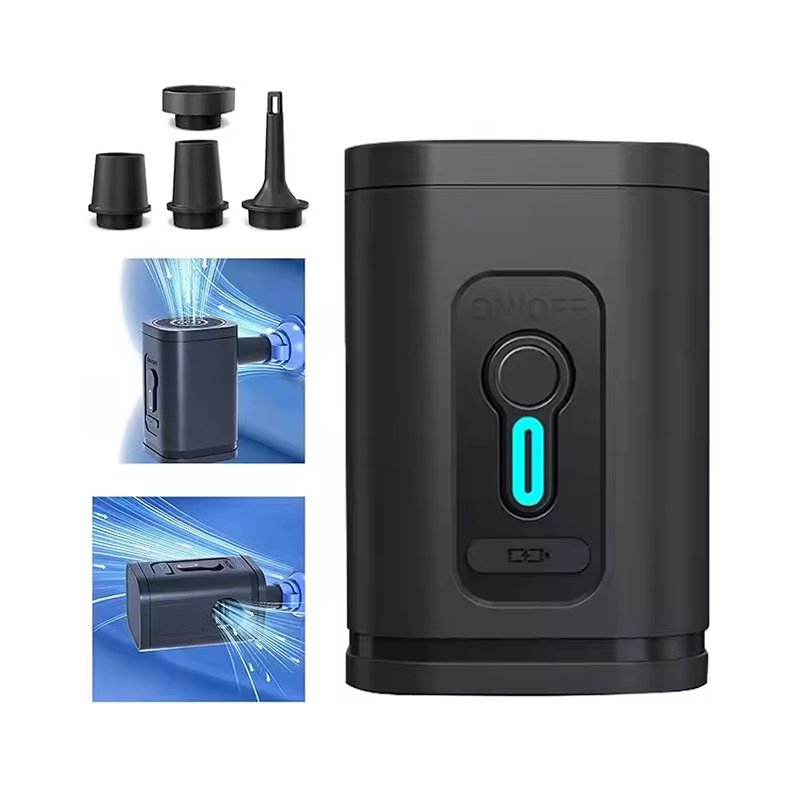
Source High-Performance, Fully Customizable Air Pumps
Do Tire Pumps Overheat and Burn Out When Used on Large Inflatables?
Yes, a tire pump will likely overheat and burn out on large inflatables. It’s built for high pressure, not high volume, forcing it to run too long under stress.
The Mismatch: High-Pressure Design vs. High-Volume Needs
A car tire pump is built for one job: pushing a small amount of air against high resistance. This high-pressure, low-volume design is the exact opposite of what you need for an air mattress. Trying to fill a large inflatable forces the pump to run continuously for far too long, stressing the motor and leading directly to overheating and failure.
The HVLP Solution: High Airflow (140-500 L/min) Prevents Strain
The right tool for the job is a High Volume Low Pressure (HVLP) pump. KelyLands pumps are engineered specifically for this, moving a massive amount of air—between 140 and 500 liters per minute. This high airflow fills large items in minutes, not half an hour. It completely avoids the prolonged, stressful runtime that kills a tire pump’s motor.
The 0.5 PSI Limit: Preventing Mattress Explosion from Over-pressure.
Air mattresses operate safely at very low pressures, under 0.6 PSI. High Volume Low Pressure (HVLP) pumps fill them fast without exceeding these limits, preventing material stress and bursting.
Understanding Operating Pressure vs. Burst Pressure
There’s a massive safety margin built into inflatable products. A standard air mattress feels perfectly firm and usable at a normal operating pressure of around 0.6 PSI. The actual burst pressure—the point where the seams or vinyl give way—is much higher. Material failure typically happens between 2.5 and 4.5 PSI, giving you a wide buffer against accidents.
Engineered for Safety: The KelyLands 0.33–2.0 PSI Specification
We calibrate our KelyLands HVLP pumps to operate within a specific pressure range of 0.33–2.0 PSI. This is a deliberate engineering choice. The design pushes a high volume of air to inflate mattresses quickly, but the pressure is capped well below the material’s burst threshold. This ensures the pump can’t accidentally over-inflate and damage the product, providing a reliable and safe user experience.
Часто задаваемые вопросы
Can I use a tire inflator on an air mattress?
It’s the wrong tool for the job. A tire inflator is built for high pressure (PSI) to fill a small space. An air mattress needs high volume (L/min) at very low pressure. Using a tire pump would take over 30 minutes and could easily burn out its motor. A dedicated air mattress pump fills the same bed in about 2 minutes without risk.
How long does it take to inflate a standard air bed?
With a proper electric pump designed for inflatables, a standard twin or queen air bed inflates in 2 to 5 minutes. High-airflow AC models with outputs around 450-500 L/min can often get the job done in under 3 minutes, depending on the mattress size and how firm you want it.
Will a high-pressure pump damage my pool float?
Yes, it absolutely can. A high-pressure tool can easily overinflate a pool float and rupture the seams. It’s much safer to use a high-volume, low-pressure (HVLP) pump. These are designed to fill inflatables quickly without exceeding the safe pressure limit, which is typically under 2.0 PSI.
Why does my pump get hot after 10 minutes of continuous use?
Heat is a normal byproduct of the motor and the air compression process. Cheaper pumps with basic motors can’t dissipate that heat effectively and will overheat quickly. Our commercial-grade models are designed for continuous runtimes of 15-30 minutes. High-end units with brushless motors run even cooler and have a much longer service life.
Заключительные мысли
Choosing the right pump is a business decision. Generic, underpowered units lead to negative reviews and customer returns from motor burnout or burst inflatables. Our certified HVLP pumps deliver 140-500 L/min airflow and a strict 2.0 PSI safety limit, protecting your brand’s reputation.
The best way to confirm performance is to test it yourself. Request a sample kit to evaluate inflation speeds and build quality firsthand. Contact our team to discuss your private label requirements and secure a B2B quote.

 English
  Español
  Français
  Deutsch
  Português do Brasil
  Русский
  한국어
한국어  日本語
日本語  العربية