

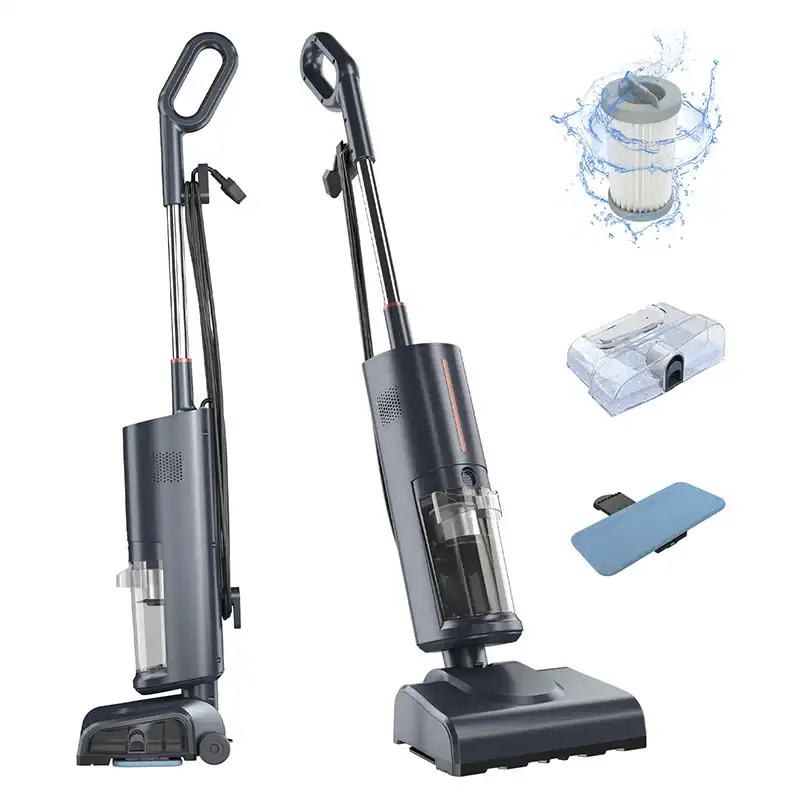
Supplying the wrong equipment for drywall and woodworking projects leads to immediate performance failure and serious health risks. Fine particles between 1 and 10 microns can choke suction by 60% within minutes, creating a maintenance cycle that stalls production and compromises air quality. For professional teams, staying below the OSHA silica exposure limit of 50 µg/m³ requires a shift from standard shop vacuums to specialized extractors designed to handle high-volume fine dust without motor failure.
We examine the technical requirements for modern dust containment, including the 99.97% efficiency ratings required for HEPA certification and the mechanics of pulse-jet cleaning systems that operate at 60-100 psig. This overview compares multi-layer fleece bags with pleated cartridges and details how auto-start outlets with current-sensing relays ensure synchronized collection during sanding and grinding tasks.
The “Clogged Filter” Nightmare: Drywall Dust
Drywall dust consists of fine particles between 1 and 10 microns that rapidly cake filter membranes, causing suction to drop by 60%. Effective extraction in 2026 relies on HEPA-grade filtration and pre-separators to maintain airflow while staying below the OSHA silica exposure limit of 50 µg/m³.
Particle Dynamics and Suction Power Loss
Standard wet-dry vacuums without cyclonic separation lose up to 60% of their suction power almost immediately. Fine limestone and perlite dust particles coat the filter membrane, creating an impermeable barrier that prevents air from passing through. This mechanical failure occurs because standard filters lack the surface area or material composition to shed microscopic construction debris.
Dust particles smaller than 10 microns increase the differential pressure across the filter. This restriction chokes airflow and forces the محرك المكنسة الكهربائية to work harder, which often leads to overheating. High-performance extractors mitigate this by using pulse-cleaning systems that vibrate the filter to dislodge the dust cake during operation.
Accumulated dust cakes reduce the primary filter lifespan to under 6 months in heavy-use environments. Operators who do not employ a pre-separator or specialized dust bags face frequent replacement costs and diminished performance. Using a cyclonic bucket or a high-efficiency interceptor keeps the bulk of the material out of the vacuum canister, preserving the integrity of the main filtration unit.
Filtration Standards and OSHA Safety Limits
OSHA sets the permissible exposure limit (PEL) for respirable crystalline silica at 50 µg/m³ over an 8-hour time-weighted average. Drywall compounds often contain silica, making it vital to use extraction equipment that prevents these particles from becoming airborne. Proper engineering controls are necessary to maintain air quality below the 0.05 mg/m³ threshold for respirable dust.
True HEPA filters provide 99.97% efficiency at 0.3 microns, which is the baseline for safe construction dust management. Advanced extractors can achieve 99.999% efficiency to ensure safety in high-dust environments. These systems ensure that the air exhausted back into the room is cleaner than the ambient air, protecting both the operator and the HVAC system from contamination.
Reusable DustLock bags and MERV 11+ HVAC filters provide secondary protection by capturing particles down to 1 micron before they reach the main exhaust. This multi-stage approach prevents vacuum filter clogging and ensures that fine limestone particles do not settle into ductwork or sensitive electronic equipment. Maintaining 130 CFM of airflow through these filters ensures the vacuum maintains enough velocity to pull dust directly from the source.
Filtration Stages: Fleece Bags vs. Cartridge Filters
Vacuum systems in 2026 rely on a two-stage process. Fleece bags utilize multi-layer depth filtration (40–300 g/m²) to capture bulk debris, while pleated cartridge filters provide absolute pore-size retention (0.5–1500 μm) for fine particulate polishing. Using both prevents premature motor failure and maintains high airflow.
| Filtration Component | Technical Structure | مواصفات الأداء |
|---|---|---|
| Fleece Bags (Nonwoven) | Multi-layer S-PES-B BICO gradient matrix | 40–300 g/m² grammage; 3D depth loading |
| Cartridge Filters | Pleated Micro Polypropylene (HA/HB) | 0.5–1500 μm pore size; 92–98% efficiency |
Multi-Layer Fleece Bags for Depth Filtration
S-PES-B BICO nonwoven media utilizes a three-layer gradient structure to trap progressively finer particles within a 3D matrix. This design ensures that coarse debris stays on the outer layers while fine dust penetrates deeper into the fiber network without blocking airflow immediately. Unlike standard paper bags, this depth-filtration approach maintains suction power even as the bag reaches capacity.
Fleece grammage typically ranges from 40 to 300 g/m², providing a significantly higher dirt-holding capacity for industrial and DIY applications. High-suction tasks involve sharp or heavy debris that can easily puncture thin materials. Mechanical needle-punched and calandered polyester fibers provide the necessary tensile strength to resist tearing under high-pressure conditions.
Pleated Cartridges for Absolute Particle Retention
Absolute pore sizes ranging from 0.5 to 1500 μm allow for precise air polishing during the final filtration stage. These filters capture the microscopic particulates that fleece bags might miss. By utilizing micro polypropylene media, specifically the HA and HB variants, these systems achieve efficiency ratings between 92% and 98% for fine dust particles.
Pleated designs maximize the available surface area within a compact housing, which helps manage the air-to-cloth ratio. While this geometry increases the total filtration area, users must monitor inlet pressure. Smaller pore sizes demand higher pressure to drive air through the media. Pairing these cartridges with a fleece pre-filter prevents premature loading and extends the service life of the expensive pleated element.
HEPA Requirements: Lead Paint and Silica Safety
HEPA filtration for lead and silica requires a 99.97% capture rate of particles as small as 0.3 microns. Compliance involves meeting OSHA and EPA standards, using UL 586-certified filters, and maintaining specific airflow metrics like 25 CFM per inch for grinding tools and -5 Pa pressure for containment zones.
Certified HEPA Standards for Silica and Lead Dust Containment
OSHA 1910.1053 and EPA lead-safe regulations mandate HEPA filters that capture 99.97% of particles at 0.3 micrometers. These agencies require certified media because smaller hazardous particles easily penetrate standard shop vacuums or consumer-grade filters. Lead paint disturbance applies to any material with lead concentrations reaching or exceeding 1.0 mg/cm² or 0.5% by weight. المكنسة الكهربائية القياسية filters often allow respirable crystalline silica (RCS) to bypass the system, which makes HEPA-certified media mandatory for all sanding and scraping tasks. Updated 2026 safety protocols recognize any detectable lead levels as hazard risks, necessitating sealed containment systems to hit strict post-abatement clearance levels of 5 µg/ft² on floors and 40 µg/ft² on window sills.
Technical Performance Metrics for Regulatory Compliance
Negative air machines must maintain -5 Pa (0.02 inch water column) differential pressure to prevent dust escape from work zones. This pressure gradient ensures air flows into the containment area rather than leaking out into clean spaces. Extractors used for grinding require 25 CFM per inch of wheel diameter to suppress silica dust below the 50 µg/m³ exposure limit. Engineering specifications require HEPA systems to deliver 70% of their rated capacity at 620 Pa static pressure even when the filter is 70% loaded. A typical HEPA filter reaches its service limit after approximately 700 hours of continuous operation. UL 586 certification serves as the primary benchmark for filter durability and efficiency in high-load industrial environments.
Scale Your Brand with Premium, Custom-Built Home Vacuums

Filter Cleaning: Pulse/Shaker Mechanisms
Pulse and shaker systems maintain suction by removing dust cakes from filter media. Shaker systems use 4 Hz mechanical vibrations to flex bags, while pulse jets deliver 60-100 psig compressed air bursts lasting 0.1-0.15 seconds to reverse airflow and clear cartridges without stopping operation.
| المقياس التشغيلي | Mechanical Shaker | Pulse Jet System |
|---|---|---|
| Primary Mechanism | 4 Hz Vibration / 2-3″ Amplitude | 60-100 psig Compressed Air |
| Cleaning Duration | Cyclical (Requires Flow Stop) | 0.1 – 0.15 Seconds (Online) |
| المتطلبات الرئيسية | Tensioned Bag Installation | 6:1 Air-to-Cloth Ratio |
Mechanical Shaker and Pulse Jet Fundamentals
Mechanical shakers isolate specific filter compartments to apply physical vibrations at a frequency of 4 Hz with a 2-3 inch amplitude. This movement flexes the filter bags, causing the accumulated dust cake to fracture and fall into the collection hopper. Because this process requires the forward airflow to stop, shaker systems typically operate on intermittent heavy-duty cycles or use modular compartments that take turns offline.
Pulse jet systems utilize momentary blasts of compressed air to reverse the airflow, cleaning cartridges or bags while the system remains fully operational. These bursts momentarily expand the media, dislodging fine particles like silica or drywall dust without interrupting suction. Equipment designers prioritize needle-punched felt and high-strength synthetic fabrics to withstand the dynamic stress of these rapid cleaning cycles, often housing the components in hermetically sealed steel or stainless steel units to handle pressure fluctuations.
Technical Performance Specs and Pressure Limits
Effective cleaning requires maintaining an air-to-cloth ratio of at least 6:1 to prevent premature clogging. Pulse jet systems typically operate between 60-100 psig, with 90-100 psig providing the sharp, momentary burst necessary for difficult dust loads. If the pressure exceeds these limits, the media risks rupture; if it falls below, the dust cake remains lodged, increasing differential pressure and reducing overall system throughput.
Filtration velocity for easily cleanable dusts stays restricted to a range of 0.5–0.9 m/min to ensure efficient particle release during the 0.1-second pulse. To maintain stable airflow, sequencing logic prevents adjacent filter rows from firing at the same time. This cyclical firing pattern minimizes internal turbulence and ensures a uniform air distribution across the entire filter bank, supporting performance ranges from 500 to over 235,000 CFM depending on the baghouse configuration.
Tool Activation: Auto-Start Outlets for Sanders
Auto-start outlets use current-sensing relays to detect power draw from a sander and automatically trigger the dust extractor. These systems incorporate programmable delays to prevent circuit overloads during startup and ensure the vacuum runs long enough to clear residual fine dust from the hoses after the tool stops.
Current Sensing and Synchronized Collection Logic
Integrated sensors monitor electrical current, typically between 15A and 20A, to identify when a sander begins operation. This detection signals the connected vacuum to activate. Systems like the iVAC Pro utilize a 1.5-second turn-on delay to stagger power demands, which prevents simultaneous motor surges from tripping circuit breakers. After sanding finishes, automatic timers keep the vacuum running for an additional 5 to 45 seconds. This extended run time clears residual drywall or wood dust from the collection hoses and ensures it reaches the filtration unit. Current hardware meets TUV certifications including UL60950-1 and CSA 60950-1 standards, providing reliable safety for professional workshop environments.
Electrical Ratings and Multi-Tool Scaling
Modern switches handle diverse power loads, supporting 1HP at 115Vac or 2HP at 240Vac for heavy-duty extraction units. Industrial machinery, such as the SCM DMC SD 60, employs Logic TS controllers to manage sequential motor startup and pneumatic belt tensioning at 88 PSI. For expanding shops, networked switches allow for scaling up to 32 tools while maintaining reliable 40-foot line-of-sight communication. High-volume environments also rely on specific suction performance, where vacuum pressure ratings like 2200 mm H2O ensure the system effectively captures debris as soon as the auto-sync trigger activates.
خاتمة
Managing fine construction debris like drywall dust and sawdust requires more than just raw suction power. Systems that integrate HEPA filtration, pulse-cleaning technology, and multi-stage fleece bags provide the only consistent way to maintain airflow and stay within OSHA safety limits. These technical components work together to prevent the rapid clogging that typically stalls projects during heavy sanding or grinding.
Selecting the right extraction hardware protects long-term health and maximizes tool life. Features like auto-start outlets and synchronized collection logic remove the manual effort from dust management, allowing for a more efficient workflow. Staying aligned with these 2026 safety standards keeps the workspace free from hazardous lead and silica while ensuring the vacuum system operates at peak performance throughout its lifespan.
الأسئلة المتداولة
Do you offer tear-resistant fleece bags for drywall dust?
Tear-resistant fleece bags align with 2026 containment standards for drywall dust, providing the durability necessary to handle high-volume fine particles without bag failure.
Is the HEPA filter certified for lead paint removal (RRP)?
The HEPA filters achieve 99.97% efficiency at capturing 0.3-micron particles, which meets the 2026 EPA RRP and OSHA safety guidelines for capturing lead dust.
Does the auto-start outlet support high-wattage sanders?
The integrated auto-start outlets support 15-20A circuits, providing 1800W to 2400W at 120V to accommodate high-wattage sanders while maintaining synchronized extraction.

 English
 Español
 Français
 Deutsch
 Português do Brasil
 Русский
 한국어
 日本語
 العربية