 Zum Hauptinhalt springen Zum Footer springen

Nailing the Engineering & NTC(12V electric kettle) specifications is the only barrier between a reliable in-cabin appliance and a catastrophic thermal runaway event that causes massive RMA spikes. Commercial fleets subject mobile electronics to constant vibration and unpredictable voltage fluctuations that tear standard components apart. When a cheap temperature sensor drifts out of calibration due to physical shock, the system boils dry, creating an immediate fire hazard that destroys vehicles and ruins manufacturing contracts.
We built this technical standard operating procedure to help hardware teams lock down thermal stability and electronic durability. The following sections break down the specific integration methods we rely on to secure single-degree temperature accuracy and keep printed circuit board failure rates near zero in high-vibration applications. We detail the required automotive-grade capacitor specs for the main motherboard and explain how engineers modify the firmware heating curves to safely process different types of liquids.
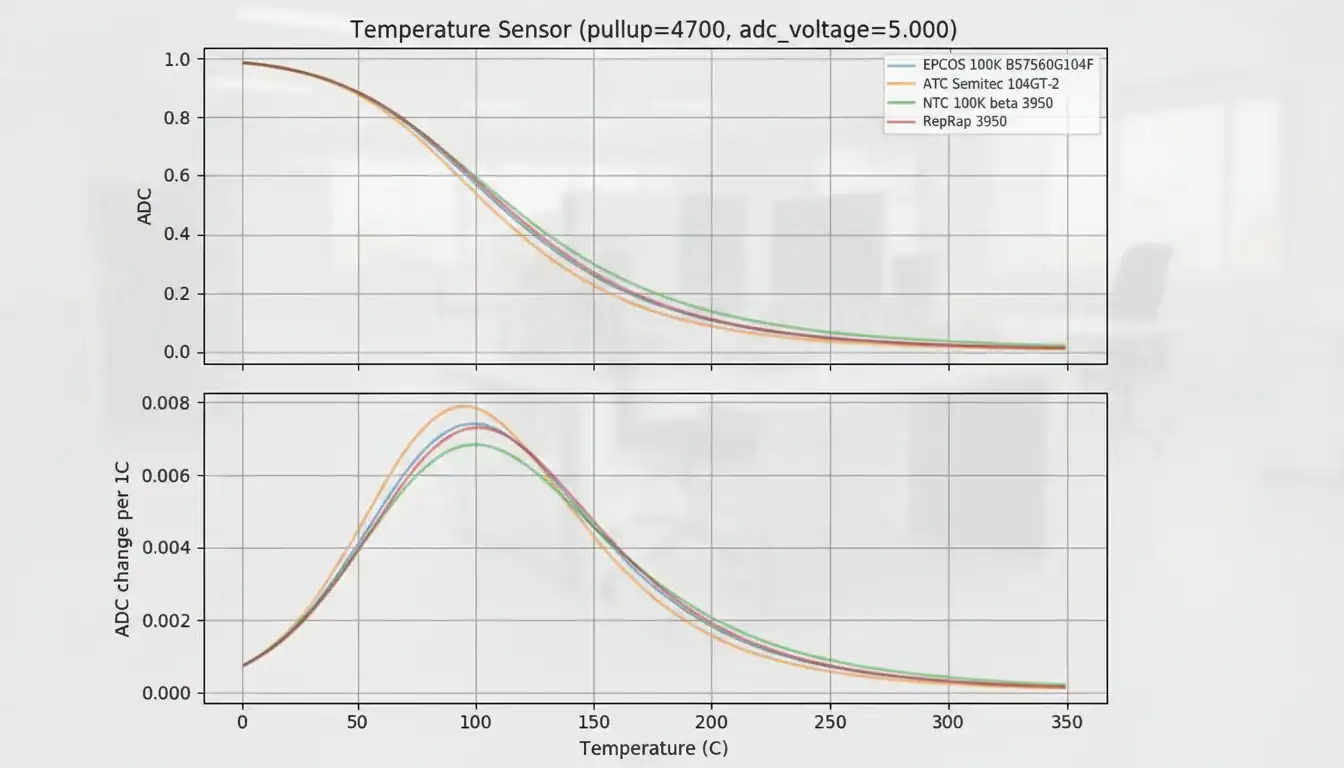
How Does the NTC Thermistor Ensure 1°C Temperature Accuracy?
Achieving ±1°C accuracy in fluctuating 12V/24V automotive systems demands strict NTC thermistor calibration combined with ratiometric measurement circuits to neutralize supply voltage drops.
Individual Calibration Data
Premium NTC components undergo individual calibration to achieve tight resistance tolerances of 0.3%. This precise resistance tolerance directly produces a temperature accuracy of approximately 0.1 K at the critical +100°C threshold. Engineers map the nonlinear resistance-temperature relationship during production to guarantee the onboard MCU translates raw resistance values into exact temperature readings.
Ratiometric Measurement Methods
Applying ratiometric biasing instead of absolute measurement negates the severe power-supply variations typical in automotive environments. This measurement strategy cuts potential error scenarios from 27 down to just 2. By referencing the sensor’s voltage against the supply voltage rather than an absolute ground, the system maintains consistent 1°C accuracy even during erratic power states.
| Measurement Strategy | Error Scenarios | Voltage Fluctuation Impact |
|---|---|---|
| Absolute Measurement | 27 Potential Sources | High (Skews temperature readings) |
| Ratiometric Biasing | 2 Potential Sources | Neutralized (Maintains ±1°C accuracy) |
Optimized Circuit Design
Minimizing self-heating effects requires precise component selection on the main PCB. Selecting the correct bias resistors prevents excessive current from passing through the thermistor and generating artificial heat. Sizing shunt resistors correctly keeps these internal self-heating effects within strict technical limits. These hardware-level optimizations lock the sensor’s accuracy firmly within the ±1°C target range.
Single-Point Offset Calibration
A focused baseline calibration corrects measurements across the appliance’s entire operating range. Manufacturers apply a room-temperature offset calibration for products operating in variable environments like 12V electric kettles.
- This software-level correction shifts the response curve to align perfectly with physical water temperatures.
- While NTC sensors naturally lose sensitivity at higher temperatures, this offset guarantees the heating element shuts off exactly at the boiling point.
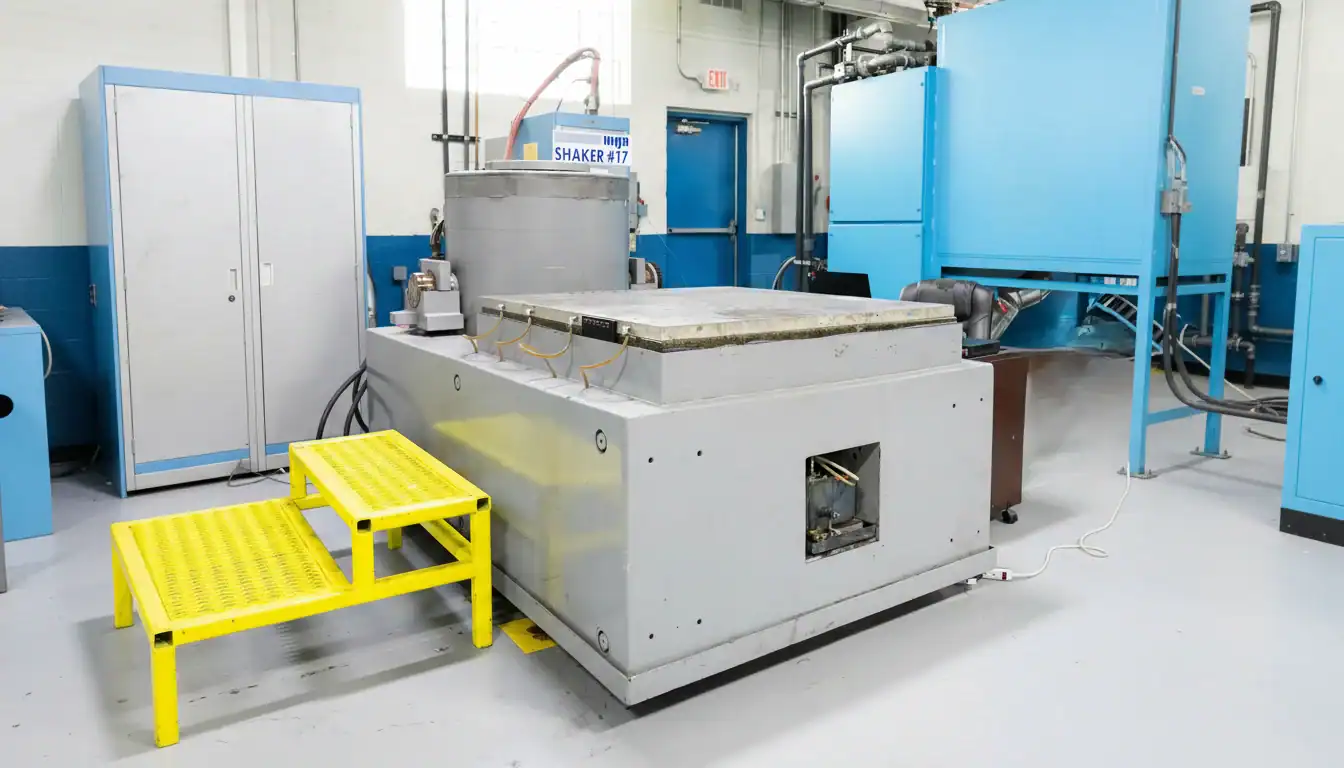
What Is the Failure Rate (RMA) of Smart PCBs in High-Vibration Vehicles?
Vibration-induced stress drives up to 25 percent of automotive electronic failures, prompting our engineering teams to enforce IATF 16949 quality controls that keep KelyLands’ RMA rates well below the industry baseline.
Automotive PCB Vibration Failure Statistics
Industry benchmarks from 2026 fleet data reveal that vibration-induced stress accounts for 20 to 25 percent of all electronic component failures in automotive environments. KelyLands closely tracks Return Merchandise Authorization (RMA) records to guarantee internal failure rates remain significantly below these industry averages. Factory auditing teams enforce strict IATF 16949 quality controls to maintain consistent reliability across bulk B2B production runs of our 12V and 24V appliances.
| Reliability Metric | Standard Automotive PCB | KelyLands Smart PCB |
|---|---|---|
| Vibration Failure Contribution | 20% – 25% of total failures | Minimal RMA anomaly footprint |
| Manufacturing Standard | Basic Consumer Grade | IATF 16949 Audited Controls |
| Vibration Mitigation | Standard FR-4 laminates | High-Tg laminates + Conformal coating |
Primary Failure Modes Under Mechanical Stress
Continuous road vibration frequently fractures solder joints, completely severing the electrical connections on standard circuit boards. Heavy mechanical shock causes trace damage and component detachment, heavily impacting bulky parts like relays mounted directly on the motherboard. Engineering teams map resonance frequencies during the design phase to reinforce vulnerable mounting points before initiating OEM mass production.
Manufacturing Mitigations and Accelerated Life Testing
Engineers specify high-Tg (glass transition temperature) laminates and apply conformal coatings to shield the PCB surface from vibration and micro-abrasions. We utilize Accelerated Life Testing (ALT) to subject components to combined thermal and mechanical stress, simulating years of long-haul logistics driving in a few weeks.
Strategic component placement and rigorous testing verify every smart PCB meets global durability standards before assembly into the final appliance. We actively enforce these standards through precise manufacturing steps:
- Triple-layer inspection (IQC, PQC, FQC) prevents compromised components from advancing to the assembly line.
- Simulation-driven design optimization mitigates resonance effects across the entire circuit structure.
- Dedicated stabilization techniques secure high-mass electronic parts against continuous vehicle shock.
Source Ultra-Safe OEM 12V/24V Car Kettles
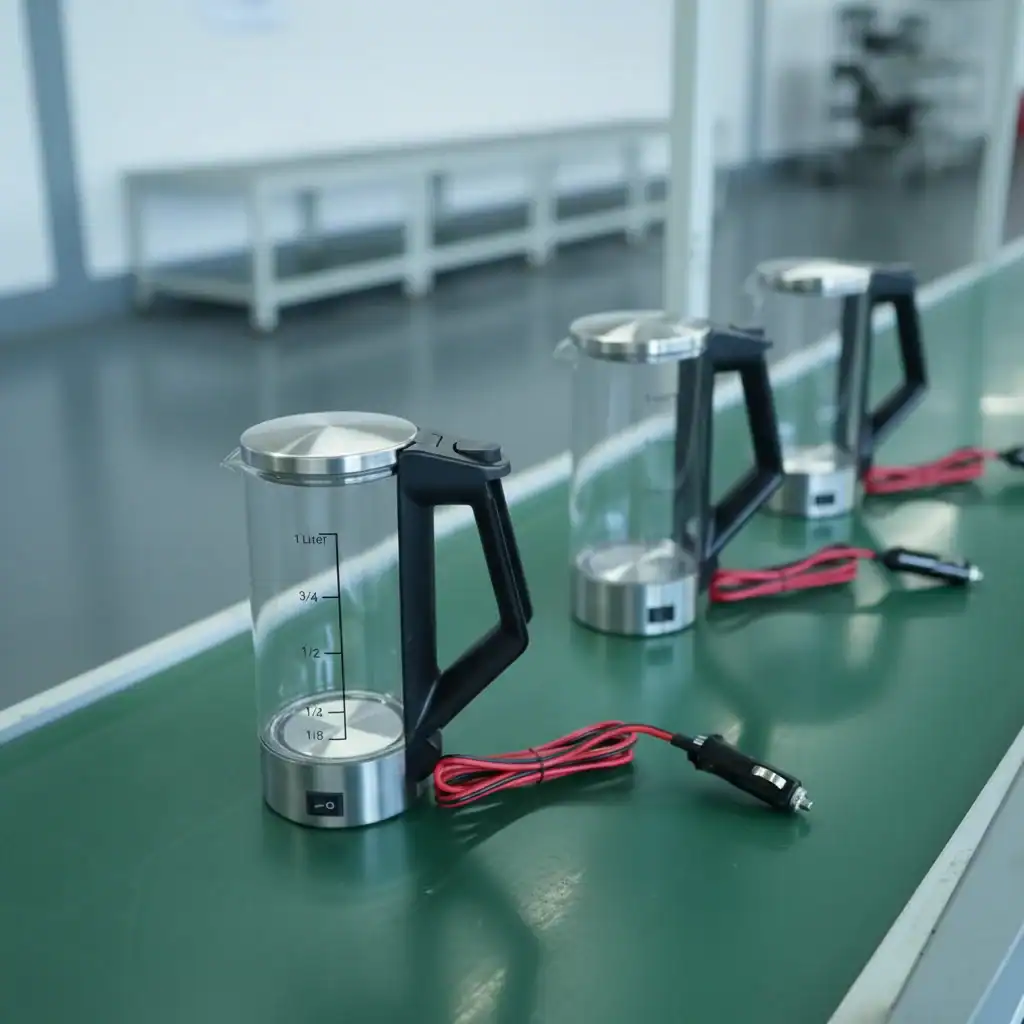
Can We Customize the Heating Curve via Firmware for Different Liquids?
While standard firmware maximizes 12V/24V water boiling efficiency, our smart PCB architecture supports custom algorithms to heat liquids with different viscosities and mineral densities.
Firmware Infrastructure for OEM Development
Our baseline firmware configurations prioritize water boiling efficiency, completing the cycle in approximately 30 minutes for standard 12V and 24V DC kettles. To support diverse commercial applications, the integrated circuit features real-time NTC thermistor monitoring. This hardware foundation gives B2B clients the direct capability to request custom temperature milestones tailored to specific liquids.
Our engineering team programs multiple temperature presets directly into the microcontroller. This approach compensates for the distinct thermal conductivities of non-water fluids, ensuring the hardware applies the exact heat profile required without triggering premature shut-offs.
Adaptive Calibration for Thermal Dynamics
Customizing the thermal cycle requires dynamic algorithms that adapt to specific liquid properties, such as high viscosity or heavy mineral density. We deploy advanced NTC thermistor calibration curves that continuously track heating rates and thermal stability during the active cycle.
When clients need to heat thicker liquids—a frequent request from RV outfitters and long-haul logistics fleets—the firmware automatically modulates power delivery to prevent scorching. These adaptive calibration mechanisms also compensate for standard sensor drift, securing precise heat application across an array of distinct liquid profiles over the product’s lifespan.
Safety Validation and Certification Compliance
Deploying multi-liquid heating profiles demands strict alignment with our hardware safety architecture and international regulatory standards. Our engineering team partners directly with commercial buyers to validate custom heating curves, actively mitigating liability risks well before moving into mass production. This validation process includes several critical steps:
- Synchronizing firmware modifications flawlessly with the KelyLands Triple Safeguard system.
- Testing the recoverable temperature controller and physical dry-boil prevention features under new fluid density parameters.
- Initiating immediate compliance reviews for CE, LFGB, and RoHS standards to uphold baseline product safety requirements.
Do You Use Automotive-Grade Capacitors on the Main Motherboard?
KelyLands integrates AEC-Q200 certified automotive-grade MLCCs to stabilize power delivery across extreme thermal gradients, cutting logic board failure rates by up to 50% in high-vibration commercial vehicle deployments.
Integration of AEC-Q200 Certified Capacitors
KelyLands specifies AEC-Q200 certified automotive-grade capacitors for the logic boards in its EV chargers and 12V/24V appliances to maintain stable power delivery across variable commercial networks.
- We source advanced Multilayer Ceramic Capacitors (MLCCs) that meet strict automotive quality benchmarks to handle severe power fluctuations in evolving 800V EV systems and traditional 12V/24V circuits.
- These components actively manage power spikes and prevent voltage drops during high-demand operations, ensuring consistent performance when running a heavy-duty 300W car kettle or a 22kW charging station.
Extreme Temperature Resilience (-40°C to +125°C)
Motherboards operating in automotive and outdoor environments face severe thermal stress, demanding capacitors built specifically for volatile climates. Standard consumer capacitors degrade rapidly inside vehicle cabins under these rigorous conditions.
We install heavy-duty components rated to function seamlessly across a massive temperature gradient from -40°C to +125°C. This thermal tolerance prevents logic board freezing during winter logistics operations and stops capacitor bulging or venting during summer heatwaves inside parked commercial trucks.
Lifespan Extension and Failure Rate Reduction
Installing automotive-grade components directly extends the operational lifecycle of our in-car ecosystem and smart EV charging units. Our engineering data confirms that upgrading to automotive-grade capacitors drops PCB failure rates by up to 50% compared to standard commercial electronic alternatives.
By implementing these high-end MLCCs across our 2026 smart PCB designs, we confidently back our commercial B2B warranties with hardware engineered for constant high-vibration and high-load durability.
Schlussfolgerung
Integrating precise NTC thermistors and automotive-grade capacitors ensures consistent performance in high-vibration vehicle environments. These reliable PCB designs directly reduce RMA rates while protecting heavy-duty fleet electrical systems from overload conditions. Prioritizing strict electronic tolerances guarantees safety and extends product lifespans for demanding B2B applications.
Evaluate your current procurement strategy to confirm your 12V appliances meet these rigorous vibration and thermal standards. Contact the KelyLands team to discuss OEM customization options or request a technical sample for your quality assurance engineers.
Häufig gestellte Fragen
How accurate is the temperature sensor in the 12v kettle?
The temperature sensor in the 12V kettle utilizes an NTC thermistor that achieves an accuracy of ±1°C. This high level of precision is maintained through single-point calibration, specifically a room-temperature offset, alongside an optimized ratiometric circuit design that actively negates power-supply variations and minimizes self-heating across the operating range.
Can the firmware be updated for custom heating curves?
Yes, the internal microcontroller supports firmware updates to implement custom heating curves. Updates can be deployed via a dedicated internal diagnostic interface or through Over-The-Air (OTA) protocols on connected models, allowing users to precisely tune temperature profiles and hold times for specialized beverage brewing.
Are the internal electronics protected against vehicle vibration?
The internal electronics are rigorously protected against continuous vehicle vibration. The printed circuit board (PCB) is treated with an automotive-grade conformal coating to prevent moisture ingress, and high-mass components are mechanically staked. Additionally, the entire electronics assembly is mounted using vibration-dampening silicone standoffs to prevent solder joint fatigue during off-road or transit use.
What happens if the NTC sensor fails?
If the NTC sensor fails—whether due to an open circuit or a dead short—the microcontroller instantly detects the out-of-bounds resistance value. The system’s hardware failsafe immediately cuts power to the heating element to prevent thermal runaway, and the device triggers a fault mode, displaying an error code or flashing LED sequence to alert the user.

 English
  Español
  Français
  Deutsch
  Português do Brasil
  Русский
  한국어
한국어  日本語
日本語  العربية