 Zum Hauptinhalt springen Zum Footer springen

Choosing the correct Home Wallbox is the critical step separating a safe, code-compliant installation from one that risks overloading your electrical panel or failing a final inspection. The choice between a 7kW and an 11kW charger seems simple, but it carries significant implications for your property’s electrical load, daily charging routine, and long-term energy costs. Selecting the wrong power level can lead to frustratingly slow charging speeds that don’t meet your needs or, conversely, trigger expensive and unplanned electrical service upgrades.
This technical guide provides the data needed to make an informed engineering decision. We will analyze the real-world charging speed calculations to determine if 7kW offers sufficient range per hour for your vehicle and commute. We will also detail the operational necessity of smart features like WiFi connectivity and app scheduling, especially for homes with solar panels. Finally, we will compare hardwired and plug-in installations, focusing on safety standards, electrical code requirements, and long-term reliability.
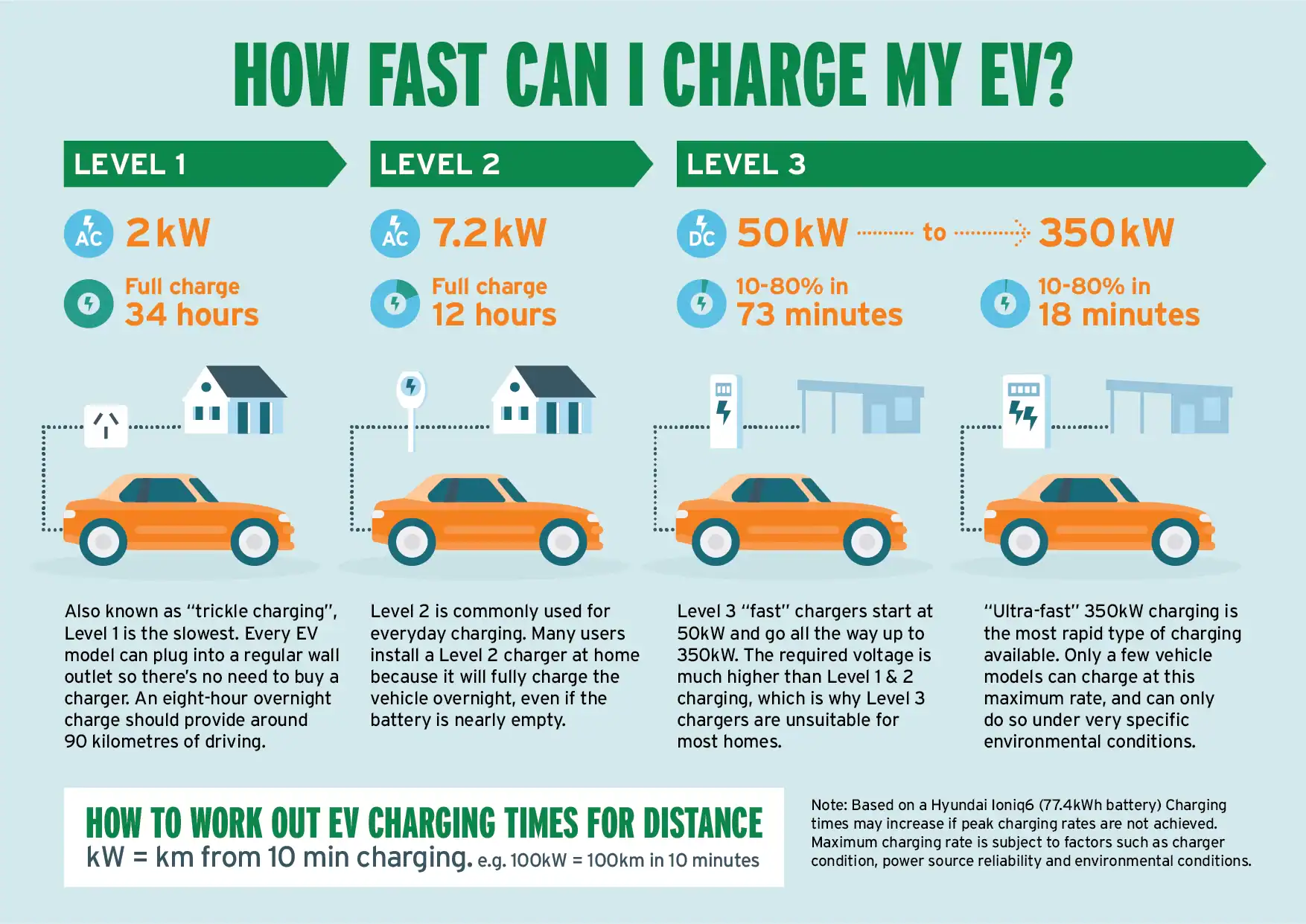
Charging Speed Math: Does 7kW Really Add 25 Miles Per Hour?
The “miles of range added per hour” is a marketing average, not a technical guarantee; real-world charging speed depends entirely on vehicle efficiency, battery state, and the car’s own onboard power limits.
Vehicle Efficiency and Size
The range added per hour is not a fixed number because it’s directly tied to a vehicle’s energy efficiency. Smaller, lighter cars use less energy to travel a mile, so they gain more range from the same 7kW charge. In contrast, larger electric SUVs or trucks are heavier and less aerodynamic, requiring more power to cover the same distance and thus gaining fewer miles per hour of charging.
| Fahrzeugtyp | Typical Efficiency (kWh/100 miles) | Estimated Range Added Per Hour (7kW) |
|---|---|---|
| Compact / Efficient EV | ~24 kWh | ~30 miles (48 km) |
| Mid-Size Electric SUV | ~30 kWh | ~24 miles (38 km) |
| Large Electric Truck | ~40 kWh | ~18 miles (29 km) |
- Highly efficient EVs can add approximately 30 miles of range in an hour.
- Larger, less efficient models typically gain closer to 20 miles of range in the same time.
Battery State and Temperature
Charging speed is dynamic and automatically slows down to protect the battery. The rate is fastest when the battery is at a lower capacity and will decrease significantly as it gets closer to full. This “tapering” effect is most noticeable after the battery reaches an 80% charge. Extreme cold or heat can also cause the vehicle’s battery management system (BMS) to reduce charging speed to prevent damage.
- The fastest charging occurs below the 80% state-of-charge threshold.
- A vehicle’s battery management system adjusts charging speed to regulate temperature and preserve battery health.
The Limiting Power Factor
The actual charging speed is determined by the lowest maximum capacity between the charger and the car’s onboard system. A 7kW home charger cannot force a vehicle to charge faster than its own built-in limit. This is a common bottleneck, especially with older or lower-spec electric vehicles.
- If a vehicle’s onboard charger has a maximum rate of 5kW, it will only draw 5kW of power, even from a 7kW home charger.
- The charging rate is always dictated by the lower of the two capacities: the charger’s output or the car’s acceptance rate.
Smart Features: Why Do You Need WiFi and App Scheduling?
By 2026, a non-connected EV charger is an obsolete asset; smart features directly translate to lower operating costs and prepare a property for future grid integration.
What was once a premium feature is now the industry standard. WiFi and app connectivity aren’t just for convenience—they are core to managing energy consumption efficiently. A smart charger gives an operator or homeowner direct control over when and how a vehicle charges, turning a simple power draw into a managed, cost-effective process. Without this intelligence, you are leaving significant savings on the table and ignoring the charger’s potential role in a larger energy ecosystem.
Automated Scheduling for Lower Electricity Costs
The primary financial benefit of a smart charger comes from automated scheduling. WiFi and app connectivity allow the charger to align with a utility’s time-of-use (TOU) rates, which offer cheaper electricity during off-peak hours (typically overnight). This automated process ensures the vehicle charges at the most economical time without requiring any manual intervention. You set the schedule once, and the charger handles the rest, directly reducing energy bills by avoiding high-cost peak periods.
- Align charging sessions with your utility’s time-of-use (TOU) rates to maximize savings.
- Avoid high-cost peak demand periods for charging.
- Set your schedule once and let the charger automatically start and stop sessions.
| Merkmal | Standard (Non-Smart) Charger | KelyLands Smart Charger |
|---|---|---|
| Cost Management | Manual process; relies on user to plug in during cheap rate periods. | Automated TOU scheduling via app to guarantee lowest-cost charging. |
| Energy Monitoring | No data provided; energy use is unknown until the utility bill arrives. | Real-time session data (kWh consumed) and historical reports in the app. |
| Grid & Home Integration | Isolated appliance; cannot interact with solar or home energy systems. | Supports solar matching and Dynamic Load Balancing (DLB) to prevent overload. |
Real-Time Monitoring and Remote Control
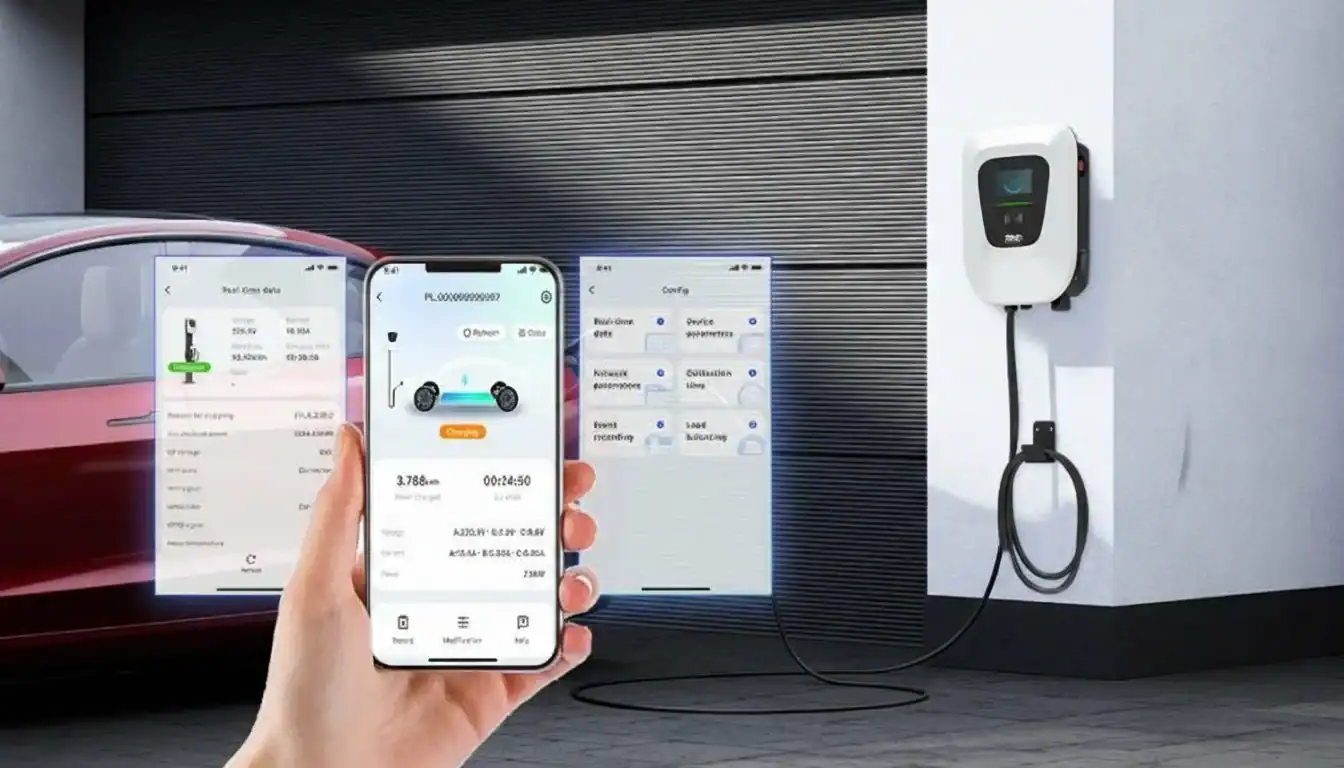
A mobile app provides complete visibility and control over charging sessions from any location. This remote access is practical for checking charging status without going to the garage, but its real value lies in data transparency. You can see precisely how much energy each session consumed, track costs, and adjust settings on the fly. This level of control is essential for fleet managers tracking expenses or homeowners who want to understand their energy usage patterns.
- Track live energy consumption in kWh for each session.
- Start, pause, or stop charging remotely through the app.
- Receive notifications on your phone when charging is complete or if an issue occurs.
Integration with Home and Grid Energy Systems
Smart chargers are designed to function within a larger energy ecosystem. They can communicate with home solar installations to use only excess solar power for charging, maximizing self-consumption of clean energy. They are also built to participate in utility demand-response programs, where the charger can automatically pause or slow its charging rate during grid-wide peak demand events. This bidirectional communication helps stabilize the electrical grid and often provides financial incentives to the charger’s owner.
- Connects with home solar systems to charge your EV with self-generated clean energy.
- Supports grid stability by pausing or slowing charging during high-demand events.
- Enables bidirectional communication between your charger, home, and the grid for smarter energy management.
Boost Your Brand with Smart EV Chargers

Solar Matching: Can It Charge Using Only Excess Solar Power?
Yes, modern smart EV chargers can isolate and use only surplus solar energy, a feature known as solar matching that maximizes self-consumption and prevents unnecessary grid imports for EV charging.
How Solar Matching Works
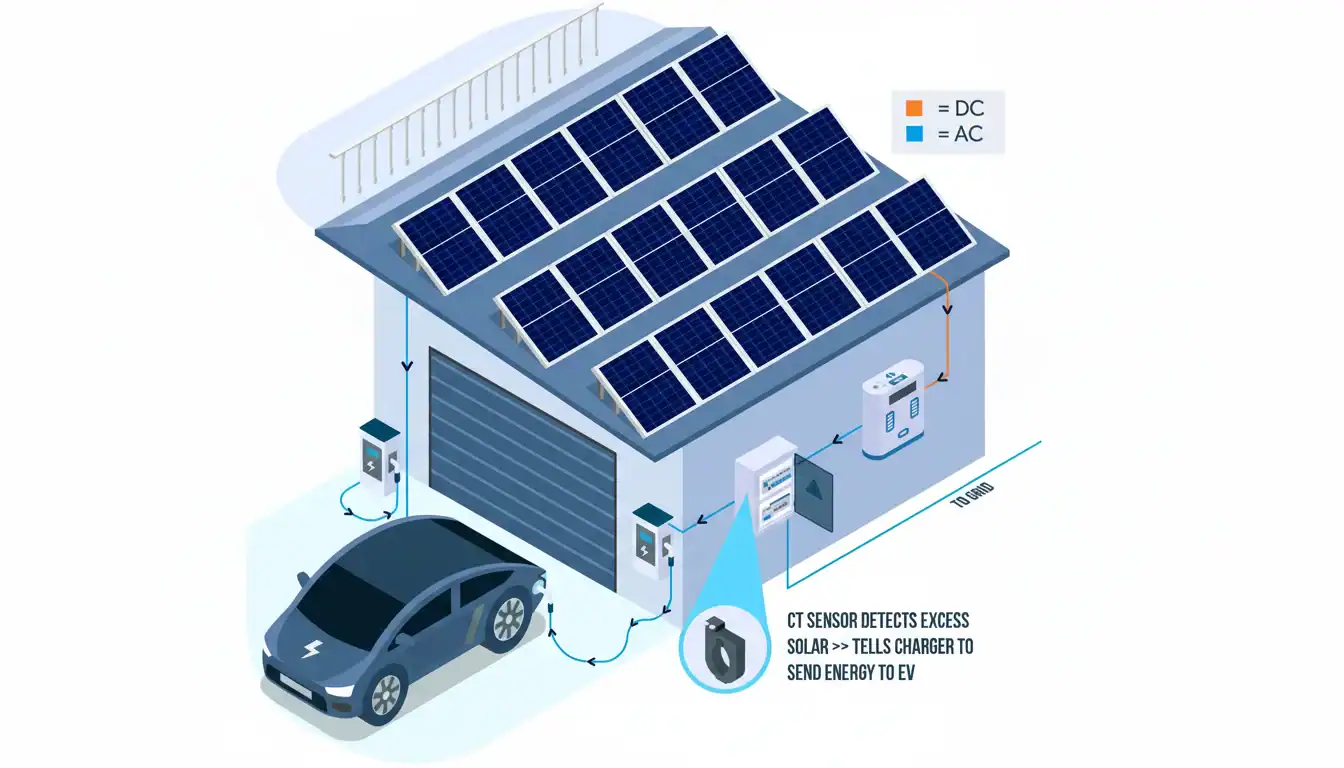
A smart EV charger communicates directly with a home energy monitor to enable solar-only charging. The system constantly measures your solar panel production against your home’s real-time energy consumption. It then directs only the surplus electricity—the power that would otherwise be exported to the grid—to charge your electric vehicle. This ensures you are using 100% free, self-generated energy to power your car.
- The charger’s power output adjusts dynamically in real-time to match the available excess solar energy, from a slow trickle to its maximum rate.
- Your home appliances are always prioritized; the EV only receives the leftover electricity after all other household needs are met.
- This process optimizes self-consumption, converting the free energy you generate into usable range for your vehicle instead of selling it back to the utility for minimal credit.
Key Components for an Effective System
To enable charging with only excess solar, specific hardware must create a coordinated home energy ecosystem. A standard Level 2 charger cannot perform this function on its own because it lacks the necessary communication and load management capabilities.
- A smart EV charger equipped with adaptive or dynamic load balancing features.
- An energy monitoring system, which typically uses current transformer (CT) clamps installed inside your main electrical panel to measure power flow.
- An automation platform or dedicated mobile app that allows the charger and monitor to communicate and execute predefined charging rules.
Handling Variable Solar Conditions
Solar production fluctuates constantly with weather conditions like passing clouds. Advanced solar matching systems are engineered to handle this variability without repeatedly starting and stopping the charging session, which can be inefficient and put stress on the vehicle’s onboard charger.
- Many systems use a buffer or delay, waiting for a stable period of surplus energy before initiating a charging session to avoid intermittent starts and stops.
- Hybrid modes can automatically blend solar and grid power to maintain a consistent, minimum charging speed if the sun is inconsistent.
- Some chargers allow you to set a minimum solar surplus threshold (e.g., 1.4 kW) before charging begins, ensuring the session is meaningful and effective.
Future of Solar Charging and Home Energy
The integration between EV charging and home solar is evolving quickly. Future systems will provide far greater control and flexibility, transforming the EV from a simple load into an active component of the home’s energy management strategy.
- Vehicle-to-Grid (V2G) technology will allow an EV to power your home during a grid outage or send energy back to the grid to support it during peak demand.
- Tighter integration with home battery storage will let you store excess solar power in a stationary battery and use it to charge your EV at night or on cloudy days.
- Advanced microgrid architectures will give homeowners the tools to become more independent from the main electrical grid, balancing generation, storage, and consumption seamlessly.
Hardwired vs. Plug-in: Which Installation Method Is Safer?
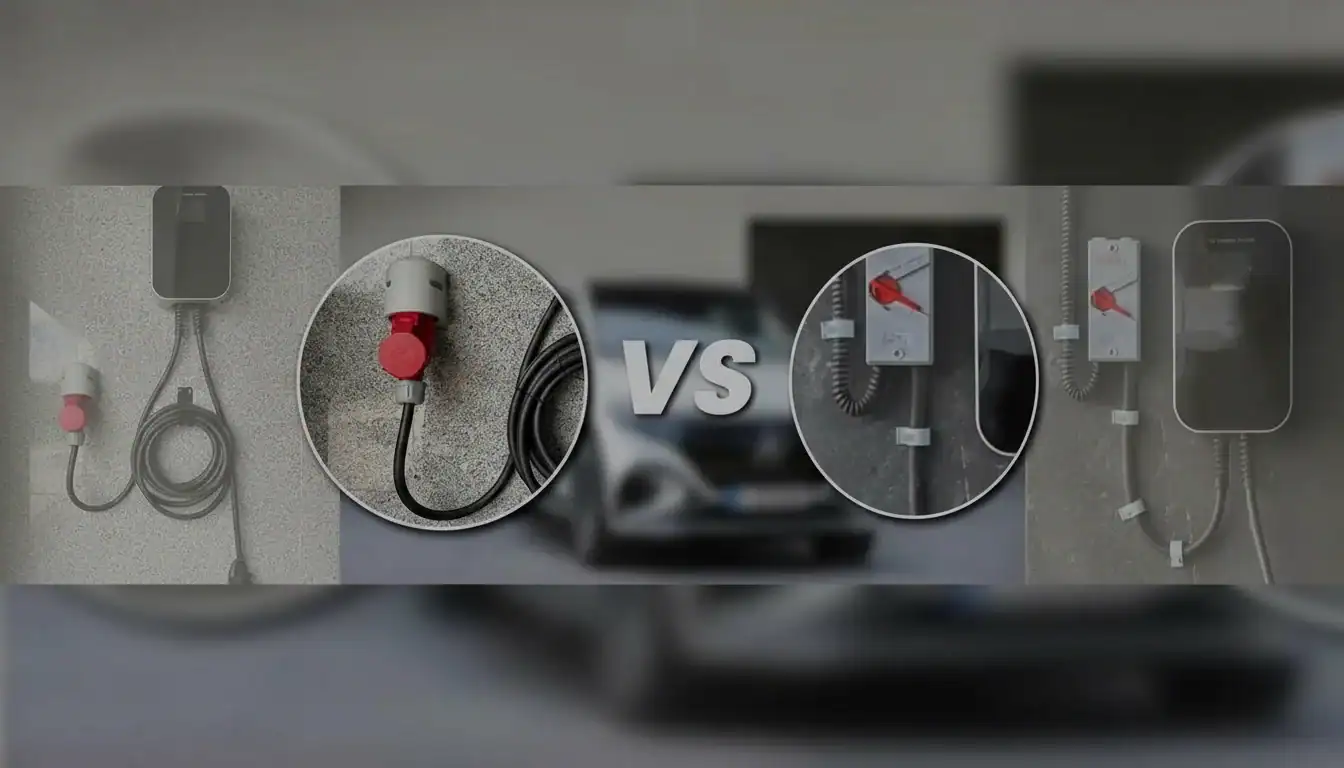
Hardwired installations offer superior long-term safety and weather resistance, while plug-in chargers provide a flexible, code-compliant alternative for renters or situations where a suitable outlet already exists.
Hardwired Installation: The Permanent Safety Standard
A hardwired installation directly connects the EV charger to your home’s electrical panel, creating a permanent and highly stable link. This method is the industry gold standard for long-term safety and performance, especially for homeowners who don’t plan on moving. It is the most robust solution for daily, heavy use.
- Eliminates the wear and tear on outlets from repeatedly plugging and unplugging a heavy-duty cable.
- Reduces the risk of loose connections, a common source of overheating and potential fire hazards over time.
- Integrates directly with GFCI breakers at the panel for a reliable and centralized safety shutoff mechanism.
Plug-in Chargers: A Flexible and Cost-Effective Choice
Plug-in EV chargers offer a safe and convenient alternative, particularly for renters or anyone who might move in the future. Their safety is entirely dependent on a correctly installed industrial-grade 240V outlet and a certified charger. When installed to code, they provide reliable performance without the permanence of a hardwired unit.
| Merkmal | Hardwired Installation | Plug-in Installation |
|---|---|---|
| Connection Type | Permanent, direct link to circuit breaker | Connects via a 240V industrial outlet |
| Long-Term Safety | Higher; no outlet wear or loose connection risk | Safe; dependent on outlet quality and proper use |
| Bester Anwendungsfall | Homeowners, outdoor setups, maximum reliability | Renters, future relocations, existing outlets |
| Tragbarkeit | Not portable; fixed to the property | Easily unplugged and moved |
- Offers the flexibility to easily take the charger with you if you relocate.
- Installation can be less expensive if a suitable 240V outlet is already available, reducing labor time.
- Safety is assured when using a UL-certified charger with an outlet installed to current electrical codes by a qualified electrician.
Weather Resistance for Outdoor Installations
When installing a charger outdoors, the connection method plays a critical role in its durability and safety against the elements. Hardwired systems create a sealed, weatherproof enclosure that offers a more robust defense against moisture, dust, and temperature changes compared to a plug-in connection.
- A hardwired connection is fully sealed from the conduit to the unit, protecting internal components from rain, snow, and dust.
- Plug-in connections, even with weather-rated outlets, can create a potential entry point for moisture, increasing the risk of short circuits in harsh conditions.
- Hardwired units are better suited for regions with extreme weather, ensuring reliable charging year-round without compromising safety.
Schlussfolgerung
Choosing the right EV charger depends on the home’s electrical system, the vehicle’s capabilities, and the user’s charging habits. Understanding the differences in speed, smart features, and installation methods allows you to recommend the safest and most efficient solution. This knowledge ensures your clients get a reliable charger that meets their specific needs.
To review the technical specifications for our 7kW and 11kW smart chargers, contact our team to request a product catalog. We can help you select the ideal models and discuss OEM options for your projects.
Häufig gestellte Fragen
How much to install an EV charger at home?
The total cost for a home EV charger installation typically ranges from $1,100 to $2,100. This is broken down into two main parts: the charger hardware, which costs between $500 and $900 for a reputable Level 2 smart charger, and the professional installation by a certified electrician, which can range from $600 to over $1,200. Installation costs vary based on the home’s existing electrical system, the distance from the panel to the charger location, and whether a circuit or panel upgrade is required.
Can I install a fast EV charger at home?
While you cannot install a commercial-grade DC Fast Charger (50kW+) at home due to residential power limitations, you can install a powerful Level 2 charger, which is the fastest and most common home solution. The industry standard is a 7kW charger, which provides about 25-30 miles of range per hour. Some homes with sufficient electrical capacity can support higher-powered Level 2 units (up to 19.2kW), but this requires a specific vehicle and a robust home electrical service, often with significant upgrades.
Does an EV charger increase home value?
Yes, installing a home EV charger is increasingly seen as a valuable upgrade that enhances a property’s marketability and value. As electric vehicle adoption becomes standard, a pre-installed Level 2 charger is a significant convenience and a key selling point for a growing number of homebuyers. While it may not have a direct dollar-for-dollar return on investment, it broadens the home’s appeal, can lead to a faster sale, and positions the property as modern and future-ready.
How long to install an EV charger at home?
The physical installation of a home EV charger by a qualified electrician is typically completed in 2 to 4 hours for a standard setup. This assumes the charger is located near the main electrical panel with no major complications. More complex installations that require running long conduits, wall fishing, or a main panel upgrade can take a full day, ranging from 6 to 8 hours or more.

 English
  Español
  Français
  Deutsch
  Português do Brasil
  Русский
  한국어
한국어  日本語
日本語  العربية