 Saltar al contenido principal Saltar al pie de página

Retailers and distributors often struggle with the trade-off between battery life and suction power in the floor care market. Corded stick vacuums eliminate these runtime constraints by using direct power to deliver 600W of motor performance in a lightweight 1.4kg frame. These units provide a reliable alternative for consumers who want the agility of a stick vacuum but require the deep-cleaning capability of a traditional mains-powered motor.
This guide breaks down the technical benchmarks of the AC stick niche, from 18,000Pa suction ratings to the ergonomics of self-standing vs. top-heavy designs. We examine how liquid cooling technology keeps slim motors efficient and why the $40 retail price point remains a high-volume target for 2026 inventory. By understanding these hardware specifications and thermal management strategies, B2B buyers can better position these tools for budget-conscious households.
The Market Gap: Stick Convenience without Charging
Corded stick vacuums bridge the gap between heavy uprights and battery-limited cordless models. These tools provide a lightweight 1.4kg to 1.7kg form factor while delivering consistent 600W AC power. This 2026 market segment prioritizes unlimited runtime and high suction pressure, often exceeding 18,000Pa, for complete room cleaning without recharging delays.
Stick Vacuum Portability with Continuous Power
Corded designs eliminate the 20-40 minute runtime constraints typical of 2026 cordless batteries. By drawing power directly from a wall outlet, these machines avoid the performance degradation that occurs as lithium-ion cells lose charge. A cord range between 16ft and 21ft facilitates whole-room cleaning while keeping the machine weight between 1.4kg and 1.7kg, allowing users to move the unit easily across different levels of a home.
The 3-in-1 handheld conversion provides the maneuverability of a portable unit with the reliability of a mains-powered motor. This design allows for quick transitions from floor cleaning to upholstery or ceiling vents without the weight of an internal battery pack. These units offer the convenience of a stick vacuum with the endurance of a traditional upright, meeting the needs of users who require sustained cleaning power for larger floor plans.
Suction Benchmarks and Motor Efficiency
Standard 600W AC motors in this category consistently generate 12,000Pa to 18,000Pa of sealed suction, frequently outperforming mid-range battery-powered units. Technical data indicates that high-efficiency airflow metrics reach over 100 CFM, ensuring effective debris pickup across hard floors and low-pile carpets. These motors maintain high water lift and pressure levels throughout the entire cleaning session, effectively handling large particles without scattering.
Washable HEPA filtration systems and 0.5L to 1.0L dustbins provide industrial-grade air cleaning in a consumer-friendly frame. Systems like those found in the Duronic VC9 or BLACK+DECKER Powerseries+ emphasize cost efficiency by using reusable filters and easy-empty bins. Engineering logic focuses on kPa pressure and CFM airflow to ensure that these compact motors deliver deep-cleaning results that align with professional performance benchmarks.
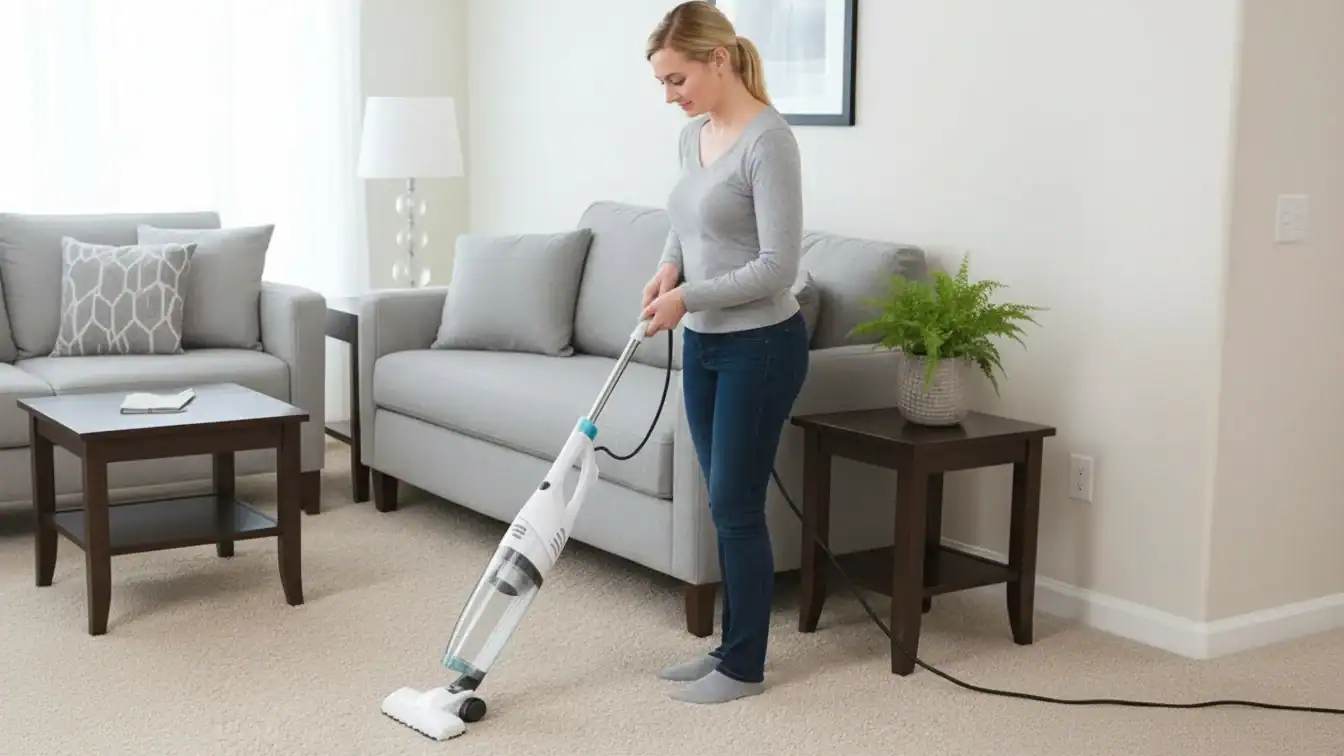
Motor Specs: 600W AC vs. 150W DC
Standard 600W AC motors provide high-pressure suction reaching 15-18 kPa for carpets and pet hair, whereas 150W equivalent units favor portability and basic hard-floor maintenance. High-wattage designs prioritize airflow and deep cleaning, while low-wattage motors enable ultra-lightweight 3.7 lb frames for quick tasks.
Suction Pressure and Cleaning Performance Benchmarks
600W AC corded motors generate approximately 15 kPa of suction pressure, which provides the necessary force for extracting debris from rugs and thick carpets. 150W motors, often rated as 1.2 Amp AC units, produce lower airflow suitable for stairs and surface-level hard floor cleaning. Performance validation relies on air watts, a metric calculated by measuring the ratio of cubic feet per minute (CFM) to water lift height. High-output motors like the 600W variant enable 10-inch to 12-inch wide cleaning paths without losing suction at the edges.
Technical Specifications and Design Engineering Trade-offs
Physical weight varies from 3.7 lb for 150W handheld hybrids to 8.6 lb for 500W-600W full-sized stick models. Manufacturing standards utilize ISO 9001:2015 protocols to ensure motor thermal stability during sustained high-wattage operation. High-power AC motors typically pair with 0.8-gallon dirt cups and 25-foot power cords to manage entire room cleaning sessions without interruption. Engineering durability for 600W units often supports 5-year limited warranties, while lower-power motors prioritize cost-effective retail pricing for light-duty tasks.
Center of Gravity: Motor Down (Self-Standing) vs. Motor Up
Weight distribution determines a vacuum’s usability and storage requirements. Placing the motor at the base creates a low center of gravity that enables self-standing stability, while a motor-up configuration shifts weight toward the hand to increase maneuverability for high-reach cleaning and agile floor movements.
Ergonomic Advantages of Freestanding Design
Low center of gravity models like the Intercleaner 1701 position the motor at the base to enable self-standing capabilities. This configuration allows the unit to stand upright independently without wall support or leaning against furniture. Users experience less physical strain because they do not need to bend over to retrieve the vacuum after brief interruptions during a cleaning session. The 15.47 x 8.46 x 5.59-inch footprint of these units provides a stable foundation for the 3 lb frame.
Current market trends for 2026 show a growing preference for freestanding corded sticks in rental properties. These environments often prohibit wall-mounted brackets, making a self-standing design a practical necessity. The weight distribution at the base provides a grounded feel on hard surfaces, which helps the vacuum maintain a straight path and reduces the “wandering” effect seen in lighter, top-heavy models. This stability improves overall control when navigating long hallways or open floor plans.

Maneuverability Metrics for Motor-Up Configurations
Motor-up designs, seen in models like the Dyson DC62, shift the center of gravity toward the grip to make lifting easier for ceiling and upholstery tasks. Total unit weights in this category range from 3 lb to 4.4 lb, but the motor placement significantly alters the moment of inertia. By concentrating the mass near the hand, designers reduce the effort required to swivel the floor nozzle. This agile configuration allows for rapid directional changes and more responsive steering around chair legs and corners.
While motor-down units focus on stability, motor-up configurations often utilize a slimmer floor nozzle profile. This design choice grants better access to tight spaces under low-clearance furniture. Technical teams at KelyLands balance 20,000Pa suction power with this handle-heavy feel to ensure the vacuum remains effective for overhead cleaning. Heavier options, like the 4.4 lb VonHaus 800W or the 4 lb Eureka NES312, prioritize different ergonomics but follow the same principle of shifting mass to improve handheld versatility over freestanding convenience.
Scale Your Brand with Custom OEM/ODM Home Vacuum Solutions

Heat Management: Cooling AC Motors in Slim Bodies
Engineers manage heat in slim AC motors by utilizing liquid cooling (IC71W) and fanless enclosure designs, which reduce unit size by up to 55%. These systems leverage low-loss windings and Class H insulation to maintain IE3 efficiency while keeping noise levels between 60-80 dB(A) without traditional bulky fans.
Enclosure Design and Thermal Dissipation Techniques
Integrating IC71W liquid cooling into the motor housing enables fanless operation, allowing a weight and size reduction of 25% compared to air-cooled IP55 models. In frame sizes ranging from 315 mm to 500 mm, this liquid-cooled approach can reduce dimensions by up to 55% when compared to air-to-water exchangers. Utilizing Totally Enclosed Non-Ventilated (TENV) and Totally Enclosed Fan Cooled (TEFC) enclosures prevents dust circulation, which is vital for maintaining performance in the restricted airflow environments of slim-profile vacuum chassis.
Modern designs use low-loss windings to minimize internal heat generation at the source. This thermal optimization allows for the use of rotatable IP66 terminal boxes and square-frame formats that align with DC motor dimensions. These configurations fit 600W AC power into low-profile housing while dissipating heat via an external liquid circuit rather than relying on internal air volume.
Efficiency Benchmarks and Protective Standards
Slim AC motors maintain IE3 premium efficiency across power ratings from 150 kW to 1500 kW by maximizing power-to-heat ratios. To protect motor integrity during frequency adjustments, engineers apply Class H insulation that exceeds NEMA MG-1 Part 31 specifications. These standards ensure the motor survives high thermal loads and voltage spikes associated with adjusted frequency power without degrading the winding life.
Liquid-cooled systems support constant torque from 0-50 Hz without the need for derating, even within compact IP55 or IP56 enclosures. Removing mechanical fans reduces operational noise to 60-80 dB(A) LpA and minimizes mechanical vibration. This reduction is particularly beneficial in handheld configurations where user comfort and high output are equally prioritized.
Price Strategy: The $40 Retail King
The $40 price point represents a strategic entry-level tier where manufacturers prioritize high-volume sales through simplified AC motor engineering. By eliminating expensive battery components, these models offer 500W to 600W of power at a fraction of the cost of cordless alternatives, making them ideal for high-traffic discount retail environments.
| Hardware Component | Budget Tier Benchmark | Strategic Impact |
|---|---|---|
| Motor Configuration | 500W–600W AC | Achieves 12kPa suction without battery costs |
| Chassis Material | 8.2 lbs (ABS/PC Plastic) | Reduces global shipping and logistics expenses |
| Filtration System | 1L / HEPA Filter | Minimizes ongoing maintenance for consumers |
Retail Positioning for High-Volume Discount Segments
Retailers use the under-$50 category in major hardware and department stores to capture impulse buyers and budget-conscious households. These 3-in-1 lightweight models serve as secondary cleaning tools that offer higher reliability than low-end cordless units which often suffer from battery degradation. Manufacturers utilize factory-direct OEM/ODM models with low minimum order quantities (MOQs) to help B2B distributors maintain competitive margins in saturated markets. Providing 4-5 year warranty standards in this segment builds consumer trust while avoiding the technical failure risks associated with aging lithium-ion cells.
Technical Benchmarks for Budget-Tier Performance
Engineers standardize 500W to 600W AC motor configurations to provide up to 28kPa of suction power. This approach bypasses the manufacturing expense of DC brushless systems used in more expensive cordless models. Designers implement 1L bagless dust canisters and washable foam filters to keep consumer maintenance costs low. Using durable ABS and PC plastics keeps the chassis weight at approximately 8.2 lbs, which optimizes global logistics and shipping efficiency. Cord length benchmarks remain between 16 and 25 feet to balance material costs with functional cleaning reach. Adopting 8.5-inch cleaning paths with swivel head functionality ensures these devices remain versatile on both hard floors and carpets.
Reflexiones finales
Corded stick vacuums offer a practical middle ground for users who want strong suction without the weight of a traditional upright or the time limits of a battery. These machines deliver steady 600W power to handle entire floors, ensuring the suction never drops during a session. By removing expensive lithium-ion cells, manufacturers focus on raw performance and motor longevity.
Choosing between a self-standing motor-down design and a nimble motor-up configuration depends on the specific layout of a home. The low retail cost makes these units accessible as either primary tools for small apartments or reliable backups for larger houses. As motor cooling technology improves, these slim devices will continue to provide high-pressure cleaning that rivals much more expensive cordless alternatives.
Preguntas frecuentes
Does the corded stick vacuum feature a low center of gravity?
Yes. Many designs integrate the motor into the handheld base at the bottom of the 46-inch stick. This placement creates a lower center of gravity, which improves maneuverability and reduces the effort required to steer the unit.
How does the vacuum prevent the motor from overheating?
The units include thermal protection systems, such as suction bleed valves. These valves activate automatically if a filter clogs or a blockage occurs, allowing airflow to reach the motor and prevent heat damage.
Is the unit capable of standing upright independently?
Most models utilize a rigid stick structure and a low-mounted motor that allows them to be self-standing. This design enables the vacuum to remain upright when not in use, simplifying storage and temporary pauses during cleaning.

 English
  Español
  Français
  Deutsch
  Português do Brasil
  Русский
  한국어
한국어  日本語
日本語  العربية