 Saltar al contenido principal Saltar al pie de página

Effective cable management for EV charging is the first line of defense against premature equipment failure, site liability, and operational downtime. A charging cable left on the ground is more than just an eyesore; it’s a trip hazard for employees and customers, and it’s constantly exposed to being crushed by vehicle traffic. This daily abuse degrades the cable jacket and damages the sensitive connector pins, leading to costly repairs and unreliable charging sessions that frustrate drivers and hurt your bottom line.
This guide provides a technical breakdown of the hardware designed to solve these problems. We will analyze the mechanics of overhead cable retractors for keeping garage and depot floors clear, explain the critical role holsters play in protecting the connector head, and compare the functional differences between spiral and straight cables for daily use. The goal is to equip facility managers and installers with the information needed to specify a safe, durable, and user-friendly charging setup.
The “Garden Hose” Problem: Why Are Cables So Heavy and Dirty?
The physical requirements for safe power delivery—heavy copper wiring and durable insulation—make EV charging cables inherently heavy, dirty, and difficult to manage, creating a daily usability challenge.
Copper Wiring and Insulation: The Source of Cable Weight
The substantial weight of an EV charging cable isn’t a design flaw; it’s a direct consequence of the materials needed to safely transmit high electrical currents over several hours. At its core is a set of thick copper conductors, which are necessary to manage heat and electrical resistance. These conductors are then wrapped in multiple layers of heavy, protective insulation to ensure durability and operational safety during constant daily handling.
- High-amperage charging demands large-gauge copper wiring to prevent overheating, and this copper forms the majority of the cable’s total weight.
- Durable outer sheathing, usually a thermoplastic or rubber compound, provides critical weatherproofing and protects against abrasion, adding significant mass to the final product.
- Beyond the main power wires, modern cables also contain smaller communication conductors that facilitate the data handshake between the charger and the vehicle, which further increases the cable’s overall thickness and weight.
Why Cable Jackets Attract Dust and Grime
EV charging cables spend their lives on garage floors, driveways, and public parking surfaces. The material properties of their outer sheathing make them magnets for any dirt, dust, and oil they encounter. This grime is then easily transferred to a user’s hands, clothes, and vehicle during handling.
- The flexible polymer used for the outer jacket has a slightly porous or textured surface that readily picks up dust, mud, grease, and other debris from the ground.
- Dragging the cable to and from the vehicle ensures that this grime accumulates along its entire length.
- This buildup makes the cable unpleasant to handle and creates a real risk of dirtying the user and the car’s trunk or interior where the cable is often stored.
The Daily Hassle of Managing Heavy, Unwieldy Cables
The combination of significant weight and length makes EV cables cumbersome to use and store neatly. This leads to cluttered garages and can turn the simple daily routine of plugging in and unplugging into a frustrating task. The cable’s tendency to tangle and resist coiling—the “garden hose” effect—complicates storage and retrieval for every charge cycle.
- Coiling a heavy and stiff cable requires physical effort, a problem that gets much worse in cold temperatures when the jacket material becomes less flexible.
- Without a dedicated holster or retractor system, cables are often left in a pile on the floor, creating a persistent trip hazard and a messy appearance.
- Many users find that the cable fights back when being coiled, tangling and kinking just like a stubborn garden hose, which discourages proper storage.
Cable Retractors: Can Overhead Systems Save Your Garage Floor?
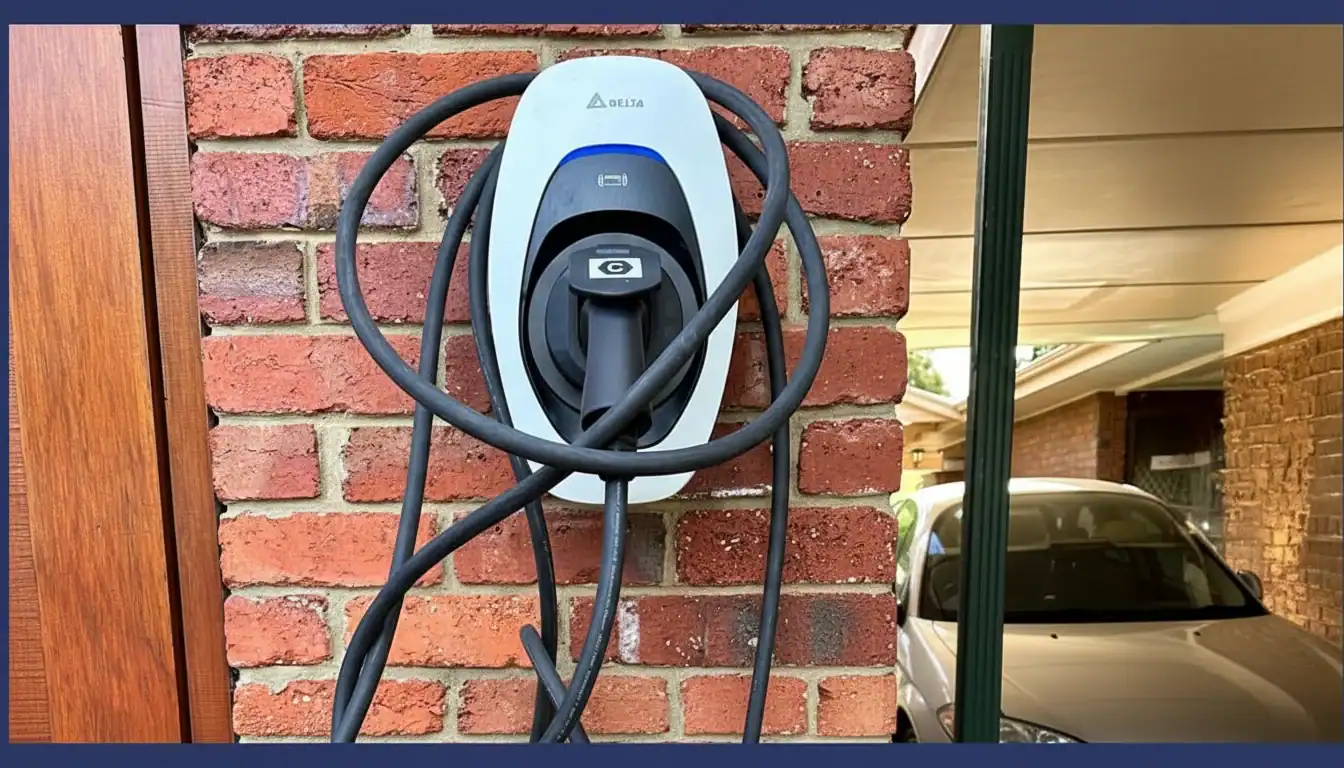
Overhead systems offer a clean solution to cable clutter, but the market lacks purpose-built residential retractors, forcing a choice between inadequate static storage and overkill industrial equipment.
The Data Gap on Garage-Specific Retractors
There is a clear absence of market data for cable retractors designed specifically for home EV charging. Searches for overhead garage solutions typically yield two unrelated categories: general-purpose storage shelves for boxes and industrial-grade cable management systems for factory floors. No information points to manufacturers or products purpose-built to lift and store a single EV charging cable in a residential setting. This makes a direct comparison of available products impossible, as the niche itself is largely unserved by mainstream manufacturers.

General Overhead Storage vs. Active Cable Management
The overhead racks and shelving found in market research are passive, static storage solutions. They are meant for holding items that are not in daily use, like seasonal equipment. These systems do not solve the core problem of managing an EV cable during and after charging. A true solution requires an active management device—one with a mechanism to retract the cable off the floor after use or suspend it safely during charging, rather than just a shelf to store it on.
| Característica | Static Storage (Shelves/Hooks) | Ideal Residential Retractor |
|---|---|---|
| Uso principal | Passive storage of coiled cable | Active management and suspension of cable during/after use |
| Floor Clutter | Does not solve the problem; cable is still on the floor during charging | Eliminates floor clutter and tripping hazards entirely |
| Complexity & Cost | Low complexity, low cost | Moderate complexity, moderate cost |
| Market Availability | Widely available | Very limited; mostly DIY or repurposed industrial solutions |
Why Industrial Systems Don’t Translate to Home Garages
Sophisticated cable management systems exist for industrial settings like data centers and manufacturing plants, but they are not a practical solution for homeowners. These systems are engineered to manage hundreds of cables simultaneously and are built to withstand heavy industrial use. Their complexity, physical size, and high cost are prohibitive for a single-vehicle home charging setup. The core need in a residential garage is a simple, safe, and semi-automated retractor, which is a fundamentally different product from a large-scale industrial cable carrier.
Boost Your Brand with OEM EV Chargers.
Holsters & Docks: Why Is Protecting the Plug Head Critical?
A dedicated holster is not just for tidiness; it’s a critical component for preventing physical damage, weather corrosion, and electrical faults that cause costly repairs and safety hazards.
Preventing Physical Damage and Wear
The EV plug head is handled daily and is vulnerable to accidental drops, impacts, or being run over by a vehicle. A dedicated holster or dock provides a secure housing that absorbs shock and protects the connector pins and plastic casing from cracks and breakage. Without this protection, you risk expensive repairs or a full cable replacement.
- A dropped plug can easily crack, exposing sensitive internal wiring and creating an immediate safety risk.
- Connector pins can bend or break if stepped on or crushed, which prevents a secure link with the vehicle’s charge port and can interrupt charging.
- By 2026, protecting charging equipment from user mishandling is a standard practice for reducing maintenance costs at both home and public stations.
Shielding Connectors from Weather and Debris
When left on the ground, the plug’s electrical contacts are exposed to moisture, dust, dirt, and even insects. A holster shields these critical components, preventing corrosion and blockages that disrupt charging, reduce efficiency, or cause connection failures over time.
- Moisture from rain, snow, or humidity is a primary cause of contact corrosion, leading to poor conductivity and potential short circuits.
- Dust and small debris can accumulate inside the connector, obstructing the pins and causing intermittent charging errors.
- A well-designed dock holds the plug head facing downward, allowing any condensation or moisture to drain away naturally.
Maintaining Electrical Integrity and Safety
The physical condition of the plug head is directly linked to its electrical safety and performance. Damage to the pins or housing compromises insulation and creates poor connections, which introduces risks of overheating or electrical arcing. A holster ensures the plug remains in optimal condition for safe, reliable operation.
- Clean, straight pins ensure a solid electrical connection, which is essential for consistent and safe power delivery at any amperage.
- Properly seating the plug in a holster helps prevent arcing faults that can occur from loose or contaminated connections.
- Keeping the plug grounded and shielded is a fundamental requirement for the long-term reliability of any charging equipment.
Reducing Trip Hazards and Promoting Organization
A charging cable left lying on the garage or driveway floor creates a significant trip hazard. A holster provides a designated, off-the-ground storage spot for the plug, keeping the area tidy, organized, and safer for everyone.
- Storing the plug in a dock keeps the cable neatly managed and clears the walking path.
- An organized charging setup reduces clutter and minimizes the risk of the cable becoming tangled or damaged from being run over.
- In shared environments like workplaces or apartment buildings, proper cable storage is essential for maintaining a safe and accessible space for all users.

Spiral vs. Straight: Which Cable Type Is Better for Daily Use?
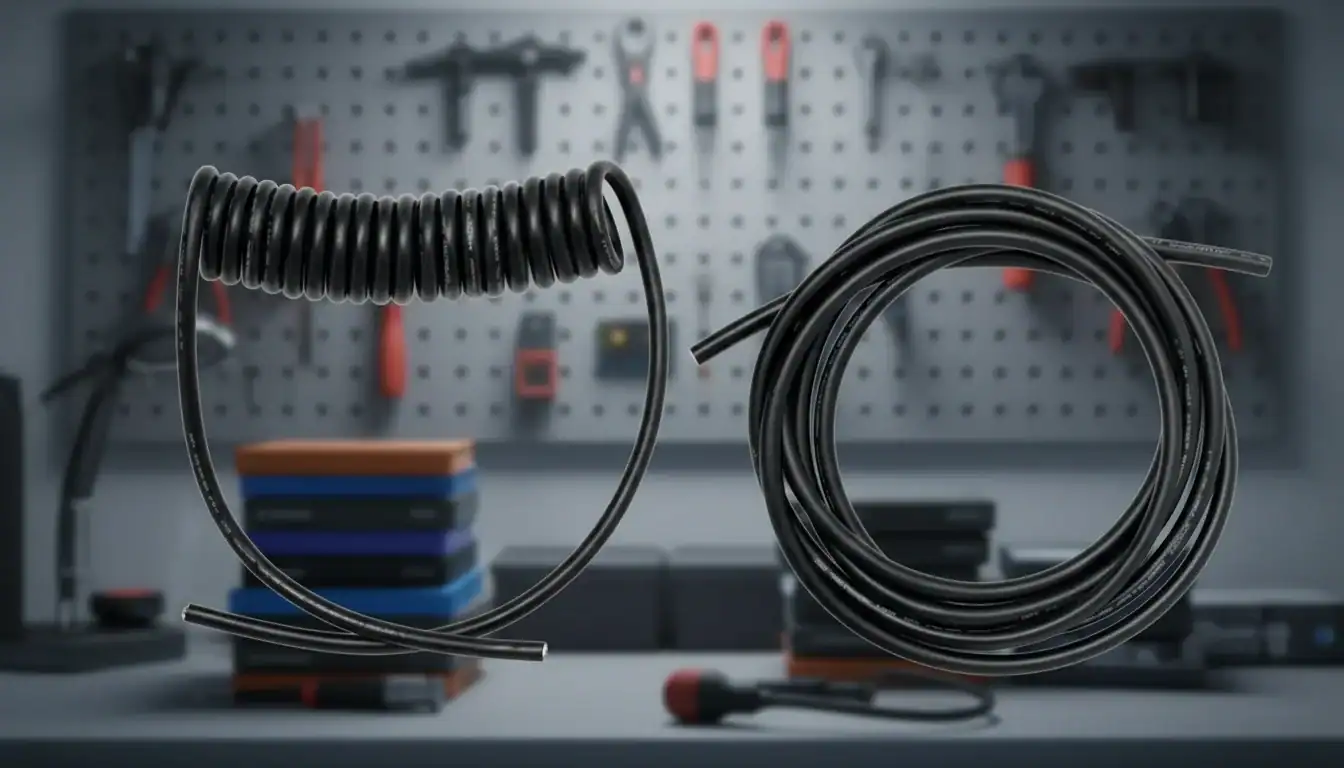
The market no longer debates which cable is universally superior; instead, selection is driven entirely by application. Spiral cables solve for dynamic, space-constrained environments, while straight cables deliver maximum reach and cost-efficiency in fixed installations.
Storage and Space: The Compact Advantage of Spiral Cables
Spiral cables are engineered for environments where clutter is a liability. Their coiled design is self-retracting, which keeps excess cable off the ground and prevents the tangles common with long straight cables. This characteristic is critical in busy commercial garages or home setups with limited floor space, as it minimizes trip hazards and simplifies storage. The cable naturally contracts to a fraction of its extended length, making it ideal for mobile applications or charging stations that need to maintain a clean, professional appearance.
Reach and Fixed Installations: Where Straight Cables Excel
For static installations, straight cables are the industry standard. They provide the maximum possible reach for their given length without the inherent tension of a coiled cable. This makes them the go-to choice for permanent home wallbox chargers or industrial machinery where the distance between the power source and the EV is fixed and predictable. From a manufacturing perspective, straight cables are also more cost-efficient to produce, particularly for longer runs, making them the default for most tethered charger models.
| Característica | Spiral Cable | Straight Cable |
|---|---|---|
| Caso de uso principal | Dynamic, space-constrained areas (e.g., commercial garages, workshops). | Static, fixed installations (e.g., home wallbox, industrial machinery). |
| Storage & Tidiness | Self-retracting and compact, keeps floor clear. | Requires manual coiling and a hook/holster for neat storage. |
| Effective Reach | Shorter effective reach due to coil tension. | Maximum reach for its specified length. |
| Durability Trait | Distributes bending stress along the coils, reducing fatigue. | Highly robust in static setups; can see wear at flex points if mismanaged. |
Durability and Longevity in Daily Use
A cable’s design directly influences its lifespan. The coils in a spiral cable act like a spring, absorbing pulling and bending forces and distributing stress evenly along its length. This design inherently protects the internal wiring from the metal fatigue that occurs from repeated flexing in one spot. Straight cables are very durable in static settings, but if they are repeatedly bent sharply at the connector or charger exit point, they can develop wear and tear. High-quality TPU (Thermoplastic Polyurethane) jacketing helps both types resist abrasion and remain flexible in low temperatures, but the spiral form provides a mechanical advantage against handling stress.
Application-Specific Selection Criteria
The decision between spiral and straight cables comes down to practical needs. A one-size-fits-all approach is inefficient and leads to user frustration. A clear evaluation of the charging environment is the only way to ensure optimal performance.
- Assess Charging Distance: If you need to maximize every inch of cable length to reach your vehicle’s charge port, a straight cable is the correct choice.
- Evaluate Storage and Clutter: For tight garages or public-facing stations where a tidy appearance is mandatory, the self-retracting nature of a spiral cable is superior.
- Consider Daily Handling: If the cable will be plugged, unplugged, and moved frequently, the spiral design’s ability to manage stress offers a tangible longevity benefit.
- Factor in Installation Permanence: For a permanent, “set it and forget it” wallbox installation, a straight cable is simpler and more cost-effective.
Conclusión
Effective cable management is about more than just a tidy garage; it is a core component of a safe and efficient charging station. Using retractors, holsters, and the correct cable type prevents trip hazards and protects the charging plug from damage. This ensures the longevity of your equipment and maintains a professional environment for daily operations.
If you are outfitting a commercial facility or sourcing accessories for your product line, we provide durable management systems designed for high-use environments. Contact our team to discuss your project requirements or to request a full catalog of our EV charging solutions.
Preguntas frecuentes
What cable do I need for an EV charger extension?
For Level 1 (120V) charging, you must use a heavy-duty, outdoor-rated extension cord specifically designed for high-amperage, continuous loads. Look for a cord with a 10-gauge (10 AWG) wire, as this thickness minimizes voltage drop and heat buildup. At a minimum, a 12-gauge cord can be used for shorter distances, but 10-gauge is the industry standard for safety. The cord must be rated for at least 15 amps (20 amps is better) and be certified by a recognized safety authority like UL or ETL. Using an extension cord for Level 2 (240V) charging is not recommended under any circumstances due to extreme safety risks.
Can I use an extension cord with my EV charger?
It is strongly discouraged by all EV manufacturers and electrical safety experts, and it may void your vehicle’s warranty. The only exception is for temporary, emergency use with a Level 1 (120V) charger, provided you use a properly specified heavy-duty extension cord (10 or 12-gauge, outdoor-rated, UL-certified). Never use a standard household or light-duty extension cord, as it creates a significant fire hazard. For Level 2 (240V) charging, using an extension cord is strictly prohibited due to the high power load. The safest and most reliable solution is to have a qualified electrician install a dedicated outlet closer to your parking location.
Is it safe to use an extension cord for EV charging?
Generally, no. Using a standard extension cord is a severe fire risk because it cannot handle the high, continuous electrical load of EV charging, leading to overheating. Even with a heavy-duty cord, you introduce risks. These include significant voltage drop over the cord’s length, which can slow charging and potentially damage your vehicle’s onboard charger over time. Furthermore, the additional connection point between the charger and the extension cord is a potential point of failure that can wear out, overheat, or allow moisture ingress, creating a shock hazard. The only professionally accepted safe practice is to plug the EV charger directly into a properly installed, dedicated wall outlet.
How to store EV charging cables neatly?
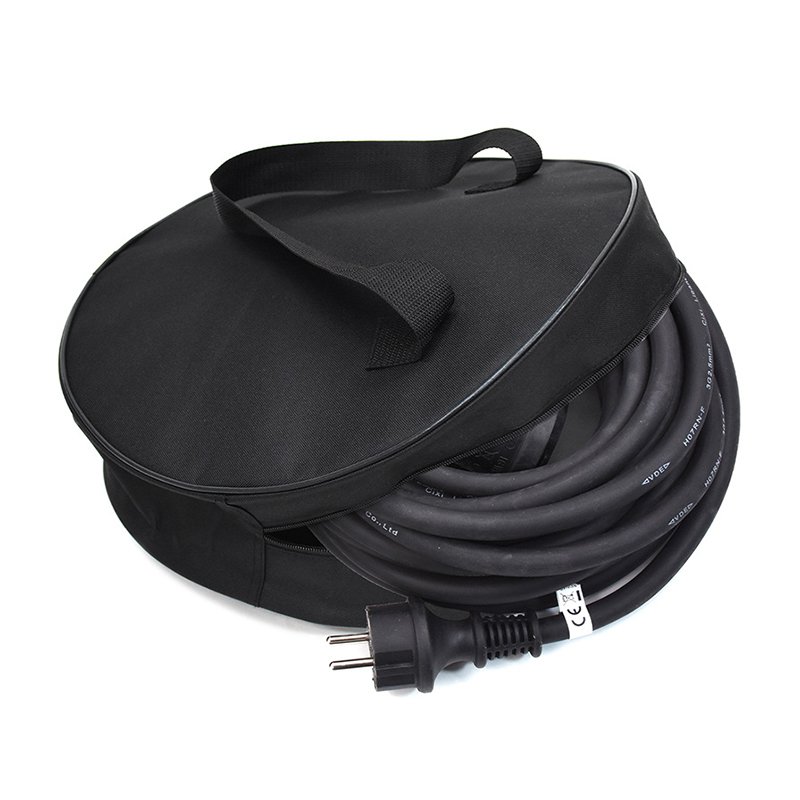
Proper storage prevents damage and keeps your charging area safe and organized. The best practice is to coil the cable in large, loose loops to avoid stressing the internal wiring, similar to how you would handle a garden hose. Avoid tight bends or wrapping it around a small object. The most effective solutions include installing a wall-mounted cable holder, hook, or reel near the charger. Additionally, use a dedicated holster or dock for the connector head (nozzle). This protects it from dirt, moisture, and impact damage while keeping it off the ground. For portable cables stored in your vehicle, a dedicated carrying case or bag is ideal.

 English
  Español
  Français
  Deutsch
  Português do Brasil
  Русский
  한국어
한국어  日本語
日本語  العربية