 Saltar al contenido principal Saltar al pie de página

Proper Fan Maintenance(12v cooling fan) is often the one variable separating a well-rested driver from a significant operational liability. In commercial trucking, a fan isn’t just for comfort; it’s a critical component for ensuring driver alertness and retention. Yet, many stock fans are loud, prone to failure from dust accumulation, and create a constant source of low-level noise that degrades sleep quality over time, directly impacting fleet safety and increasing long-term maintenance costs.
This technical brief moves past simple airflow ratings to focus on the engineering decisions that truly matter. We’ll compare brushless and brushed motor technologies to see how they affect longevity and ambient noise. We’ll also cover the role of intake dust filters for protecting components in harsh cabin environments and explore modular housing designs that allow for fast, simple user replacement, reducing vehicle downtime.
Brushless vs. Brushed Fans: Does the Noise Factor Matter?
The choice between brushless and brushed fans directly impacts product reliability and user experience, with noise profiles dictating suitability for sensitive electronic applications.
Acoustic Noise Profile: A Direct Decibel Comparison
A direct comparison shows a significant gap in acoustic output. Brushless motors typically operate under 50 decibels, a level comparable to conditions in a quiet library. Brushed motors, in contrast, often generate noise exceeding 65 decibels, which is similar to street traffic. This difference stems from the core design. The primary noise source in brushed motors is the constant physical friction and electrical arcing between the carbon brushes and the spinning commutator.
Electrical Noise and EMI in System Integration
Beyond audible sound, electrical noise—or electromagnetic interference (EMI)—is a critical differentiator. The same arcing that creates audible noise in brushed motors also generates significant EMI, which can disrupt sensitive control circuits. Brushless motors avoid this entirely by using solid-state electronic commutation, producing minimal EMI and ensuring electromagnetic compatibility. This is a non-negotiable factor in modern products with microcontrollers and digital displays, like the control panels on compressor car fridges.
Long-Term Noise Consistency and Component Wear
The noise profile of a fan is not static over its lifespan. A brushed motor will inevitably become louder as its carbon brushes physically wear down from friction. This degradation increases both mechanical and electrical noise. Brushless motors, lacking any physical brushes, maintain a consistent, low-noise profile throughout their entire operational life. This fundamental design difference is a primary reason for the extended reliability and reduced maintenance needs of brushless fans.
Application-Specific Noise Impact on Product Design
The acceptable noise level is entirely dependent on the application. For products used in quiet environments like vehicle cabins or medical settings, the low acoustic signature of a brushless fan is a core design requirement. In precision instrumentation or disk drives, the absence of both acoustic and electrical noise is essential for proper function. It is also worth noting that high-speed brushless applications can introduce ‘coil whine’ from the control electronics, a different tonal characteristic to consider versus the mechanical noise of a brushed motor.

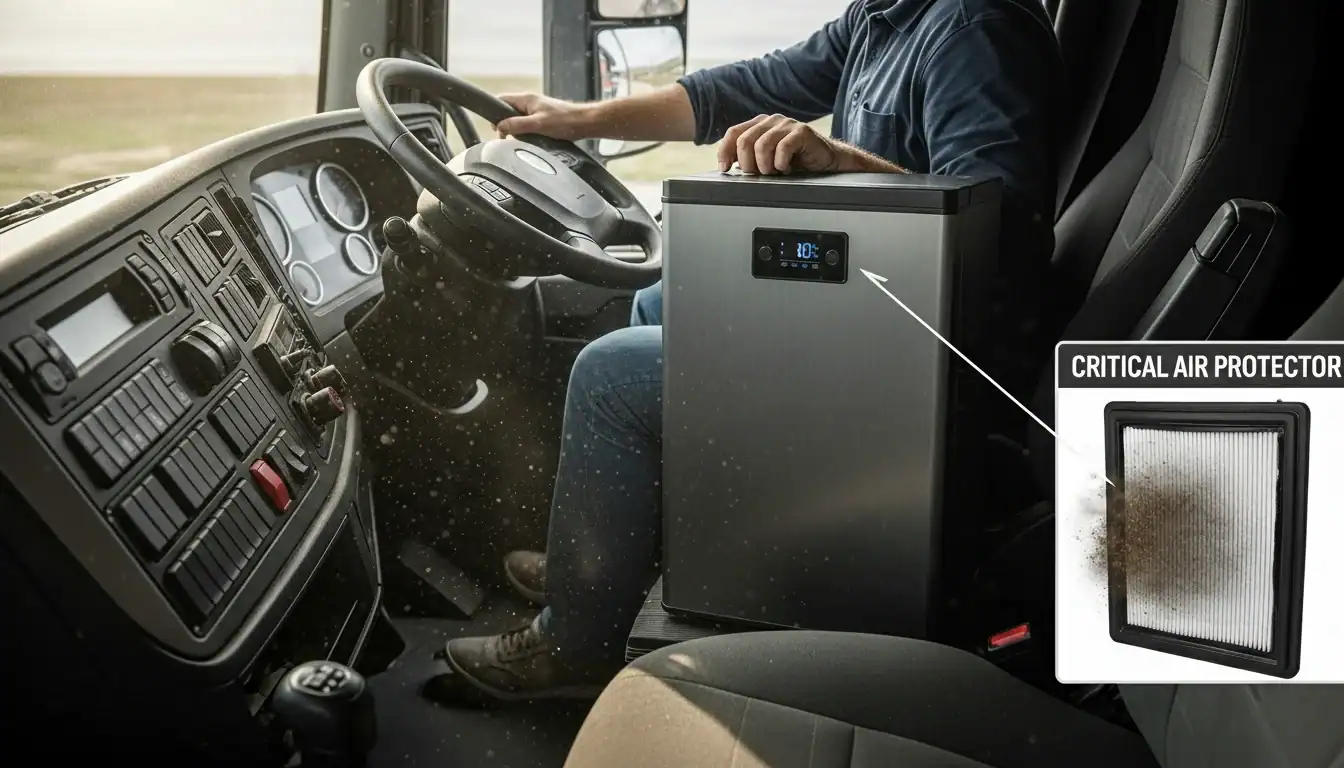
Dust Protection: Why Intake Filters Are Critical for Truck Cabins.
A clean intake filter is a non-negotiable component that protects driver health from hazardous particles and prevents premature, costly failure of the entire HVAC system.
Maintaining Air Quality for Driver Health
The cabin air filter serves as the primary defense against airborne contaminants. It traps a wide range of particulates—including dust, pollen, mold spores, and exhaust fumes—before they can enter the cabin. This is critical for driver health, as unfiltered air inside a truck can be up to six times dirtier than the air outside. For drivers with allergies or respiratory sensitivities, a functional filter significantly reduces exposure to irritants that can trigger reactions during long hauls, directly impacting their comfort and concentration.
Preventing Damage to HVAC Components
Beyond air quality, the intake filter physically shields internal HVAC components. A clogged or failing filter allows abrasive debris to accumulate on the blower motor and evaporator core, leading to mechanical strain and overheating. This restriction forces the entire system to work harder, causing excessive wear and leading to premature failure. If the blockage becomes severe, the pressure can even compromise seals, allowing unfiltered air to bypass the system entirely and cause downstream damage to sensitive fans and valves.
Sustaining Optimal Airflow and System Efficiency
System performance is directly tied to the condition of the intake filter. A clean filter ensures unrestricted airflow, allowing for effective and rapid cabin cooling and heating. When the filter is clogged, the blower motor must run at higher speeds to compensate, increasing both energy consumption and operational noise. Key warning signs of a degraded filter include noticeably weaker airflow from the vents or a hissing sound at high fan speeds, indicating the system is struggling against a blockage. Regular filter replacement, typically once or twice a year depending on operating conditions, is essential for maintaining efficiency.
Source High-Margin, Certified Car Coolers

Noise Levels: Can We Achieve <35dB for Sleeping Drivers?
Hitting the sub-35dB sleep threshold isn’t just about the motor; it requires a systems approach combining component selection, vibration damping, and operational modes.
Primary Noise Sources in Portable Refrigeration
A portable compressor fridge generates audible noise from two primary sources: the DC compressor motor itself and the internal ventilation fan responsible for heat dissipation. To manage this, we use brushless DC fans as a standard. This design eliminates the mechanical friction and electrical arcing noise common in older brushed motors, providing a significantly quieter baseline. For overnight use, the unit’s ‘Eco Mode’ further reduces noise by lowering the compressor’s cycling frequency, minimizing disturbances when the user is trying to sleep.
Acoustic Benchmarks: Brushed vs. Brushless Technology
The performance difference between motor types is substantial. Brushless motors typically operate below 50 dB, while older brushed designs can easily exceed 65 dB. Reaching the sub-35 dB target for a quiet sleeping environment requires optimization beyond just the motor. Effective case insulation and anti-vibration mounts become critical to prevent the transfer of sound. Brushless motors also produce far less electrical noise, which is a key benefit in modern vehicles. The absence of arcing prevents electromagnetic interference with sensitive onboard electronics like navigation and communication systems.
Design and Component Selection for Quiet Operation
Our engineering choices directly address noise reduction through several key features. The goal is to build a quiet system from the ground up, not just silence a noisy component.
- Our standard configuration uses brushless fans for their superior noise profile and enhanced reliability over the unit’s lifespan.
- The shockproof chassis, engineered to operate effectively at a 30° tilt, is inherently rigid and minimizes the transfer of vibration and rattling sounds during operation.
- For specialized applications where minimal noise is a primary requirement, we offer optional compressor upgrades from manufacturers like LG or SECOP, which provide enhanced efficiency at lower decibel ratings.
User Replaceability: Designing Modular Fan Housings.
Modular designs allow technicians to replace critical fan components in minutes, drastically reducing equipment downtime and overall maintenance costs.
Standardized Mounting Points for Fan Swaps
Effective modularity starts with the physical interface. Designing fan housings with universal mounting patterns accommodates a wide range of both brushless and brushed motor frames. This approach prevents vendor lock-in and allows for component upgrades using standardized parts. Engineers must also ensure the chassis depth is sufficient to allow for fan interchangeability without the new unit impeding internal components or disrupting established airflow paths.
Quick-Connect Terminals for Electrical Interface
A simple, plug-and-play power terminal eliminates complex wiring during fan replacement, turning a specialized task into a straightforward swap. Using shielded connectors is critical for electrical integrity. Brushed motors are known to generate significant electrical noise through arcing at the commutator, which can interfere with sensitive PCBs. Shielded terminals help mitigate this noise, protecting the unit’s electronics and ensuring stability, particularly when upgrading to a quieter, more efficient brushless fan.
Integrated Vibration and Acoustic Dampening
To manage operational noise, silicone or rubber grommets should be integrated at all mounting points. These grommets absorb the mechanical vibrations inherent in fan operation, preventing them from resonating through the equipment housing. This design feature is key for user experience, as it enables a field upgrade from a noisy brushed fan (often exceeding 65 dB) to a near-silent brushless model that operates under 50 dB. The result is a significant improvement in operator comfort, especially in environments like sleeper cabs.
Conclusión
Investing in superior fan technology directly impacts product reliability and market reputation. Brushless motors, effective dust filtration, and modular designs are critical for reducing long-term failure rates and simplifying after-sales support. Achieving quiet operation under 35dB also meets a key user demand, especially for drivers who sleep in their cabins.
We encourage you to review these technical points when defining the specifications for your next car cooler or fridge order. Contact our team for detailed data sheets on our fan options and to discuss your custom OEM requirements.
Preguntas frecuentes
Is the cooling fan brushless (long life) or sleeve bearing?
The fan uses a brushless motor, which is specifically chosen for extended reliability and a long operational life. Unlike brushed designs, brushless motors eliminate the friction and mechanical wear of physical brushes, resulting in superior durability and quieter performance.
What is the dBA noise rating in “Eco Mode”?
While a specific “Eco Mode” rating is not detailed, the underlying brushless motor technology operates at noise levels under 50 dBA, which is comparable to quiet library conditions. This is achieved by eliminating the mechanical friction and arcing noise common in brushed motors.
Is there a removable dust filter on the air intake?
The provided research content does not include information about a removable dust filter or other physical chassis features. The documentation focuses exclusively on the internal motor technology, its acoustic performance, and electrical characteristics.
What is the CFM airflow rating of the fan?
A specific CFM (Cubic Feet per Minute) airflow rating is not available in the research data. The content’s scope is limited to the operational benefits of the brushless motor, such as its low noise output (dBA), minimal electrical interference, and long-term reliability

 English
  Español
  Français
  Deutsch
  Português do Brasil
  Русский
  한국어
한국어  日本語
日本語  العربية