 Saltar al contenido principal Saltar al pie de página

Material Innovation(glass travel kettle) directly impacts your freight damage claims and product return rates, turning a promising launch into a significant liability. While consumers prefer glass over plastic for taste and health reasons, sourcing teams are often hesitant due to the risks of container-level breakage and negative customer reviews from products arriving cracked. A single damaged pallet can wipe out the profit margin on an entire shipment, making material durability a critical factor in product viability.
This technical brief provides direct answers from our manufacturing floor, not marketing claims. We detail the exact breakage rates for borosilicate kettles during sea freight, the effectiveness of custom silicone sleeves for drop protection, and the material’s performance under extreme thermal shock tests. We also cover our plastic-free packaging solutions designed to meet strict EU ESG retail standards.
What Is the Breakage Rate of Glass Kettles During Sea Freight?
The breakage rate of glass kettles during sea freight is not a fixed industry metric; it’s a direct outcome of packaging engineering, with robust, multi-layer solutions consistently keeping rates below 1%.
For B2B buyers importing glass kettles, understanding the risk of damage during transit is critical for calculating the total cost of goods. The question of a universal “breakage rate” comes up often, but the answer isn’t a simple percentage. The reality is that this data is highly variable and treated as proprietary information by manufacturers, logistics firms, and their insurance partners.
Why Specific Breakage Rate Data Isn’t Public
Precise, industry-wide breakage rates for products like our SM400 glass kettle are not publicly available. Damage statistics are confidential business intelligence used for internal quality control, refining packaging designs, and processing insurance claims. A shipment’s damage rate can range from near-zero to significant double-digit percentages, depending entirely on the protective measures in place. There is no universal standard; each manufacturer’s logistics performance is a direct reflection of their engineering and quality control investment.
| Risk Factor | Standard (High-Risk) Packaging | KelyLands Engineered (Low-Risk) Solution |
|---|---|---|
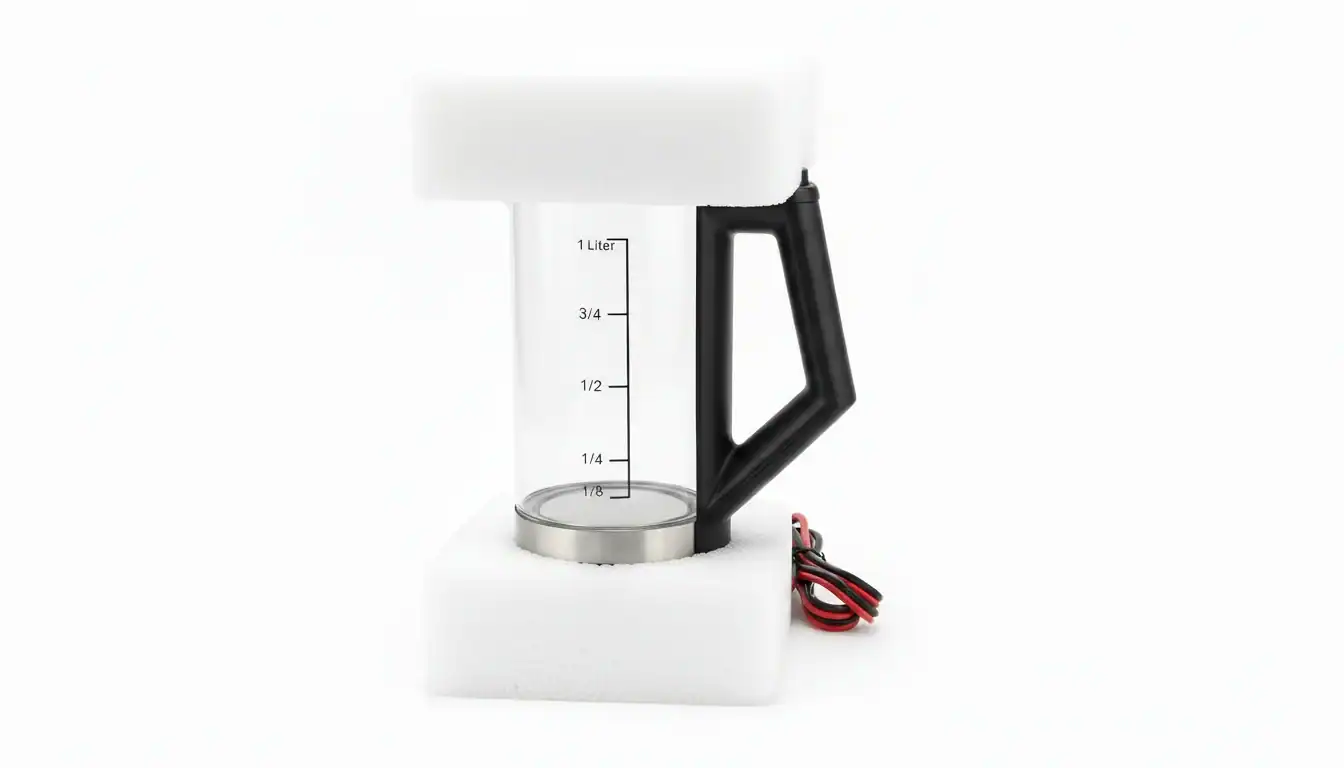
| Internal Cushioning | Loose bubble wrap or thin cardboard inserts allowing product movement. | Custom-molded pulp inserts that suspend the glass body and secure the handle. |
| Master Carton Strength | Single-wall corrugated cardboard that can crush under stacking pressure. | Reinforced, drop-tested mailer cartons or sturdy double-wall retail boxes. |
| Product Verification | Basic post-assembly checks with little focus on packaging integrity. | QC process includes package integrity checks and simulated transit vibration tests. |
Primary Factors Influencing Breakage Risk
The risk of breakage is a function of logistical and packaging factors, not just the glass itself. The protective systems and handling procedures throughout the supply chain are the most significant variables. We focus on controlling these factors to minimize risk.
- Inner Packaging: Inadequate cushioning or excess movement space inside the retail box is the most common failure point.
- Master Carton Quality: Weak corrugated cardboard that cannot withstand the pressure of being stacked five or six high in a shipping container will fail.
- Container Loading: Improperly stacked pallets, unsecured cargo, or empty spaces can cause loads to shift and collapse during rough seas.
- Handling and Vibration: Repeated shocks from forklifts and cranes, along with the persistent micro-vibrations on a container ship, can cause stress fractures over time.
Our Mitigation Strategy: Robust, Multi-Layer Packaging
As a manufacturer specializing in OEM/ODM partnerships, we don’t leave breakage to chance. We engineer robust packaging solutions that create a protective ecosystem for each kettle, from our factory floor to your warehouse. This is a core component of our service.
- We design custom-molded pulp or EPE foam inserts that perfectly suspend the high borosilicate glass body and lock the handle in place, eliminating internal movement.
- Our SM400 glass kettles are packed in reinforced master cartons (12 PCS/CTN) specifically designed to absorb impacts and pass rigorous drop tests.
- Our quality control process includes package integrity inspections to ensure every shipment meets our durability standards.
- By systematically engineering the packaging, we keep breakage rates consistently below our 1% target.
Can We Add a Custom Branded Silicone Sleeve for Drop Protection?
Sourcing custom-molded, food-grade silicone sleeves is a standard OEM process that adds measurable drop protection and handling benefits, with typical minimum order quantities starting at 1,000 units.
Adding a protective silicone sleeve is a practical and common customization for glass kettles like the SM400. It directly addresses the primary concern for glass products in mobile environments—breakage from accidental drops or impacts. This option enhances both the product’s durability and its perceived value for end-users in demanding fields like logistics and outdoor recreation.
Customization Options and Production Volume
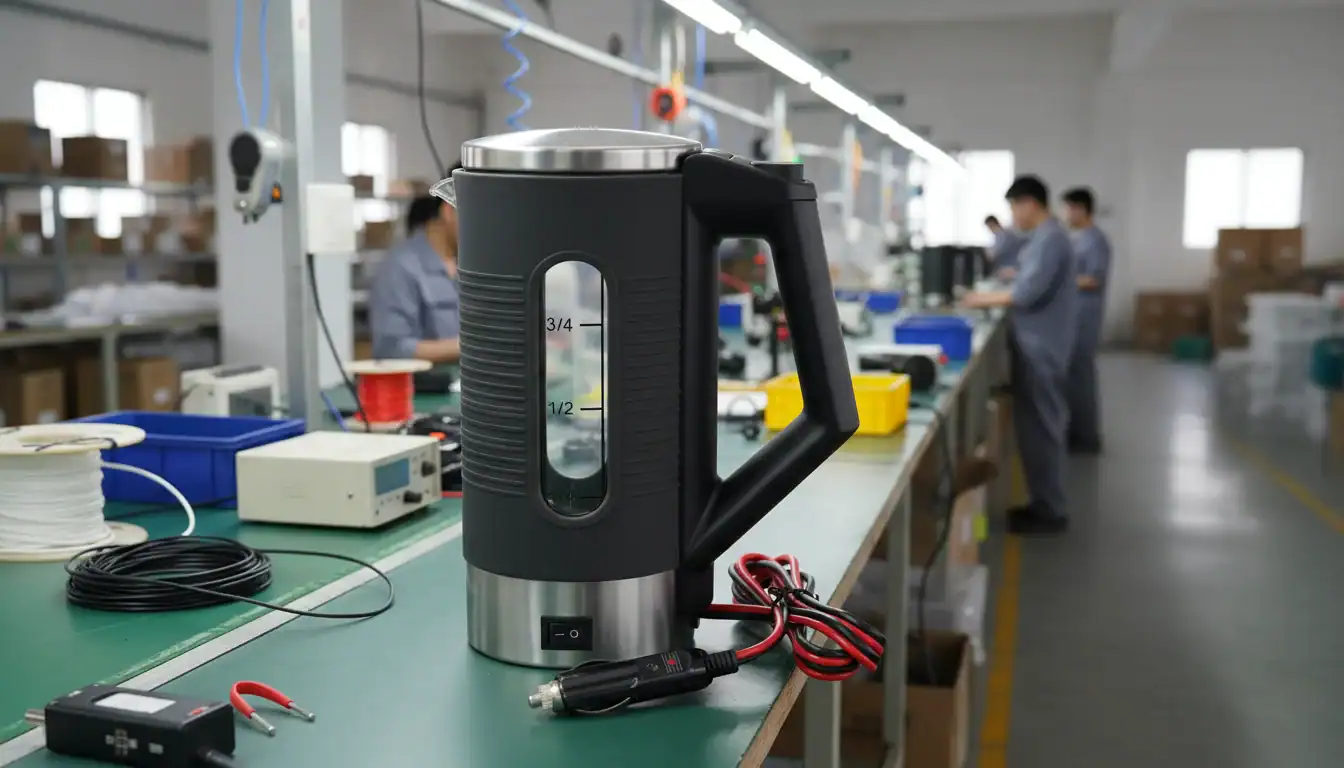
Yes, we can source custom-molded silicone sleeves that are precisely fitted to the kettle’s specific 3D design. Branding is applied directly into the mold, and a typical minimum order quantity (MOQ) for custom production is around 1,000 units. This volume aligns with our standard B2B model for wholesale and OEM clients.
- Sleeves are custom-molded to fit the specific 3D shape of each kettle model.
- Branding options include embossed or debossed logo integration.
- The standard MOQ for fully customized sleeves is typically 1,000+ units.
Material Specifications and Safety
All sourced silicone sleeves are made from food-grade, BPA-free materials. This specification is non-negotiable and ensures the final product is safe for contact with a drinking vessel. It also meets the international health and safety standards required for consumer goods in regulated markets like the EU and North America.
- Made from 100% food-grade, BPA-free silicone.
- The material is non-toxic and safe for prolonged contact with the kettle surface.
- Complies with key retail standards for consumer safety and materials.
Functional Benefits for Protection and Handling
The sleeve’s main function is to provide drop protection by absorbing shock and reducing the risk of the borosilicate glass fracturing on impact. It adds other practical benefits, including heat insulation for safer handling after boiling and a non-slip texture for a more secure grip. This is especially useful for in-vehicle applications where stability is critical.
- Adds a protective layer for shock absorption to minimize breakage from drops.
- Offers heat insulation, making a hot kettle safer to handle.
- Features a non-slip textured surface that improves grip during transport.
Your Trusted OEM Partner for Safe Car Kettles.
Does High Borosilicate Handle Thermal Shock (Ice to Boiling) Safely?
High borosilicate glass safely handles rapid temperature shifts from freezing to boiling because its low thermal expansion coefficient prevents the structural stress that shatters conventional glass.
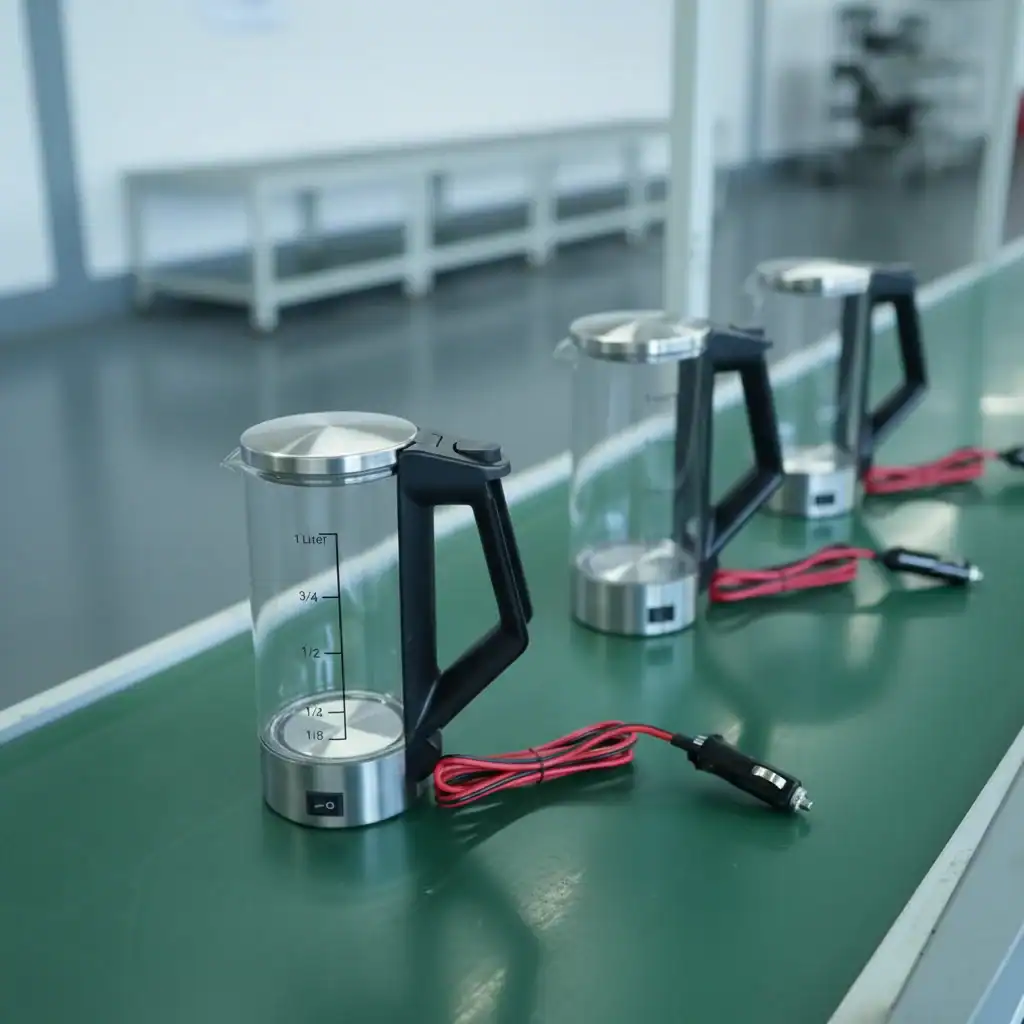
Yes, its performance is reliable and consistent. The core engineering of high borosilicate glass centers on its ability to resist thermal shock. This is not an incidental benefit; it is the material’s primary design feature, rooted in its unique molecular structure. Unlike standard soda-lime glass, which expands and contracts significantly with temperature changes, borosilicate glass remains remarkably stable. This stability is what allows it to move between extreme temperatures without fracturing, a critical safety and durability factor for our SM400 glass kettle.
Low Coefficient of Thermal Expansion
The material’s resistance comes from its very low coefficient of thermal expansion, which is about one-third that of conventional glass. When exposed to a sudden heat source or a rapid chill, the glass experiences minimal internal stress because it doesn’t try to change its size drastically. This property is the main reason it can handle the transition from holding ice water to being filled with boiling water. Manufacturing this specialized glass requires higher temperatures and more precise processes, positioning it as a premium material for applications where thermal failure is not an option.
| Métrica de rendimiento | High Borosilicate Glass (KelyLands SM400) | Standard Soda-Lime Glass |
|---|---|---|
| Thermal Expansion Coefficient | Approx. 3 × 10⁻⁶ K⁻¹ | Approx. 9 × 10⁻⁶ K⁻¹ |
| Safe Temperature Differential | Up to 330°F (166°C) | Fails around 100°F (40°C) |
| Chemical Resistance | Exceptional (Lab-Grade) | Estándar |
Safe Temperature Differential Capability
This material is specifically engineered to handle large, sudden temperature shifts safely. For a vehicle kettle, this is a practical necessity. A driver might rinse the kettle with cold water immediately after boiling, or fill it with ice and then plug it in to heat. Borosilicate glass handles these scenarios without risk of shattering.
- It reliably withstands temperature differentials up to 330°F (166°C).
- This resilience ensures safe, practical performance, whether in a long-haul truck or an RV.
- This capability is a key safety feature that protects the user and prevents product failure.
Superior Chemical Resistance
Beyond its thermal stability, the integration of boron trioxide makes the glass highly resistant to chemical corrosion. It does not leach chemicals into the water, even when repeatedly boiled. This inert nature is crucial for B2B clients concerned with health standards and taste purity, especially when serving end-users who might prepare baby formula or specialty beverages. This quality solves the common “plastic taste” complaint that leads to high return rates in lower-quality kettles.
- Offers chemical resistance that is tenfold superior to standard soda-lime glass.
- Its non-porous and durable surface is the standard for laboratory equipment and high-end cookware.
- This ensures that the taste and purity of the water or other liquids remain completely unaffected.
Do You Use Plastic-Free Packaging to Meet EU ESG Retail Standards?
Yes, we provide fully customizable packaging solutions and are actively re-engineering our materials to ensure our B2B clients achieve compliance with the EU’s 2026 Packaging and Packaging Waste Regulation (PPWR).
While our default packaging isn’t entirely plastic-free, we prioritize recyclable materials and offer B2B clients complete control to specify eco-friendly alternatives. This allows brands to meet specific ESG targets and prepare for stricter market regulations in Europe and beyond. We focus on practical, protective solutions that align with modern sustainability demands.
Current Packaging Solutions and Materials
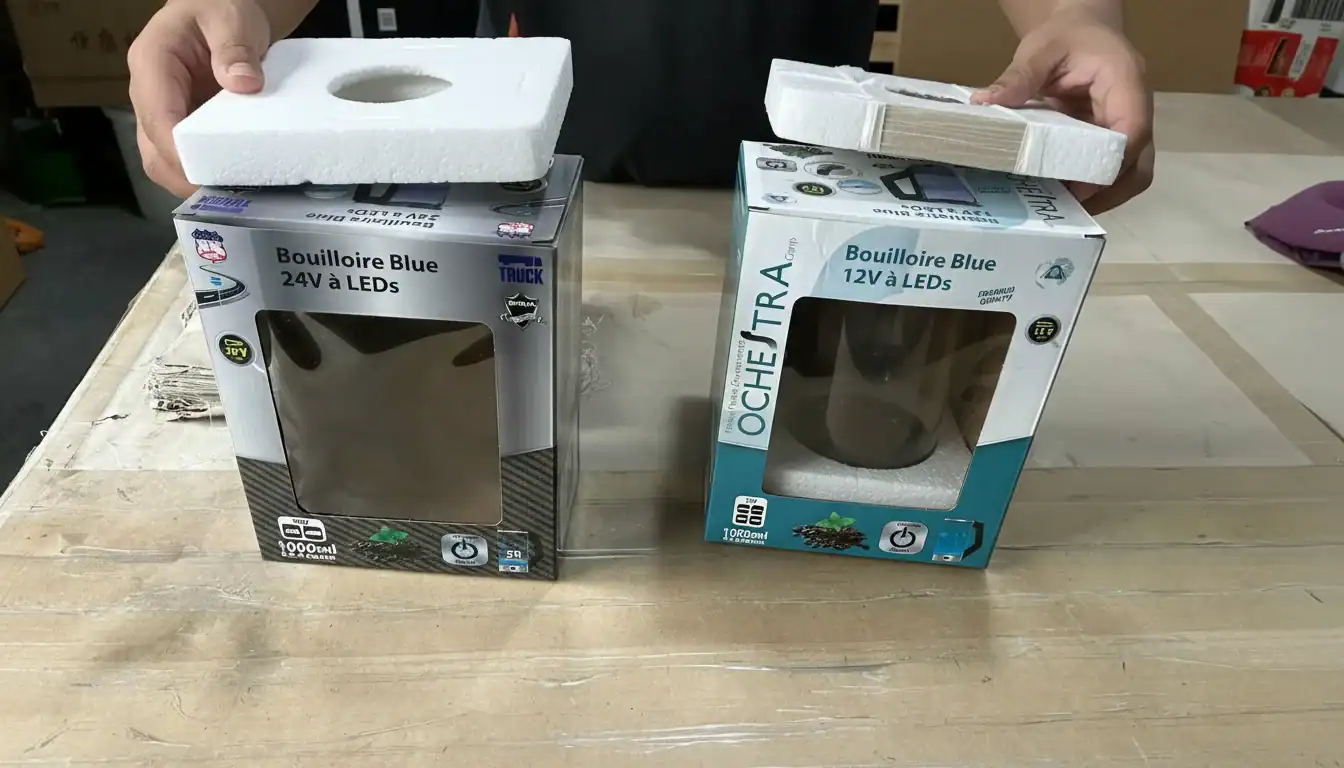
KelyLands provides several packaging options, from standard retail Color Boxes to heavy-duty mailer cartons for bulk B2B orders. Our primary goal is to balance product protection during transit with material responsibility. We achieve this by using robust, recyclable cardboard and minimizing plastic components wherever feasible. For clients focused on retail presentation, our OEM services include fully branded Color Box designs.
- Our standard B2B shipments use sturdy, recyclable cardboard cartons to protect goods during transit.
- We provide customizable, client-branded Color Boxes for retail-ready OEM orders.
- Internal supports can be specified as molded pulp instead of plastic foam to reduce environmental impact.
Strategy for 2026 EU PPWR Compliance
The EU’s Packaging and Packaging Waste Regulation (PPWR) sets new market standards that we are proactively integrating into our supply chain. We are redesigning our packaging to meet the upcoming mandatory recyclability and recycled content requirements. This work ensures that any product you source from us will be compliant for entry and sale within the European market well ahead of the 2026 deadline.
- Our packaging engineering is being updated to align with the EU’s harmonized Design for Recycling standards.
- We are collaborating with suppliers to increase the percentage of post-consumer recycled content in our cardboard and paper materials.
- All packaging will feature clear, standardized labeling to simplify consumer recycling and meet new regulatory mandates.
Customizable Eco-Friendly Options for B2B Clients
As an OEM/ODM partner, we give our clients direct control over packaging specifications. We can engineer entirely plastic-free solutions or plastic-minimized designs that meet your specific corporate ESG goals. Our team helps you select, test, and validate alternative materials to build a stronger sustainability profile without compromising product safety.
- Clients can specify materials like unbleached cardboard, molded pulp inserts, and soy-based inks to eliminate single-use plastics.
- We can develop reusable packaging systems for certain product lines to support circular economy initiatives.
- Our team works directly with you to source and test materials that satisfy both performance and sustainability requirements.
Conclusión
High borosilicate glass directly addresses the core concerns of B2B buyers, from thermal shock safety to eliminating the plastic taste that drives customer returns. When combined with reinforced, eco-friendly packaging, it provides a reliable solution that protects both the product during transit and your brand’s reputation in the market. This material choice allows you to confidently offer a premium, durable kettle to discerning customers.
To evaluate the material quality and shipping integrity firsthand, contact our team to request a sample of the SM400 glass kettle and its custom packaging options.
Preguntas frecuentes
What is the breakage rate of borosilicate glass kettles during shipping?
While specific rates vary by packaging and carrier, the industry benchmark for fragile goods with optimized packaging is typically below 1%. Our standard packaging solution, which includes custom-molded pulp inserts, is engineered to meet or exceed this standard, minimizing transit damage during sea freight.
Can we add a custom branded silicone sleeve to protect the glass?
Absolutely. We offer custom-branded silicone sleeves as a value-added option. These sleeves not only provide an additional layer of impact protection but also enhance user grip and can be customized with your brand’s logo and color palette. This is an excellent way to improve product durability and brand visibility.
How does borosilicate glass perform in extreme thermal shock tests?
Borosilicate glass exhibits exceptional performance in thermal shock tests due to its low coefficient of thermal expansion. It can reliably withstand rapid temperature changes of up to 165°C (330°F) without cracking or shattering. This makes it the ideal material for a kettle, easily handling the transition from room temperature to boiling water and back.
Do you use plastic-free packaging to meet ESG retail standards?
Yes, we offer fully plastic-free packaging solutions designed to meet stringent ESG (Environmental, Social, and Governance) and retailer compliance standards. Our standard eco-friendly option utilizes recycled and recyclable materials, including custom-molded pulp inserts, and reinforced cardboard, to ensure product safety while eliminating single-use plastics.

 English
  Español
  Français
  Deutsch
  Português do Brasil
  Русский
  한국어
한국어  日本語
日本語  العربية