 Saltar al contenido principal Saltar al pie de página

Choosing the right insulation and materials for a portable freezer cooler directly determines your product’s market position and warranty claim rate. A rotomolded shell promises rugged, near-indestructible performance, while a metal body offers premium aesthetics. A mismatch between the material and your customer’s expectations, like a dented aluminum unit marketed for off-road use, can quickly erode brand credibility and profit margins.
This analysis provides the data to make an informed sourcing decision. We benchmark rotomolded LLDPE against metal alloys on dent resistance, passive cooling performance from high-density PU foam, and the functional resilience of a shockproof design that operates at a 30° tilt. The objective is to align your unit’s physical build with your brand promise.
Rotomolding (LLDPE): Is It Really “Bear-Proof”?
Rotomolded LLDPE offers great durability. But true “bear-proof” status requires specific design features and official certification, not just a strong material.
Material Strength vs. Certified Design
Rotomolding LLDPE creates a seamless, single-piece shell. This process results in thick, uniform walls that make the final product incredibly durable and impact-resistant. It’s a solid foundation for any rugged container.
But strength alone doesn’t make something “bear-proof.” True bear resistance comes from specific design features an animal can’t bypass. This includes specialized latch mechanisms and automated locking systems that are impossible for a bear to manipulate. The material provides the shell, but the hardware provides the security.
Official certification is what separates a tough box from a genuinely bear-resistant one. Organizations like the Interagency Grizzly Bear Committee (IGBC) award this status only after a product survives rigorous, live-animal testing.
Practical Durability for Rugged Conditions
This brings us to the practical durability of our compressor fridges. They feature a shockproof design that ensures the compressor works efficiently even at a 30° tilt. This level of construction is built for the real-world demands of off-road vehicles and harsh outdoor environments.
Our standard coolers are highly durable against impacts and are certainly rodent-resistant. They will stand up to almost anything you can throw at them during a typical trip. They are not, however, certified as bear-proof and shouldn’t be marketed as such for use in designated bear-prone areas where certified containers are required.

Metal Housing: Premium Aesthetics vs. Dent Risk.
Metal cooler housing is a trade-off. Lightweight aluminum dents easily, while heavy stainless steel offers a premium look and superior dent resistance. The choice depends on looks versus ruggedness.
| Característica | Aluminum | Stainless Steel |
|---|---|---|
| Portability / Weight | Excellent (Lightweight) | Poor (Heavy) |
| Dent Resistance | Poor (Soft material) | Excellent (Superior strength) |
| Corrosion Resistance | Excelente | Excelente |
| Caso de uso principal | Price-sensitive consumer goods | Premium, rugged applications |
Material Trade-Offs: Aluminum vs. Stainless Steel
The choice between aluminum and stainless steel comes down to a simple question: what does your customer value more, looks or durability? Aluminum offers a lightweight body with great corrosion resistance, which makes it easy to carry. But it’s a soft metal, so it dents and scratches easily during transport or rough handling.
Stainless steel provides a clean, modern look and is far more resistant to dents. It holds up to abuse. The downside is its weight. For a product designed to be portable, adding several kilograms can be a major disadvantage for the end-user. This is a classic engineering compromise where you can’t have it all.
Prioritizing Performance with Shockproof Design
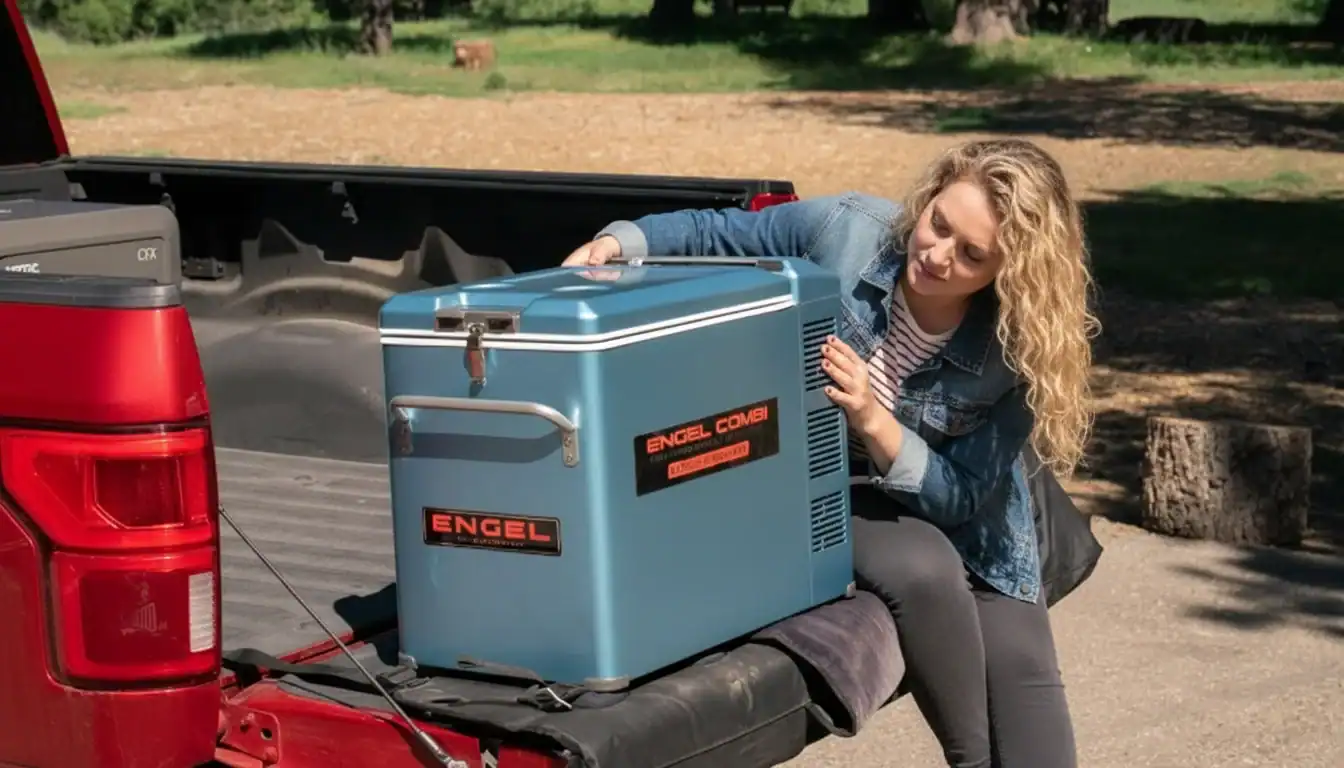
While the exterior material debate focuses on aesthetics, the real performance is determined by the internal design. Our compressor fridges feature a shockproof design that keeps the unit running reliably, even when tilted up to 30 degrees. This isn’t a cosmetic feature—it’s a critical function for demanding environments.
For customers using these coolers in off-road 4×4 vehicles or on boats, the unit will be subjected to constant vibration and movement. A standard cooler might fail, but this design ensures consistent cooling. It’s a functional resilience that provides real value over a simple metal shell.
Source Custom, Certified Car Coolers for Your Brand

Latches: Rubber T-Latches vs. Stainless Steel – Which Lasts?
Stainless steel latches offer superior strength and longevity for heavy loads. Rubber T-latches provide better flexibility, shock absorption, and corrosion resistance, ideal for marine or high-vibration use.
Rubber T-Latches: Superior Flexibility and Corrosion Resistance
Rubber T-latches are engineered to flex, absorb shock, and dampen vibration while maintaining a secure seal. Their natural resistance to corrosion makes them a reliable choice for marine or chemical environments where metal can deteriorate. The molded rubber handle is easy to operate, even with gloves on. The main trade-off is degradation from long-term UV and temperature exposure, which can eventually reduce the material’s elasticity.
Stainless Steel Latches: Unmatched Strength and Long-Term Durability
Stainless steel delivers superior strength, making it the standard for applications involving heavy loads and repeated use. It offers excellent resistance to abrasion and performs reliably for decades with minimal degradation. This makes it perfect for static, heavy-load situations where raw strength is the primary requirement. Its rigidity is a drawback in high-vibration scenarios, as it cannot flex to absorb shock.
Passive Cooling: Can It Hold Ice for 3 Days Power Off?
Yes, a high-quality cooler can hold ice for 3+ days, but performance hinges on its construction. Success depends on insulation quality, pre-chilling, and keeping the lid shut.
Key Factors That Determine Ice Retention
How long a cooler stays cold without power isn’t magic; it comes down to managing heat transfer. Four variables have the biggest impact on performance.
- Insulation Quality: This is the primary factor. High-performance models with dense foam or vacuum insulation panels dramatically outperform standard coolers with thin walls.
- Pre-Cooling: Chilling the cooler box with sacrificial ice or cold packs before adding your main contents significantly extends cooling duration. A warm cooler melts the first batch of ice just to cool itself down.
- Temperatura ambiente: A cooler left in direct sunlight on a hot day will lose its cool much faster than one kept in the shade or a cool vehicle.
- Lid Discipline: Every time the lid opens, cold air escapes and warm air rushes in. Minimizing access is critical for long-term ice retention.
The Role of High-Density PU Foam
KelyLands compressor fridges are built with high-density PU (Polyurethane) foam, a superior insulator that traps cold air effectively. This level of insulation is what allows our compressor units to maintain safe temperatures for extended periods when turned off, essentially functioning as a high-end passive cooler. The energy efficiency gained during powered operation translates directly to longer passive cooling time when the power is cut.
Preguntas frecuentes
Is the cooler’s housing made from rotomolded LLDPE?
Yes, rotomolded LLDPE is a standard material for high-performance portable coolers. This process creates a single, seamless piece that is extremely durable and impact-resistant. It’s often combined with thick polyurethane insulation to maximize ice retention, providing a tough exterior suitable for outdoor use.
How long will a portable freezer keep food frozen without power?
A well-insulated portable freezer can typically keep food frozen for 24 to 48 hours, as long as the lid remains closed. Performance depends on how full the unit is, the ambient temperature, and the quality of the lid seal. A fully stocked freezer will hold its temperature longer than a half-empty one.
Are the latches on the coolers replaceable?
Yes, latches on most portable coolers are designed for easy replacement. We provide replacement kits that include the new latch and necessary mounting hardware. This allows you to extend the life of your cooler if a latch becomes damaged from regular use.
How can I prevent ice buildup inside the freezer?
Ice buildup happens when warm, moist air gets inside. The best way to prevent it is to limit how long you keep the lid open. Always make sure the lid gasket is clean and creates a tight seal when closed. Also, let hot foods cool to room temperature before placing them inside the unit.
Reflexiones finales
The choice between rotomolded durability and metal aesthetics defines your brand’s promise. While entry-level coolers focus on looks, our shockproof compressor design ensures function at a 30° tilt. This is the engineering that prevents returns and protects your reputation in the premium outdoor market.
A spec sheet can’t convey build quality. Request a sample unit to test the material finish and performance firsthand. Contact our team to discuss your private label requirements and lock in your production slot.

 English
  Español
  Français
  Deutsch
  Português do Brasil
  Русский
  한국어
한국어  日本語
日本語  العربية