 Saltar al contenido principal Saltar al pie de página

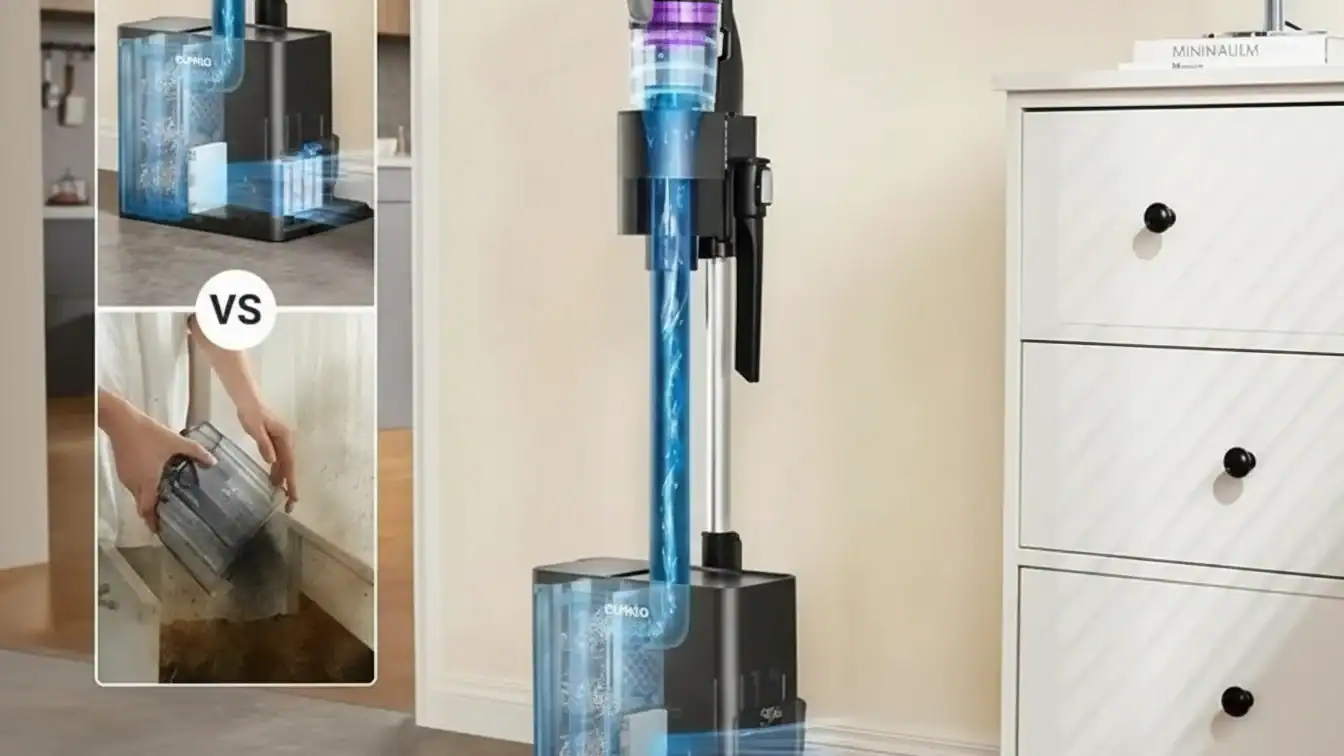
Manual bin disposal often undermines cleaning efficiency by releasing fine debris back into the work environment. When an operator opens a standard canister, falling material displaces air at high speeds, creating a plume of 0.3-micron particles that settle on furniture and floors. Transitioning to self-emptying docks eliminates this hygiene gap by using sealed suction pathways to confine allergens during the disposal process.
This analysis covers the technical specifications of modern auto-empty bases, including the 20,000Pa suction force required for total debris transfer and the H13 HEPA filtration standards that ensure air quality. We compare the maintenance benefits of 3L storage bags, which extend service intervals to 75 days, and evaluate the structural integrity of tower versus compact dock designs for commercial sourcing.
The “Dust Cloud” Problem: Why Stick Bins are Messy
Manual bins create dust clouds because falling debris displaces air at high speed, generating turbulence that carries fine particles into the room. Without a sealed suction pathway or 60-120 ft/min air velocity to confine the plume, 0.3-micron particles escape the bin and settle on floors and furniture.
Turbulence and Plume Formation in Open Bins
Falling material from a vacuum canister generates sudden air displacement, creating a plume that rises toward the operator. High-pressure zones at the bottom of the bin force fine irritants through the top opening before the lid closes. This mechanical reaction occurs because the volume of falling debris pushes existing air out of the way, carrying light particles with it.
A lack of physical confinement allows turbulent air to expand the dust cloud beyond the immediate disposal area. Static electricity within plastic bins often holds onto 0.3-micron particles until the mechanical jar of emptying releases them into the air. These particles are small enough to remain suspended in the room’s ambient airflow for extended periods.
Air Velocity and Filtration Standards for Containment
Effective dust confinement requires a minimum air velocity of 60 ft/min to prevent cloud expansion. High-turbulence environments demand up to 120 ft/min air velocity to successfully direct particles into a secondary storage bag. Standard trash cans do not provide this necessary suction, allowing the high-pressure displacement to overcome gravity.
HEPA-sealed systems target 99.97% efficiency to capture microscopic particles that typically bypass standard bin seals. Automated docks replace manual dumping with a negative-pressure cycle. This design ensures debris moves through a filtered pathway without exposure to the room environment, mimicking industrial bin vent dust collectors that maintain negative pressure to recover fine materials.
Dock Mechanics: Suction Pathway from Bin to Bag
In 2026, self-emptying docks utilize high-velocity negative pressure differentials to pull debris through an airtight conduit. By generating suction forces often exceeding 20,000Pa, the dock creates a vacuum seal that ensures dust travels from the portable bin to the larger 2L bag without escaping into the ambient air.
| System Component | Especificaciones técnicas | Operational Benefit |
|---|---|---|
| Suction Motor | 13,000Pa – 20,000Pa | Generates negative pressure for debris transfer |
| Transport Conduit | High-Density Polyethylene (HDPE) | Resists grit abrasion and maintains airflow |
| Seal Integrity | IATF 16949 / ISO 9001:2015 | Prevents leakage and maintains structural vacuum |
Negative Pressure and Suction Dynamics
Negative pressure differentials drive the transfer of debris by creating a vacuum inside the dock’s base unit. High-performance motors generate suction power ranging from 13,000Pa for portable units to 20,000Pa for heavy-duty home docks. This mechanism ensures the suction-assisted penetration of airflow reaches the bottom of the bin to clear heavy particles. Engineering teams monitor pressure limits during operation to prevent structural buckling or seal failure under high-load extraction.
Conduit Architecture and Seal Integrity
Internal pathways utilize durable HDPE piping and molded fittings to maintain smooth airflow and resist abrasion from grit. Airtight interfaces use mechanical tolerances to ensure the vacuum intake aligns perfectly with the dock’s suction tube. Systems adhere to ISO 9001:2015 and IATF 16949 standards to guarantee the reliability of the triple-layer filtration seal. Self-weight and suction-assisted penetration models guide the depth of the intake mouth to maximize material pickup efficiency.
Bag Capacity: 2L Dock vs. 0.5L Vacuum
In 2026, most docking stations offer 3L bags compared to 0.3L-0.5L onboard bins, creating a 4-6x volume multiplier. This scaling allows for up to 75 days of autonomous operation, significantly reducing manual maintenance while improving dust containment through sealed bag technology.
| System Component | Standard Capacity | Autonomy/Efficiency |
|---|---|---|
| Xiaomi / Roborock / Tapo Dock | 3.0 Liters | 60–75 Days / 99.99% Filtration |
| bObsweep Self-Empty (Bagless) | 2.46 Liters (0.65 Gal) | Up to 100 Days Use |
| Onboard Robot Dustbin | 0.33 – 0.50 Liters | Manual Emptying Every 1–2 Days |
Volume Multipliers and Maintenance Intervals
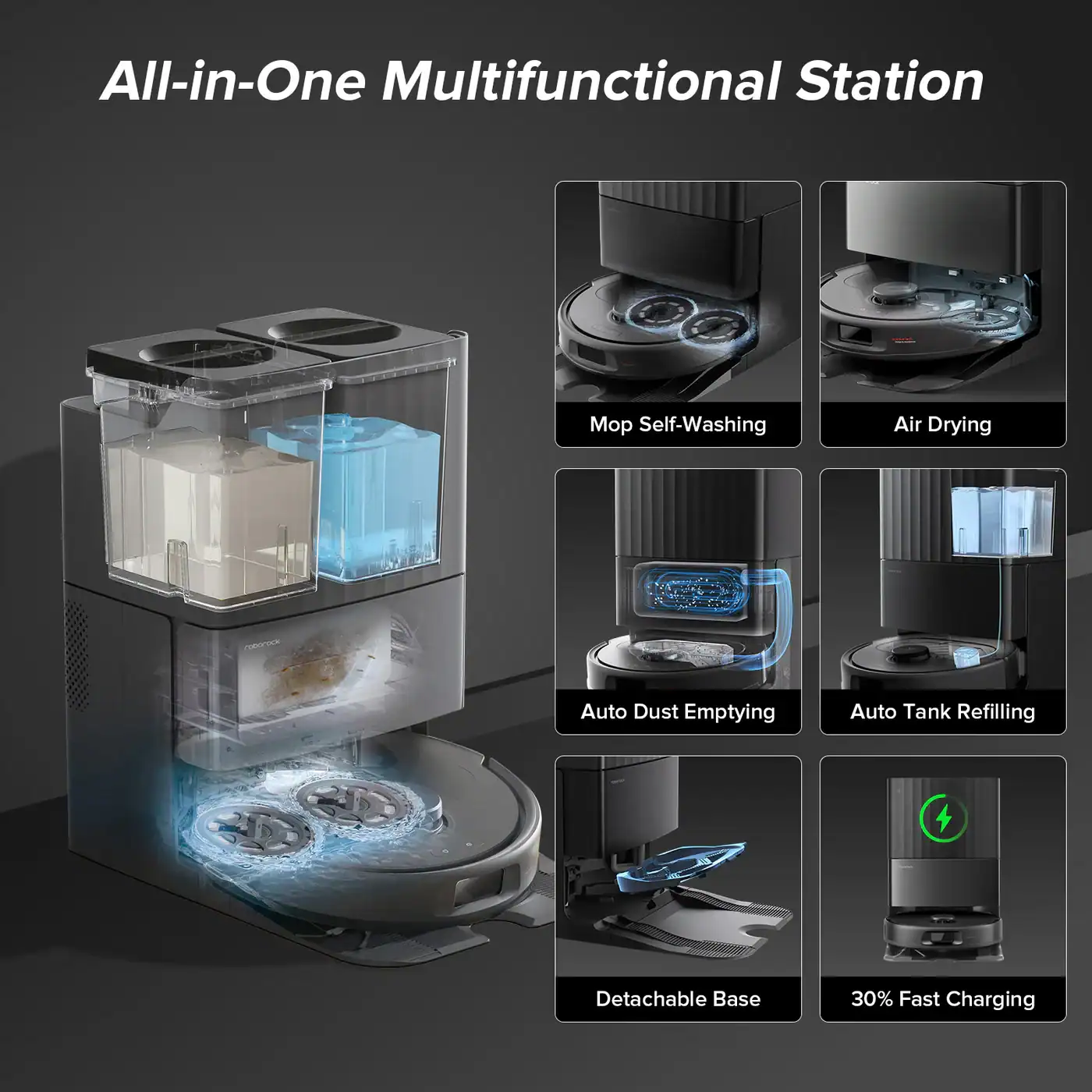
Transferring debris from a 330ml onboard bin to a 3L dock enables 60 to 75 days of hands-free use for typical households. Dock suction systems utilize high-power pathways to compact dust into sealed bags, maximizing storage density compared to loose debris in a stick vacuum. Roborock and Tapo systems employ dustbin detection algorithms to automate the emptying process and maintain suction efficiency throughout the 60-day cycle. This automated transfer prevents the performance degradation that usually occurs when small onboard bins reach capacity.
Storage Metrics and Filtration Benchmarks
Xiaomi and Roborock standardize on 3L dust bags to meet IEC 62885-2:2016 efficiency requirements for particle retention. Bagless dock alternatives like bObsweep offer 2.46L capacities for up to 100 days of use, though they trade self-sealing bag convenience for lower recurring costs. High-capacity 3L bags trap particles as small as 0.3 to 0.7 microns with 99.99% efficiency, preventing air contamination during disposal. KelyLands emphasizes HEPA-grade filtration in their vacuum designs to complement the high-capacity storage of 2026 docking systems, ensuring that captured allergens remain trapped during the high-velocity transfer from robot to dock.
Custom Home Vacuum Solutions Tailored for Your Brand

Filtration: Keeping the Base HEPA-Sealed
HEPA filtration in dock bases ensures captured dust remains trapped during the high-speed transfer from the vacuum bin to the storage bag. By utilizing H13 to H14 grade filters, these systems capture at least 99.95% of particulates as small as 0.3 microns, preventing fine allergens from escaping into the environment during 2026 maintenance cycles.
Filtration Efficiency and Particle Capture Standards
HEPA filters meet DOE and US EPA standards by removing at least 99.97% of particles 0.3 microns or larger. These systems utilize H13 and H14 grade filters to ensure efficiency between 99.95% and 99.995% based on EN 1822 and ISO 29463 classifications. Engineering focus centers on the most penetrating particle size (MPPS) at 0.3 microns to address the highest risk of particulate escape through the filter media.
High-efficiency capture allows these systems to achieve cleanroom-equivalent air quality levels comparable to ISO 5 standards. This classification limits particles to 3,520 per cubic meter, ensuring that fine debris and allergens remain confined within the dock structure during high-velocity transfer cycles.
Leak Integrity and Technical Performance Metrics
Sealed housings comply with ISO 14644-3 protocols to prevent bypass leakage during high-suction emptying cycles. Integrity verification through DOP/PAO aerosol scan testing ensures no leaks exist in the filter frame or gaskets. This testing confirms that air passes exclusively through the filtration media rather than escaping through structural seams.
Operational pressure drop stays at approximately 300 Pa (0.044 psi) to balance airflow volume with filtration density. Adherence to ASTM F3150-18 benchmarks for vacuum systems ensures consistent performance in high-volume commercial and retail environments, where maintaining strict dust containment is necessary for operational hygiene.
Design: Tower Docks vs. Compact Bases
Tower docks utilize wide ‘L’ or ‘T’ shapes and 12-inch steel trusses to manage high torsion and dead loads in 2026 maritime and logistics settings. In contrast, compact bases prioritize space efficiency, using 4-inch wall projections and 10% approach grades to handle heavy point loads within constrained footprints.
Geometry and Torsion Resistance in Tower Dock Structures
Engineers configure tower docks in ‘L’, ‘U’, ‘H’, or ‘T’ shapes using 6-foot wide sections to eliminate twisting across long spans. These systems integrate steel box trusses with 10 to 12-inch depths. These frames include internal gussets and torsion bars to support 1,000 lb sections and a dead load of 8.3 lbs per sq ft. High-profile designs often utilize pylon suction and extra-thick walls to ensure stability in rough water environments without standard framing components.
Load Capacity and Approach Engineering for Compact Bases
Compact bases handle 13.6 lbs per sq ft live loads from occupants while maintaining a low-profile buoyancy of 30 lbs per sq ft with LLDPE materials. Structural standards mandate a maximum 10% approach grade for depressed docks to maintain vehicle traction and prevent cargo shifts during loading operations. Flush dock designs project exactly 4 inches beyond the building wall to provide necessary bumper protection while supporting 25,000 lb point loads within a minimal footprint.
Reflexiones finales
Transitioning to self-emptying docks fixes the inherent flaws of manual dustbin disposal. High-pressure suction cycles and airtight pathways contain the microscopic particles that usually escape into the room during emptying. This shift toward larger, sealed storage bags provides months of operation without exposing users to the debris they just vacuumed up.
Choosing the right hardware involves balancing the suction metrics with the filtration standards of the dock. High-performance units using HDPE conduits and H13 filters ensure long-term reliability and air purity. These technical specifications matter most for maintaining a clean environment while minimizing the manual labor required for floor care.
Preguntas frecuentes
Do self-emptying docks automatically charge the vacuum and clear the dustbin?
Yes, these docking stations serve as a dual-purpose hub. They recharge the vacuum battery while using high-powered suction to pull debris from the robot’s internal bin into a larger disposable bag inside the base unit.
What is the typical storage capacity of the base station dust bag?
In 2026, most consumer models utilize dust bags with a capacity between 2L and 3L. This volume allows the system to hold debris for approximately 30 to 60 days, depending on floor traffic and pet hair levels.
Is the noise level during the emptying cycle disruptive?
The emptying process typically registers around 76dB. While this suction phase is louder than the vacuum’s standard operation, it stays below the 80dB threshold and usually concludes in under 30 seconds.

 English
  Español
  Français
  Deutsch
  Português do Brasil
  Русский
  한국어
한국어  日本語
日本語  العربية