 Saltar al contenido principal Saltar al pie de página

Adquirir un aspirador USB-C PD (Power Delivery) para coche con un protocolo de carga defectuoso es un camino directo a costosas reclamaciones de garantía. Las unidades incompatibles que fallan en el intercambio de voltaje pueden dañar los puertos de los vehículos, lo que provoca devoluciones de productos y erosiona los márgenes de beneficio de los importadores.
Este análisis desglosa el protocolo esencial de carga USB-C PD, centrándose en la negociación de voltaje del controlador IC y la protección contra sobretensión (OVP). Evaluamos a los proveedores en función de su cumplimiento de las normas CE y FCC para identificar socios OEM fiables para el mercado de accesorios de vehículos eléctricos.
¿Por qué los VE modernos (Tesla) dejan obsoletos los encendedores de 12 V?
Los vehículos eléctricos no han dejado obsoletos los puertos de 12V. Siguen siendo esenciales para accesorios de gran consumo, como aspiradoras potentes con cable que requieren una energía sostenida muy superior a la que proporcionan los puertos USB.
Existe la creencia generalizada de que el auge del USB-C en los vehículos eléctricos modernos supone el fin del clásico puerto de 12 V del encendedor de cigarrillos. Esto no es exacto. Los principales fabricantes de vehículos eléctricos, como Tesla, siguen instalando estos puertos porque tienen una finalidad fundamentalmente distinta. No son una tecnología heredada, sino un sistema de alimentación complementario para una clase específica de accesorios de gran demanda.
| Característica | Puerto de mechero de 12 V | Puerto USB estándar del vehículo |
|---|---|---|
| Potencia máxima de salida | ~120-180 vatios | ~5-100 vatios (con USB-PD) |
| Caso de uso principal | Aparatos de gran consumo: aspiradoras, neveras, infladores de neumáticos | Carga de aparatos electrónicos personales: teléfonos, tabletas |
| Limitación del tiempo de ejecución | Ilimitado (alimentado por la batería principal del vehículo) | Limitado por la duración de la batería interna del accesorio |
La importancia de los puertos de 12 V en los vehículos eléctricos
Un vistazo rápido al interior de un nuevo Tesla u otro vehículo eléctrico demuestra que el puerto de 12 V está vivo y coleando. Los encontrarás en la consola central, en el maletero o incluso en el maletero. El mercado de accesorios de 12 V no se está reduciendo; un fuerte mercado secundario de adaptadores multipuerto y kits de expansión muestra una demanda constante por parte de los consumidores. Estos puertos son la fuente de alimentación de toda una categoría de equipos que mantienen el coche en funcionamiento, como neveras portátiles para viajes por carretera, compresores de aire de emergencia y cargadores de teléfono fiables.
Imprescindible para accesorios de gran potencia y autonomía ilimitada
Para determinados accesorios, el enchufe de 12 V CC no es negociable. Por ejemplo, un aspirador de coche con cable de alta succión. Un modelo alimentado por batería simplemente no puede igualar la potencia sostenida necesaria para una limpieza profunda. La conexión directa de 12 V proporciona un tiempo de funcionamiento ilimitado, que es un punto de venta crítico para cualquiera que se tome en serio la limpieza de coches. Esta potencia directa es compatible con motores lo suficientemente potentes como para lograr un alto rendimiento, como los que alcanzan hasta 13.000 Pa de succión. Ese nivel de potencia requiere más energía de la que cualquier puerto USB estándar está diseñado para suministrar de forma constante.
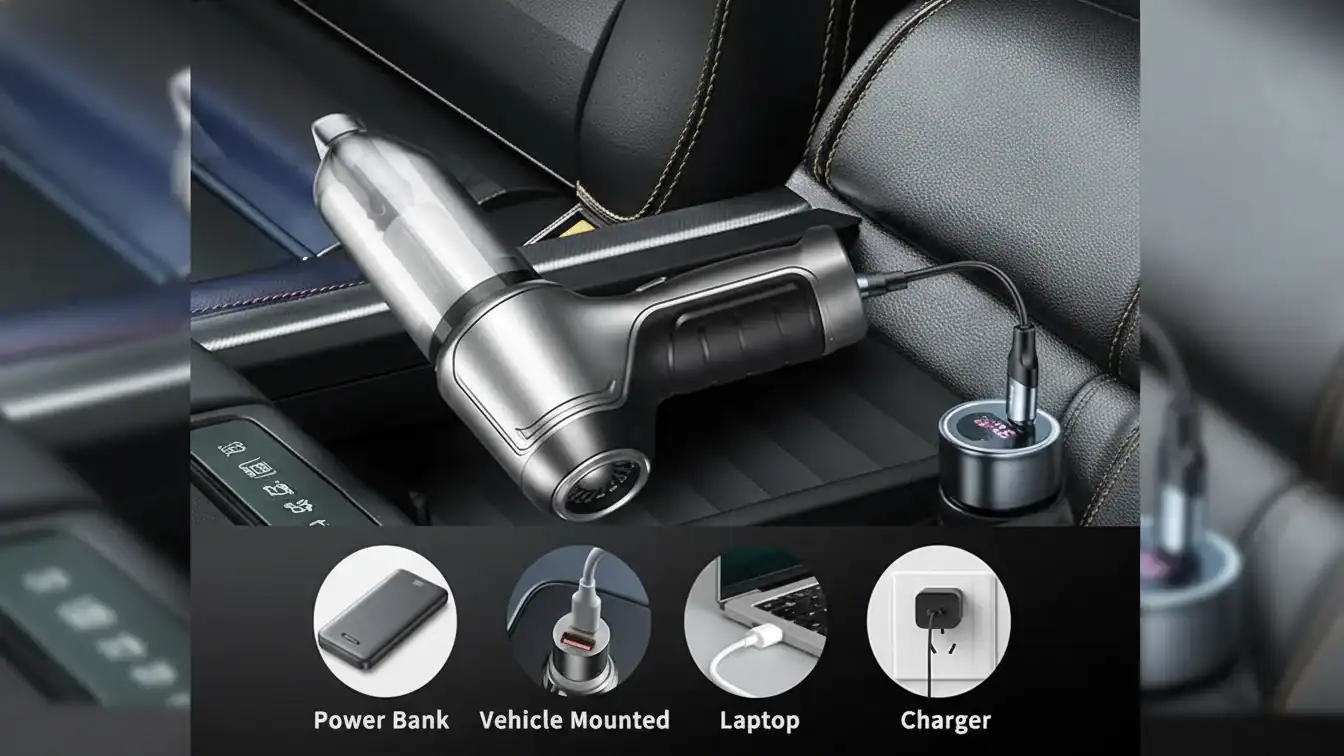
¿La compatibilidad “C-to-C” evita fallos de carga en los portátiles?
No. La compatibilidad física no es suficiente. El cargador, el cable y el portátil deben ser compatibles con el mismo perfil USB Power Delivery (PD), incluida la potencia específica que necesita el portátil.
Más allá del conector: El papel de USB Power Delivery (PD)
El puerto USB-C es solo la interfaz física. El proceso de carga real se gestiona mediante un protocolo de comunicación electrónica llamado USB Power Delivery (PD). La mayoría de los portátiles modernos dependen de este estándar, que permite al dispositivo y al cargador negociar diferentes niveles de voltaje y corriente para una carga segura y eficiente.
Enchufar el cable establece el enlace físico, pero eso es todo. Sin una negociación PD satisfactoria -un apretón de manos digital-, el cargador pasará por defecto a un nivel de potencia muy bajo que no puede cargar un portátil, o no enviará energía alguna.
Por qué deben coincidir el vataje y el voltaje
Los portátiles tienen unos requisitos mínimos de potencia. Muchos necesitan al menos 20-30 vatios para empezar a cargarse, mientras que los modelos de alto rendimiento pueden exigir 100 vatios o más. El cargador que utilices debe ser capaz de cumplir o superar esos requisitos.
Por eso suele fallar un cargador para un accesorio pequeño. Un cargador USB-C estándar para una aspiradora portátil de coche, por ejemplo, suele tener una salida de 5 V/2 A (10 vatios). Aunque el enchufe encaja perfectamente, no puede suministrar la alta potencia en vatios necesaria para satisfacer la demanda de energía de un ordenador portátil.
Source Aspiradores de coche personalizables y de alto rendimiento

¿Cómo gestiona el controlador IC la negociación de voltaje (5V/9V/12V)?
El controlador IC negocia el voltaje comenzando en unos seguros 5V. El cargador enumera las opciones de alimentación, la aspiradora solicita la mejor y la fuente cambia a ella de forma segura.
El protocolo USB-C Power Delivery (PD) no es solo un conector universal, sino una comunicación inteligente. Un controlador de circuito integrado (CI) actúa como cerebro, permitiendo a dispositivos como una aspiradora de coche hablar con una fuente de alimentación y seleccionar el mejor voltaje. Este proceso automatizado garantiza una carga rápida, eficaz y segura sin intervención manual.
El protocolo Handshake paso a paso
La negociación del voltaje es un apretón de manos automatizado que se produce en milisegundos. Sigue un procedimiento estricto y seguro para evitar daños en el dispositivo o en el cargador.
- Conexión inicial: En el momento en que conectas el cable, el sistema siempre se sitúa por defecto en un nivel seguro y universal de 5V. Este es el nivel básico de potencia que entienden todos los dispositivos USB.
- Fuente Publicidad: El cargador (fuente de alimentación) envía un mensaje digital con una lista de sus capacidades. Esta lista contiene objetos de suministro de energía (PDO) que describen cada combinación de voltaje y amperaje que puede ofrecer, como 5V/3A, 9V/2A y 12V/1,5A.
- Solicitud de dispositivo: El controlador interno de la aspiradora analiza esa lista. Compara las opciones con sus propios requisitos de potencia y devuelve una solicitud para el PDO más adecuado que admita.
- Transición de tensión: Una vez que el cargador recibe y acepta la solicitud, su controlador conmuta de forma segura la salida de energía. Aumenta la tensión en la línea de alimentación desde los 5 V iniciales hasta el nivel acordado, como 9 V o 12 V.
La carga USB-C y el fallo de seguridad de 5V
Este protocolo afecta directamente a la fiabilidad de nuestros productos. Los aspiradores de coche inalámbricos KelyLands cuentan con carga rápida USB-C estándar a 5 V/2 A. Se trata de una elección de diseño clave para lograr la máxima compatibilidad.
Si la aspiradora se conecta a un cargador que no es compatible con el protocolo Power Delivery, o si el apretón de manos falla por cualquier motivo, no hay ningún riesgo. El sistema simplemente permanece en su estado de conexión inicial. Esta función de seguridad incorporada garantiza que la aspiradora adopte por defecto el nivel estándar de 5 V, lo que le permite cargarse de forma fiable desde cualquier puerto USB -en un coche, en un portátil o con un banco de alimentación- sin peligro de que se produzcan desajustes de voltaje.
¿Es crítica la protección contra sobretensiones (OVP) para los picos eléctricos del coche?
Sí, el OVP es fundamental. Protege los componentes electrónicos sensibles del coche, como ordenadores y accesorios, de los dañinos picos eléctricos, evitando fallos permanentes y garantizando la fiabilidad del sistema.
Los riesgos de las sobretensiones eléctricas incontroladas en el coche
El sistema eléctrico de un vehículo puede experimentar picos de tensión repentinos que superan el rango de funcionamiento normal. Sin protección, estos picos pueden causar daños inmediatos y costosos al vehículo y a los accesorios conectados.
- Daños en microelectrónica sensible, incluidos los sistemas de gestión del motor y las unidades de infoentretenimiento.
- Sobrecalentamiento y degradación de los componentes internos de los dispositivos de 12 V conectados.
- Reducción de la vida útil de la batería debido a condiciones de sobrecarga causadas por un regulador defectuoso.
Cómo protegen los dispositivos certificados de 12 V
Los accesorios diseñados correctamente están preparados para soportar la inestabilidad de la tensión. Nuestras aspiradoras de coche con cable, por ejemplo, utilizan un enchufe de mechero estándar de 12 V CC, diseñado específicamente para el sistema eléctrico de un vehículo.
El pleno cumplimiento de certificaciones como CE, RoHS y FCC confirma que los circuitos internos del dispositivo son lo bastante robustos como para gestionar con seguridad las fluctuaciones eléctricas habituales. Esta resistencia integrada evita que las sobretensiones dañen el producto, lo que le proporciona una vida útil más larga y fiable.
Preguntas frecuentes
¿Sus aspiradoras son compatibles con USB-C Power Delivery (PD)?
Sí. Nuestros modelos sin cable utilizan el protocolo USB Power Delivery (PD). Esto permite que la aspiradora se comunique con el cargador para negociar automáticamente la velocidad de carga más segura y eficiente.
¿Cuál es la potencia máxima de entrada para la carga rápida?
Nuestras aspiradoras están diseñadas para una entrada estándar de 5 V/2 A (10 W). Como utilizan el estándar USB PD, son compatibles con una amplia gama de cargadores de mayor potencia, pero solo consumirán la cantidad específica de energía necesaria para un funcionamiento seguro.
¿Existe una protección contra sobretensiones (OVP) para los picos eléctricos del coche?
Absolutamente. Los circuitos de carga incluyen protección contra sobretensión (OVP) como característica de seguridad estándar. Se trata de un requisito básico de la especificación USB PD y protege los componentes internos de los picos de tensión habituales en los sistemas eléctricos de los vehículos.
¿Se incluye un cable de carga USB-C en la caja?
Sí, todos los aspiradores de coche inalámbricos incluyen un cable de carga USB-C compatible. El kit estándar también incluye un filtro lavable, una boquilla para hendiduras y un cabezal de cepillo, con lo que tendrás todo lo necesario para empezar.
¿Puedo utilizar el cargador de mi MacBook Pro para cargar la aspiradora?
Sí. Nuestras aspiradoras son compatibles con el estándar USB Power Delivery, por lo que puedes utilizar con seguridad cualquier cargador USB-C compatible, incluido el de alta potencia de un MacBook Pro. El cargador y la aspiradora negociarán automáticamente el voltaje correcto para una carga segura.
Reflexiones finales
Las aspiradoras genéricas pueden encajar en el puerto, pero a menudo carecen de controladores IC certificados para una negociación segura de la energía. Esto crea un alto riesgo de fallos de carga y devoluciones de los clientes. Nuestros productos totalmente certificados garantizan un rendimiento fiable, protegiendo su inversión en inventario y la reputación de su marca.
Las especificaciones técnicas hablan por sí solas, pero la calidad se comprueba mejor en persona. Póngase en contacto con nosotros para solicitar un catálogo de productos o pedir muestras de nuestros modelos inalámbricos y de 12 V. Nuestros ingenieros están a su disposición para estudiar sus necesidades de personalización de marcas blancas y OEM.

 English
  Español
  Français
  Deutsch
  Português do Brasil
  Русский
  한국어
한국어  日本語
日本語  العربية