 메인 콘텐츠로 건너뛰기 푸터로 건너뛰기
Has a supplier ever told you the thermoelectric mini fridge ‘will be fine for weekend camping’ when the lab data says it holds 18°C at 30°C ambient? That single disconnect frames the entire Peltier vs compressor mini fridge problem more clearly than any quote comparison.
A pre-production sample can pass your sample approval process, yet the mass production run still underperforms. Thermoelectric modules and compressor systems respond differently to heat load, and the sample was often tested in a 22°C air-conditioned room, not a parked car. Your FOB pricing might look attractive, but the return rate from customers who expected 4°C and got 18°C will eat the margin.
When you compare units from Chinese suppliers, ignore the retail packaging and ask for five numbers: cooldown time from 25°C to 5°C, ambient-to-box temperature gap at 30°C, amp draw at 12V, duty cycle over 24 hours, and noise dB(A) measured at 1 meter. These five metrics separate units that sell from units that gather returns.
Cool-Down Time: The Fastest Test Metric
Compressor wins the cool-down test.
Run a cool-down test at 25°C ambient with a target box temperature of 5°C. A compressor mini fridge will get there under realistic portable fridge conditions. A Peltier unit will not, which is why this metric separates the two technologies faster than any other.
25°C ambient to 5°C box temperature
The test is straightforward: empty box, lid closed, ambient held at 25°C, internal probe logging every 10 minutes. A small swing compressor unit pulls the interior down and crosses 5°C with margin. A 45W Peltier unit stalls far higher.
A 45W Peltier unit rarely drops below 15°C box temperature in 30°C ambient. In a 25°C room the floor moves down a few degrees, but still lands well above 5°C. That plateau is not a defect; it is the physical limit of thermoelectric cooling.
A Peltier module is a heat pump with a maximum temperature differential of roughly 18–20°C between hot and cold sides. The hot side is vented into the cabin, so once cabin air is 25°C, the cold side cannot force the box to 5°C under normal insulation and airflow losses.
The practical consequence for an outdoor gear buyer: a Peltier cooler is a drink chiller for a day trip, not a food-safety device for a multi-day camping run. If a spec sheet claims 5°C in 25°C ambient from a thermoelectric unit, ask for the test report and the ambient measurement point.
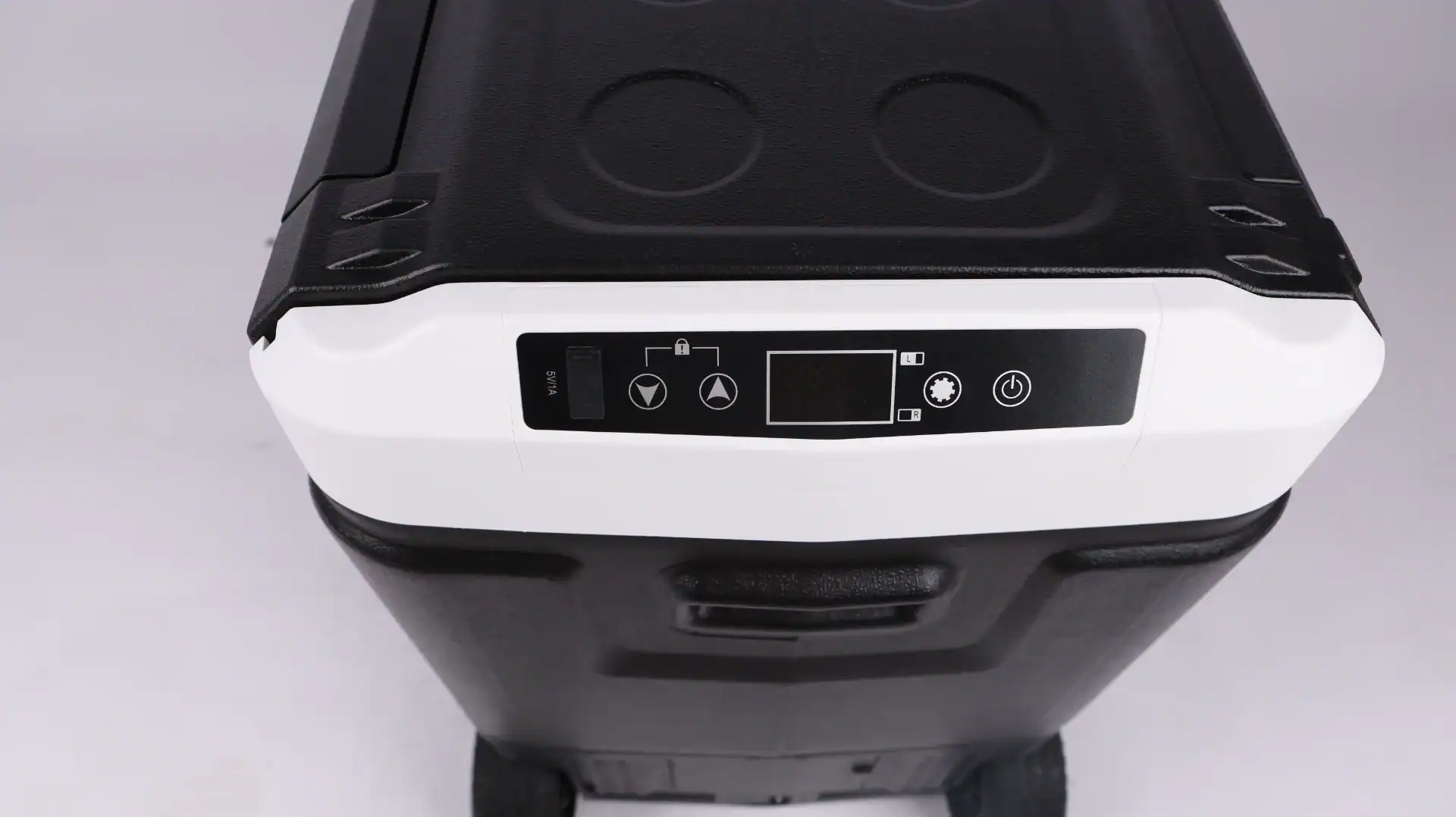
Why Peltier units plateau at 18–20°C
The 18–20°C figure describes the maximum temperature gap a single-stage Peltier module can sustain. At 25°C ambient, the theoretical floor sits near 5–7°C. Real units lose several degrees to fan heat, lid seals, and cold-side heat exchanger inefficiency, so the usable floor lands at 10–15°C.
Compressor technology does not rely on a temperature differential limit. A swing compressor, the type used in small 12V portable fridges, can pull the evaporator below 0°C and cycle off once the box hits target. That is why a compressor unit holds 4°C in the same ambient where a Peltier unit sits at 15°C.
-
- Cool-down speed: Compressor: crosses 5°C with margin | Peltier: stalls at 10–15°C in 25°C ambient.
- Temperature floor: Compressor: 4°C or lower | Peltier: roughly 15°C in 30°C ambient, 10°C only in ideal lab conditions.
- Test reliability: Compressor: consistent across ambient temps | Peltier: declared 5°C specs are usually measured with no load and auxiliary fans.
For a camping gear specialist comparing Chinese supplier quotations, cool-down time is the fastest way to spot a Peltier unit being positioned as a compressor fridge. Look for the ambient line on the spec sheet. If the supplier lists 5°C without a matching ambient 25°C test condition, treat the number as marketing.
KelyLands entered the car fridge segment in 2018 through a Ningbo-based portable fridge factory, and its line includes mini fridges and car coolers. That manufacturing context is worth remembering when a quotation arrives with vague cooling claims. Demand the same test discipline you would expect from any supplier selling into international markets.
Amp Draw and Duty Cycle: The Hidden Operating Cost
Amp draw tells you which fridge drains the battery overnight.
The hidden operating cost in a mini fridge isn’t the purchase price — it’s the amp-hours pulled from a 12V battery over a 24-hour camping cycle. A 45W Peltier unit draws a continuous 3.75A at 12V. A small swing compressor may draw 5A briefly at startup, but it can pull the box down to 4°C and then cycle off.
Compressor startup surge vs continuous Peltier draw
The real-world result shows up in battery math. In a 30°C ambient, a Peltier unit rarely drops below 15°C box temperature, and it does that while drawing 3.75A the entire time. The compressor can hit 4°C and then rest, which means less total battery drain over the same period. For an overnight camp setup, that difference decides whether the engine starts in the morning.
This is also why the Peltier fridge plateau at 18°C box temperature shows up constantly in hot-cabin tests. A thermoelectric element transfers heat only while current flows, and the gap between the hot and cold sides limits the effect. In a warm car, the physics simply won’t let a 45W element push the interior colder.
-
-
- Peltier: 45W element = 3.75A continuous at 12V. No off cycle. Typical plateau around 15–20°C in warm ambient.
- Compressor: Startup spike around 5A, then runs only until box temp hits ~4°C. Lower total amp-hour consumption over 24 hours.
-
Battery protection voltage cut-offs for 12V use
Duty cycle is only half the equation. The other half is the low-voltage cut-off that keeps a fridge from turning a starter battery into a paperweight. A quality compressor fridge — including the portable units KelyLands sources through its Ningbo-based partner factory — ships with a battery protection table that cuts power before the battery is drained too low.
Many Peltier coolers skip this entirely. They draw the battery down until the voltage collapses, because the cheapest control boards don’t include a low-voltage disconnect. When a supplier sends an FOB quote, ask for the exact 12V mini fridge battery protection cut-off voltage. If the answer is vague, plan for warranty claims from customers who got stranded.
-
- Cut-off spec to request: The battery protection table — usually 11.8V / 12.3V / 12.6V settings for low, medium, and high protection levels.
- Duty cycle spec to request: Rated amp draw at 12V plus the compressor run/rest cycle at 25°C ambient, not just the startup surge.
For a camping gear buyer, the benchmark to write down is simple: Peltier draws continuously and plateaus warm; compressor draws in bursts, cycles off, and reaches a truly cold box. If a supplier can’t provide the cut-off table in writing, that fridge doesn’t belong in your camping lineup.
| 미터법 | Peltier Unit | Compressor Unit | 구매자 영향 |
|---|---|---|---|
| Running Amp Draw at 12V | Continuous 3.75A (45W) from power-on; never drops while cooling | ~2–4A running after brief startup surge; cycles off once target hit | Compressor mini fridge 12V amp draw is far friendlier for extended off-grid trips |
| Startup Surge | None — pulls steady current from first second | Brief ~5A inrush at each compressor start | Confirm 12V socket fuse and wiring gauge handle the compressor surge |
| 24-Hour Power Consumption | High — continuous draw consumes roughly 90Ah per 24 hours | Lower — thermostat cycling cuts total amp-hour usage to roughly 20–40Ah | Compressor vs Peltier power consumption 24 hours is the decisive battery-life spec |
| 듀티 사이클 | 100% duty cycle — unit runs constantly, accelerating fan wear | Cycles on/off with thermostat; lower duty cycle preserves components | Mini fridge duty cycle 12V battery drain is much healthier with a compressor |
| Box Temperature at 30°C Ambient | Plateaus at 15–20°C; struggle to hold safe food storage temps | Reaches 4°C even in a hot cabin or truck bed | Portable compressor fridge duty cycle hot cabin scenarios still deliver cold cargo |
| 12V Battery Protection Cut-Off | Basic low-voltage cut-off near ~10.5V, often without staged alarms | Multi-stage cut-off (e.g., 11.7V / 11.3V / 10.7V) protects vehicle start battery | 12V mini fridge battery protection cut-off voltage prevents stranded customers |
| Return Risk in Outdoor Use | High — cooling failure in hot conditions drives customer complaints | Lower — reliable 4°C performance reduces after-sales friction | Outdoor car fridge return rate cooling failure drops sharply with compressor models |
Noise and Vibration: What Users Actually Hear
Fan noise reveals component quality faster than any other spec on the sheet.
The operator on the assembly line hears a Peltier mini fridge before he measures it. The fan spins the entire time the cooler is connected — a steady, continuous hiss that never lets up. A compressor unit sits silent, then kicks on with a low hum, then goes quiet again. One 30-second listen tells you which technology you are dealing with. The spec sheet just confirms it later.
dB(A) at 1 Meter: The Standard That Gets Skipped
dB(A) readings at 1 meter are the industry reference for portable fridge noise, but most budget quotations skip the measurement distance entirely. Halving that distance — from 1 meter to 50 centimeters — adds roughly 6 dB to the reading purely because of physics. If a supplier’s datasheet does not state the distance, the ambient background level, and the load condition, treat the number as marketing, not measurement.
-
- Measurement protocol: Demand a dB(A) reading taken at 1 meter from the front grille, in a room with a stated background level below the expected reading. Ask for the compressor run-cycle state: startup surge, steady running, or off.
- Noise duty cycle: Peltier: fan runs continuously while powered. Compressor: fan and compressor cycle together, which means a quiet period between cooling runs that changes the camping experience overnight.
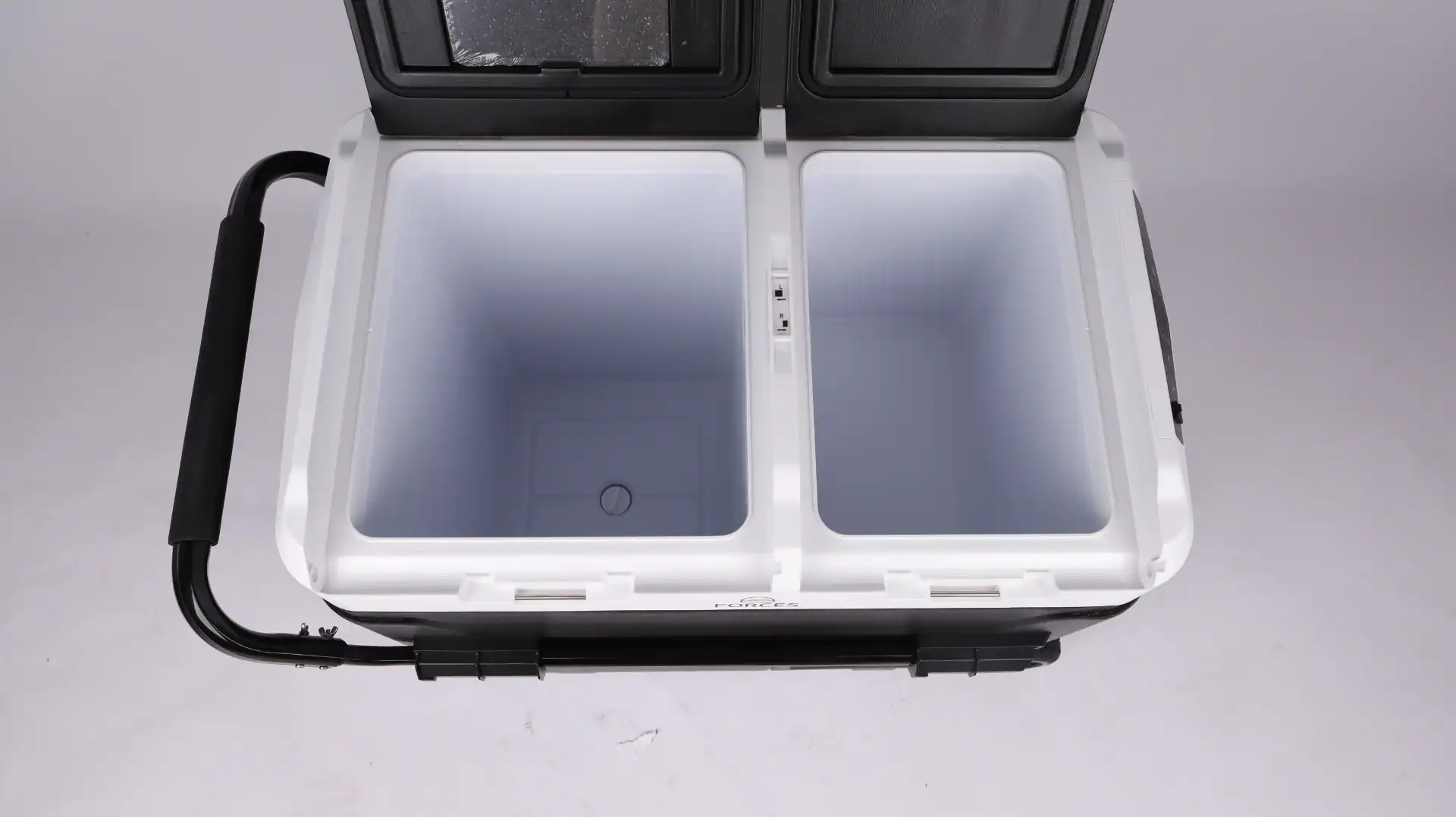
Fan Bearings Decide Whether the Noise Gets Worse
Sleeve bearings dominate budget fridges because they cost pennies. They start quiet and get audibly louder as the lubricant degrades, usually sometime around the end of the first camping season. Ball bearings hold their noise curve far longer. A buyer sourcing for an outdoor retail lineup should ask two questions: which bearing type is in the main fan, and what rated lifetime the supplier assigns to it.
The noise test works as a supply-chain screen. When a sourcing team compares quotations from Ningbo suppliers — the city where KelyLands has run its portable fridge production through a factory partnership established in 2018 — the ones that provide a third-party dB(A) report at a stated distance are the ones that have built a real quality-tolerance process. The rest send a photo of a sound meter. Sample approval for a car fridge program should include a noise check, not just a temperature check.
Mounting Isolation: The Silent Differentiator
A compressor fridge has a reciprocating pump inside. If the compressor mounts directly to the baseplate, every stroke transfers into the vehicle body. The low-frequency drone you feel through the floor is not the fridge’s own voice — it is the missing rubber isolation feet. Peltier coolers do not hammer like a compressor, but their fan motor can still transmit a buzz into the housing walls when the fan clips straight onto the case.
For a camping buyer, mounting isolation changes the product’s night-time behavior. In a rooftop tent, a wagon, or a truck cab, the enclosed space amplifies structural vibration. Rubber grommets, floating compressor brackets, and foam pads under the base break the path between the cold plate and the soundboard. The quickest verification is physical: run the fridge on a tabletop at the factory and put your palm on the case. If the housing vibrates enough to slide a phone across it, walk away from that production line.
- Pick the compressor unit if: you are selling to campers who sleep next to the fridge and will return it after one night of droning. The intermittent noise pattern is the feature that protects your margin.

결론
A 45W Peltier unit draws 3.75A continuously and rarely gets below 15°C in a 30°C cabin. A small swing compressor unit pulls 5A at startup but cycles after reaching 4°C, so its 24-hour amp-hour consumption is often lower than the thermoelectric option. The five metrics — cool-down time, ambient gap, amp draw, noise, and duty cycle — determine which fridge survives a customer’s weekend trip without a return.
-
- Peltier mini fridge cool-down time from 25°C ambient stalls around 18-20°C box temperature; compressor units can reach 4°C.
- A 45W Peltier draws 3.75A continuously, while a cycling compressor fridge can use fewer amp-hours over 24 hours.
- Compressor startup surge sits near 5A, so verify the 12V battery protection cut-off voltage before ordering a fleet.
- Measure car fridge noise dB at 1 meter, because fan bearing quality and mounting isolation decide the real user experience.
Skip this comparison and the cost shows up in warranty claims: an outdoor fridge that cannot hold temperature on a 30°C day generates returns by mid-season. Review the mini fridge spec sheets from your shortlisted suppliers, and ask for cool-down and amp draw data in writing. Browsing the KelyLands mini fridge range gives you a baseline for comparing those numbers against your current outdoor gear lineup.
자주 묻는 질문
컴프레서 미니 냉장고는 얼마나 빨리 냉각되나요?
컴프레서 미니 냉장고는 펠티에 유닛보다 더 빨리 냉각되어, 펠티에의 정체 구간 없이 25°C 주변 온도에서 5°C 박스 온도에 도달합니다.
12V 차량용 냉장고에서 예상할 수 있는 암페어 소모량은 얼마인가요?
압축기 냉장고는 시동 시에만 높은 전류를 소비하고 그 후에는 켜지고 꺼지기를 반복하는 반면, 펠티어 장치는 지속적으로 전류를 소비하여 12V 배터리를 밤새 방전시킬 수 있습니다. 선택하기 전에 항상 배터리 보호 전압 차단을 확인하십시오. 주문하기 전에 저전압 차단 사양을 확인하십시오.
펠티에와 컴프레서 중 어느 미니 냉장고가 더 조용한가요?
펠티어 냉장고는 일반적으로 팬만 사용하기 때문에 더 조용한 반면, 압축기 모델은 압축기의 윙윙거리는 소음과 진동이 추가됩니다. 실제 사용에서는 기술 유형보다 팬 베어링 품질과 장착 절연이 더 중요합니다. 대상 모델의 dB(A) 수치를 요청하십시오.
중국 공급업체로부터 펠티에 대 압축기를 구매하기 전에 무엇을 확인해야 하나요?
공급업체에 예상 주변 온도에서의 냉각 시간, 전류 소모, 듀티 사이클 및 소음에 대한 실험 데이터를 요청하십시오. 펠티에 장치는 18-20°C에서 한계에 도달하므로, 압축기가 더 안전한 선택입니다. 만약 당신의. 예상 주변 온도에서의 테스트 데이터를 요청하십시오.

 English
  Español
  Français
  Deutsch
  Português do Brasil
  Русский
  한국어
한국어  日本語
日本語  العربية