 Pular para o conteúdo principal Pular para o rodapé

Effective SKD/CKD Logistics(SKD EV charger assembly) is the primary defense against crippling 25% import tariffs that can decimate your profit margins. When fully assembled goods face these steep duties, importers are backed into a corner: absorb the cost and shrink margins, or raise prices and lose competitive ground. This market reality makes local assembly not just a logistical option, but a core financial strategy for survival and growth.
This technical guide provides the standard operating procedure for shifting to a local assembly model. We will walk through the specifics of tariff engineering, outline the simple “screwdriver factory” setup, and detail the quality assurance protocols required for post-assembly safety testing. We also cover packing schematics that can double the number of units in a single container, directly impacting your freight costs.
Tariff Engineering: Can SKD Assembly Save 25% on Import Duties?
Semi Knocked Down (SKD) assembly directly exploits the tariff gap between finished goods and components, creating a viable strategy to lower landed costs in markets with protectionist trade policies.
For international B2B importers, managing import duties is a critical part of maintaining competitive pricing. High tariffs on finished goods can quickly erode margins or push a product out of a viable price range. Tariff engineering, specifically through Semi Knocked Down (SKD) assembly, offers a structural solution to this problem by changing how a product is classified at the border.
How SKD Assembly Lowers Import Duties
SKD is a tariff optimization strategy where products are imported as semi-assembled kits rather than as fully built units. Governments often classify these components at a much lower duty rate, creating a direct path to reduce import costs without establishing a full-scale local factory. This method allows importers to leverage favorable tax classifications for parts and components. It is a practical approach for companies to reduce landing costs and navigate protectionist trade policies that heavily tax finished goods.
Tariff Differences: Finished Goods vs. Components
The financial benefit of SKD assembly comes from the significant gap between tariff rates. While duties on components can be as low as 5%–10%, fully assembled goods may face tariffs of 25%–40% in some regions. This spread is not accidental; it is designed to encourage local assembly and job creation. By shipping major components for final assembly in the target market, you align with these economic policies and realize substantial cost savings.
| Import Classification | Typical Duty Rate Range | Key Commercial Impact |
|---|---|---|
| Fully Assembled Unit (CBU) | 25% – 40% | Highest landed cost; tariffs directly impact final retail price. |
| Semi Knocked Down (SKD) Kit | 5% – 10% | Substantial cost reduction; requires local final assembly. |
Factors That Determine Actual Savings
A 25% duty reduction is not a universal guarantee. The actual savings achieved through SKD assembly depend heavily on your target market’s specific regulations, trade agreements, and the product’s HS code classification. For instance, an EV charger might be classified differently than another electronic device. Existing free trade agreements can also alter tariff calculations, sometimes reducing duties to 0%. Local content requirements, logistics efficiency, and supply chain complexity are other variables that influence the final landed cost.
The “Screwdriver” Factory: How Simple Is Final Assembly Locally?
The term “screwdriver factory” aptly describes local SKD assembly, where the value lies not in complex manufacturing but in performing the final, low-skill steps to complete a product whose critical components were engineered and built elsewhere.
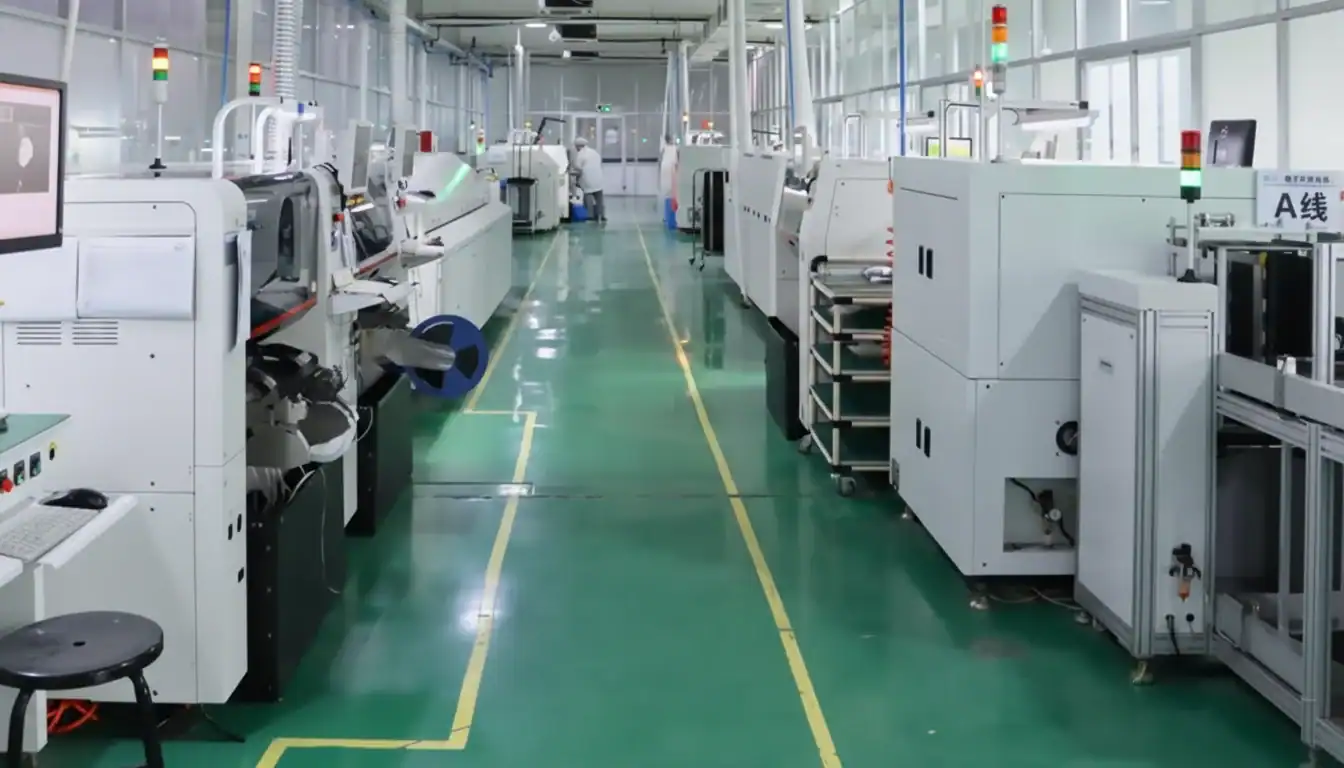
Local assembly appears simple on the surface, but this simplicity is only possible because the most demanding manufacturing stages remain centralized. Critical components like the main PCBA (Printed Circuit Board Assembly) for an EV charger depend on specialized, capital-intensive facilities. These central plants handle the complex surface-mount technology (SMT), firmware flashing, and rigorous functional testing required to meet international safety and performance standards like IATF 16949.
Core Components Requiring Centralized Production
While final assembly can be localized, the true manufacturing complexity stays upstream. The production of core electronic modules and safety-critical parts requires advanced machinery, controlled environments, and deep technical expertise. These processes are not easily replicated in a local facility without significant investment.
- PCBA production and firmware flashing demand automated SMT lines.
- Injection molding of IP-rated enclosures needs high-tonnage presses and precision tooling.
- Comprehensive electrical safety testing, like Hipot tests, requires specialized diagnostic equipment.
Steps Involved in Simple Local Assembly
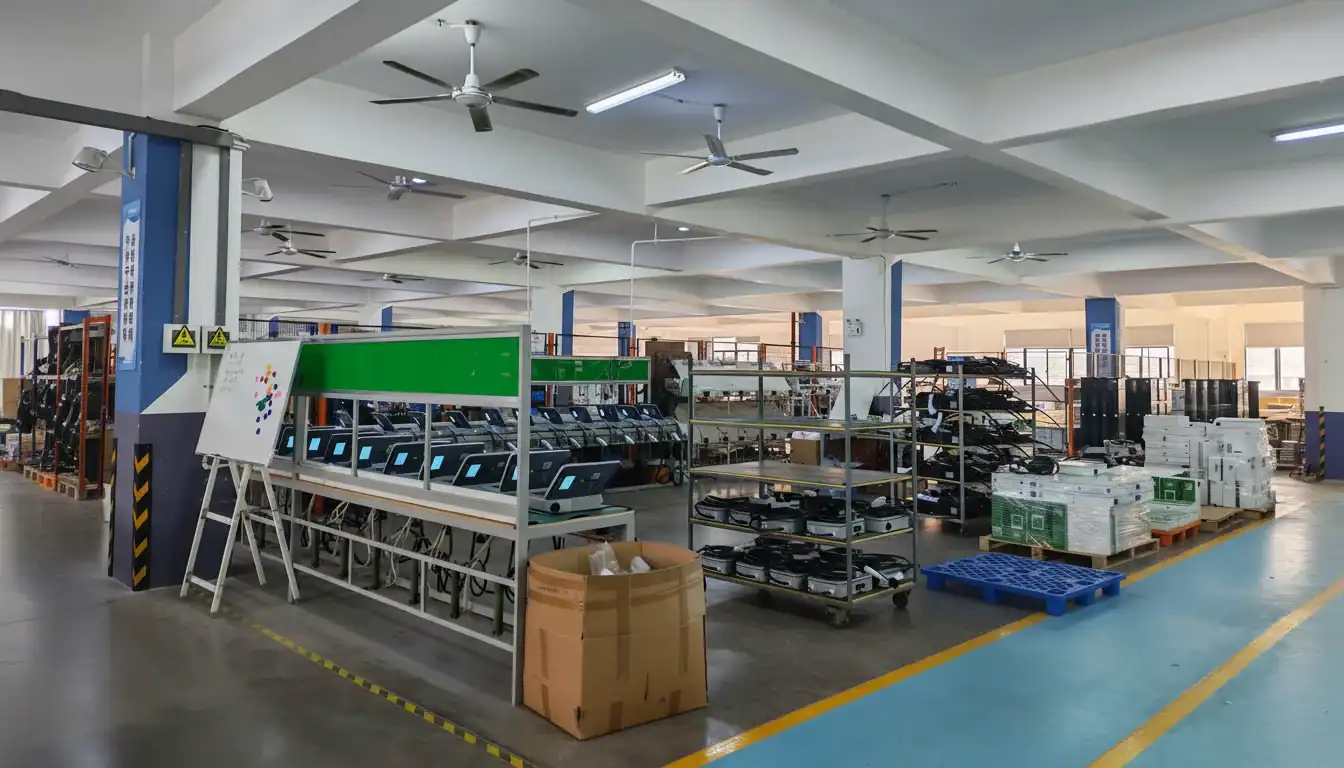
The “screwdriver factory” model focuses on the final, less technical stages of production. Local operations receive pre-manufactured, quality-controlled sub-assemblies. The local team’s role is to perform the final integration, which requires basic tools and adherence to clear assembly instructions.
| Estágio de produção | Core Tasks | Typical Location |
|---|---|---|
| Core Electronics Manufacturing | PCBA production (SMT), firmware flashing, module-level testing. | Central Certified Factory |
| Final Mechanical Assembly | Securing the main board into the casing, connecting wiring harnesses, attaching charging cable. | Local Assembly Partner |
| Embalagem final | Placing the assembled unit, user manual, and accessories into retail packaging. | Local Assembly Partner |
The Hybrid Model: Balancing Quality and Local Investment
This hybrid strategy is the most practical approach for managing costs without sacrificing quality. We centralize the production of high-precision parts to maintain strict quality control over critical electronic and safety stages. This lowers the technical barriers and initial investment for local partners, allowing them to focus on what they do best: final assembly, local distribution, and regional support. It effectively combines the cost-efficiency of local labor with the robust quality assurance of a specialized manufacturing hub.
Scale Your Business with Custom OEM Chargers

QA Protocol: How to Test Safety After Local Assembly?
A robust quality assurance protocol is not a final inspection, but a systematic, multi-stage process that combines material verification, in-process workmanship checks, and final functional testing to ensure every unit is safe and compliant before field deployment.
Establishing a rigorous quality assurance (QA) process is non-negotiable for any local assembly operation. Shipping a finished product is easy; ensuring that a locally assembled unit meets the same safety and performance standards as one from the main factory requires a structured, four-stage validation framework. This protocol guarantees that every EV charger is safe, reliable, and ready for end-user installation.
Stage 1: Incoming Component Verification
Before assembly begins, every component from the SKD kit must be inspected. This initial gatekeeping prevents damaged or incorrect parts from entering the production line, eliminating a major source of downstream failures. It sets the foundation for the final product’s quality.
- Visually inspect all housings, cables, and circuit boards for physical damage that may have occurred during shipping.
- Verify that component part numbers and specifications match the assembly’s bill of materials (BOM).
- Confirm all necessary fasteners, seals, and connectors are present and meet the required quality standards.
Stage 2: In-Process Workmanship Checks
Quality checks must be integrated directly into the assembly workflow. This approach catches workmanship errors as they happen, making corrections faster and cheaper than identifying a fault in a fully assembled unit. These checks focus on critical points of failure.
- Check that all electrical connections are secure and properly seated to prevent intermittent faults or arcing.
- Verify that fasteners are tightened to the correct torque specifications, ensuring the unit’s structural integrity.
- Inspect the placement of all seals and gaskets to confirm the enclosure meets its IP54 rating for weatherproofing.
Stage 3: Final Functional and Electrical Safety Tests
Once fully assembled, each EV charger undergoes a complete series of automated and manual tests. This is the final validation gate that confirms the unit is 100% safe and operates exactly as designed. No unit should be packaged until it passes every test in this stage.
- Conduct mandatory electrical safety tests, including high-potential (hi-pot) insulation tests and ground continuity checks.
- Run a full operational cycle to test charging output, user interface responsiveness, and OCPP communication.
- Test all built-in safety features, including over-current, over-voltage, and temperature protection sensors.
Stage 4: Documentation and Traceability
Rigorous record-keeping links each finished unit to its specific components, assembly batch, and test results. This traceability is essential for ongoing quality management, regulatory compliance, and efficient handling of any future warranty claims or component recalls.
- Assign and log a unique serial number for every assembled EV charger.
- Record the pass/fail results from all inspection and testing stages for each unique serial number.
- Archive the complete quality assurance report for each production batch for future reference and compliance audits.
Packing Efficiency: Fitting 2x More Units in a 40HQ Container?
Shipping EV chargers in SKD format isn’t just about tariffs; intelligent packing strategies can double container capacity and directly reduce per-unit freight costs.
Maximizing the number of units in a standard 40-foot High Cube (40HQ) container is a critical lever for reducing landed costs. While the concept seems simple, achieving high density requires a disciplined approach to product design, packaging, and loading methodology. The difference between an optimized load and a standard one can mean shipping twice the product for the same freight bill, fundamentally changing the economics of your import strategy.
Strategies for Maximizing Container Space
Container loading optimization depends on specific packing strategies designed to increase unit density. The goal is to eliminate “shipping air.” By designing components that nest together and using the full vertical height of the container, you can achieve significant gains in efficiency.
- Nested product design allows components like charger casings to fit within each other, minimizing wasted volume.
- Vertical space utilization ensures every cubic meter of the container is used effectively, not just the floor area.
- These optimization methods directly reduce sea freight costs by fitting more units into a single shipment.
The Trade-Off: Palletized vs. Floor-Loaded Containers
A key decision in container logistics is whether to use pallets. Palletized loading is the dominant industry practice because it simplifies and speeds up handling with a forklift. But this convenience comes at the cost of raw container volume. Floor-loading maximizes space but demands more manual labor at both ends of the journey.
- Using pallets typically reduces usable container capacity by 10-15%.
- The primary benefit of pallets is faster loading/unloading and easier inventory management at the warehouse.
- Floor-loading maximizes the number of units but is more labor-intensive and time-consuming.
Standardized Packaging for Predictable Loading
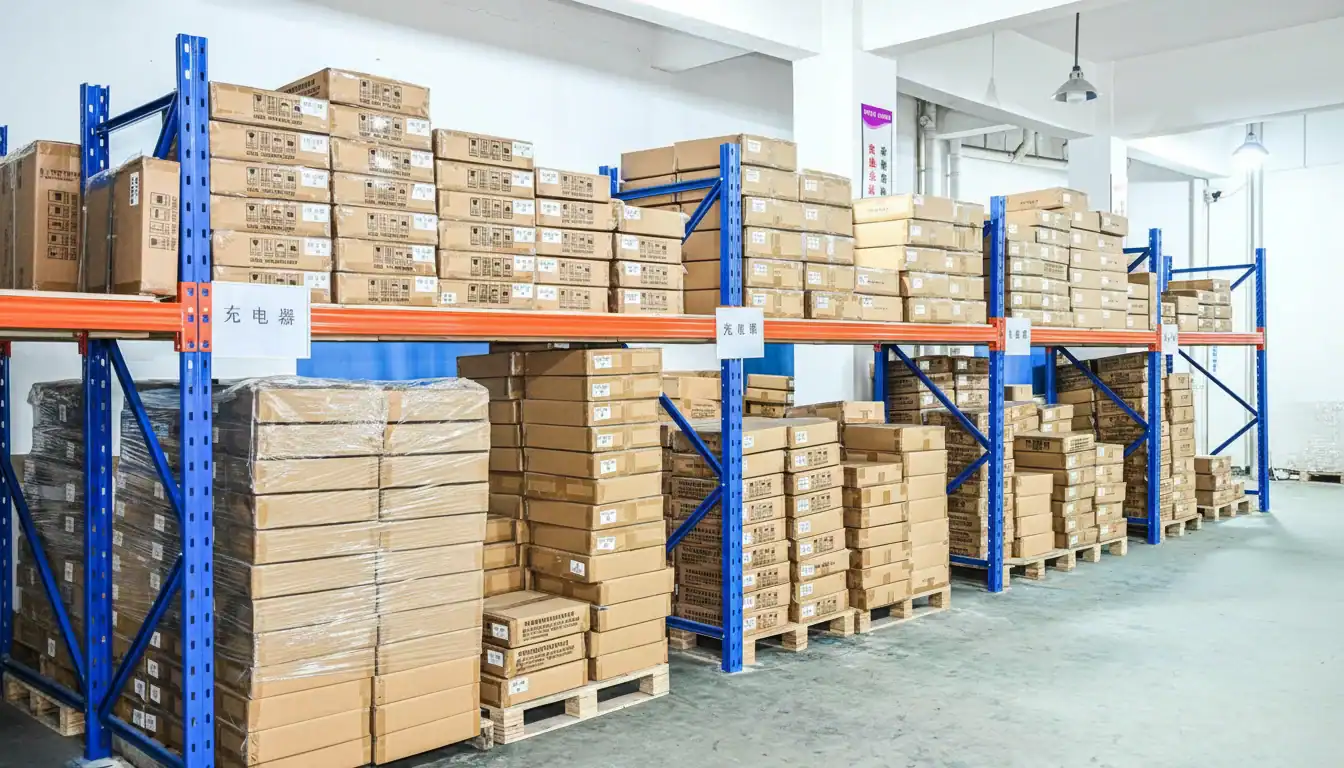
Using standardized packaging dimensions is a foundational practice for achieving high packing efficiency. Uniform box sizes allow for a predictable, stable, and repeatable stacking pattern. This “Tetris-like” approach is essential for both space optimization and preventing product damage during transit.
- Consistent packaging dimensions enable precise load planning and eliminate inefficient gaps between cartons.
- This approach helps maximize the usable 67m³ capacity of a standard 40HQ container.
- It also improves operational efficiency and predictability throughout the supply chain.
Conclusão
SKD assembly provides a direct path to reducing landed costs by navigating complex import tariffs. The process optimizes logistics by doubling container capacity and requires only minimal local setup for final assembly. With a structured quality control plan, you can ensure product safety and reliability while gaining a significant cost advantage in your market.
To see how this applies to your business, analyze the import duties for your specific region using HS code 850440. Reach out to our team for a tailored SKD proposal that includes assembly instructions and a list of required equipment.
Perguntas frequentes
What is the difference between SKD and CKD?
SKD (Semi Knocked Down) and CKD (Completely Knocked Down) refer to two different levels of product assembly. SKD kits consist of partially assembled modules, requiring less complex final assembly and basic tooling. In contrast, CKD kits are composed of individual components, requiring a more extensive local assembly process, including specialized equipment and skilled labor. SKD is often faster to implement, while CKD can offer greater tariff reductions and local content integration.
How much tariff can I save with SKD assembly?
Tariff savings vary significantly by country, product classification, and local trade policies. However, the advantage is substantial; import duties on SKD components typically range from 5% to 10%, whereas tariffs on fully assembled products can be as high as 25% to 40%. While SKD provides a clear cost benefit, the final reduction depends on the specific import regulations of the target market.
Do you provide assembly instructions and fixtures?
Yes, we provide comprehensive support for local assembly. Each SKD kit is accompanied by detailed, step-by-step assembly instructions, including diagrams, torque specifications, and quality control checkpoints. We also design and supply custom assembly jigs and fixtures to ensure consistent alignment, increase efficiency, and guarantee the final product meets all quality standards.
What equipment is needed for local EV charger assembly?
For SKD assembly of EV chargers, the required equipment is focused on precision and safety. Key items include: ESD-safe workstations with proper grounding, calibrated torque wrenches for secure connections, basic hand tools like insulated screwdrivers and wire strippers, and essential quality control devices such as a Hipot tester for electrical safety and a functional tester to validate charging protocols before shipment.

 English
  Español
  Français
  Deutsch
  Português do Brasil
  Русский
  한국어
한국어  日本語
日本語  العربية