 Zum Hauptinhalt springen Zum Footer springen

Understanding real-world 12v fridge power consumption is the critical factor preventing catastrophic power system failure in mobile and off-grid operations. Relying on the wattage printed on the box is a common engineering mistake that leads to undersized systems, dead batteries, and operational downtime. When a mobile medical unit loses temperature-sensitive samples or a remote work crew loses its provisions, the root cause is often a simple miscalculation between a manufacturer’s lab-tested specs and actual field performance.
This guide provides the technical math for engineering a reliable 12V power system. We will break down why the advertised power rating is misleading by analyzing peak draw versus average consumption. We will also explain how compressor duty cycles and ambient temperature directly impact daily energy needs, and then translate that data into precise sizing calculations for both solar arrays and LiFePO4 battery banks. Consider this your standard operating procedure for building a system that works.
Average vs. Peak Draw: Why Is the “45W” Label Misleading?
A “45W” label on a portable fridge represents its maximum instantaneous power draw, not its average consumption, which is typically 60-70% lower due to compressor cycling.
Understanding Nameplate Wattage vs. Real-World Consumption
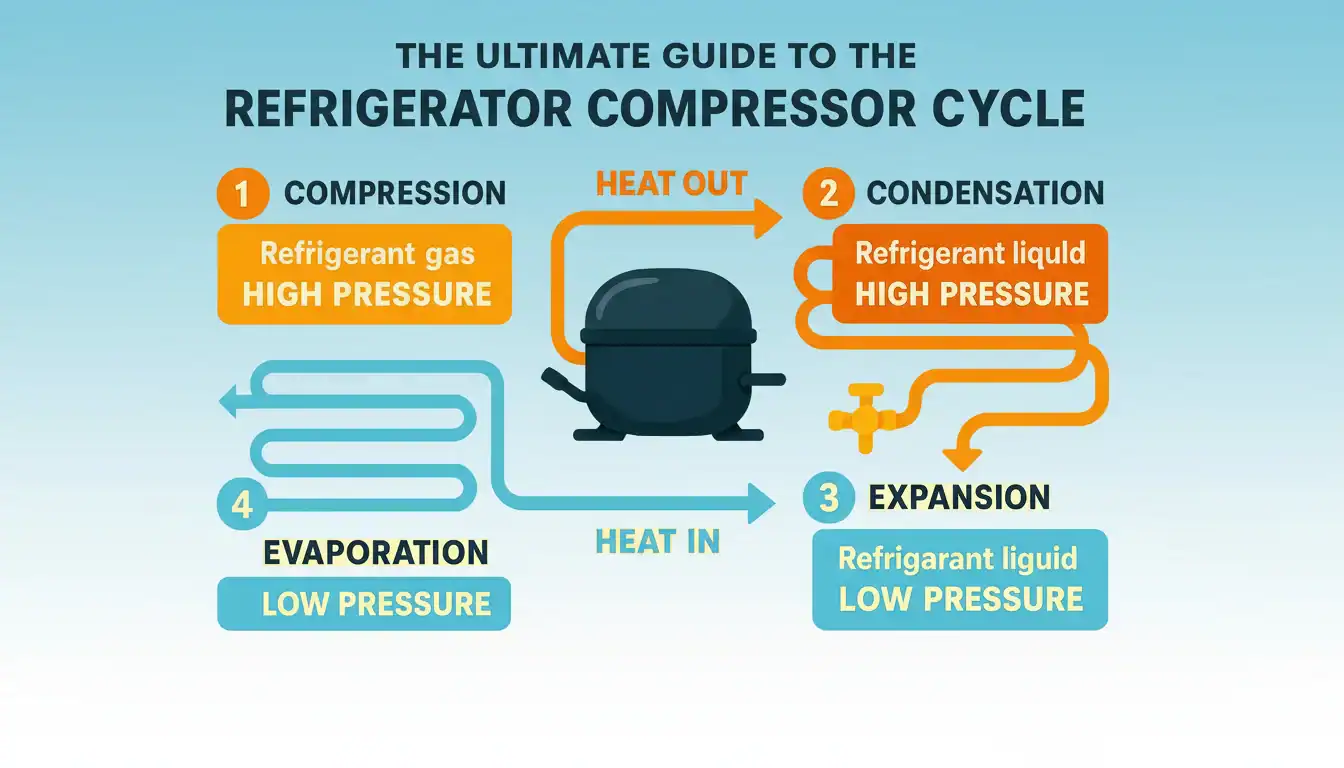
The wattage printed on a device, often called the nameplate or peak rating, indicates the maximum power it can pull at any single moment. For a compressor fridge, this peak draw usually happens during startup when the compressor kicks in against high pressure. This figure is critical for sizing fuses and wiring but is misleading for calculating long-term energy use. Actual energy consumption is far lower because the fridge’s compressor doesn’t run continuously. It operates on a duty cycle, turning on only when needed to maintain the set temperature and shutting off the rest of the time.
| Parameter | Peak Draw (Nameplate Rating) | Average Consumption (Real-World) |
|---|---|---|
| Definition | Maximum instantaneous power drawn, usually at startup. | Actual power consumed over time, accounting for on/off cycles. |
| Typical Value | 45W – 60W | 15W – 20W (averaged over an hour) |
| Primärer Anwendungsfall | Sizing fuses, wiring, and inverter capacity. | Calculating battery runtime and solar panel requirements. |
How Duty Cycles and Smart Technology Lower Power Draw
Modern DC compressor fridges are highly efficient because they don’t run constantly. The compressor’s job is to reach a target temperature and then stop. It only restarts when the internal temperature rises by a few degrees. This on-off pattern is the “duty cycle.” In typical conditions (25°C ambient), a well-insulated fridge might have a duty cycle of 30-40%, meaning the compressor is only running for about 18-24 minutes out of every hour. The rest of the time, the unit consumes almost no power. Features like Eco Mode further optimize this process, allowing for slightly wider temperature swings to reduce compressor runtime and save energy.
The Impact on Battery Sizing and Energy Cost Estimates
Relying on the 45W peak rating for system planning leads to significant over-estimation of power needs. If you calculate battery runtime using 45W, your estimate will be drastically shorter than the actual performance. This creates a poor customer experience and can lead to unnecessary investment in oversized batteries and solar arrays. For accurate off-grid power planning, you must use the average consumption figure, typically measured in Amp-hours (Ah) or Watt-hours (Wh) over a 24-hour period. As this issue becomes more widely understood, industry standards are slowly moving toward requiring manufacturers to disclose average consumption data to give buyers a realistic basis for their calculations.
Duty Cycle: Why Does the Compressor Only Run 30% of the Time?
A compressor’s duty cycle is a measure of efficiency, not power; a 30% runtime shows the unit is maintaining temperature without wasting energy, not that it is underperforming.
What Is a Compressor Duty Cycle?
A compressor’s duty cycle is the percentage of time it actively runs to maintain its set temperature. A 30% duty cycle means the compressor is on for about 18 minutes of every hour. It turns off once the target temperature is reached and cycles back on as needed to hold that temperature. This on-off pattern is a direct indicator of an efficient cooling system. The primary goal is to run the compressor only as much as necessary, which saves power and reduces mechanical wear. Modern portable and residential refrigerators typically operate with duty cycles between 30% and 50% under normal conditions.
Key Factors That Influence Duty Cycle
The compressor’s runtime isn’t fixed. It constantly adapts based on its working environment and how you use the fridge. Several external factors directly impact how often and for how long the compressor needs to engage.
- Umgebungstemperatur: The hotter the surrounding air, the harder the compressor works to remove heat. A 10°F increase in ambient temperature can raise the unit’s runtime by 15-20%.
- Product Load: A fully stocked fridge, especially one filled with warm items, requires the compressor to run much longer initially to cool down all the contents.
- Door Openings: Every time the door opens, cold air escapes and is replaced by warmer, humid air. This forces the compressor to cycle on to bring the internal temperature back down.
When to Expect a Higher Duty Cycle
While a low duty cycle is ideal for energy efficiency, some situations will push the compressor to run almost constantly, and this is completely normal. High-demand scenarios require more cooling power, pushing the duty cycle towards 100%.
- Initial Cooldown: When you first plug in the fridge, the compressor will run continuously until it reaches the target temperature. This can take several hours depending on the model and ambient heat.
- Extreme Heat: On a hot day inside a vehicle in 2026, the unit will cycle far more frequently to combat the intense external heat load.
- Heavy Use: During a family trip with frequent door openings for drinks and snacks, the compressor runtime will naturally increase to compensate for the constant introduction of warm air.
How Duty Cycle Can Signal a Problem
A sudden and sustained increase in duty cycle without an obvious cause can be an early warning of a system issue. Monitoring this behavior helps identify potential problems before they lead to a complete failure of the cooling system.
- If the compressor suddenly starts running constantly in mild conditions, it may point to a refrigerant leak.
- Clogged or dirty condenser coils trap heat and insulate the system, forcing the compressor to work overtime to compensate.
- A faulty or damaged door seal allows cold air to leak out, triggering more frequent and longer cooling cycles to maintain the set temperature.
Source Custom-Branded Coolers for Global Markets

Solar Sizing: How Do You Match Panels to a 12V Fridge?
Correctly sizing a solar setup involves matching panel wattage to the fridge’s daily Watt-hour consumption, not its peak draw, while building in a 20-30% buffer for system losses and cloudy days.
Properly matching solar panels to a 12V compressor fridge is a technical exercise in energy balance. The entire system—panels, charge controller, and battery—must be designed to replace the energy the fridge consumes over a 24-hour cycle, plus a margin for inefficiencies. Miscalculations lead to depleted batteries and unreliable cooling, a critical failure for off-grid applications.
Calculate Daily Energy Consumption
Before selecting any hardware, you must establish the fridge’s daily energy budget in Watt-hours (Wh). A typical 12V compressor fridge uses between 240 Wh and 600 Wh per day. This figure is not constant; it fluctuates based on the ambient temperature, the quality of the fridge’s insulation, and how often the door is opened. This calculation is the foundation for sizing both the solar array and the battery bank needed to sustain operation.
Size Your Solar Panels
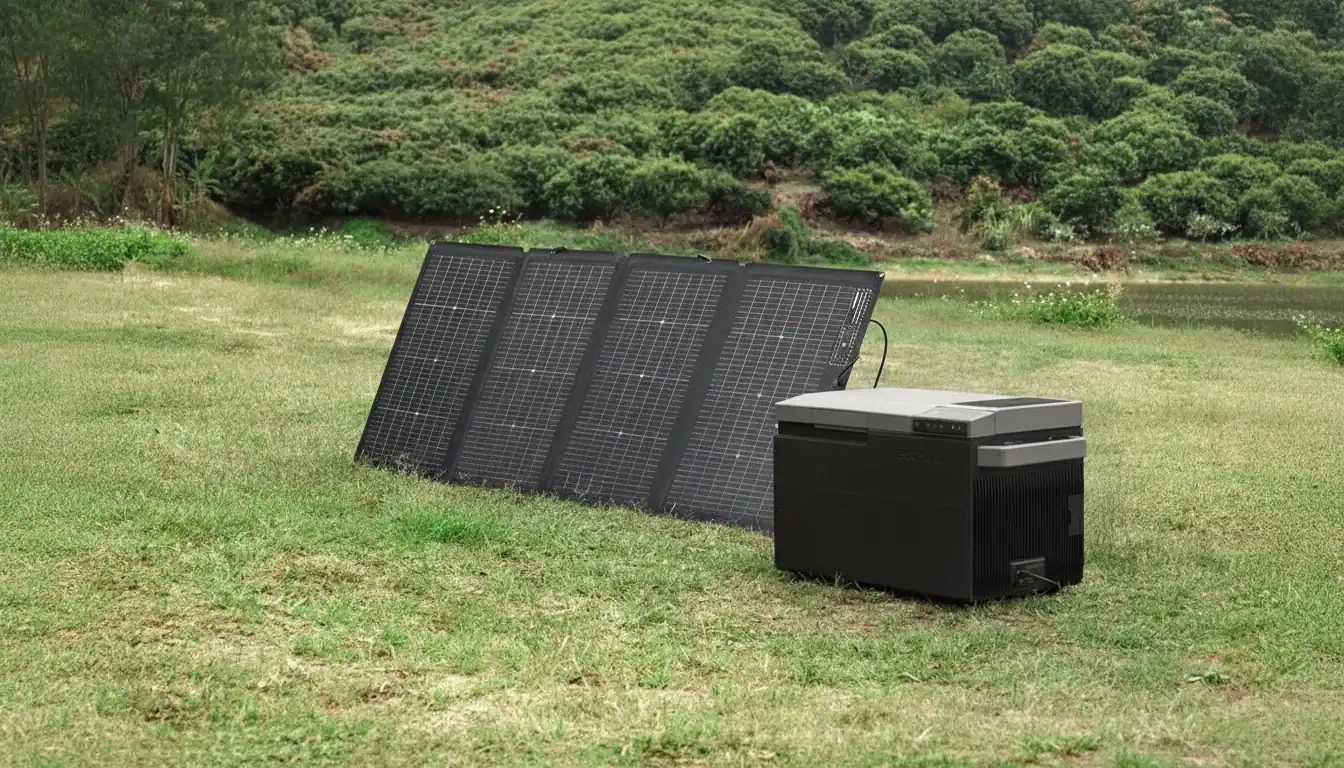
Once you know the daily energy requirement, you can size the solar array. The goal is to generate enough power during peak sun hours to cover the fridge’s consumption and fully replenish the battery. For most portable setups, this requires between 100W and 200W of solar panels. The final wattage depends heavily on geographical location and seasonal sun exposure, as areas with fewer peak sun hours require a larger panel to generate the same total Watt-hours.
| Fridge Daily Consumption | Panel Wattage (4 Peak Sun Hours) | Panel Wattage (6 Peak Sun Hours) |
|---|---|---|
| 300 Wh/day (Efficient Model) | 100W Panel | 100W Panel |
| 450 Wh/day (Standard Model) | 150W Panel | 100W Panel |
| 600 Wh/day (Large/Inefficient Model) | 200W Panel | 150W Panel |
Choose an Efficient Controller and System
Component selection directly impacts overall system efficiency. An MPPT (Maximum Power Point Tracking) charge controller is superior to a basic PWM controller, as it can harvest significantly more energy from the panels, especially in overcast or low-light conditions. Powering the fridge directly from the battery’s DC output is also critical. Using an AC inverter to run a DC appliance introduces unnecessary conversion losses that can waste up to 15% of your stored energy.
Account for Real-World Conditions
Published ratings for solar panels and batteries are based on ideal laboratory conditions. In the field, performance is always lower. High ambient temperatures can reduce a solar panel’s output voltage and overall power generation. Wiring, connections, and battery cycling all introduce small energy losses. It is standard practice to oversize the battery bank to create a buffer for consecutive cloudy days and to account for these unavoidable real-world inefficiencies.
Battery Runtime: How Long Will It Run on a 100Ah LiFePO4?
Calculating runtime for a 100Ah LiFePO4 battery is a direct process: divide the battery’s total energy in watt-hours (Wh) by the appliance’s average power consumption in watts (W), then adjust for real-world inefficiencies.
Determining how long your equipment will operate on a 100Ah Lithium Iron Phosphate (LiFePO4) battery isn’t guesswork. It’s a straightforward calculation based on energy capacity and appliance demand. Unlike older battery chemistries, LiFePO4 provides a stable voltage and nearly 100% usable capacity, which makes these estimates highly reliable for system design and product marketing.
Calculating Total Battery Capacity in Watt-Hours (Wh)
To accurately estimate runtime, you must first convert the battery’s amp-hour (Ah) rating into watt-hours (Wh). Watt-hours represent the total amount of energy stored. For LiFePO4 batteries, this conversion is consistent because they maintain a flat voltage curve throughout their discharge cycle.
- A standard “12V” LiFePO4 battery has a nominal voltage of 12.8V.
- Use the formula: Voltage (V) × Amp-Hours (Ah) = Watt-Hours (Wh).
- For a 100Ah battery, the calculation is: 12.8V × 100Ah = 1280Wh of total energy.
- You can use nearly all 1280Wh without damaging the battery, a significant advantage over lead-acid batteries that are often limited to a 50% depth of discharge.
Finding Your Appliance’s Average Power Consumption
Next, you need to identify the appliance’s average power consumption in watts (W). This is not the same as the peak or startup power listed on the label. An accurate average is critical for a realistic runtime estimate. For cycling appliances like a compressor fridge, the nameplate wattage only applies when the compressor is running. The true average must account for its duty cycle—the percentage of time it’s actually drawing that power. A fridge running 30% of the time uses far less energy than its label suggests.
The most precise method is to connect a DC power meter between the battery and the appliance to measure its actual consumption over a typical operational period.
The Core Runtime Calculation Formula
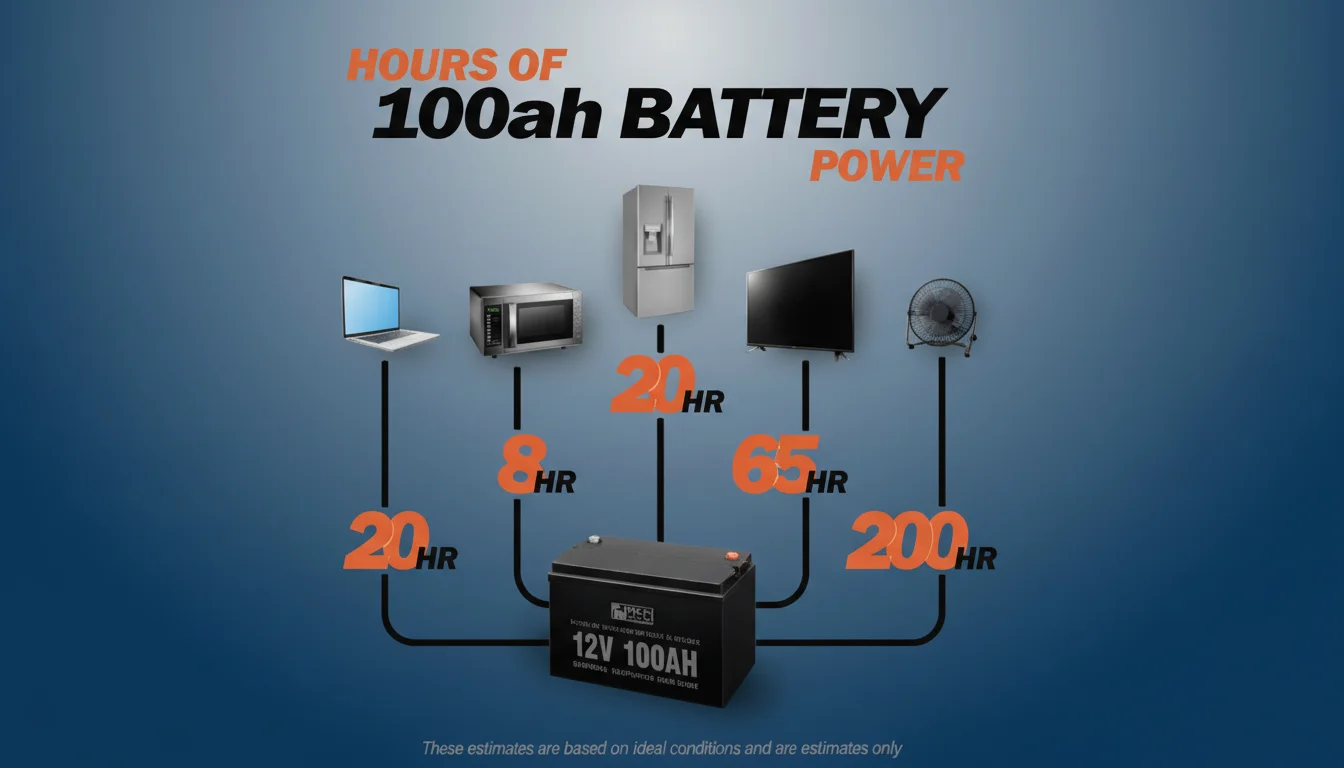
With the battery’s total energy (Wh) and the appliance’s average draw (W), you can calculate the baseline runtime. The formula is a simple division: Total Battery Watt-Hours / Average Appliance Watts = Runtime in Hours. For example, powering a device with a consistent 40W average draw gives you a clear runtime: 1280 Wh / 40 W = 32 hours. This provides a solid theoretical maximum before accounting for external factors.
| Appliance Example | Average Power Draw (Watts) | Estimated Runtime on 100Ah (1280Wh) |
|---|---|---|
| Compressor Fridge (Eco Mode) | ~20W | ~64 Hours |
| Compressor Fridge (Standard Use) | ~40W | ~32 Hours |
| Laptop Charging (via DC-AC inverter) | ~75W (includes 15% inverter loss) | ~17 Hours |
| Multiple LED Camp Lights | ~10W | ~128 Hours |
Real-World Factors That Affect Runtime
The calculated runtime is an ideal baseline. In any practical application, several factors will reduce the actual performance you observe. These variables must be considered when designing a power system or promising performance metrics to customers.
- Temperature: LiFePO4 performance can degrade in extreme cold (below freezing). High ambient heat also forces cooling appliances like refrigerators to run more frequently, increasing their average power consumption.
- Inverter Inefficiency: Converting 12V DC power to 110V/240V AC power is not 100% efficient. The inverter itself consumes energy, resulting in a 10-15% loss of your battery’s stored power. Powering DC appliances directly is always more efficient.
- Battery Health: While LiFePO4 batteries have an exceptionally long lifespan of 2,000–5,000 cycles, their total capacity will gradually decline over years of heavy use. A new battery will perform better than one nearing the end of its service life.
- Cabling and Connections: Undersized wiring or poor connections create resistance, which leads to voltage drop and wasted energy as heat. This can slightly reduce the effective power delivered to your appliance.
Schlussfolgerung
Calculating power requirements for a 12V compressor fridge involves more than just its peak wattage rating. Understanding duty cycle, solar sizing, and actual battery runtime provides a realistic energy budget for any off-grid setup. This ensures the systems you build or sell meet end-user expectations for performance and reliability.
To review the full specifications for our compressor fridge lineup, contact our team for the latest technical catalog and OEM customization options.
Häufig gestellte Fragen
How many Amp-hours does it consume in 24 hours at 25°C ambient?
In a 25°C (77°F) ambient environment, this fridge consumes approximately 30 Amp-hours (Ah) over a 24-hour period. This is based on a typical compressor duty cycle for maintaining temperature, though actual consumption can vary based on factors like contents, thermostat setting, and how frequently the lid is opened.
How long can a Jackery 500 run this 12v fridge?
A fully charged Jackery 500, with its 518Wh capacity, can run this fridge for approximately 30 to 32 hours under typical conditions. This calculation accounts for the fridge’s average power consumption and the power station’s DC output efficiency. Runtime may vary with ambient temperature and usage.
What is the current draw in Eco Mode vs Max Mode?
In Max Mode, the compressor draws approximately 3.5 to 4.0 amps for rapid cooling. In Eco Mode, the current draw is reduced to around 2.5 to 3.0 amps when the compressor is active. Eco Mode prioritizes energy efficiency by running a less aggressive cooling cycle, which significantly lowers the overall daily energy consumption.
Can it run directly off a 100W solar panel without a battery?
No, running a compressor fridge directly from a solar panel is not recommended and is technically unreliable. A panel’s power output is too variable and cannot supply the stable voltage and high inrush current required for the compressor to start. A battery and solar charge controller are essential to provide a stable power buffer.

 English
  Español
  Français
  Deutsch
  Português do Brasil
  Русский
  한국어
한국어  日本語
日本語  العربية