 Zum Hauptinhalt springen Zum Footer springen

Selecting the best rv fridge 12v for a custom conversion directly impacts the project’s long-term reliability and avoids costly client callbacks due to component failure. An incorrectly specified unit creates a cascade of problems, from inefficient power draw that compromises the entire electrical system to overheating compressors that present a genuine fire risk inside a wooden cabinet. For professional builders, a fridge failure isn’t an inconvenience; it’s a warranty claim that damages both the budget and reputation.
This guide serves as a technical breakdown for evaluating upright 12V fridges based on critical installation and layout parameters. We analyze the operational differences between front-opening and chest-style models for galley kitchens and detail the clearance requirements for proper compressor ventilation. We also cover the practical value of reversible doors for adapting to tight floor plans and whether a removable freezer compartment is a functional necessity or an unnecessary complication.
Front-Opening vs. Chest: Why Is Upright Better for Van Kitchens?
For built-in van kitchens, upright fridges offer superior space efficiency and accessibility, making them the practical choice despite minor trade-offs in thermal performance and total storage volume.
Easier Access and Organization
The main advantage of an upright fridge in a van is its intuitive, front-opening door. This design feels like a residential refrigerator, letting you see and access everything at a glance. You don’t have to dig through layers of food to find something at the bottom, which is a constant frustration with chest-style coolers. Integrated door storage also provides a secure place for bottles and small items, preventing them from shifting while you drive.
- Convenient front-opening access makes it simple to locate and grab items quickly.
- It eliminates the need to unpack and repack contents, a common issue with top-loading chest fridges.
- Door storage keeps frequently used items secure and organized.
Superior Space Efficiency
Floor space is the most valuable commodity in a van conversion. An upright fridge’s vertical design consumes a much smaller footprint than a chest fridge with the same internal capacity. This frees up critical floor area for cabinetry, counter space, or a walkway. For example, an 85-liter upright model uses significantly less floor real estate than a comparable chest unit, which often requires a heavy-duty slide-out tray to even be accessible.
| Merkmal | Upright Fridge (Front-Opening) | Chest Fridge (Top-Opening) |
|---|---|---|
| Access | Easy, at-a-glance access with shelves and door storage. | Requires digging through stacked items from the top. |
| Footprint | Small footprint, uses vertical space efficiently. | Large footprint, takes up significant floor space. |
| Cold Air Loss | Higher; cold air spills out when the door is opened. | Lower; cold air is dense and stays inside when the lid is lifted. |
| Einrichtung | Integrates cleanly into cabinetry for a built-in look. | Often requires a slide-out mechanism for accessibility. |
Practical Trade-offs to Consider
The convenience of an upright fridge comes with a few trade-offs. They are generally less efficient at retaining cold air, since the cool air spills out every time you open the door. A chest fridge, by contrast, holds cold air better because you only open the top. Upright models also tend to have slightly less usable storage space than a chest fridge of the same rated liter capacity, and they often come with a higher initial purchase price.
- Cold air escapes more quickly when the door is opened, making the compressor work harder.
- A 40-liter upright often stores less usable food volume than a 40-liter chest model.
- They may require more deliberate planning for ventilation within a cabinet.
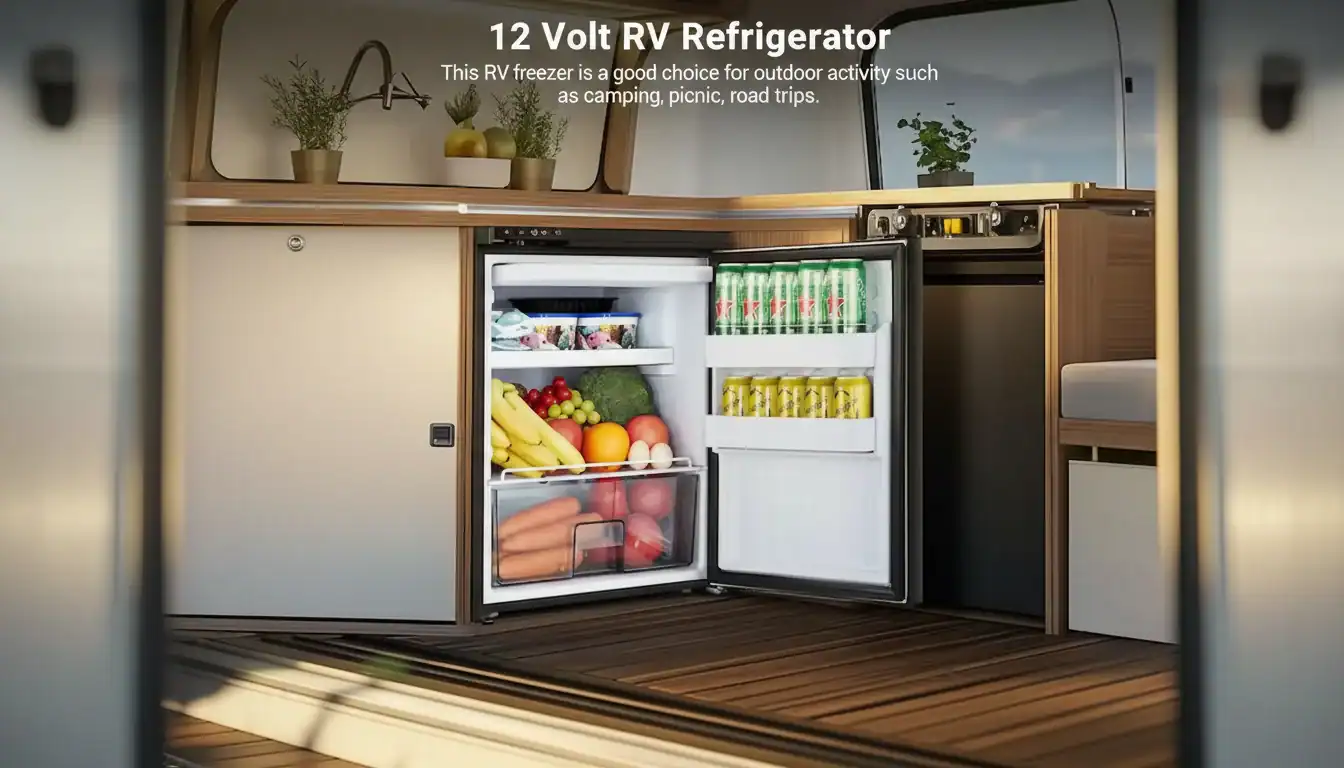
Reversible Doors: Can It Adapt to Your Layout?
While a reversible fridge door provides some layout flexibility, true space optimization in a van build comes from eliminating obstructions entirely with solutions like sliding doors, multi-functional furniture, and clever use of vertical storage.
A reversible door on a 12V fridge is a useful feature, allowing you to adapt the appliance to a left-hand or right-hand cabinet opening. This simple modification can prevent the door from swinging into a walkway or blocking another cabinet. But in the context of a complete van build, door swing is just one piece of a much larger spatial puzzle. Smarter layout strategies often move beyond simple door reversal to reclaim valuable floor space and improve flow.
The Advantage of Sliding Doors in Tight Spaces
In compact van layouts, a traditional swinging cabinet door can render a hallway impassable when open. This forces you to constantly close doors just to move around. Sliding or tambour doors completely solve this problem. They operate along a track instead of swinging out, which means they require zero clearance space to open. This makes them an ideal solution for kitchenettes, overhead cabinets, and storage units built into tight corridors.
- They conserve floor space by sliding along a track rather than swinging out.
- Customizable to precise specifications for a clean, integrated fit.
- Perfect for high-traffic areas where a conventional door would block movement.
Integrating Rear Door Storage Solutions
Van builders often overlook the significant storage potential of the rear doors. This vertical real estate is perfect for mounting specialized organizers for tools, recovery gear, or outdoor equipment. By moving these items to the doors, you free up interior cabinet space for food, clothing, and other daily essentials. This strategy also improves accessibility, allowing you to grab gear from outside the van without having to climb inside.
- Mount organizers directly onto van doors to use otherwise wasted vertical space.
- Keeps essential gear secure, organized, and easy to access.
- Reduces clutter inside the primary living area.
Creating Adaptable Spaces with Flexible Zoning
The most adaptable van layouts rely on multi-functional design. Instead of building permanent, single-use structures, effective zoning uses convertible furniture and modular components. A dinette can transform into a sleeping platform, and a bench seat can hide storage compartments. This approach allows a small footprint to serve multiple purposes throughout the day, making the entire living space more dynamic and efficient without permanent barriers that restrict movement.
- Incorporate convertible furniture that can be stowed, folded, or changed.
- Use modular components to define different living zones as needed.
- Maximize the utility of the floor plan by making the layout dynamic.
Get Certified OEM Car Coolers for Your Brand

Venting Logic: Do You Have Enough Air Gap for the Compressor?
Failing to ventilate a 12V compressor fridge is the primary cause of premature failure and excessive power drain in vehicle builds. This isn’t just about leaving a gap; it’s about engineering a clear path for heat to escape.
The 50mm (2-Inch) Clearance Rule
A compressor fridge works by transferring heat from inside the unit to the outside via its cooling fins. If that heat has nowhere to go, it builds up, creating a pocket of hot air that effectively insulates the fridge. The accepted industry standard is to maintain a minimum of 50mm (about 2 inches) of clearance around the top, sides, and back of the unit. This air gap is non-negotiable for preventing the compressor from constantly fighting to cool itself down. Anything less traps heat and forces the entire system to work harder.
| Installation Parameter | Incorrect Setup (High-Risk) | Best Practice (Efficient) |
|---|---|---|
| Air Gap Clearance | Less than 25mm (1″) – Traps heat | 50mm+ (2″) – Allows dissipation |
| Arbeitszyklus des Kompressors | High / Near-Constant Operation | Normal / Efficient Cycling |
| Effect on Battery | Significant Power Drain | Optimized Low-Wattage Draw |
| Expected Lifespan | Reduced due to Overheating | Full Operational Lifespan |
Impact on Power Drain and Lifespan
When trapped heat forces the compressor to run longer and more often, the direct consequence is a heavy drain on your vehicle’s auxiliary battery. The unit struggles to reach its target temperature, compromising cooling speed and risking food safety in hot weather. This constant overwork also generates excessive wear, which can significantly shorten the operational lifespan of the compressor itself. A well-ventilated fridge cools faster, runs less, and lasts longer.
Dual Vents for Optimal Thermal Management
The most effective ventilation strategy creates a passive airflow channel using the principles of natural convection. This requires two vents cut into the cabinet housing the fridge. This “thermal chimney” setup allows the compressor to breathe, moving cool air over the components that need it most.
- Position one vent low to draw in cooler, denser air from the vehicle’s cabin.
- Place a second vent high to allow hot air, which naturally rises, to escape.
- This arrangement passively pulls air across the compressor’s cooling fins.
- In tight installations, some builders add a low-wattage 12V fan to the upper vent to guarantee active airflow.
Freezer Compartment: Is the Removable Freezer a Must-Have?
A removable freezer compartment provides modularity for changing trip requirements, but it’s a specific feature, not a universal necessity, that trades complexity for adaptability.
Flexibility in a Single Unit
A removable freezer offers significant adaptability for van and vehicle builds. Many compressor fridge models achieve this with a removable divider, letting you instantly switch between a combined fridge-freezer, a large fridge-only space, or even an all-freezer configuration. This modularity is driven by the dynamic needs of different trips, eliminating the need for a second appliance.
- Dual-zone models with removable dividers enable dynamic space management.
- They allow quick conversion from refrigeration to deep freezing without a separate unit.
- This design is ideal for users whose storage needs change from one trip to the next.
Designs Without Removable Compartments
Not all portable fridges depend on removable components. Some single-compartment compressor models prioritize consistent temperature zones, often featuring a dedicated dairy shelf that remains slightly warmer than the main cooling area. For budget-focused builds, thermoelectric coolers are a common alternative. They provide simple cooling based on the ambient temperature (Delta T) but have no freezing capability at all.
- Some models prioritize stable, dedicated temperature zones over modular design.
- Thermoelectric options sacrifice freezing for lower cost, weight, and simplicity.
- These alternatives are practical if you don’t require simultaneous freezing and refrigeration.
Deciding What’s Right for Your Build
Choosing a fridge with a removable freezer depends entirely on your travel style and build constraints. It is not an essential feature for every user. The decision comes down to your real-world food storage habits, the physical space available in your vehicle, and the capacity of your power system. A freezer function running consistently will have a noticeable impact on your battery budget.
- Assess if you consistently need to freeze and refrigerate items at the same time.
- Consider the physical footprint and how a single or dual-zone unit fits your cabinet layout.
- Evaluate your power budget, as true freezer operation demands more energy than simple refrigeration.
Schlussfolgerung
Selecting the right upright fridge involves more than just its volume. Details like a reversible door, sufficient compressor ventilation, and a removable freezer are essential for a functional and durable van kitchen. Paying attention to these fitment requirements ensures your final build is practical and reliable for long-term use.
If you are sourcing 12V fridges for van conversion projects or retail, our team specializes in OEM solutions. Contact us to discuss your custom requirements and get access to our complete product catalog.
Häufig gestellte Fragen
What is the best upright 12v fridge for a Sprinter van?
While the “best” fridge depends on your specific layout and capacity needs, the most highly-regarded brands in the industry are Dometic and Isotherm. Models like the Dometic CRX series or the Isotherm Cruise series are industry standards known for their high efficiency, reliability, and features tailored for mobile use. For a balanced build, an 85-liter unit offers a good compromise between food storage and a compact footprint, which is a key advantage for upright models in a van.
Does the fridge need external ventilation?
Yes, proper ventilation is critical. All 12v compressor fridges generate heat at the rear condenser coils as part of the cooling cycle. To ensure efficiency and prevent the compressor from overworking, this heat must be exhausted. Best practice is to install at least two vents—a lower vent to draw in cool air and an upper vent to expel hot air—creating a convection airflow path. These can vent to the van’s exterior or into a large, well-ventilated area like a garage space.
Can the door hinge be swapped to the other side?
Most premium upright 12v fridges designed for van and marine applications feature a reversible door. This is a standard design consideration to accommodate the custom and often tight layouts of a van build. However, this feature is model-specific. It is essential to verify in the product manual or specifications sheet that the particular model you are considering has a swappable hinge before purchasing.
Is it quiet enough to sleep next to?
Yes, modern 12v compressor fridges are specifically engineered for quiet operation in small living spaces. You will hear a very low hum when the compressor cycles on, but the sound level is minimal and generally not disruptive for sleeping. Proper installation is key; ensuring the unit is securely mounted will prevent any rattling or vibrational noise. For most users, the noise is unobtrusive and easily ignored.

 English
  Español
  Français
  Deutsch
  Português do Brasil
  Русский
  한국어
한국어  日本語
日本語  العربية