 Zum Hauptinhalt springen Zum Footer springen

Selecting the best 12v fridge for truckers is a critical equipment decision that directly impacts driver retention and prevents expensive roadside downtime. A standard cooler or a poorly built unit simply can’t handle the constant G-force and vibration of a semi-truck chassis. When a compressor fails mid-route, it results in spoiled food, a reliance on unhealthy truck stop meals, and a frustrated driver. Even worse, an inefficient fridge can drain the starter battery overnight, causing a failed start, a missed delivery window, and a costly service call.
This guide provides the technical specifications needed to choose a reliable unit for your sleeper cab. We’ll analyze the most important engineering criteria: vibration resistance rated for long-haul routes, low-voltage cutoff systems that protect your truck’s battery, and noise levels under 45dB suitable for sleeping. We also examine specific fitment requirements, like drawer-style models designed for under-bunk storage and dimensions that match the standard cabinet openings in a Freightliner Cascadia.
Vibration Resistance: Can It Survive 100,000 Miles of Vibration?
A truck fridge’s longevity depends on a purpose-built system of shock-absorbing compressor mounts, reinforced frames, and durable composite materials designed to withstand constant road vibration.
Standard consumer refrigerators fail quickly in commercial vehicles. The constant micro-vibrations and sudden jolts from rough roads transfer directly to sensitive components, leading to premature failure. A durable truck fridge isn’t just a regular appliance with a 12V plug; it’s an engineered system built specifically for the demanding environment of a long-haul truck cab.
Shock-Absorbing Compressor Mounts
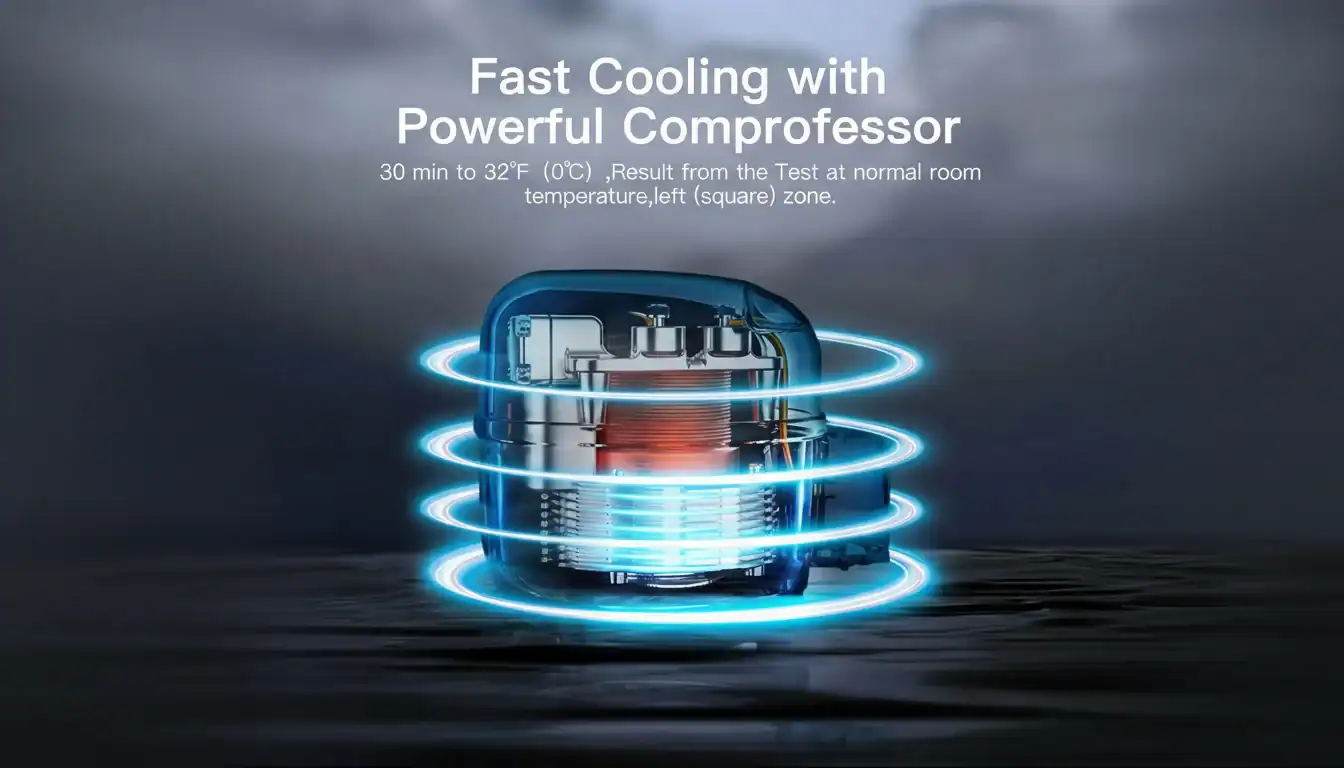
The compressor is the heart of the refrigeration system, and it’s the component most vulnerable to vibration damage. To protect it, purpose-built truck fridges use advanced mounts that isolate the compressor from the unit’s chassis. These mounts act as dampers, absorbing the constant jarring that would otherwise fatigue connections and cause internal damage.
- Specialized rubber or spring mounts dampen road vibrations.
- This prevents internal component failure caused by prolonged shaking.
- The system ensures consistent cooling performance, even on rough terrain.
| Komponente | Standard Design Approach | Heavy-Duty Truck Design |
|---|---|---|
| Compressor Mounting | Rigidly bolted or uses simple rubber feet. | Isolated on shock-absorbing mounts to dampen vibrations. |
| Structural Frame | Light-gauge metal or plastic; prone to flexing. | Reinforced, rigid frame to prevent twisting and protect internals. |
| Casing & Insulation | Thin plastic casing with standard foam insulation. | Composite GRP panels and high-density PU foam for added rigidity. |
Reinforced Structural Frames
The outer shell and internal frame must withstand the constant torque and stress of a moving vehicle. A heavy-duty, rigid frame prevents the unit from flexing, which protects internal plumbing and electrical connections from strain. This robust construction keeps all components securely locked in place, reducing the risk of cracks, loose parts, or damage to the outer casing over years of service.
- Built with a rigid frame to handle the demands of a moving vehicle.
- Protects internal components by keeping them securely in place.
- Reduces the risk of cracks or damage to the outer casing over time.
Durable Materials and Insulation
The choice of materials is critical for both durability and efficiency. Modern truck fridges use composite materials like GRP (glass-reinforced plastic) panels and high-density polyurethane (PU) foam. This combination does more than just keep the cold in; the dense insulation also acts as a structural buffer, absorbing vibrations and adding to the unit’s overall rigidity. This robust build lowers maintenance needs and directly contributes to a longer operational lifespan.
- Features composite GRP panels and high-density PU foam for strength.
- The insulation acts as a structural buffer against vibrations.
- This robust build helps lower maintenance needs and extends the fridge’s lifespan.
Size Matters: Why Are Drawer Fridges Perfect for Under-Bunk?
Drawer-style refrigerators convert unused under-bunk cavities into ergonomic, accessible cold storage, a critical space-optimization strategy for modern sleeper cabs.
Maximizing Space in Sleeper Cabs
Drawer fridges are specifically engineered to fit into the often-wasted space under a sleeper bunk. Their compact, horizontal layout slides perfectly into the confined dimensions of a truck cabin, converting dead space into efficient cold storage. This design frees up valuable vertical and floor space that would otherwise be occupied by a traditional cooler or upright fridge, making the entire cabin feel less cluttered. By utilizing these under-bunk areas, operators preserve the original cabin layout and keep dedicated storage areas available for other essential gear.
| Attribut | Drawer Fridge (Under-Bunk) | Top-Loading Chest Fridge |
|---|---|---|
| Primary Placement | Integrated into under-bunk cabinet | Occupies floor space or passenger seat |
| Weltraum-Effizienz | Utilizes existing, unused space | Consumes valuable cabin living area |
| Accessibility | Easy slide-out access while seated | Requires leaning over and digging from the top |
Ergonomic Slide-Out Accessibility
Unlike top-loading coolers that force drivers to move items around to find what they need, a drawer fridge provides direct, unobstructed access to contents with a simple pull. Drivers can grab a drink or meal without standing up or rummaging through a deep, disorganized chest. The slide-out mechanism offers a clear, immediate view of everything inside, saving time and reducing frustration. This level of convenience significantly improves driver comfort, especially during brief stops or when maneuvering in tight quarters.

Seamless Integration with Truck Platforms
The industry is shifting toward drawer-style units as a standard. Many models are engineered to integrate smoothly with major truck platforms, and some manufacturers now offer them as a factory-installed option. Their dimensions are often tailored to fit common under-bunk compartments in popular models from brands like Cascadia. The 12/24-volt DC power system connects directly to the truck’s electrical system for reliable performance, eliminating the need for complex wiring or inverters. This built-in approach provides a clean, professional finish that enhances the overall function and value of the sleeper cab.
Source High-Quality, Custom OEM Car Coolers

Noise Level: Is It Quiet Enough (<45dB) for Sleeping Cabins?
A compressor fridge operating below 45 decibels is functionally silent in a typical truck sleeper, as its noise output is completely masked by the cabin’s high ambient sound levels.
How <45dB Compares to Real-World Cabin Noise
A noise level below 45 decibels (dB) is significantly quieter than the environment inside a working truck cabin. Professional measurements show that sleeper cabs typically register between 87 and 103 dB, a level high enough to require hearing protection over long shifts. A sub-45dB appliance produces less noise than a normal conversation (around 50 dB), meaning its operation adds no disruptive sound to the driver’s living space.
- The fridge runs quieter than the background hum of the truck, even when the engine is off.
- Its sound output falls well below baseline cabin noise, ensuring it does not interfere with rest or conversation.
- This low decibel level allows the unit to cycle on and off continuously without ever becoming a noticeable distraction.
Meeting Health Recommendations for Sleep
An operating noise level under 45 dB aligns with international health standards for creating a safe and healthy sleep environment. The World Health Organization (WHO) and EPA recommend noise levels below 53–55 dB to protect residential health. A quiet fridge helps bring the cabin’s ambient noise closer to these guidelines, promoting better sleep quality and reducing driver fatigue—a critical factor for safety in long-haul operations.
Constant exposure to noise levels over 85 dB, common in truck cabs, can cause permanent hearing damage. Introducing a quiet appliance is a practical step toward mitigating occupational health risks.
The Impact of Quiet Operation on Driver Comfort
For drivers spending weeks at a time in their cabins, minimizing any additional noise is essential for comfort and mental well-being. A quiet refrigerator directly contributes to a more peaceful living and sleeping area, which reduces stress and allows for proper rest. Achieving such a low decibel output is not trivial; it requires advanced compressor technology and effective internal soundproofing, which are indicators of a well-engineered product. Ultimately, a quieter cabin environment supports better driver performance and safety on the road.

Efficiency: Does It Save the Truck’s Starter Battery?
An efficient 12V fridge is a critical component in a modern truck’s electrical ecosystem, directly protecting the starter battery by reducing the strain on auxiliary power systems.
Decoupling Hotel Loads from the Starter Battery
The industry standard in 2026 is to use hybrid electrification with auxiliary lithium power systems. This strategy creates a clear separation between the power needed for in-cab appliances (hotel loads) and the starter battery. By isolating the two, the starter battery is shielded from the frequent, deep discharge cycles that degrade performance. Its primary job—starting the engine—remains protected.
- Auxiliary power systems independently handle the energy demands of refrigerators, lights, and electronics.
- This separation prevents the damaging discharge cycles that wear out traditional starter batteries.
- It guarantees the starter battery holds enough charge for reliable engine starts, which is essential for trucks with start-stop technology.
| System Architecture | Traditional Single-Battery System | Modern Auxiliary Power System (APS) |
|---|---|---|
| Primäre Rolle | Starts engine & powers all appliances | Starter Battery (Engine Only) + Auxiliary Battery (Appliances) |
| Impact on Starter Battery | High wear from deep discharge cycles | Protected; isolated from appliance drain |
| Engine Start Reliability | Reduced, especially in cold weather | High; dedicated charge is maintained |
The Role of Advanced Batteries in Modern Trucks
Advanced batteries, like Absorbed Glass Mat (AGM) and lithium types, are fundamental to managing the electrical loads in today’s trucks. They are engineered to withstand 3 to 6 times more charge cycles than conventional flooded lead-acid batteries. This durability makes them ideal for handling the demands of both frequent engine restarts from start-stop systems and the continuous power draw from hotel loads.
- AGM and lithium batteries are built to handle the constant cycling of modern engine efficiency features.
- Their robust design mitigates the wear caused by running appliances while the engine is off.
- This battery technology is necessary to gain fuel-saving benefits without sacrificing battery lifespan.
Optimizing Power Systems for Longevity
An efficient appliance reduces the total electrical demand, putting less stress on the truck’s entire power system. When you pair a low-draw fridge with proper battery monitoring and optimized charging systems, you extend the life of both the starter and auxiliary batteries. This ensures long-term operational reliability and prevents costly downtime.
- Lower power consumption from efficient appliances reduces the depth of battery discharge.
- Effective battery monitoring systems help maintain optimal charge levels and overall system health.
- System optimization and planned replacement protocols are now standard practices for maximizing both fuel efficiency and battery life.
Schlussfolgerung
Choosing a 12V fridge for a commercial truck cabin balances durability with driver comfort. A unit must withstand constant road vibration, operate quietly enough for sleep, and fit within compact bunk dimensions. Most importantly, an efficient compressor with battery protection ensures the truck is always ready to start its next run.
For fleet managers and accessory importers, the next step is to evaluate your cabin specifications and power requirements. Contact our team to request a full product catalog and discuss OEM solutions for your volume needs.
Häufig gestellte Fragen
What is the best refrigerator for a semi truck sleeper?
The best refrigerator for a semi truck sleeper is a 12V DC compressor model from a reputable brand like Dometic or TruckFridge (Indel B). These units are engineered for the high-vibration environment of a truck, featuring shock-absorbing compressor mounts and reinforced frames to ensure longevity. Look for models with a high-efficiency Danfoss/Secop compressor, excellent PU foam insulation for stable temperatures, and a low-voltage cutoff to protect your truck’s batteries.
Do 12v fridges drain truck batteries overnight?
No, modern 12V compressor fridges are designed specifically to prevent this. They are highly energy-efficient and feature a built-in Battery Protection System or Low-Voltage Cutoff (LVC). This system automatically shuts the fridge off if the battery voltage drops to a preset level (usually with 2-3 adjustable levels), ensuring there is always more than enough power left to start the engine. This is a standard and essential feature for any quality truck fridge.
Which is the quietest 12v fridge for sleeping?
The quietest 12V refrigerators are typically those that use a variable-speed Danfoss/Secop compressor. These compressors are the industry benchmark for low-noise and low-vibration operation. Models from brands like Dometic’s CRX series are well-known for their quiet performance, often operating in the 35-45 decibel range, which is comparable to a soft whisper. The combination of a quality compressor and robust, insulated construction minimizes operational noise, making them ideal for sleeper cabs.
Does it fit the standard cabinet opening in a Cascadia?
Yes, many popular 12V refrigerators are specifically designed as direct-fit, OEM-style replacements for the standard cabinet openings in major truck models, including the Freightliner Cascadia. Brands like TruckFridge and Dometic offer models (e.g., TF49 or CRX 50) that are sized to slide directly into the factory space without modification. Always confirm the exact dimensions of your cabinet and the fridge model’s specification sheet before purchasing to guarantee a perfect fit.

 English
  Español
  Français
  Deutsch
  Português do Brasil
  Русский
  한국어
한국어  日本語
日本語  العربية