 Zum Hauptinhalt springen Zum Footer springen
Finding the best portable car refrigerator is the critical step between a successful road trip and a logistical failure rooted in spoiled food and wasted money. Most electric “coolers” are actually thermoelectric units that struggle to keep contents even moderately cool in a hot car, creating a food safety risk. When the ambient temperature climbs, their performance drops, leaving you with lukewarm drinks and questionable perishables just when you need them most.
This guide provides a technical standard operating procedure for selecting a budget-friendly unit with real compressor power. We analyze the critical performance differences between compressor and thermoelectric technology and test how fast these units can drop from room temperature to freezing. We also break down capacity—comparing 20L and 30L models—to help you decide if you need space for cans or full meals, so you can make an informed purchase based on engineering, not marketing claims.
Tech Battle: Why Choose a Compressor Over a Thermoelectric Cooler?
Compressor models deliver genuine refrigeration and freezing independent of outside heat, while thermoelectric units are budget-friendly coolers fundamentally limited by the ambient temperature.
When sourcing portable cooling units, the core technology determines performance and reliability. The choice between a compressor-based fridge and a thermoelectric cooler isn’t about which is better, but which is right for the intended use case. One offers true freezing capabilities for serious food preservation, while the other provides basic cooling for short trips at a lower cost.
Powerful Cooling Independent of Ambient Temperature
Compressor-based car fridges offer true refrigeration and can function as freezers, reaching temperatures as low as -20°C. Unlike thermoelectric models whose performance is directly tied to the surrounding air temperature (a concept called Delta T), compressor systems maintain consistent internal temperatures even on hot days. This makes them the only reliable choice for preserving perishable goods like meat and dairy during extended travel.
| Merkmal | Kompressor-Kühlschrank | Thermoelektrische Kühlung |
|---|---|---|
| Kältetechnik | DC Compressor with Refrigerant | Peltier Module (Semiconductor) |
| Leistung | True freezing to -20°C, independent of ambient heat | Cools 15–20°C below ambient temperature |
| Power Usage | Cycles on/off to maintain temp (energy efficient) | Runs constantly (higher continuous draw) |
| Bester Anwendungsfall | Serious camping, long road trips, off-grid use | Day trips, keeping drinks cool, short-term use |
- Achieves deep-freeze temperatures suitable for storing frozen goods.
- Performance is not dependent on the outside weather, ensuring reliable cooling.
- Ideal for serious camping, road trips, and off-grid adventures where food safety is critical.
Greater Energy Efficiency for Sustained Use
Thermoelectric coolers run constantly to maintain their temperature delta, leading to a steady power draw. A compressor unit operates more like a home refrigerator, cycling on and off to maintain the set temperature. This process results in significantly lower overall power consumption, making compressor fridges a better choice for running off a vehicle’s battery for extended periods without risking a complete discharge.
- Efficient power cycling reduces the total drain on a car’s battery system.
- Most models include 3-stage battery protection systems that automatically shut off the unit to prevent stranding the vehicle.
- Switchable Eco and Max modes allow users to prioritize energy savings or rapid cooling speed.
Long-Term Value and Durability
While compressor fridges carry a higher initial cost, their robust construction and superior performance provide better long-term value for serious users. They are built to handle the vibrations and tilts of vehicle travel—often rated to operate at angles up to 30 degrees. This durability ensures a longer operational lifespan compared to thermoelectric coolers, which are better suited for shorter trips and less demanding use.
- Constructed with durable components designed specifically for mobile environments.
- Offers a much longer service life, justifying the initial investment for frequent travelers.
- Provides the reliability needed for preserving temperature-sensitive items like medicine or fresh food over multiple days.
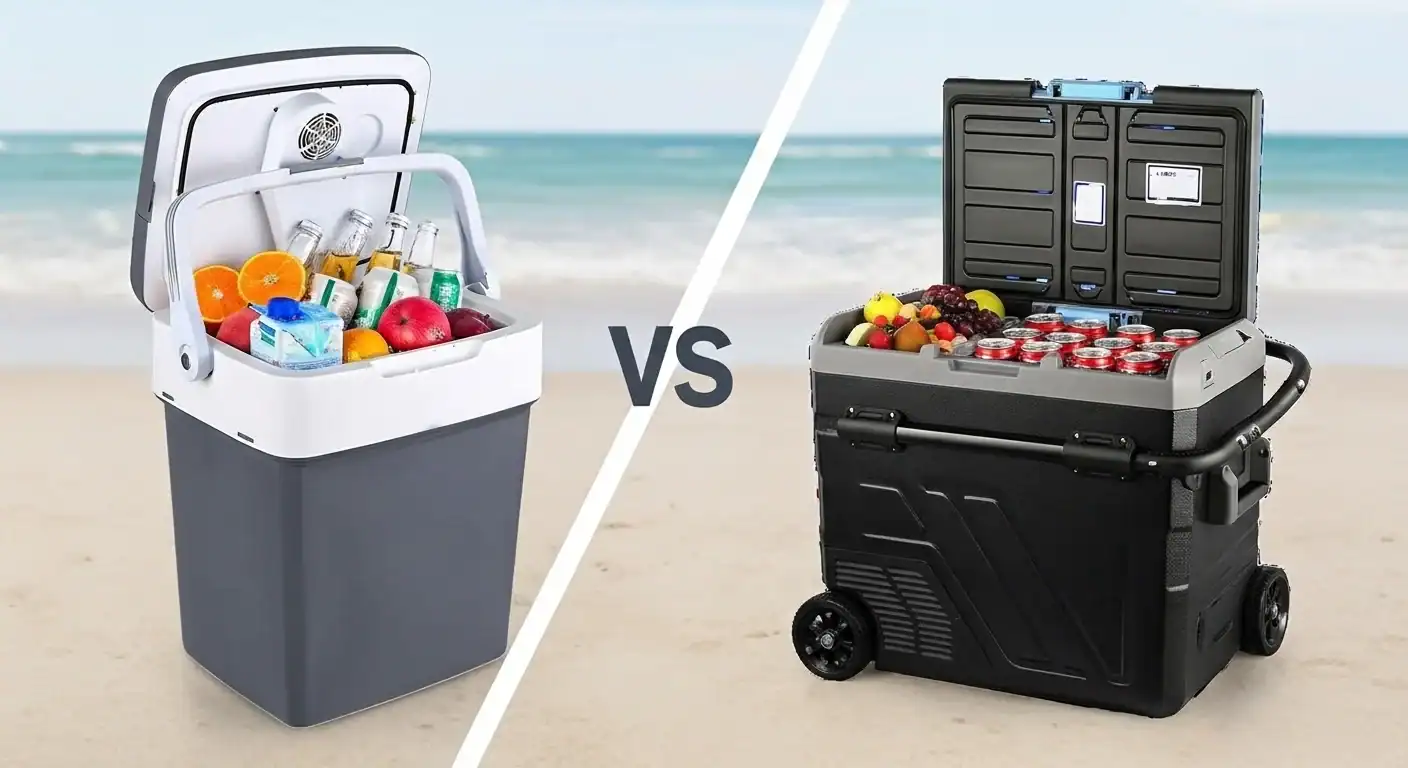
Capacity: 20L vs 30L – Do You Need Space for Cans or Food?
Choosing between a 20L and 30L car refrigerator hinges entirely on your use case: 20L is optimized for day trips and couples, while 30L provides the necessary capacity for small families on weekend getaways.
20L Models: Ideal for Day Trips and Couples
A 20L car refrigerator provides just enough space for short outings, making it a compact and highly portable choice for individuals or couples. This size is perfect for keeping drinks and snacks cool without taking up significant vehicle space. Its smaller footprint fits easily in most car trunks or back seats, and it’s typically lighter and easier to carry from the car to a picnic spot.
30L Models: Suited for Small Families and Weekend Trips
For small families or trips lasting more than a day, a 30L model offers the extra storage needed for meals, drinks, and perishable items. This capacity ensures you can pack enough to keep everyone supplied for a weekend adventure. It offers ample room for a weekend’s worth of food for 3-4 people and accommodates taller bottles or larger food containers more easily.
| Spezifikation | 20L Capacity Model | 30L Capacity Model |
|---|---|---|
| Primärer Anwendungsfall | Day trips, individuals, couples | Weekend trips, small families (3-4) |
| Typical Loadout | Drinks, snacks, small food items | Full meals, groceries, tall bottles |
| Trip Duration Fit | Under 24 hours | 2-3 days |
Key Factors for Your Decision
The right capacity ultimately depends on your travel habits. To find the best balance between space and portability, analyze your group size, trip length, and what you typically store.
- A 20L unit is often sufficient for one or two people, while a 30L unit better serves a small family.
- For quick trips under 24 hours, 20L is practical. For longer weekends, 30L is more reliable.
- If you only need to cool cans, 20L works well. For storing full meals and groceries, 30L offers greater flexibility.
Build Your Brand with Certified OEM Coolers

Cool Down Speed: Can It Go from Room Temp to 0°C in 20 Mins?
High-efficiency compressors enable rapid cooling to 0°C in under 20 minutes, though actual performance is directly influenced by ambient temperature, unit capacity, and initial contents.
The quick answer is yes, a modern 12V car fridge can hit freezing temperatures in under 20 minutes. This speed is a direct result of using powerful, efficient compressor systems that function just like a home refrigerator. It’s a key differentiator from older, slower technologies.
The Role of Compressor Technology in Rapid Cooling
Modern 12V car fridges achieve these impressive cooling speeds primarily through high-efficiency compressor systems. This technology allows them to quickly drop internal temperatures from ambient down to 0°C (32°F), making them ready for use shortly after plugging in. KelyLands integrates reliable compressors from established brands like BAIXUE and LG to ensure efficient performance and durability. This technology enables the unit not just to chill but to deep-freeze contents, often reaching temperatures as low as -20°C (-4°F).
| Leistungskennzahl | Compressor Fridge (KelyLands) | Thermoelektrische Kühlung |
|---|---|---|
| Cooling Speed to 0°C | ~15-20 minutes (empty) | Cannot reach 0°C |
| Lowest Temperature | -20°C (-4°F) | 15–20°C below ambient |
| Leistung bei Hitze | Maintains set temperature regardless of ambient | Performance degrades as ambient temperature rises |
Key Factors That Influence Cooling Time
While reaching 0°C in under 20 minutes is a solid benchmark, actual performance depends on several real-world conditions. Understanding these factors helps set accurate expectations for your car cooler’s initial pull-down time.
- Ambient Temperature: The unit will cool faster on a mild day than in scorching heat, as the compressor has less work to do.
- Refrigerator Capacity: A smaller, 20L cooler will reach its target temperature more quickly than a larger 50L unit with more space to cool.
- Initial Contents: Placing pre-chilled or frozen items inside significantly reduces the time needed to reach and maintain low temperatures.
- Stromquelle: Performance is generally stable, but consistent power from an AC outlet might provide slightly faster initial cooling than a 12V DC car socket.
Setting Realistic Performance Benchmarks for 2026
For high-quality car refrigerators, cooling an empty unit from room temperature to freezing in about 15 to 20 minutes is achievable under ideal conditions. This rapid performance is a key feature for travelers who need on-the-go convenience. A practical expectation for most users in typical conditions is reaching the target temperature within 20-30 minutes. To get the best results, turn the fridge on a few minutes before you load it with food and drinks.

Portability: Do You Need Wheels and Telescopic Handles?
Wheels and telescopic handles are a practical necessity for moving large, fully-stocked refrigerators across campgrounds or event spaces, but are often overkill for simple car-to-kitchen transfers.
Assessing Your Use Case: When Are Wheels Essential?
The decision to source a car fridge with wheels and a handle depends entirely on the end user’s application. These features become valuable when moving a heavy, fully-stocked cooler over any significant distance, like across a campground, down a boat dock, or into a large event. For simple trips from the car trunk to a nearby picnic table, they can be an unnecessary addition.
- For frequent outdoor events or extended camping trips, wheels and handles significantly reduce physical strain.
- Larger capacity fridges (typically our 35L-50L models) become extremely difficult to carry when full, making wheels a practical requirement.
- If the cooler is usually moved only a few feet from the vehicle, integrated side handles on a lighter model are sufficient.
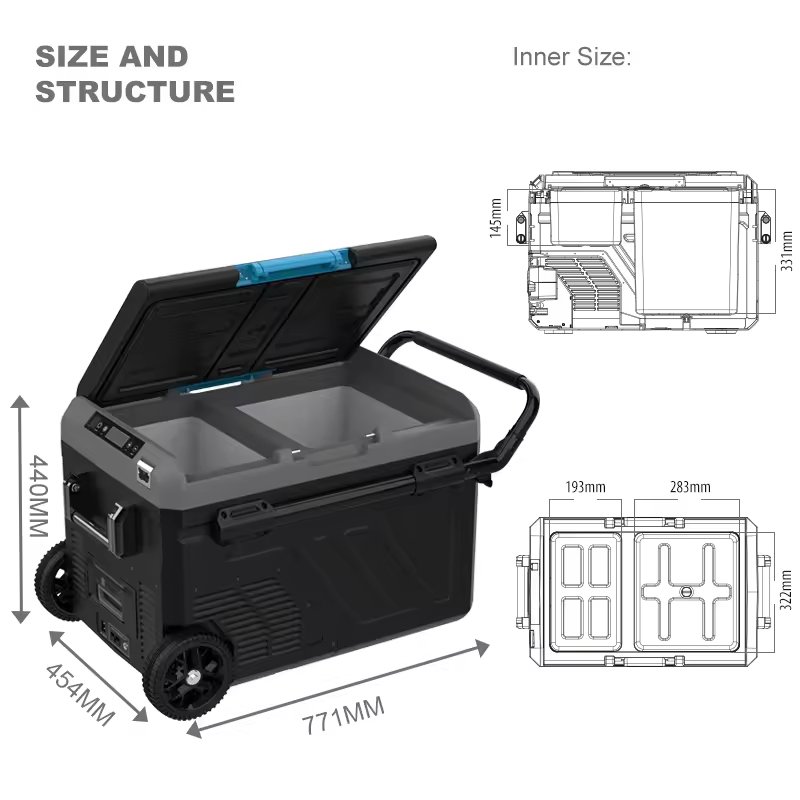
Design Impact: Weight, Size, and Durability
Adding wheels and a telescopic handle directly impacts the cooler’s design profile. By 2026, we’ve focused on integrating these features without compromising too much internal volume, but it’s still a trade-off. A wheeled model is inherently heavier and slightly larger than a non-wheeled counterpart of the same capacity, which affects logistics and vehicle packing.
- Check the wheel construction; rugged, all-terrain wheels are necessary for outdoor use and far superior to small plastic casters.
- A sturdy, multi-stage telescopic handle provides more user flexibility and is less likely to fail under a heavy load.
- Account for how the wheels and handle affect the unit’s external dimensions and confirm it will still fit in the intended space within a vehicle.
The Rise of Multi-Functional Portability
Modern portable refrigerators are engineered for versatility across multiple environments, not just inside a car. Wheels and handles directly support this trend. They transform the appliance from a simple vehicle cooler into a mobile refrigeration solution for road trips, boating, tailgating, and even as a temporary extra fridge at home during events.
- Enhanced mobility allows users to bring reliable compressor-based cooling far beyond the reach of their vehicle.
- When paired with efficient compressor systems, these units maintain true refrigeration performance anywhere they can be rolled.
- This multi-functional design increases the overall value and utility of the investment for the end consumer.
Schlussfolgerung
Choosing the right portable fridge comes down to matching technology with your customers’ needs. A compressor model delivers true freezing capabilities for serious adventures, while capacity and portability features define its convenience for family trips or daily use. Understanding these core differences ensures you select a product that performs as promised and avoids costly returns.
If you are an appliance buyer or outdoor brand looking to build a custom car fridge lineup, our team can help you configure the right models. Contact us to discuss OEM specifications or to get our complete factory catalog.
Häufig gestellte Fragen
Are portable car fridges worth the money?
Yes, for many users, portable car fridges are a worthwhile investment. Their value depends on your use case. For frequent travelers, campers, or professionals on the road, a compressor-based fridge offers significant long-term savings and convenience by keeping food fresh and drinks cold, reducing the need to buy ice or eat out. For occasional, short trips, a less expensive thermoelectric cooler might be sufficient, but for true refrigeration and performance in various ambient temperatures, a compressor model provides superior value.
What is the best cheap car refrigerator with a compressor?
While specific brand recommendations change, the best budget-friendly compressor car refrigerators share key features. Look for models with a reputable, energy-efficient compressor as this is the core component affecting performance and longevity. Prioritize units with robust insulation, a clear digital temperature control panel, and a multi-level battery protection system to prevent draining your vehicle’s battery. Often, value-oriented brands offer these features by using a more basic external construction, which is a common trade-off for a lower price.
What is the difference between an electric cooler and a portable fridge?
The primary difference lies in the cooling technology. An ‘electric cooler’ typically uses a thermoelectric system, which is compact and silent. Its cooling ability is relative to the outside temperature, usually lowering it by a fixed amount (e.g., 30-40°F below ambient). A ‘portable fridge,’ on the other hand, uses a compressor-based system, just like your home refrigerator. This allows it to achieve and maintain a specific, much colder temperature (including freezing) regardless of the external heat. Compressor models are more efficient and powerful, making them true refrigerators, while thermoelectric units are best for keeping already cool items cool on short trips.
Can it make ice cubes?
This depends entirely on the type of unit. A true compressor-based portable refrigerator can definitely make ice cubes. Since they can reach and maintain sub-freezing temperatures (often down to 0°F / -18°C or lower), you can easily freeze water in an ice tray. However, a thermoelectric electric cooler cannot make ice. These devices are designed to cool a certain number of degrees below the ambient temperature and lack the power to reach the freezing point of water.

 English
  Español
  Français
  Deutsch
  Português do Brasil
  Русский
  한국어
한국어  日本語
日本語  العربية