 Zum Hauptinhalt springen Zum Footer springen

Reliable car battery protection is the first line of defense against the operational downtime that leads to missed service level agreements and expensive vehicle recovery. For any commercial fleet, a vehicle stranded with a dead starter battery is a critical failure point that halts service delivery, damages equipment, and erodes profit margins.
This technical guide provides the standard operating procedure for configuring a 3-stage voltage cut-off system. We will cover how to correctly set the High, Medium, and Low thresholds for starter versus auxiliary batteries, explain how voltage hysteresis prevents destructive on-off cycling loops, and analyze why wiring thickness is a critical factor in the protection logic’s accuracy.
The “Stranded” Fear: Why Is Low Voltage Protection Non-Negotiable?
Low voltage protection is a critical system that prevents deep discharge cycles, safeguards sensitive vehicle electronics, and ensures the starter battery always retains enough charge to start the engine.
Protecting Your Car Battery’s Lifespan
Low-voltage protection acts as a safeguard against deep discharge cycles, a primary cause of premature battery failure. By cutting off power before the battery is fully depleted, the system helps maintain the battery’s health and significantly extends its operational life, ensuring you get the most out of your investment.
- Prevents batteries from falling into a dangerously low discharge state.
- Avoids irreversible damage to battery cells caused by over-discharging.
- Maintains healthier charge cycles, preserving long-term capacity and performance.
Safeguarding Sensitive Vehicle Electronics
Modern vehicles from 2026 and beyond rely on a network of sensitive electronic components that can be damaged by unstable or low voltage. A protection system ensures a stable power supply by disconnecting accessories before voltage drops to a critical level, preventing data corruption in onboard computers and protecting delicate circuits.
- Disconnects power before voltage drops to levels harmful to components.
- Stops data corruption in Engine Control Units (ECUs) and other onboard systems.
- Ensures consistent power for critical electronic functions when the vehicle is off.
Ensuring You Can Always Start Your Engine
The most practical benefit of low-voltage protection is that it reserves enough power in the battery to start the engine. It intelligently disconnects non-essential accessories like a car fridge, so you never have to worry about a dead battery leaving you stranded after camping or parking for an extended period.
- Automatically disconnects accessories like car coolers or portable electronics.
- Preserves the minimum voltage required for the starter motor to crank the engine.
- Eliminates the risk of being stranded due to a battery drained by connected devices.
H/M/L Settings: How to Configure for Starter vs. Aux Batteries?
The H/M/L setting directly controls the voltage cutoff threshold, allowing you to prioritize engine start capability with a High setting or maximize runtime from an auxiliary power source with a Low setting.
Choosing the Right Setting for Your Battery Type
The ideal battery protection setting depends entirely on your power source. Selecting the correct mode is a trade-off between runtime and starting reliability. You want to prevent draining a vehicle’s starter battery, but you also want to maximize the cooling duration from a dedicated auxiliary battery. The configuration should match the specific application to avoid unexpected shutdowns or a dead starter battery.
| Battery Power Source | Recommended Setting | Hauptziel |
|---|---|---|
| Vehicle Starter Battery | High (H) or Medium (M) | Ensures the engine always has enough power to start. |
| Dedicated Auxiliary / Dual Battery | Low (L) or Medium (M) | Maximizes runtime by allowing a deeper discharge. |
| AC Adapter / Portable Power Station | Low (L) | Safely maximizes usage as there is no vehicle to strand. |
Understanding the Voltage Cutoff Levels
Each protection level corresponds to a specific voltage threshold that instructs the refrigerator’s compressor to shut down. This automatic cutoff is what protects the connected battery from over-discharge, which can shorten its lifespan or, in the case of a starter battery, leave you stranded. The settings are designed to cover the most common use cases in vehicle and off-grid applications.
- High (H): Shuts off at approximately 12.4V. This offers the highest level of protection and is the safest setting for a primary vehicle battery.
- Medium (M): Shuts off around 11.0V. This is a balanced choice, providing decent runtime while still leaving a safe margin on many deep-cycle batteries.
- Low (L): Shuts off at about 10.1V. This setting allows for the deepest battery discharge and should only be used with dedicated auxiliary batteries (like LiFePO4) or power stations that have their own internal BMS protection.
How to Adjust the Protection Setting
You can change the battery protection level directly from the cooler’s control panel. The process is simple and takes just a few seconds. With the cooler turned on, press the ‘SET’ button repeatedly (usually three times) until the current mode (H, M, or L) flashes on the display. Then, use the ‘UP’ and ‘DOWN’ buttons to cycle through the options. Once you see your desired mode, just wait a moment and the system will automatically save your selection and exit the settings menu.
Important Note on the Factory Default Setting
KelyLands portable refrigerators and most others in the industry ship from the factory with the battery protection level set to High (H). This is a deliberate safety measure to prevent a customer from accidentally draining their car battery on first use. If you are powering the unit from a dual-battery system or a portable power station, you must remember to change this setting to Medium (M) or Low (L) to achieve the maximum runtime from your dedicated power source.
Boost Sales with Custom-Branded Car Coolers

Voltage Hysteresis: How Does It Prevent “On-Off” Cycling Loops?
Voltage hysteresis is a chemical property of a battery, not a safety feature. The “on-off” cycling loop is prevented by a programmed disconnect and reconnect voltage gap in the Battery Management System (BMS), which is a deliberate engineering choice.
Understanding the Voltage Gap in LFP Batteries
Voltage hysteresis is an inherent characteristic of Lithium Iron Phosphate (LFP) batteries. It refers to the measurable difference between the battery’s voltage curve during charging and its curve during discharging, even at the same state of charge. This gap, typically between 5–25 mV, arises from the internal chemistry of the two-phase reaction between LiFePO₄ and FePO₄. This is a natural chemical phenomenon that a Battery Management System must account for, not a protective mechanism in itself.
The Voltage Rebound Effect After a Cut-Off
When a device like a compressor fridge reaches its low voltage cut-off point, the protection circuit disconnects the load. Instantly, the battery’s terminal voltage “rebounds” or recovers to a slightly higher resting level. If the protection logic only used a single voltage threshold, this rebound would be enough to trigger the device to turn back on. The load would immediately pull the voltage back down, causing another shutdown and creating a destructive on-off cycling loop.
| Parameter | Example Voltage | Funktion |
|---|---|---|
| Low Voltage Disconnect (LVD) | 10.8V | Shuts off the appliance to protect the battery. |
| Immediate Voltage Rebound (No Load) | ~11.0V | Natural battery recovery; insufficient to restart the appliance. |
| Programmed Reconnect Voltage | 12.4V | Requires significant charge recovery before restarting, breaking the loop. |
How Programmed Thresholds Break the Loop
The solution to the cycling problem is not chemical but electronic. The appliance’s BMS is programmed with two distinct voltage setpoints. The first is the Low Voltage Disconnect (LVD), which turns the appliance off at a low voltage (e.g., 10.8V). The second is a much higher reconnect threshold (e.g., 12.4V). This large, programmed gap ensures the voltage rebound effect is ignored. The appliance will only restart after the battery has genuinely recovered or begun receiving a charge, effectively breaking the on-off cycle.
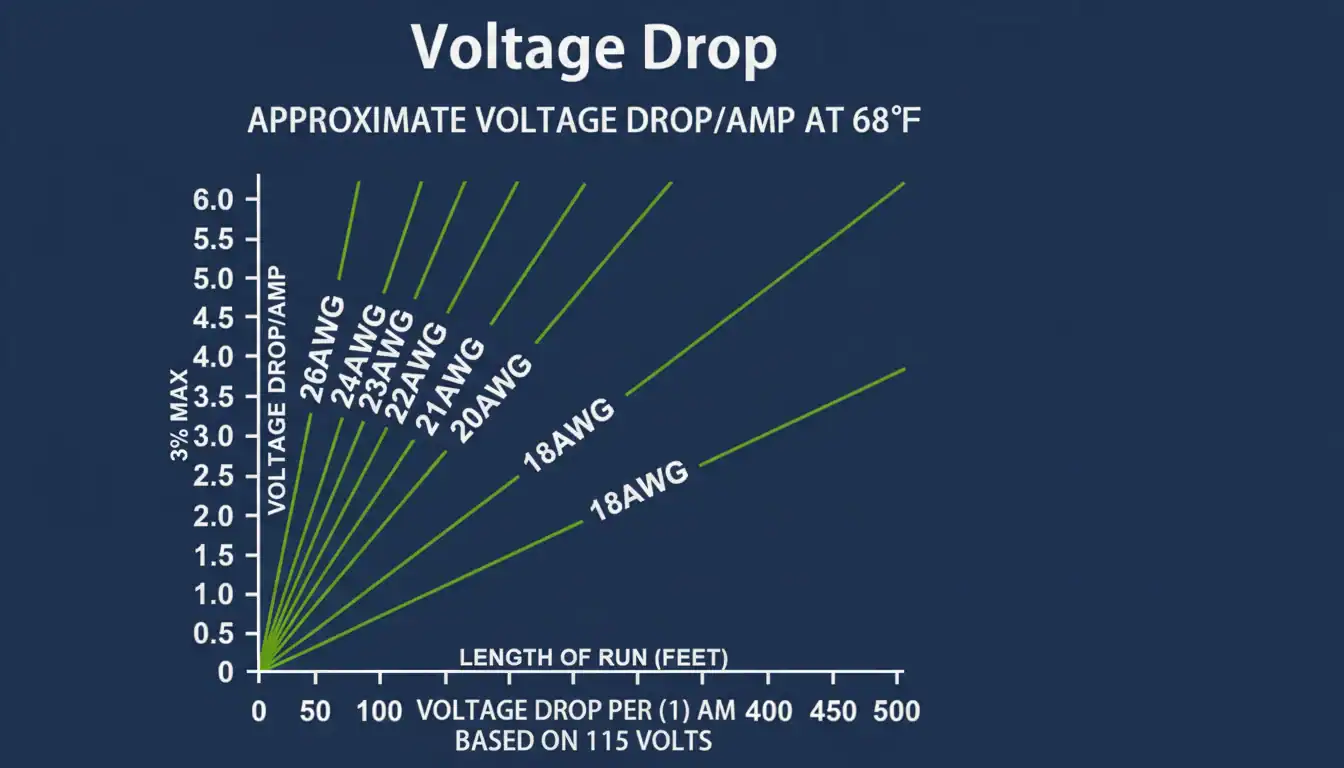
Cable Voltage Drop: Why Does Wiring Thickness Affect Protection?
Excessive voltage drop from undersized wiring is a primary reason low-voltage protection systems trigger false shutdowns, as the device reads a lower voltage than what the battery is actually supplying.
The Basics of Voltage Drop
Voltage drop is the reduction of electrical pressure as power moves through a wire. Every cable has internal resistance that consumes a small amount of energy, which increases with the length of the wire. The farther electricity travels or the thinner the wire, the more voltage is lost before it reaches the connected device.
- Think of it like water pressure in a hose. A long, narrow hose delivers a weaker stream at the end than a short, wide one.
- This energy loss converts into heat within the wire, making incorrect wiring a potential safety hazard.
- Industry standards typically limit acceptable voltage drop to around 3% for critical circuits to ensure devices get enough power to operate correctly.
How Wire Gauge Influences Resistance
Wire thickness, measured by its American Wire Gauge (AWG), directly controls its electrical resistance. A thicker wire (lower AWG number) has lower resistance because it provides more pathways for electricity. A thinner wire (higher AWG number) constricts the flow, which increases resistance and voltage drop.
- Using an undersized wire for a high-power device like a compressor fridge is the most common cause of excessive voltage drop.
- The calculation also depends heavily on the current load (amperage) and the total length of the circuit.
- By 2026, professional installers rely on standardized sizing charts to match wire gauge to the circuit’s length and expected amperage draw.
Why Inaccurate Readings Trigger False Alarms
A low-voltage protection system measures voltage where it connects to the device, not directly at the battery terminals. When significant voltage drop occurs in the power cable, the voltage reading at the device is lower than the actual battery voltage. This discrepancy tricks the protection circuit into shutting down power prematurely.
- For example, the battery might be at a healthy 12.5V, but a long, thin wire causes a 1.0V drop. The fridge’s sensor only sees 11.5V.
- If the low-voltage cutoff is set to 11.8V, the system will shut down, even though the battery has plenty of charge remaining.
- This leaves the user stranded without power, incorrectly assuming the battery is dead when the real fault is inadequate wiring.
Schlussfolgerung
Configuring the 3-stage voltage protection correctly ensures your customers never face a dead starter battery. An understanding of voltage settings, hysteresis, and proper wiring leads to reliable performance and protects the vehicle’s electrical system. This built-in logic is a key factor in equipment longevity and user satisfaction.
If you require detailed specifications for integrating our compressor fridges into your product line or fleet, our engineering team is available to assist. Contact us to discuss OEM customization or to request our full technical catalog.
Häufig gestellte Fragen
What are the specific voltage cut-off points for High, Med, Low?
The protection unit features three user-selectable cut-off levels designed for standard 12V systems:
• High: 12.2V (Reconnects at 12.8V)
• Medium: 11.8V (Reconnects at 12.6V)
• Low: 11.5V (Reconnects at 12.4V)
These settings allow you to balance battery lifespan with the power-draw requirements of your connected devices.
Does the unit have a memory function to save settings after power loss?
Yes, the unit is equipped with non-volatile memory. Your selected voltage cut-off setting (High, Medium, or Low) is automatically saved and will be retained even if the unit is completely disconnected from the battery. When power is restored, it will resume operation with your last chosen setting.
How does voltage drop in long cables affect the protection logic?
Voltage drop across long or undersized cables can cause the protection circuit to trigger prematurely. The unit measures voltage at its input terminals, so any voltage lost in the wiring will be interpreted as a drop in the battery’s voltage. To ensure accurate readings and prevent early cut-offs, we recommend mounting the unit as close to the battery terminals as possible and using the proper gauge wire for the expected current load.
Is the protection circuit compatible with Lithium (LiFePO4) BMS?
Yes, the protection circuit is compatible and can be used with a LiFePO4 battery that has its own integrated Battery Management System (BMS). The BMS should always be considered the primary protection for the battery cells. Our unit will act as a secondary safeguard, disconnecting the load based on its set voltage, which can prevent deep discharge if the BMS fails or is not present on the load side.

 English
  Español
  Français
  Deutsch
  Português do Brasil
  Русский
  한국어
한국어  日本語
日本語  العربية