

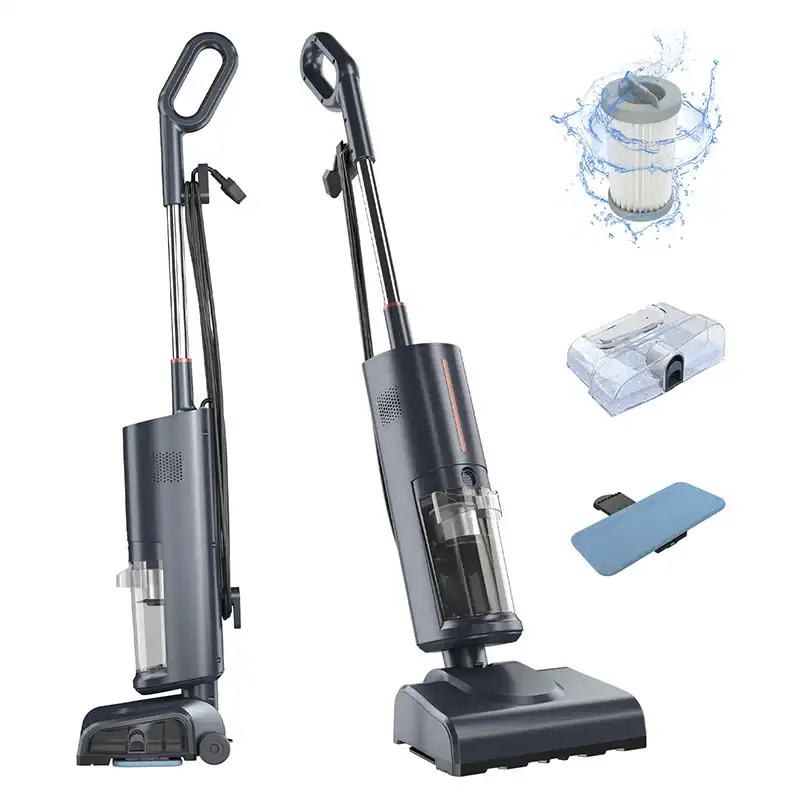
Supplying the wrong equipment for drywall and woodworking projects leads to immediate performance failure and serious health risks. Fine particles between 1 and 10 microns can choke suction by 60% within minutes, creating a maintenance cycle that stalls production and compromises air quality. For professional teams, staying below the OSHA silica exposure limit of 50 µg/m³ requires a shift from standard shop vacuums to specialized extractors designed to handle high-volume fine dust without motor failure.
We examine the technical requirements for modern dust containment, including the 99.97% efficiency ratings required for HEPA certification and the mechanics of pulse-jet cleaning systems that operate at 60-100 psig. This overview compares multi-layer fleece bags with pleated cartridges and details how auto-start outlets with current-sensing relays ensure synchronized collection during sanding and grinding tasks.
The “Clogged Filter” Nightmare: Drywall Dust
Drywall dust consists of fine particles between 1 and 10 microns that rapidly cake filter membranes, causing suction to drop by 60%. Effective extraction in 2026 relies on HEPA-grade filtration and pre-separators to maintain airflow while staying below the OSHA silica exposure limit of 50 µg/m³.
Particle Dynamics and Suction Power Loss
Standard wet-dry vacuums without cyclonic separation lose up to 60% of their suction power almost immediately. Fine limestone and perlite dust particles coat the filter membrane, creating an impermeable barrier that prevents air from passing through. This mechanical failure occurs because standard filters lack the surface area or material composition to shed microscopic construction debris.
Dust particles smaller than 10 microns increase the differential pressure across the filter. This restriction chokes airflow and forces the vacuum motor to work harder, which often leads to overheating. High-performance extractors mitigate this by using pulse-cleaning systems that vibrate the filter to dislodge the dust cake during operation.
Accumulated dust cakes reduce the primary filter lifespan to under 6 months in heavy-use environments. Operators who do not employ a pre-separator or specialized dust bags face frequent replacement costs and diminished performance. Using a cyclonic bucket or a high-efficiency interceptor keeps the bulk of the material out of the цилиндрический пылесос, сохраняя целостность основного фильтрующего узла.
Стандарты фильтрации и предельно допустимые концентрации по стандартам OSHA
OSHA устанавливает предельно допустимый уровень воздействия (PEL) для респираторной кристаллической диоксида кремния на уровне 50 мкг/м³ в расчете на 8-часовую средневзвешенную продолжительность. Шпаклевочные смеси часто содержат диоксид кремния, поэтому крайне важно использовать оборудование для улавливания пыли, предотвращающее ее попадание в воздух. Необходимы надлежащие инженерные меры контроля для поддержания качества воздуха ниже порога в 0,05 мг/м³ для респираторной пыли.
Истинные HEPA-фильтры обеспечивают эффективность 99,97% при размере частиц 0,3 микрона, что является базовым уровнем для безопасного управления строительной пылью. Продвинутые пылеуловители могут достигать эффективности 99,999% для обеспечения безопасности в условиях высокой запыленности. Эти системы гарантируют, что воздух, выбрасываемый обратно в помещение, будет чище фонового воздуха, защищая как оператора, так и систему HVAC от загрязнения.
Многократно используемые мешки DustLock и фильтры HVAC класса MERV 11+ обеспечивают дополнительную защиту, захватывая частицы размером до 1 микрона до их попадания в основной выпускной поток. Этот многоступенчатый подход предотвращает засорение фильтров пылесоса и гарантирует, что мелкие частицы известняка не оседают в каналах вентиляции или чувствительном электронном оборудовании. Поддержание воздушного потока на уровне 130 CFM через эти фильтры обеспечивает достаточную скорость для забора пыли непосредственно из источника.
Filtration Stages: Fleece Bags vs. Cartridge Filters
Вакуумные системы в 2026 году основываются на двухступенчатом процессе. Мешки из нетканого материала используют многослойную объемную фильтрацию (40–300 г/м²) для захвата крупного мусора, тогда как плиссированные картриджные фильтры обеспечивают абсолютное удержание частиц по размеру пор (0,5–1500 мкм) для тонкой очистки от мелкой пыли. Использование обоих типов предотвращает преждевременный выход двигателя из строя и поддерживает высокую воздухопроизводительность.
| Фильтрующий компонент | Техническая структура | Технические характеристики |
|---|---|---|
| Мешки из нетканого материала | Градиентная матрица S-PES-B BICO многослойная | Грамматуры 40–300 г/м²; объемная нагрузка 3D |
| Картриджные фильтры | Плиссированный микрополипропилен (HA/HB) | Размер пор 0,5–1500 мкм; эффективность 92–98% |
Multi-Layer Fleece Bags for Depth Filtration
S-PES-B BICO nonwoven media utilizes a three-layer gradient structure to trap progressively finer particles within a 3D matrix. This design ensures that coarse debris stays on the outer layers while fine dust penetrates deeper into the fiber network without blocking airflow immediately. Unlike standard paper bags, this depth-filtration approach maintains suction power even as the bag reaches capacity.
Fleece grammage typically ranges from 40 to 300 g/m², providing a significantly higher dirt-holding capacity for industrial and DIY applications. High-suction tasks involve sharp or heavy debris that can easily puncture thin materials. Mechanical needle-punched and calandered polyester fibers provide the necessary tensile strength to resist tearing under high-pressure conditions.
Pleated Cartridges for Absolute Particle Retention
Absolute pore sizes ranging from 0.5 to 1500 μm allow for precise air polishing during the final filtration stage. These filters capture the microscopic particulates that fleece bags might miss. By utilizing micro polypropylene media, specifically the HA and HB variants, these systems achieve efficiency ratings between 92% and 98% for fine dust particles.
Pleated designs maximize the available surface area within a compact housing, which helps manage the air-to-cloth ratio. While this geometry increases the total filtration area, users must monitor inlet pressure. Smaller pore sizes demand higher pressure to drive air through the media. Pairing these cartridges with a fleece pre-filter prevents premature loading and extends the service life of the expensive pleated element.
HEPA Requirements: Lead Paint and Silica Safety
HEPA filtration for lead and silica requires a 99.97% capture rate of particles as small as 0.3 microns. Compliance involves meeting OSHA and EPA standards, using UL 586-certified filters, and maintaining specific airflow metrics like 25 CFM per inch for grinding tools and -5 Pa pressure for containment zones.
Certified HEPA Standards for Silica and Lead Dust Containment
OSHA 1910.1053 and EPA lead-safe regulations mandate HEPA filters that capture 99.97% of particles at 0.3 micrometers. These agencies require certified media because smaller hazardous particles easily penetrate standard shop vacuums or consumer-grade filters. Lead paint disturbance applies to any material with lead concentrations reaching or exceeding 1.0 mg/cm² or 0.5% by weight. Standard vacuum filters often allow respirable crystalline silica (RCS) to bypass the system, which makes HEPA-certified media mandatory for all sanding and scraping tasks. Updated 2026 safety protocols recognize any detectable lead levels as hazard risks, necessitating sealed containment systems to hit strict post-abatement clearance levels of 5 µg/ft² on floors and 40 µg/ft² on window sills.
Technical Performance Metrics for Regulatory Compliance
Negative air machines must maintain -5 Pa (0.02 inch water column) differential pressure to prevent dust escape from work zones. This pressure gradient ensures air flows into the containment area rather than leaking out into clean spaces. Extractors used for grinding require 25 CFM per inch of wheel diameter to suppress silica dust below the 50 µg/m³ exposure limit. Engineering specifications require HEPA systems to deliver 70% of their rated capacity at 620 Pa static pressure even when the filter is 70% loaded. A typical HEPA filter reaches its service limit after approximately 700 hours of continuous operation. UL 586 certification serves as the primary benchmark for filter durability and efficiency in high-load industrial environments.
Scale Your Brand with Premium, Custom-Built Home Vacuums

Filter Cleaning: Pulse/Shaker Mechanisms
Pulse and shaker systems maintain suction by removing dust cakes from filter media. Shaker systems use 4 Hz mechanical vibrations to flex bags, while pulse jets deliver 60-100 psig compressed air bursts lasting 0.1-0.15 seconds to reverse airflow and clear cartridges without stopping operation.
| Операционная метрика | Mechanical Shaker | Pulse Jet System |
|---|---|---|
| Primary Mechanism | 4 Hz Vibration / 2-3″ Amplitude | 60-100 psig Compressed Air |
| Cleaning Duration | Cyclical (Requires Flow Stop) | 0.1 – 0.15 Seconds (Online) |
| Ключевое требование | Tensioned Bag Installation | 6:1 Air-to-Cloth Ratio |
Mechanical Shaker and Pulse Jet Fundamentals
Mechanical shakers isolate specific filter compartments to apply physical vibrations at a frequency of 4 Hz with a 2-3 inch amplitude. This movement flexes the filter bags, causing the accumulated dust cake to fracture and fall into the collection hopper. Because this process requires the forward airflow to stop, shaker systems typically operate on intermittent heavy-duty cycles or use modular compartments that take turns offline.
Pulse jet systems utilize momentary blasts of compressed air to reverse the airflow, cleaning cartridges or bags while the system remains fully operational. These bursts momentarily expand the media, dislodging fine particles like silica or drywall dust without interrupting suction. Equipment designers prioritize needle-punched felt and high-strength synthetic fabrics to withstand the dynamic stress of these rapid cleaning cycles, often housing the components in hermetically sealed steel or stainless steel units to handle pressure fluctuations.
Technical Performance Specs and Pressure Limits
Effective cleaning requires maintaining an air-to-cloth ratio of at least 6:1 to prevent premature clogging. Pulse jet systems typically operate between 60-100 psig, with 90-100 psig providing the sharp, momentary burst necessary for difficult dust loads. If the pressure exceeds these limits, the media risks rupture; if it falls below, the dust cake remains lodged, increasing differential pressure and reducing overall system throughput.
Filtration velocity for easily cleanable dusts stays restricted to a range of 0.5–0.9 m/min to ensure efficient particle release during the 0.1-second pulse. To maintain stable airflow, sequencing logic prevents adjacent filter rows from firing at the same time. This cyclical firing pattern minimizes internal turbulence and ensures a uniform air distribution across the entire filter bank, supporting performance ranges from 500 to over 235,000 CFM depending on the baghouse configuration.
Tool Activation: Auto-Start Outlets for Sanders
Auto-start outlets use current-sensing relays to detect power draw from a sander and automatically trigger the dust extractor. These systems incorporate programmable delays to prevent circuit overloads during startup and ensure the vacuum runs long enough to clear residual fine dust from the hoses after the tool stops.
Current Sensing and Synchronized Collection Logic
Встроенные датчики контролируют электрический ток, обычно в диапазоне от 15 до 20 А, чтобы определять момент начала работы шлифмашины. Этот сигнал активирует подключенный пылесос. В таких системах, как iVAC Pro, используется задержка включения в 1,5 секунды для распределения пиковых нагрузок, что предотвращает срабатывание автоматических выключателей из-за одновременного запуска двигателей. После завершения шлифовки автоматические таймеры поддерживают работу пылесоса еще 5–45 секунд. Это продленное время работы позволяет очистить сборные шланги от остатков гипсовой или древесной пыли и гарантированно подать их в фильтрующий блок. Текущее оборудование соответствует требованиям сертификации TUV, включая стандарты UL60950-1 и CSA 60950-1, обеспечивая надежную безопасность в профессиональных мастерских.
Электрические характеристики и масштабирование для работы с несколькими инструментами
Современные коммутационные устройства способны выдерживать различные электрические нагрузки: поддержка 1 л.с. при 115 В переменного тока или 2 л.с. при 240 В переменного тока для мощных extraction-систем. Промышленное оборудование, например станок SCM DMC SD 60, использует контроллеры Logic TS для управления последовательным пуском двигателей и пневматическим натяжением ремней при давлении 88 фунтов на квадратный дюйм. Для расширяющихся цехов сетевые переключатели позволяют подключать до 32 инструментов, сохраняя надежную связь на расстоянии до 40 футов по прямой видимости. В условиях высокой производительности особое значение имеет конкретная мощность всасывания: такие показатели давления всасывания, как 2200 мм вод. ст., гарантируют, что система будет эффективно захватывать мусор сразу после срабатывания датчика авто синхронизации.
Заключительные мысли
Утилизация мелкого строительного мусора, такого как гипсовая пыль и опилки, требует не только мощного всасывания. Системы, оснащенные HEPA фильтрами, технологией импульсной очистки и многокомнатными мешками из нетканого материала, обеспечивают единственный надежный способ поддержания воздушного потока и соответствия нормативам OSHA по технике безопасности. Эти технические компоненты работают в связке, предотвращая быстрое засорение, которое обычно останавливает рабочие процессы при интенсивной шлифовке или заточке.
Выбор подходящего оборудования для улавливания пыли защищает долгосрочное здоровье сотрудников и продлевает срок службы инструмента. Такие функции, как розетки с автозапуском и синхронизированная логика сбора, исключают необходимость ручного контроля за удалением пыли, позволяя поддерживать более эффективный рабочий процесс. Соответствие этим стандартам безопасности 2026 года поддерживает рабочую зону свободной от опасных свинцовых и силикатных частиц, обеспечивая при этом оптимальную производительность пылесборной системы на протяжении всего срока ее службы.
Часто задаваемые вопросы
Предоставляете ли вы мешки из нетканого материала, устойчивые к разрывам, для сбора гипсовой пыли?
Мешки из нетканого материала, устойчивые к разрывам, соответствуют стандартам изоляции 2026 года для гипсовой пыли, обеспечивая необходимую прочность для обработки больших объемов мелкодисперсных частиц без риска повреждения мешка.
Имеет ли HEPA фильтр сертификацию для удаления красок, содержащих свинец (RRP)?
HEPA фильтры обеспечивают эффективность улавливания 99,97 % частиц размером 0,3 микрон, что соответствует требованиям 2026 года EPA по правилам RRP и нормам OSHA по безопасности при работе с пылью, содержащей свинец.
Поддерживают ли розетки с автозапуском мощные шлифмашины?
Интегрированные розетки с автозапуском поддерживают цепи 15–20 А, обеспечивая мощность от 1800 до 2400 Вт при напряжении 120 В, что подходит для мощных шлифмашин при сохранении синхронизированного режима улавливания пыли.

 English
 Español
 Français
 Deutsch
 Português do Brasil
 Русский
 한국어
 日本語
 العربية