 跳转到主要内容 跳转到页脚

Finding the best battery powered fridge is a critical logistical step for any field operation, where a single power failure can compromise temperature-sensitive assets and halt productivity. Standard coolers require a constant supply of ice, and traditional 12V fridges tether your team to a running vehicle, creating a single point of failure. This dependency introduces significant risk to remote work sites, mobile labs, and any operation requiring a reliable cold chain without guaranteed access to grid power.
This guide establishes a technical evaluation framework for modern portable fridges, treating them as self-sufficient micro-grid hubs. We benchmark each unit against key operational metrics from our outline: Can the integrated battery maintain cooling for at least five hours? Does it offer Vehicle-to-Load (V2L) capability to charge phones and LED lights? Can you connect solar panels directly without a separate controller? We also analyze the emerging solid-state battery technology to assess its impact on field safety and unit portability.
Integrated Battery: Can It Cool for 5 Hours on a Single Charge?
A 5-hour runtime is an achievable benchmark in 2026, but it’s a direct outcome of the entire cooling system’s efficiency—not just the battery size. The interplay between battery capacity, compressor power draw, insulation quality, and ambient temperature determines the final result.
Battery Capacity vs. Power Consumption
Whether a portable fridge can run for five hours depends on a simple equation: its battery’s capacity in Watt-hours (Wh) against the compressor’s power consumption. In 2026, a typical portable compressor fridge pulls between 30 and 60 watts while actively cooling. To sustain this for five hours, considering the compressor isn’t running constantly, the battery needs a substantial capacity. A 200-300 Wh battery is the common industry benchmark for this level of performance. At KelyLands, we focus on engineering this balance, pairing high-capacity lithium-ion batteries with efficient compressors to maximize off-grid cooling time.
| System Component | Benchmark for 5-Hour Runtime | Impact on Performance |
|---|---|---|
| Battery Capacity | 200-300 Wh | Directly determines the maximum energy reserve available. |
| Compressor Power Draw | 30-60W (Active) | Higher wattage cools faster but drains the battery much more quickly. |
| Compressor Duty Cycle | 25-30% (Optimized) | A lower cycle percentage means the compressor runs less, saving power. |
The Role of Ambient Temperature and Insulation
External conditions are a critical variable. A fridge operating in a hot, 32°C (90°F) vehicle will drain its battery much faster than one in a cooler 21°C (70°F) environment. This is because the compressor must run more frequently to fight the heat seeping in from the outside. High-density PU foam insulation is the first line of defense; it minimizes this heat ingress, letting the compressor rest for longer periods and conserving battery life. A simple but effective strategy is to pre-cool the fridge and its contents using vehicle or mains power before relying on the battery. This reduces the initial workload and significantly extends runtime.
Eco-Modes and Smart Compressor Management
Modern portable fridges use intelligent power management to hit longer runtimes. An “Eco-Mode” is a standard feature that limits the compressor’s maximum power draw, which is ideal for maintaining temperature without wasting energy. Smart thermostats also play a key role by optimizing the compressor’s on/off cycles, ensuring it only runs when absolutely necessary. In a well-insulated unit that has been pre-cooled, the compressor might only need to run 25-30% of the time. This low duty cycle makes a 5-hour operational window a very realistic expectation from a quality portable fridge.

V2L Ready: Can the Fridge Charge Your Phone or LED Lights?
Vehicle-to-Load (V2L) technology effectively turns a compatible electric vehicle into a mobile generator, supplying enough AC power to run demanding appliances like compressor fridges and other campsite electronics.
The concept of a portable fridge isn’t just about its own internal battery anymore. The power source is just as important. With the rise of electric vehicles, Vehicle-to-Load (V2L) technology is changing how we power devices off-grid. Instead of relying on a separate portable power station or a noisy generator, the car itself becomes the power hub.
How V2L Turns an EV into a Power Source
Vehicle-to-Load lets an electric vehicle’s high-voltage battery supply AC power to external electronics. Using a specialized adapter that plugs into the car’s charging port, the system functions as a mobile power outlet. It converts the battery’s stored DC power into usable AC electricity, capable of running everything from smartphones to small appliances without a separate generator.
- V2L systems are now standard or optional in models like the Hyundai Ioniq 5, Kia EV6, and Ford F-150 Lightning.
- The technology leverages standardized adapters (like J1772 or CCS2 attachments) to connect with common extension cords and devices.
- It safely inverts the battery’s DC power into stable AC electricity suitable for sensitive electronics.
| Power Source Comparison | Typical Power Output | Primary Limitation |
|---|---|---|
| EV with V2L | 3.6 kW – 5 kW AC | Requires a V2L-capable electric vehicle. |
| Portable Power Station | 500 W – 2.2 kW AC | Limited battery capacity; needs separate recharging. |
| Gasoline Generator | 1 kW – 4 kW AC | Noise, exhaust fumes, and requires carrying fuel. |
Power Output: What You Can Actually Run
The critical question is whether V2L delivers enough power for practical use. The answer is yes. Most systems provide a substantial amount of wattage, capable of running multiple devices at once. This makes it a legitimate solution for camping, tailgating, or remote work setups where reliable power is essential.
- A typical V2L system delivers between 3.6 to 5 kW of AC power, far exceeding the needs of a single portable fridge.
- This output is sufficient to operate a compressor fridge, string lights, and charge phones and laptops all at the same time.
- The large battery capacity of modern EVs means you can power devices for multiple days without a significant impact on the vehicle’s driving range.

Practical Uses for Camping and Emergencies
Market demand for V2L is growing because of its utility in situations where grid power is unavailable. It offers a clean, quiet, and reliable power source for both planned recreational activities and unexpected power outages, adding significant value to an EV owner.
- For camping, it can run coolers, electric kettles, lights, and other equipment without the noise or fumes of a gas generator.
- During a power failure, it acts as a dependable backup source for essential home devices like a refrigerator or medical equipment.
- It supports off-grid work by enabling professionals to power laptops, charge tool batteries, and operate other equipment in remote locations.
Source Certified Car Coolers for Your Brand

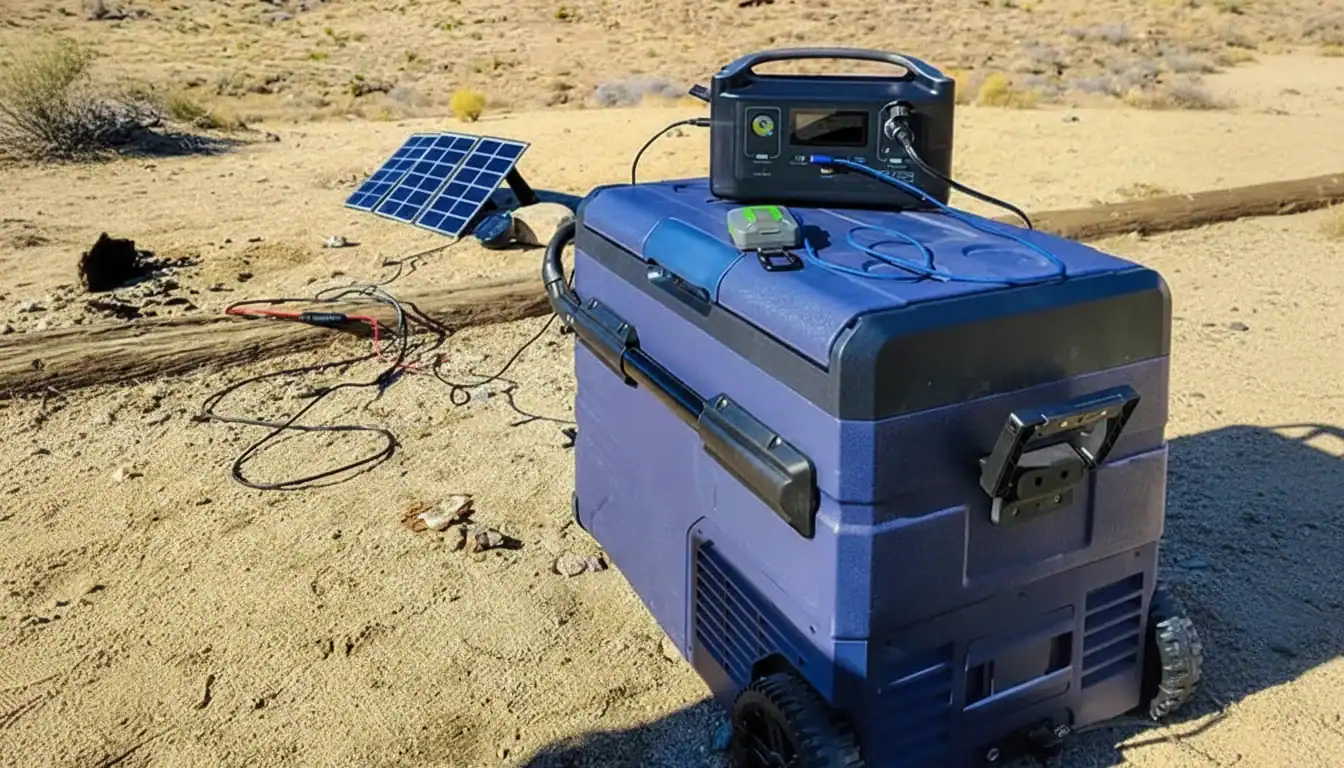
Solar Direct: Can You Plug Panels Directly (No Controller Needed)?
Connecting a standard 18-20V solar panel directly to a 12V battery system without a charge controller will damage the battery due to a fundamental voltage mismatch.
The Core Issue: Voltage Mismatch
Connecting a solar panel straight to a battery is not a viable setup for any serious application. Solar panels are engineered to produce a higher voltage than the battery needs. This ensures consistent charging even in lower light, but it creates a dangerous incompatibility. A typical 12V battery requires a precise charging voltage between 11.8V and 14.5V. Sending unregulated 18-20V power directly into it will cause irreversible damage and significantly shorten its life.
| Component | Typical Voltage Output | Required Charging Voltage |
|---|---|---|
| Standard Solar Panel | 18V – 20V | N/A |
| 12V Battery System | N/A | 11.8V – 14.5V |
Why a Charge Controller is Necessary
A charge controller is the non-negotiable component that sits between the solar panel and the battery. It functions as an intelligent voltage regulator, managing the energy flow to protect the battery and optimize the entire charging process for both safety and efficiency.
- It detects the battery’s voltage and steps down the panel’s high-voltage output to a safe level.
- The controller prevents overcharging by cutting off the current once the battery reaches full capacity.
- This regulation is essential for extending battery lifespan and ensuring reliable performance.
Risks of Bypassing a Controller
Charging a battery without a controller exposes it to raw, uncontrolled voltage. This isn’t just inefficient; it’s a direct path to permanent failure and creates serious safety hazards.
- Overcharging is the most immediate threat, which can boil the electrolyte and physically destroy the battery cells.
- Sustained high-voltage input will drastically shorten the battery’s operational life.
- You eliminate all built-in safety mechanisms that protect the system from electrical faults.
Niche Exceptions: Low-Power Systems
While a controller is mandatory for any professional or medium-scale solar setup, there is an exception for very small systems. Direct connections can work for tiny panels of 10 watts or less, where the current is too low to cause significant harm. These are typically used for simple trickle charging applications, like maintaining a car battery or powering small USB devices. This exception does not apply to any system designed to power an appliance or charge a medium-to-large battery bank.
Solid-State Future: Are New Batteries Safer and Lighter?
By 2026, solid-state battery technology is moving from lab validation to early commercial use, offering 50–80% higher energy density and eliminating the flammable liquid electrolytes found in traditional lithium-ion cells.
Higher Energy Density for Longer Runtimes
Solid-state battery technology provides a significant leap in energy storage. It packs more power into the same physical space compared to conventional lithium-ion, allowing devices to be built lighter or run much longer on a single charge.
- Energy densities reach 350–500 Wh/kg, which is 50–80% higher than conventional lithium-ion.
- This allows for smaller battery packs without sacrificing performance or provides extended use on a single charge with same-size packs.
Improved Safety by Eliminating Flammable Liquids
A key advantage of solid-state batteries is their inherent safety. They replace the flammable liquid electrolyte found in lithium-ion cells with a stable, solid material, reducing the risk of fire or chemical leaks from physical damage.
- The solid electrolyte design makes the battery less volatile and more resistant to punctures and impact.
- This stability is a critical improvement for both high-demand consumer electronics and electric vehicle applications.
Path to Commercialization
Solid-state technology is moving from the lab toward practical implementation. While fully solid-state batteries still face production challenges, semi-solid designs are already being validated in high-end electric vehicles, signaling wider market adoption by the end of the decade.
- Semi-solid-state batteries are entering prototype validation, bridging the gap to full commercialization.
- Major automakers and tech companies are investing heavily to scale up production, with timelines aiming for broad availability in the late 2020s.
Conclusion
Modern battery-powered fridges have evolved beyond simple cooling. With integrated batteries, direct solar input, and V2L charging, these units function as self-sufficient power hubs. This transforms them into reliable tools for everything from casual outings to serious off-grid applications.
If you are sourcing portable power and refrigeration solutions, review our full catalog for technical specifications. Our team can help you configure compressor fridges and OEM accessories to meet your market’s demands.
Frequently Asked Questions
Which portable fridge has the longest battery life?
Battery life is determined by battery capacity (measured in Watt-hours), compressor efficiency, and ambient temperature. Models from leading brands like EcoFlow or Dometic often offer the longest runtime, with high-capacity battery options providing 24-40 hours of continuous operation under typical conditions. For maximum duration, look for models with large, modular batteries (250Wh or higher) and highly efficient variable-speed compressors.
Can I charge the fridge battery with a solar panel?
Yes, most modern portable fridges are designed to support solar charging. They typically feature a dedicated DC input (often an Anderson or XT60 port) that connects directly to a portable solar panel. For optimal performance, a 100W to 240W solar panel is recommended, as this allows the fridge to run and charge its battery simultaneously in good sunlight. The required solar charge controller is usually integrated directly into the fridge’s power system.
Is the battery removable for charging?
Many premium portable fridges feature a modular, removable battery pack. This design provides significant flexibility, allowing you to charge the battery indoors using a standard wall outlet while the fridge remains in your vehicle. It also enables you to carry spare batteries, which can be swapped in to extend off-grid cooling time indefinitely. Entry-level models, however, may have a fully integrated, non-removable battery.
Can I use the fridge to charge my laptop (USB-C)?
Yes, many contemporary portable fridges double as mobile power stations and include high-power output ports. It is a standard feature on mid to high-end models to include a USB-C Power Delivery (PD) port. These ports typically provide 65W to 100W of output, which is sufficient to charge most modern laptops, tablets, and other high-draw electronics directly from the fridge’s battery.

 English
  Español
  Français
  Deutsch
  Português do Brasil
  Русский
  한국어
한국어  日本語
日本語  العربية