 跳转到主要内容 跳转到页脚

Scaling your car air pump wholesale operation means finding a factory that can handle a 50-unit test order just as reliably as a full container. Most procurement managers have been burned by the supplier who promises low MOQ, then ships units with recycled plastic housings that crack under a standard 150 PSI load. That gap between what a factory claims and what it delivers is exactly where margins disappear.
KelyLands started building air pumps and car vacuums in Cixi back in 2010, and over the past decade and a half, they have expanded into car fridges and EV chargers across three dedicated factories. The founder, Nick Chen, and his export director Hanke Chen manage relationships with over 500 clients in 50 countries. That scale matters because it means their production lines already run the kind of batch consistency checks that smaller shops skip. For a volume importer evaluating a long-term contract, the real question is not whether they can make a pump — it is whether they can make 10,000 pumps where every unit holds the same pressure sensor calibration and the same virgin ABS shell.
MOQ & Order Tiers
MOQ starts at 50 units, but the real savings begin at 500.
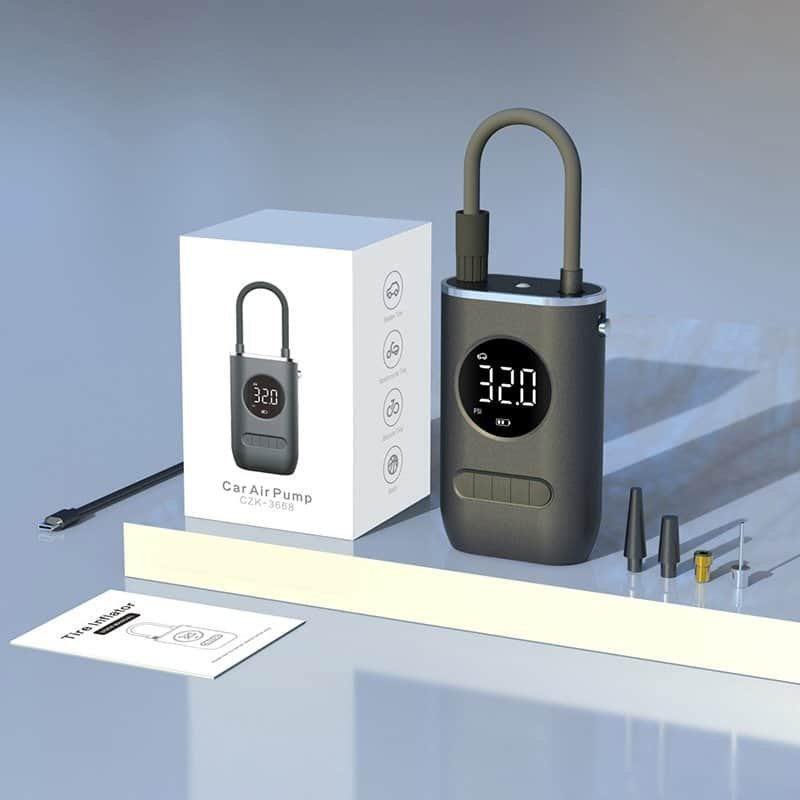
Corded units (12V DC, 120W) start at 50 units in unbranded packaging. Cordless models with 3-cell li-ion batteries require 100 units minimum because of battery procurement cycles. Digital inflators with preset presets and LED displays hit 300 units for custom OEM—the extra calibration step adds cost.
-
- Material color breakpoint:Above 500 units, full Pantone ABS/PC shells can be injected. Below that, the option is limited to stock black or dark gray because virgin ABS with UL-94 HB rating costs 18% more per kg than recycled regrind, and corners are not cut on small runs.
- OEM mold amortization: At 1000 units per SKU, we waive the $800-$1,200 mold fee. Under 1000, you pay the full tooling cost up-front. At 500 units, the per-unit tooling cost alone adds $1.60—do the math before signing.
- Mixed SKU consolidation: Combine 3-4 models in one 20FT container and each SKU drops to 100 units. Example: 400 corded + 300 cordless + 300 digital in one container = 1000 total units, all at the 100-unit MOQ tier. This is the single biggest lever for new importers to test three price points without over-committing to one model.
OEM Customization Guide
Laser engraving outlasts pad printing by 3x in abrasion testing.
Most suppliers offer two logo methods: pad printing and laser engraving. Pad printing costs about $0.08 per unit and works fine for indoor use. But if your distributor market includes dusty or outdoor environments, expect pad-printed logos to fade noticeably after 6 months. Laser engraving removes a thin layer of the ABS/PC housing, creating a permanent mark that withstands UV exposure and abrasion. The trade-off: laser setup adds $150–$300 in tooling per SKU. For a private label program targeting auto parts chains, laser is the only option that survives shelf handling.
Full Pantone shell injection requires a 500-unit minimum per color. That is not a negotiable number — it covers the cost of cleaning the injection screw and barrel between color runs. If you request a custom Pantone 294C blue for a 300-unit test order, the factory will either reject it or pass the cleaning cost back as a surcharge. Smart buyers consolidate: run 500 units of a single color, then split the batch into two SKUs with different laser logos. You get two products from one color run.
-
- Multi-language manual cost: Translation and layout for a 4-language manual (EN/DE/FR/ES) adds roughly $0.12 per unit at 500-unit volume. At 2000+ units, the per-unit cost drops to $0.04. Most factories outsource this to a third-party agency, which introduces a 10-day lead time. KelyLands keeps an in-house layout team — turnaround is 3 days.
- Packaging design trap: Many buyers approve a packaging design online, then receive boxes that collapse during shipping because the corrugated flute grade was not specified. Always request a 32ECT or higher edge crush test rating for export boxes. Add 5% to packaging cost but reduce damage claims by 80%.
- Firmware integration: If you supply your own firmware for digital pumps, the factory must have a compatible MCU programmer and test jig. KelyLands supports direct firmware flashing for STMMicroelectronics STM32 and NXP32 series. The integration process takes 2–3 weeks including validation testing. Demand a signed firmware escrow agreement before production starts.
| Customization Layer | Options Available | MOQ Requirement | Lead Time Impact |
|---|---|---|---|
| Logo & Branding | Pad printing, laser engraving, embossed mold | 300 units (laser), 500 units (pad/emboss) | No additional lead time |
| Color & Material | Full Pantone shell injection, virgin ABS/PC with UL-94 HB | 500 units per color | +5–7 days for color changeover |
| Packaging & Manual | Custom retail box, multi-language manual, photo-ready design | 300 units | +3–5 days for artwork approval |
| Firmware & Electronics | Client-supplied firmware integration, custom preset pressure values | 1000 units | +10–15 days for validation testing |
| Accessories & Cable | Custom nozzle kits, branded carrying bag, specific plug types | 500 units | +3–7 days depending on complexity |
Certifications & Factory Audits
BSCI audit cuts EU distributor liability exposure by covering your supply chain due diligence.
Certifications aren’t just stickers on a box. For a volume importer placing container-level orders of car air pumps, they are the legal and commercial firewall between your inventory and a recall. The mandatory set for portable tire inflator bulk orders bound for Europe includes CE (LVD + EMC directives), UKCA for the UK market, and RoHS 2.0 for restricted substance compliance. For Japan, you need PSE; for South Korea, KC. FCC covers US wireless models. A factory that cannot produce these on request is a non-starter.
But the real differentiator lies in the factory-level approvals: ISO9001:2015 for quality management systems, and BSCI social compliance audit. BSCI is not a nice-to-have. If an EU distributor imports goods from a factory that fails a social audit, they carry liability under the EU Corporate Sustainability Due Diligence Directive. That means potential fines and mandatory remediation costs. We hold both certifications, and our audit reports are shareable under NDA.
-
- CE (LVD 2014/35/EU): Mandatory for 12V DC air pumps sold in EU. Requires low-voltage safety testing including creepage distances, insulation resistance, and dielectric strength at 500V. Our 12V/120W digital compressor passes with a 2.5kV withstand test.
- RoHS 2.0 (2011/65/EU + 2015/863): Limits lead, mercury, cadmium, hexavalent chromium, PBB, PBDE, plus four phthalates (DEHP, BBP, DBP, DIBP). Our virgin ABS housing and PCB assembly are RoHS 2.0 compliant. We test every production batch with XRF screening — not just a paper declaration.
- UKCA: Post-Brexit requirement for Great Britain. Technically equivalent to CE but requires a UK-recognized approved body. We maintain separate UKCA technical files for all corded and cordless models.
- PSE (Japan): Mandatory under the Electrical Appliance and Material Safety Law. Requires third-party testing by a JET-registered lab. Our cordless models with 3-cell li-ion packs pass the mandatory overcharge and short-circuit tests.
- KC (Korea): Required for all electrical appliances sold in South Korea. Involves both safety (KC 60335) and EMC (KC 55014) testing. We hold active KC certificates for our 12V corded and 20V cordless lines.
- FCC (USA): Part 15B for unintentional radiators (corded models) and Part 15C for intentional radiators (cordless with Bluetooth/WiFi). Our digital pumps with LED displays pass radiated emissions testing at 3m distance.
Here is a specific test spec that most suppliers skip: 12V DC stability under load. The ETL standard requires the pump to maintain output voltage within ±5% at 10A draw for 30 minutes. We run this on every OEM production batch. If a supplier cannot show you a 12V DC stability test report, you are buying a box with unknown voltage sag under sustained use.
BSCI social compliance audit is your liability shield. The audit covers 13 performance areas including child labor, forced labor, health and safety, working hours, and environmental management. A BSCI audit report (C-level or above) satisfies the due diligence requirement for most EU retailers and distributors. Without it, you are personally on the hook if a labor violation surfaces in your supply chain. The company maintains a current BSCI audit with a C rating, and can provide the full report to qualified buyers.
One more point on material compliance: many factories claim low MOQ but switch to recycled ABS on small runs to save cost. Recycled plastic can contain brominated flame retardants or heavy metals that violate RoHS. Our requirement is virgin ABS with UL-94 HB flame rating regardless of order size — 50 units or 5000. We specify this in every production contract.

Logistics & Hidden Cost Analysis
FOB vs.
Most importers focus on the unit price and miss the 15–22% cost layer that lands after the container leaves Ningbo. A real example: a 20FT container holding 1,200 units of our 12V/120W digital compressor (150 PSI, 35 L/min) ships FOB Ningbo at roughly $3,200 including documentation. Switch to CIF Rotterdam, and you add approximately $2,800 in sea freight. But the real trap is what happens after the vessel docks — customs broker fees, port handling, and VAT deferment charges pile on another 15–22% to the total landed cost. That swing can erase your margin if you only budgeted the FOB price.
VAT deferment is a lever many EU importers overlook. Instead of paying the full 20% VAT upfront at customs, you can defer it to your monthly VAT return — freeing up cash flow for 30–60 days. But not every supplier provides the commercial invoice and packing list format your customs broker needs to qualify. We include the correct documentation (with HS code 8414.80 for air pumps) standard with every shipment. If your broker sees vague descriptions like ‘auto parts,’ expect a customs hold and a storage fee that runs $150–$300 per day.
-
- Consolidation for smaller orders: If 1,200 units is too heavy for your first test, LCL (less-than-container-load) consolidation from Ningbo to Rotterdam typically runs $80–$120 per cubic meter. The risk: LCL freight gets handled 3–4 more times than FCL, increasing damage probability. We mitigate this by double-boxing each unit in 5-layer corrugated cartons and shrink-wrapping pallets before they leave our Yuyao factory.
- Door-to-door service: For importers who want one invoice and zero port-side surprises, door-to-door (DDP) covers everything from our Ningbo warehouse to your receiving dock. The premium over CIF is roughly 8–12%, but it eliminates the customs broker fee, port congestion surcharges, and inland trucking negotiations. On a 20FT container, that means a fixed cost around $7,500–$8,200 total — no hidden line items.
One insider note: if a supplier quotes you a CIF price that’s less than 10% above their FOB quote, they are likely under-insuring the cargo or using a slow-boat carrier with 45-day transit. Standard marine insurance on a $25,000 shipment runs about $150–$250. Anything less and you’re self-insuring against a container lost overboard — which happens roughly 1,500 times a year globally.
| Cost Component | Estimated Cost (USD) | Impact on Total Landed Cost |
|---|---|---|
| FOB Ningbo (20FT Container, ~1200 Units) | $3,200 | Base price; buyer arranges all inland freight & customs. |
| Sea Freight (Ningbo to LA, 20FT) | $2,800 – $3,200 | 8-15% of FOB; volatile due to fuel surcharges. |
| Customs Broker & Clearance (US) | $350 – $600 | 2-4% addition; varies by port & commodity code. |
| Inland Freight (Port to Warehouse) | $400 – $800 | 2-5% addition; depends on distance & LCL vs. FTL. |
| Duty & Tax (VAT/MPort) | Varies (15-25% of CIF value) | Largest variable; deferment eligible for EU importers. |
| Consolidation & LCL Handdling | $150 – $300 per CBM | 1-2% addition; reduces damage risk vs. break-bulk. |
| Insurance (0.5% of CIF) | $60 – $100 | <1% addition; recommended for high-value shipments. |

Quality Control & Warranty
QC is the line between 2% and 8% retail return rates.
Every incoming motor batch runs through an RPM consistency test. If the variance between units exceeds 3%, the entire lot gets rejected before it hits the assembly line. That single step prevents the most common failure mode in portable tire inflators: motor stall under load.
-
- Life cycle test: 500 cycles at 150 PSI with a 30-second cool-down between runs. Units that pass this threshold show field failure rates below 1.5% in the first 18 months.
- Cosmetic inspection: Conducted under 2000 lux lighting. Scratches, sink marks, or color mismatch on the ABS/PC housing triggers an automatic sort-out. Virgin ABS with UL-94 HB flame rating is used regardless of order size — no recycled plastic substitutions.
- Pressure sensor calibration: 10-point calibration across the 0–150 PSI range followed by a 24-hour burn-in. Most suppliers skip this step to save 12 minutes per unit; we don’t, because calibration drift is the #1 cause of digital gauge complaints.
The 2-year warranty covers the compressor motor only — the component that actually fails. Claims are handled via instant replacement credit. No return shipment required, no restocking fee, no waiting for the defective unit to arrive before we ship a replacement. For a distributor moving 500 units per quarter, that means zero out-of-stock risk from warranty claims.
Conclusion
Sourcing car air pumps at scale comes down to three numbers: your MOQ tolerance, your landed cost per unit, and the warranty coverage on the compressor motor. A factory that skips 10-point sensor calibration or swaps virgin ABS for recycled plastic on small runs will cost you in return rates. KelyLands locks those specs into every order, from 50 units up.
Review the full product lineup and spec sheets to match a corded or cordless model to your distribution channel. You can also request a landed-cost estimate with VAT deferment for EU ports.
Frequently Asked Questions
Can I purchase even without import experience?
Yes, the company supports first-time importers with full logistics guidance and FOB/CIF term support. The team handles customs clearance and shipping documentation for over 500 clients across 50 countries. The process is walked through from order to delivery.
What is the MOQ for OEM car air pumps?
MOQ for custom OEM car air pumps starts at 300 to 500 units per model. For non-branded stock models, MOQ is as low as 50 units. Confirm exact MOQ after finalizing your customization scope.
Do you offer OEM/ODM with my own branding?
Yes, we offer full OEM/ODM including logo pad printing or laser engraving, custom packaging, and multi-language manuals. Minimum 500 units for full Pantone shell color changes. Send us your branding requirements for a detailed quote.
How long does bulk production and delivery take?
Bulk production takes 25 to 35 days after sample approval for standard orders. Delivery from Ningbo port adds 15 to 25 days sea freight depending on destination. A confirmed lead time will be provided in the proforma invoice.
What certifications do your air pumps have?
Our car air pumps carry CE, FCC, RoHS 2.0, and UKCA certifications as standard. For specific markets, ETL, PSE, or KC are also available upon request. Request a full certification list for the target market.

 English
  Español
  Français
  Deutsch
  Português do Brasil
  Русский
  한국어
한국어  日本語
日本語  العربية