 跳转到主要内容 跳转到页脚

Procurement teams often choose cordless convenience without fully accounting for the long-term capital expenditure that follows. While portable units eliminate cable management, they introduce a cycle of recurring costs as lithium-ion batteries degrade and require replacement every two to three years. Corded vacuums, by comparison, function as durable assets with an average eight-year lifespan and entry costs starting under $100.
This analysis examines the financial and operational trade-offs of both systems, focusing on motor longevity, suction stability, and regulatory compliance costs. We break down the data behind the 30% pack-to-product cost ratio for cordless machines and compare why corded motors maintain warranty claim rates under 1% while battery-powered alternatives see return rates as high as 7%.
The Financial Equation of Initial Cost versus Replacement Cost
Corded vacuums function as long-life assets with an average 8-year lifespan and low entry costs starting under $100. Cordless alternatives require higher initial capital, ranging from £90 to £800, and face shorter 2-3 year replacement cycles due to battery degradation, resulting in higher recurring capital expenditure.
| Financial Metric | Corded Systems | Cordless Systems |
|---|---|---|
| Entry-Level Cost | Under $100 / £50 | From $115 / £90 |
| Service Life | Approx. 8 Years | 2 – 3 Years |
| Major Component Replacement | Bags & Filters ($40–$80/yr) | Battery Pack ($40–$120) |
Upfront Investment Disparities Between Corded and Cordless Systems
Consumer-grade corded units maintain a low entry point. Many reliable models cost less than $100 in US markets and start near £50 in the UK. High-specification corded commercial units scale up to £500. Facilities management sectors view these as low-CAPEX assets because they offer high suction power without complex electronic overhead.
Cordless vacuum pricing starts near £90 and reaches £800 for premium models. The cost of high-energy lithium-ion battery packs and brushless motor electronics drives this premium. The price gap reflects the added complexity of power management systems and portable energy storage required for cordless operation.
Service Life Projections and Recurring Capital Outlay
Corded vacuums provide a service life of approximately 8 years. Major repairs or component refreshes typically become necessary only after 4 to 5 years of heavy use. In contrast, cordless units reach a practical replacement cycle within 2 to 3 years. Runtime loss and battery failure impact performance significantly during this window.
Battery replacement costs often range between $40 and $120. This expense represents nearly 50% of the price of a mainstream $100-$300 unit. Annual consumables for corded systems, such as bags and filters, cost between $40 and $80. These consumables provide a predictable maintenance path compared to full unit turnover or expensive battery refreshes.
Commercial productivity remains limited by 60 to 90 minute runtimes per battery pack. This limitation often necessitates the purchase of spare batteries, which adds to the initial and recurring replacement cost equation. Corded systems minimize replacement capital expenditure over a long horizon, whereas cordless systems front-load convenience at the expense of frequent unit or battery turnover.
Analyzing the Hidden Expense of Lithium Ion Batteries
Beyond the purchase price, lithium-ion systems incur high costs from UN 38.3 certifications, engineering for thermal safety, and a 30% pack-to-product cost ratio. Limited cycle life and state-of-charge inaccuracies further increase total ownership costs through frequent replacements and reduced usable energy.
| Cost Category | Technical Driver | Financial Impact |
|---|---|---|
| Compliance | UN 38.3 transport certification | $1,500–$3,000 per configuration |
| Safety Engineering | Cell spacing & venting (1–2 L/Ah gas) | Increased BOM and enclosure complexity |
| Operational Efficiency | 5–15% SoC estimation error | 10% mandatory capacity derating |
| Lifecycle Cost | 500–1,000 cycle service life | Recurring 30% product replacement cost |
Regulatory Compliance and Safety Engineering Overhead
Manufacturers encounter financial burdens long before a cordless product reaches the end user. UN 38.3 transport certification for lithium batteries represents an upfront investment, with costs ranging from $1,500 to $3,000 per configuration. Any modification to the battery design often necessitates full recertification, which doubles the testing expense and delays product availability. These compliance costs are a structural part of the lithium-ion supply chain that corded equipment avoids entirely.
Physical integration adds further layers of engineering expense. To mitigate thermal propagation, cylindrical cell packs require at least 2mm of spacing between each cell. Engineers must also design robust venting systems to manage the release of 1 to 2 liters of gas per Ah generated during thermal events. High-capacity chemistries like NMC or LMO can vent up to 780 L/kg of flammable gas, requiring specialized enclosures and rupture disks that significantly increase the bill of materials and tooling costs.
Performance Degradation and Replacement Frequency
The battery pack typically represents 30% of the total cost of a cordless vacuum. Unlike the durable motors found in corded systems, lithium-ion cells are consumables with a finite lifespan of 500 to 1,000 full cycles. When these cells reach 80% of their initial capacity, they usually require replacement. This recurring expense forces operators to reinvest nearly a third of the machine’s original value multiple times over the equipment’s service life.
State-of-Charge (SoC) inaccuracies introduce hidden operational costs by reducing usable energy. Typical battery management systems suffer from 5% to 15% estimation errors, forcing operators to maintain a 10% energy cushion to avoid the risks of deep discharge. This effectively derates the machine’s capacity, leading to more frequent charging cycles. These extra cycles accelerate capacity fade and shorten the time between expensive pack replacements, further separating the total cost of ownership from the initial sticker price.
Motor Lifespan Comparison Between AC and DC Systems
AC induction motors offer a 10–15 year service life because they lack brushes and commutators, eliminating friction-based wear. Brushed DC motors generally last 5–10 years as their physical electrical contacts degrade from heat, arcing, and particulate buildup during operation.
Wear Mechanisms in Brush versus Brushless Designs
Brushed DC motors rely on sliding electrical contacts, specifically brushes and commutators, to transfer power to the rotor. These components generate constant friction and carbon dust during operation, leading to inevitable mechanical failure as the surfaces erode. AC induction motors utilize electromagnetic coupling between the stator and the rotor, which removes the need for physical wear interfaces entirely.
Internal arcing within DC systems creates significant heat and surface erosion on commutator bars. This process narrows the functional window of the motor compared to AC alternatives. Technical guides from Fantech and DuoWei indicate that removing brushes eliminates the primary failure point found in portable appliances, providing a more stable architecture for long-term use.
Service Life Metrics and Industrial Duty Cycles
Small AC induction motors under 1 hp typically achieve a 12-year average lifespan, and many units reach 15 years in light industrial settings. In comparison, typical brushed DC motors reach end-of-life within 5 to 10 years. High-duty environments often require DC brush replacements as frequently as every few months to maintain operation, whereas AC motors function without such maintenance.
AC motors incorporate thermal overload cut-outs and temperature-resistant windings to manage heat. These features allow for continuous operation without the heat-related degradation common in DC units. While DC motors suit lighter, intermittent loads, they often lack the heat-handling capability required for heavy service.
The bearing system serves as the main failure point in modern AC motors rather than the electrical components. Using advanced bearing systems, such as oversized 300-series bearings, can increase AC motor operating life by up to 10 times compared to standard designs. Field data suggests that AC motors are better equipped for the heavy, repetitive service cycles required for commercial cleaning fleets and industrial equipment.
Scale Your Brand with Custom, High-Performance Home Vacuum Solutions

Performance Stability and Suction Consistency Over Time
Corded vacuums provide stable suction because they draw continuous power from an AC source, maintaining 250–400 air watts throughout a shift. Cordless units often suffer from voltage sag and thermal throttling, leading to reduced performance as the battery depletes. Corded models typically last eight years, while cordless performance often declines within three years.
Power Delivery Mechanisms and Instantaneous Suction Stability
A continuous AC supply allows corded motors to maintain constant fan speeds and torque. This ensures airflow remains stable for the duration of any cleaning task. Cordless systems experience voltage sag as the lithium-ion pack discharges. This drop in voltage increases internal resistance and forces the battery management system to throttle output to protect the cells.
Corded uprights generally deliver a sustained 250–400 air watts (AW). In contrast, cordless models typically operate between 100–300 AW and often require “Max” modes that drain batteries in minutes. Corded systems offer unlimited runtime without any degradation in suction intensity, whereas battery-powered units may run for only 30–90 minutes before performance drops.
Long-Term Air Watt Retention and Equipment Service Life
Corded vacuums average an eight-year service life with consistent suction. Basic maintenance like filter and seal replacements primarily influences their long-term performance. Cordless units often reach their effective end-of-life within two to three years. Battery capacity fade and the high cost of replacement power packs typically drive this shorter equipment lifespan.
Field data indicates that commercial settings prefer corded workhorses for heavy-duty cleaning and cost control. These environments require predictable, non-degrading suction that batteries cannot yet provide over long shifts. Maintenance teams can service mechanical wear in corded units through standard preventative programs, which avoids the steep performance drop-offs associated with electrochemical cycle-life limits.
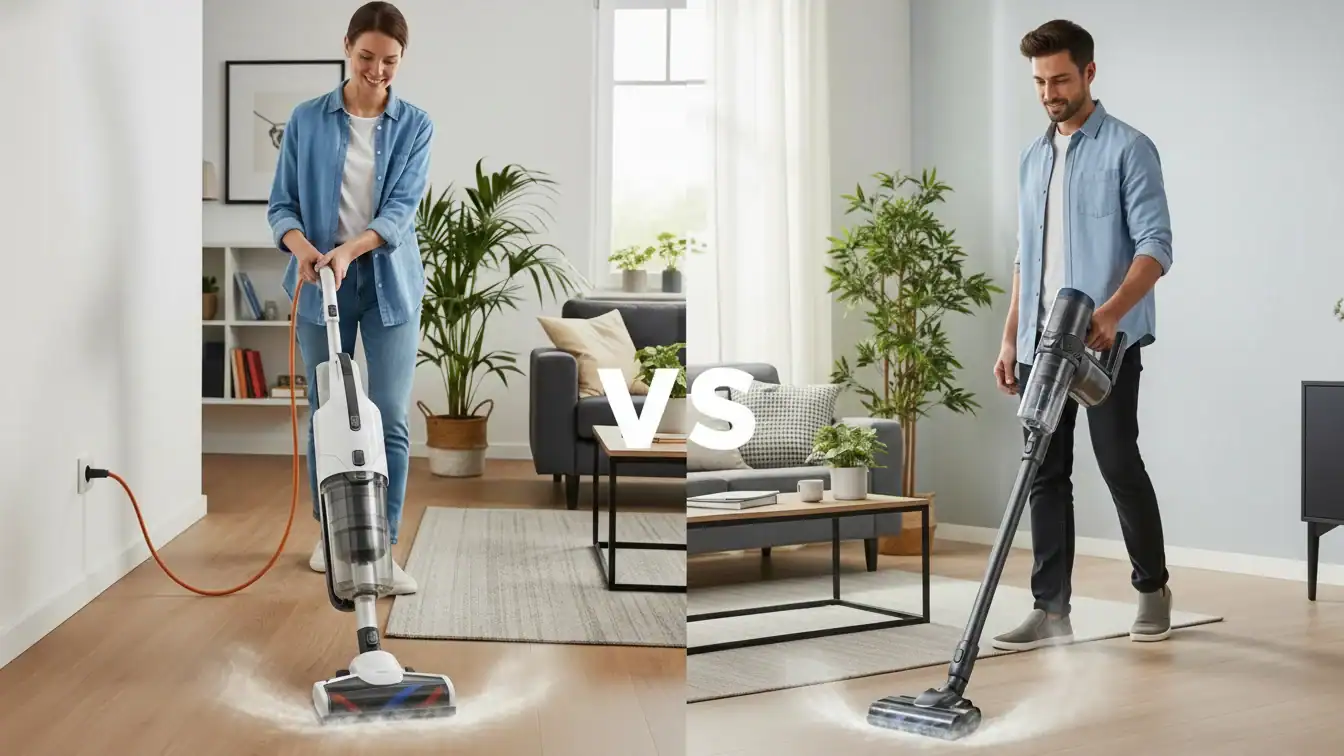
Warranty Claim Rates for Batteries versus Corded Motors
Corded motors maintain a warranty claim rate under 1%, significantly lower than the 3% to 7% return rate typical of lithium-ion battery packs. While AC motors rely on mature mechanical designs with few failure points, battery systems experience chemical degradation and management system errors. This results in higher service frequency for cordless units over a three-year period.
Comparative Reliability and Failure Mechanisms
The technical gap between these power systems stems from their fundamental physical properties. AC induction and universal motors, built to IEC or NEMA frame standards, utilize simple mechanical structures with high thermal limits. Their wear components remain almost exclusively limited to bearings and brushes, which leads to predictable long-term performance and very few points of failure during the warranty period.
Cordless systems integrate multi-cell lithium-ion packs governed by a Battery Management System (BMS) sensitive to high-current partial cycles and operating temperatures. Warranty interactions for these portable units frequently arise from complaints regarding capacity loss or firmware errors within the BMS rather than total mechanical seizure. Simple induction motors lack volatile chemical consumables, allowing them to stay within design tolerances for significantly longer periods than chemical energy storage systems.
Field Data on Return Rates and Capacity Loss
Empirical field data reveals distinct patterns in service life across different appliance categories. Annual return rates for cordless vacuum batteries range from 3% to 7% within the first three years of use. Sealed AC motors in comparable categories report warranty claim rates consistently below 1% over that same three-year window. This data highlights the inherent stability of line-powered mechanical systems compared to the fluctuating health of chemical cells.
Audited datasets from the electric vehicle industry, which provide a high-volume sample for battery performance, indicate a steady capacity loss of approximately 1.8% per year in modern lithium-ion packs. While catastrophic failures are statistically rare, the cumulative effect of chemical aging necessitates more frequent service interactions than corded alternatives. Corded motors maintain 100% performance stability and suction consistency over five years or more, whereas battery packs often require replacement to sustain original runtimes.
Environmental Impact and E-Waste Disposal Considerations
Cordless vacuums reduce operational energy consumption by roughly 50% over a ten-year lifespan compared to corded models. However, this energy saving contrasts with the high resource intensity of battery production—which consumes 500,000 gallons of water per tonne of lithium—and the complex e-waste challenges associated with frequent battery replacements.
Energy Efficiency and Operational Carbon Footprint
Life cycle assessments (LCA) indicate that cordless vacuums often result in lower overall environmental damage. This advantage stems primarily from significantly lower power consumption during the use phase. While the manufacturing of electronics and batteries requires energy, the efficiency of modern cordless motors reduces the total carbon footprint over the life of the machine.
Corded vacuums consume approximately twice as much electricity as cordless models over a ten-year period when used for one hour per week. In regions with energy grids reliant on fossil fuels, this operational energy use becomes the dominant factor in the machine’s environmental impact. Upgrading from an older 2000W corded model to a modern 650W unit provides an environmental payback period of less than three years through reduced emissions.
Material Resource Intensity and E-Waste Management
Battery manufacturing creates high local environmental stress. Extracting one tonne of lithium requires 500,000 gallons of water, often in regions already facing water scarcity. Cordless units complicate e-waste streams due to their cobalt and lithium content. These materials require specialized recycling processes that are not yet universally available, leading to potential chemical contamination if the units are not disposed of correctly.
Corded models avoid battery-related chemical waste but typically require more raw materials for their heavier housings and longer power cables. Bagless cordless designs can mitigate land pollution by trapping 99% of particles within the machine. This design eliminates the need for disposable paper or synthetic bags, which are common in corded systems and contribute steadily to landfill waste over time.
Determining the Best Format for Commercial Fleets
Fleet procurement in 2026 depends on meeting GS-42 noise limits of 70 dBA and maintaining airflow between 95 and 150 CFM. Managers must select equipment based on EN 1822 filtration classes and NFPA 652 safety protocols for combustible dust while budgeting for mandatory three-month filter maintenance cycles.
Regulatory Standards for Noise and Air Quality Compliance
Cleaning contracts for schools and healthcare facilities often mandate adherence to Green Seal GS-42 requirements. This standard sets a strict noise ceiling of 70 dBA to ensure operator safety and minimize disruption in occupied spaces. We verify the Carpet and Rug Institute (CRI) Seal of Approval to confirm that equipment meets established cleaning efficiency benchmarks before adding units to a fleet.
Filtration selection depends on EN 1822 classifications. Most commercial environments utilize HEPA filters rated for 99.97% efficiency at 0.3 μm. Sensitive zones, such as pharmaceutical labs or high-care healthcare units, require HEPA 14 for 99.99% efficiency. For specialized applications requiring the capture of particles down to 0.12 microns, we specify ULPA filters to maintain air quality standards.
Operational Metrics and Safety for Industrial Environments
Suction performance centers on maintaining an airflow range of 95 to 150 CFM. While corded machines sustain these levels continuously, cordless fleet management requires high-capacity battery packs to prevent suction drops as the charge depletes. We monitor these metrics to ensure consistent debris recovery across different floor types and facility sizes.
Hazardous zones involving combustible dust require vacuum designs that follow NFPA 652 safety codes. These units feature conductive hoses and fully bonded components to prevent static ignition. For wet and dry applications in industrial sectors, we align equipment with IEC 60335-2-69 safety standards. Scheduling filter replacements every three months protects the motor and ensures accurate total cost of ownership projections.
Final Thoughts
Professional cleaning teams and homeowners seeking longevity prioritize corded models for their 8-year service life and predictable maintenance. These machines bypass the high price of replacement batteries and provide consistent suction that never fades mid-shift. Cordless systems deliver mobility for quick spot cleaning, but they come with a financial trade-off that often includes replacing the entire unit within three years.
The decision rests on whether the user values short-term agility over decade-long reliability. Corded vacuums act as durable assets with low entry costs and minimal electronic failure points. Cordless alternatives function more like consumer electronics, requiring frequent capital investment to manage battery degradation and performance loss. Selecting the right tool depends on whether the budget allows for the recurring premium of portable power.
Frequently Asked Questions
How often do cordless vacuum batteries need replacing?
Most lithium-ion vacuum batteries last between 300 and 500 full charge cycles. For average users, this translates to a lifespan of 2 to 5 years, though capacity often begins to decline after 12 months of daily operation.
Are corded vacuums cheaper to run than cordless models?
Corded vacuums are more economical because they utilize stable mains power and bypass the recurring expense of replacement battery packs. They also tend to remain in service for over 8 years, whereas cordless units often require significant investment or replacement within 5 years.
What is the average life expectancy of a corded vacuum?
Under standard residential use, corded vacuums generally provide 8 to 10 years of service. In contrast, cordless models typically last 2 to 5 years before the battery fails or the performance degrades significantly.
Do cordless vacuums lose power as the battery drains?
Yes. Suction consistency often drops as the charge depletes or as the battery ages. Once a lithium-ion pack nears its 300–500 cycle limit, the maximum power output and runtime decrease noticeably.
Is it worth repairing a cordless vacuum?
Repairing a cordless unit is usually only cost-effective for battery or filter replacements. If the motor or circuit board fails outside of the warranty period, repair costs typically reach 50% to 80% of the price of a new machine, making replacement more practical.
Which vacuum type has the lowest maintenance cost?
Corded vacuums have the lowest long-term maintenance costs. They avoid the high price of proprietary lithium-ion packs and have simpler internal architectures that lead to fewer hardware failures over a 10-year period.

 English
  Español
  Français
  Deutsch
  Português do Brasil
  Русский
  한국어
한국어  日本語
日本語  العربية