 跳转到主要内容 跳转到页脚

Sourcing gaming and novelty products, like a Minecraft mini fridge, depends entirely on technical feasibility. A failure to verify manufacturing capabilities for custom shapes or PC-synced RGB lighting often leads to costly mold investments in a product that underperforms or fails to meet licensor standards.
This analysis provides clear answers from a factory perspective. We detail how injection molding creates complex licensed shapes and how simple USB connectivity enables true software-based RGB control, all backed by the BSCI and ISO 9001 certifications required for major brand partnerships.
Licensed Shapes: Can We Mold It Like an Xbox?
Yes, an Xbox-shaped mini fridge is feasible with injection molding. This tech creates complex shapes from durable ABS, and our OEM services manage the entire production process.
Clients often ask if we can create mini fridges with unique, proprietary shapes for licensed products. The short answer is yes. The manufacturing process isn’t a barrier; it’s an enabler. Here’s a breakdown of the technology we use and the OEM service we provide to make it happen.
| Capability | What It Means For Your Product |
|---|---|
| Injection Molding for Complex Geometries | |
| Complex Shape Production | The process allows for highly intricate geometric forms. It’s perfect for accurately replicating branded items and their specific details. |
| Material Flexibility | We use a range of material resins like ABS and PC/ABS to get the right balance of durability, aesthetic finish, and cost. |
| Scalable Manufacturing | Production is scalable from small batches for limited editions to large mass-manufacturing runs for major product rollouts. |
| Our OEM Process for Custom Housings | |
| End-to-End Development | We offer a full OEM/ODM development process. We handle everything from the initial design and prototyping to final mass production. |
| Precise Brand Alignment | Our factory can match any Pantone Color for the product housing, allowing for exact brand consistency (MOQ 500 units). |
| Certified Quality Assurance | With ISO 9001 and BSCI certifications, we provide the quality assurance and social compliance necessary for high-value brand partnerships. |
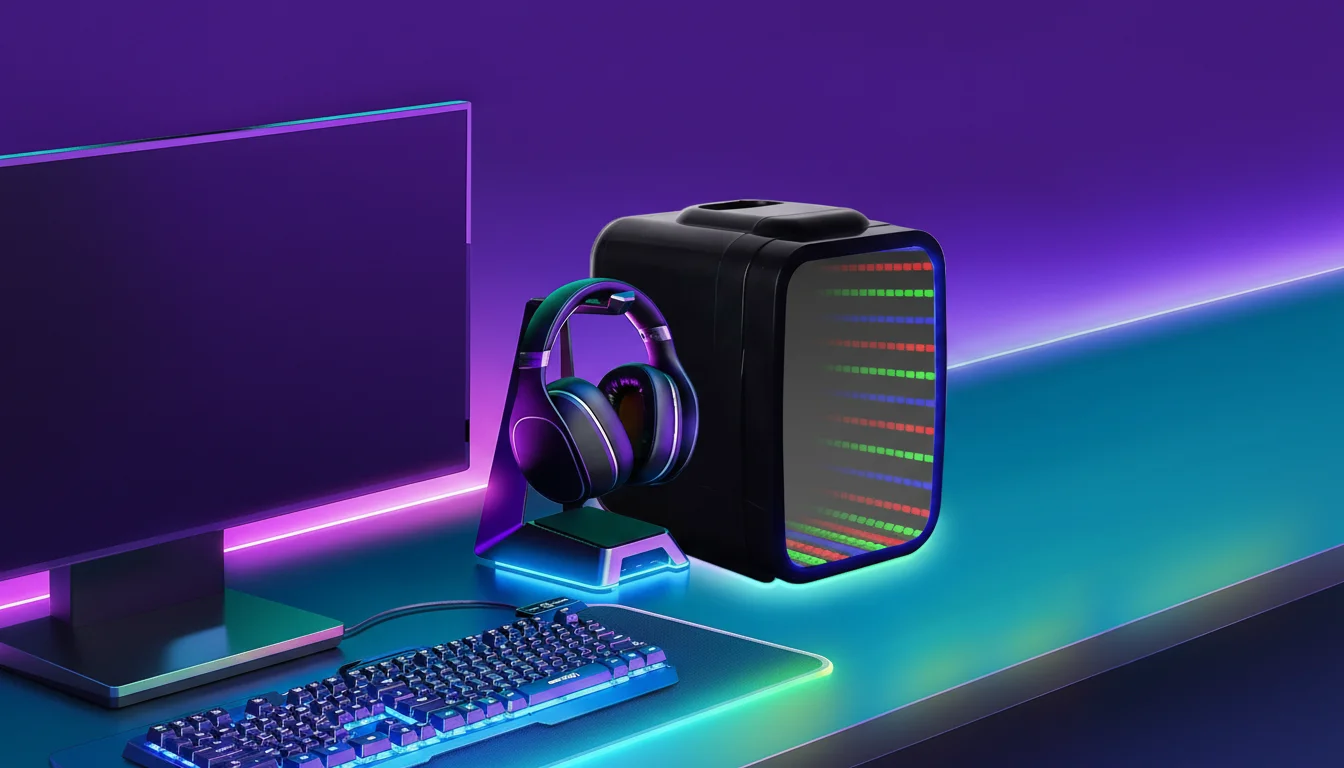
RGB Integration: Does Lighting Sync with PC?
Yes, a novelty fridge can sync with your PC’s RGB lighting. It connects via USB and uses software to unify lighting effects across your entire gaming setup.
How Software Manages Synchronized Lighting
PC lighting isn’t magic; it’s all managed by software that acts as a central command for your components. Instead of running separate apps for every light, these tools unify control. This allows a peripheral like a mini-fridge to behave just like another component in the system.
You have two main paths for this:
- Manufacturer Ecosystems: Big brands like ASUS (Aura) or MSI (Mystic Light) build software to control their own hardware. If your components are mostly from one brand, this is a straightforward option.
- Universal Solutions: Tools like OpenRGB or SignalRGB are brand-agnostic. They talk to devices from different manufacturers, letting you sync components from various brands without conflicts.
Connection Methods for External Peripherals
Getting an external device like a gaming fridge into your lighting scheme is pretty simple. The most direct and common method is a standard USB connection. The fridge’s internal lighting controller just plugs into a USB port on your motherboard or an accessible external port.
For more complex setups with many RGB devices, some people use dedicated RGB controllers or hubs. These boxes consolidate multiple connections into one, which helps with cable management. Once connected, the software sees the fridge as just another addressable RGB device, ready to sync with your fans, keyboard, and mouse.
Boost Your Brand with Custom Mini-Fridges

Desk Snack Station: Is 6-Can Capacity Optimized?
A 6-can capacity is well-optimized for a personal desk. It holds enough for a day, saves space, and encourages frequent restocking to keep contents fresh.
Balancing Consumption Needs with Desk Space
The right capacity for a desk fridge is the one that matches your daily habits. Most people consume 2-3 drinks or snacks during a workday. A 6-can unit aligns perfectly with this pattern, providing enough for a full day without encouraging you to overstock and forget what’s inside.
A smaller footprint is also critical. A unit that’s too large just becomes desk clutter. The goal is to avoid spoilage from perishable items that get pushed to the back. A compact fridge forces a “first in, first out” cycle, which minimizes waste and ensures what you grab is always fresh.
The ‘Beauty Classic’ 6L Configuration
Our top-selling model, the KelyLands 6L “Beauty Classic,” is engineered specifically for this purpose. It perfectly holds six standard soda cans. But its design is also flexible. It includes a removable shelf, so you can easily reconfigure the space to fit taller items like yogurts, bottled drinks, or skincare products alongside cans.
We also designed it for quiet environments. The thermoelectric cooling system operates at a silent 28dB, which is essential for a bedroom, a nursery, or a quiet office where fan noise would be a distraction. It provides the convenience without the noise pollution of larger, compressor-based units.

Power Options: USB vs. AC Needs
Our mini fridges use a dedicated dual-power system, not USB-C. Each unit includes an AC cord for home and a 12V DC cord for vehicles, ensuring reliable cooling anywhere.
Understanding Power Delivery in Modern Gadgets
Many portable electronics, from gaming handhelds to tablets, now rely on USB-C for power. This standard can deliver different wattages, and a device’s performance is directly tied to receiving the correct amount. Using an underpowered charger often leads to slow charging or even reduced functionality, which is unacceptable for a device that needs to maintain a consistent temperature.
AC/DC Ready for Home and Vehicle Use
To guarantee stable cooling, our mini fridges come equipped with a more robust solution. Every unit includes both an AC power cord for standard wall outlets and a 12V DC cord that plugs directly into a car’s cigarette lighter. This dual-voltage capability ensures the fridge delivers consistent cooling at home, in the office, or during a commute. It makes the unit a truly portable lifestyle product, not just a stationary gadget.
Frequently Asked Questions
What factory audits are required for licensed products from major brands?
For licensed products, factories often must undergo specific audits required by the brand, such as Disney’s ILS (International Labor Standards) program. These audits assess fire safety, labor law compliance, and workplace conditions. Our factories are certified with ISO 9001, BSCI, and WCA, providing a strong foundation to meet the compliance standards of most major retailers and licensors.
What is the lifespan of the thermoelectric cooling chip?
Thermoelectric (Peltier) chips are exceptionally reliable because they have no moving parts, eliminating mechanical wear. Under standard operating conditions, they have a Mean Time Between Failures (MTBF) rating of over 200,000 hours, ensuring long-lasting, consistent performance for years.
Can we add a custom startup sound effect for a branded project?
Yes, for OEM orders, a custom startup sound effect can be integrated into the hardware. This typically involves adding a dedicated audio chip, like a JQ6500 module, to the circuit board to play a custom sound file when the unit is powered on. This customization is ideal for creating a unique brand experience.
What is the typical cost for opening a mold for a proprietary shape?
The cost to create a new injection mold for a custom shape depends on its complexity and production volume. A simple mold may cost between $2,000 and $10,000, while a highly complex design with features like undercuts or special finishes can range from $20,000 to over $80,000. These costs are for high-volume production using durable steel molds.
Final Thoughts
Generic units can’t deliver the brand experience a licensed product requires. Our OEM process—from custom molds to precise Pantone matching—is backed by ISO 9001 and BSCI compliance. This protects your brand partnership and ensures the final product is an asset, not a liability.
Verify our manufacturing quality before committing to a custom mold. Start by ordering a sample of our core unit to test the thermoelectric performance and finish. Contact our team to scope your OEM project and get a quote for a proprietary design.

 English
  Español
  Français
  Deutsch
  Português do Brasil
  Русский
  한국어
한국어  日本語
日本語  العربية