 Zum Hauptinhalt springen Zum Footer springen

Die Einhaltung der strengen Materialvorschriften für 2. Silikon & Kunststoffe (BPA-freier Reisekessel) entscheidet darüber, ob Ihre Sendung zollfrei durchkommt oder aufgrund von chemischem Auslaugen einen kostspieligen Compliance-Rückruf erleidet. Käufer stehen unter ständigem Druck, sichere Komponenten zu beschaffen, die dem Kochen bei hohen Temperaturen standhalten, ohne schädliche endokrine Disruptoren ins Trinkwasser abzugeben. Das Vertrauen auf billige Fertigungsabkürzungen führt oft zu nicht bestandenen europäischen LFGB Tests und einem anhaltenden Fabrik- Geruch, der das Vertrauen der Verbraucher zerstört und massive Rücklaufquoten auslöst.
Diese technische Aufschlüsselung untersucht, warum Billigmaterialien strenge europäische Tests nicht bestehen und wie Fabrikteams Ausgasungsgerüche beseitigen, bevor Produkte das Fließband verlassen. Wir bieten eine klare betriebliche Norm zur Validierung der Materialsicherheit gegen extreme Hitze und erläutern die genauen Produktionsparameter, die Sie benötigen, um zusammenklappbare Komponenten nach Ihren spezifischen Farbanforderungen anzupassen.
Warum bestehen billige Silikonkessel den europäischen LFGB-Test nicht?
Die strengen europäischen LFGB-Testprotokolle decken Billigkessel aktiv auf, indem sie gefährliche Kunststofffüllstoffe nachweisen, Schwermetalle, und flüchtige organische Verbindungen, die sich unter Kochbedingungen zersetzen.
Die Verwendung giftiger Füllstoffe und Schwermetalle
Hersteller von Billigprodukten senken Materialkosten, indem sie nicht zugelassene chemische Verbindungen in ihre Silikonbasis einmischen. Minderwertige Silikonchargen stützen sich auf Kunststofffüllstoffe, die beim Kontakt mit kochendem Wasser zerfallen und schädliche Giftstoffe freisetzen. Die chemische Analyse von Billigmodellen weist häufig Schwermetalle wie Blei oder Cadmium sowie synthetische Farbstoffe nach, die nicht für den Lebensmittelkontakt zugelassen sind.
KelyLands entwickelt seine 12V/24V Auto-Wasserkocher, um globalen Markt zu skalieren. Anforderungen zu erfüllen, indem es gefährliche Füllstoffe vollständig vermeidet und reine, lebensmittelsichere Komponenten priorisiert.
Die hohen Kosten von platinvernetztem Silikon
Das deutsche Lebensmittel-, Bedarfsgegenstände- und Futtermittelgesetzbuch (LFGB) legt strenge Materialstandards fest, die Billigfabriken in der Regel umgehen. Die Erfüllung der strengen europäischen LFGB-Norm von 2026 erfordert platinqualitätssilikon, eine Premiumqualität, die ihre strukturelle Integrität unter extremer Hitze bewahrt. Die Beschaffung dieses Premiummaterials erhöht die Produktionskosten um 5% bis 15% im Vergleich zu reinen FDA-Alternativen, was Billigmarken zu minderwertigen, nicht konformen Optionen drängt.
| Testmetrik | Billigsilikon (nicht zertifiziert) | LFGB Platin-Silikon |
|---|---|---|
| Silikonqualität | Peroxidvernetzt mit Kunststofffüllstoffen | 100% platinvernetzt |
| Schwermetallgehalt | Enthält oft Spuren von Blei oder Cadmium | Kein Schwermetallnachweis |
| Auswirkungen auf die Materialkosten | Basislinie (Niedrige Produktionskosten) | 5% bis 15% höhere Beschaffungskosten |
KelyLands nutzt seine riesige Fabrikinfrastruktur in Yuyao, um LFGB-konforme Materialien in großen Mengen zu beschaffen und die Großhandelspreise für Einkaufsmanager im B2B-Bereich wettbewerbsfähig zu halten.
Versagen bei sensorischen und Migrationsprüfungen
Minderwertige Silikonkessel bestehen konsequent nicht die strengen Hochtemperatur-Testprotokolle, die für europäische Markteintritt. LFGB-Tests verlangen umfassende Kunststoffmigrationsanalysen mit Lebensmittelsimulanzien bei hohen Temperaturen, um reale Kochbedingungen zu simulieren.
Billiges Silikon gibt während des Heizzyklus flüchtige organische Verbindungen (VOCs) ab, was zu einer inakzeptablen Geruchs- und Geschmacksübertragung auf das Trinkwasser führt. Konforme Produkte setzen nur vernachlässigbare Spurenelemente frei, die weit unter den europäischen Sicherheitsschwellenwerten liegen, und stellen sicher, dass das Wasser für Langstreckenfahrer und Outdoor-Nutzer völlig unbedenklich bleibt.
Setzt das Kochen bei hohen Temperaturen in Kunststoffen endokrine Disruptoren frei?
Erhöhte Hitze verändert physikalisch die Polymermatrix von Kunststoffen und beschleunigt exponentiell die Migration von endokrinen Disruptoren wie Antimon und Nonylphenol in Flüssigkeiten.
Temperaturschwellen für die chemische Migration
Bei niedrigeren Temperaturen zwischen 4°C und 10°C bleiben endokrine Disruptoren (EDCs) wie Bisphenol A (BPA), Phthalate und Nonylphenol fest in der Kunststoffstruktur eingeschlossen, sodass nachweisbare Konzentrationen unter den analytischen Grenzwerten bleiben. Mit steigender Temperatur beschleunigt sich die chemische Migration rapide. In Polyethylenterephthalat (PET)-Behältern erreicht die Antimonkonzentration nach 12 Tagen bei 70°C 6 Teile pro Milliarde (ppb). Erhöht man die Temperatur auf 80°C, absorbiert die Flüssigkeit dieselben 6 ppb in nur 2,3 Tagen. Bei ständiger Einwirkung von 80°C über sieben Tage steigt der Antimonwert auf 14,4 ppb.
Kunststoffvarianten und Auslaugungsraten
Die spezifische Zusammensetzung des Polymers bestimmt direkt das Volumen und die Geschwindigkeit der EDC-Freisetzung unter hoher Hitze. Polypropylen (PP)-Behälter setzen über alle getesteten Temperaturbereiche hinweg signifikant höhere Konzentrationen von EDCs frei im Vergleich zu Standard-Polystyrol (GPPS). Beide Materialien laugen Verbindungen wie DEHP und Nonylphenol aus, aber PP zeigt unter der extremen Hitze, die zum Brühen heißer Getränke erforderlich ist, eine viel höhere Auslaugungsrate.
| Material Typ | Temperaturbelastung | Ergebnis der chemischen Migration |
|---|---|---|
| PET (Polyethylenterephthalat) | 80°C für 7 Tage | 14,4 ppb Antimonfreisetzung |
| PP (Polypropylen) | Siedetemperaturen | Hohe DEHP- und Nonylphenol-Freisetzung |
| Borosilicatglas (SM400 Serie) | Extreme thermische Schockbelastung / Kochen | 0% Chemische Migration (Null Geruch) |
Um diese Materialschwächen zu umgehen, entwickeln Hersteller Premium-Alternativen. KelyLands konstruiert ihre SM400 Serie 12V/24V Autokocher unter Verwendung von Borosilicatglas und LFGB-zertifizierten Komponenten, die eine chemische Migration von null garantieren und den berüchtigten Plastikgeschmack vollständig eliminieren.
Materialzerfall und Flüssigkeitsinteraktionen
Siedetemperaturen üben physischen Stress auf Kunststoffbehälter aus, indem sie die Kettenbeweglichkeit innerhalb der Polymermatrix erhöhen. Diese strukturelle Verschiebung ermöglicht es eingeschlossenen chemischen Verunreinigungen, zu entweichen und direkt in die Flüssigkeit zu diffundieren. Die Zusammensetzung des Getränks bestimmt weiterhin das Ausmaß dieser chemischen Migration. Saure Flüssigkeiten wie Limonade oder Essig wirken als Katalysatoren und erzwingen signifikant höhere Raten der EDC-Migration als neutrale Flüssigkeiten wie gereinigtes Wasser.
Beziehen Sie noch heute Premium-12V/24V-OEM-Autokessel
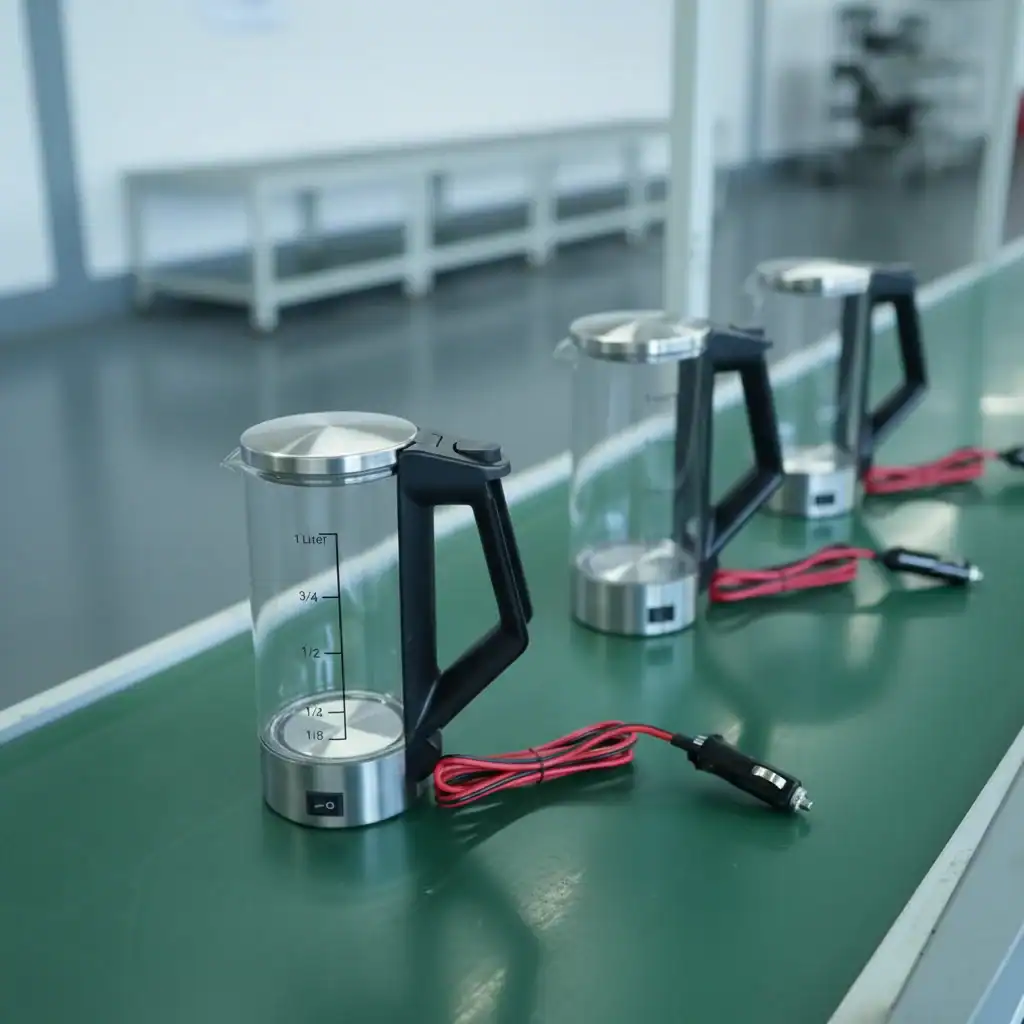
Wie beseitigt die Fabrik den “Neukunststoffgeruch” vor dem Versand?
Industrielle Geruchsbeseitigung basiert auf fortschrittlicher thermischer Verdampfung und molekularer Adsorption anstelle von Maskierungsmitteln, um von Anfang an Lebensmittelkonformität und Verbrauchersicherheit zu gewährleisten.
Mechanische und thermische Verarbeitung
Einrichtungen eliminieren flüchtige organische Verbindungen (VOCs) bereits zu Beginn des Produktionszyklus durch mechanische und thermische Intervention. Betreiber schreddern, waschen und trocknen die rohen Polymermaterialien, um Oberflächenverunreinigungen und lose Schadstoffe zu entfernen. Nach der Reinigung entfernt eine gezielte thermische Behandlung die geruchsbildenden Verbindungen durch Verdampfung, bevor der Kunststoff in die Spritzgussphase eintritt.
KelyLands schreibt vor, dass alle Kunststoffkomponenten und das Hoch Borosilikatglas verwendet in seinen 12V- und 24V-Gleichstrom-Autowasserkochern dieser strengen thermischen Behandlung unterzogen werden. Dieser strukturelle Ansatz garantiert, dass das Endprodukt strikt die LFGB- und CE-Sicherheitsstandards erfüllt ohne verbleibende herstellungsbedingte Gerüche.
Adsorptions- und geruchsbindende Additive
Um Gerüche von innen heraus zu neutralisieren, integrieren Hersteller spezielle Verbindungen direkt in die rohe Kunststoffmatrix. Anlagen setzen Aktivkohleverbindungen ein, die aktiv flüchtige organische Verbindungen in der Polymerstruktur einfangen. Ingenieure integrieren auch spezielle geruchsbindende Masterbatches, die darauf ausgelegt sind, Geruchsmoleküle zu verkapseln und physikalisch daran zu hindern, aus dem fertigen Produkt zu entweichen.
Diese präzise Additivmethode bewahrt die absolute strukturelle Integrität des Kunststoffgehäuses. Sie sichert die Verbrauchersicherheit für lebensmitteltaugliche Fahrzeuggeräte, sodass Fahrer Wasser für Getränke oder Babynahrung völlig frei von chemischen Ausgasungen.
Fortschrittliche Extraktions- und chemische Behandlungen
Produktionslinien setzen chemische Oxidationsmittel und Druckwassersysteme ein, um hartnäckige Gerüche zu bekämpfen, ohne auf schädliche organische Lösungsmittel zurückzugreifen. Spezifische Oxidationsmittel zersetzen und neutralisieren chemisch verbleibende geruchsverursachende Verunreinigungen auf molekularer Ebene. Nach der Oxidation entfernt die Druckwasserextraktion alle verbleibenden Gerüche und bietet eine hochwirksame, umweltfreundliche Alternative zu aggressiven industriellen Lösungsmitteln.
KelyLands setzt ein strenges dreistufiges Qualitätskontrollprotokoll durch, das die Eingangsqualitätskontrolle (IQC), die Prozessqualitätskontrolle (PQC) und die Endqualitätskontrolle (FQC) umfasst. Diese strenge Prüfung stellt sicher, dass alle Versandeinheiten, von leistungsstarken 24V-Gewerbekesseln bis zu 12V-Personenkraftwagenmodellen, völlig frei von chemischen Gerüchen ankommen und sofort in Logistikflotten und Wohnmobilen einsatzbereit sind.
Können wir die Pantone-Farbe des zusammenklappbaren Silikons anpassen?
KelyLands integriert das Pantone Matching System mit LAB-Farbanalytik, um eine exakte Farbwiedergabe über alle Silikonhärtegrade hinweg für Ihre Marke zu gewährleisten.
Das Pantone Matching System und die LAB-Farbgenauigkeit
Wir verwenden das Pantone Matching System (PMS) zusammen mit dem LAB-Farbsystem, um genaue Farbtöne für Ihre Markenidentität festzulegen. Unser Produktionsteam setzt fortschrittliche spektralphotometrische Messtechniken ein, um die Farbgenauigkeit jeder Charge direkt in der Fabrikhalle zu bestätigen. Dieses genaue Messprotokoll verhindert visuelle Abweichungen zwischen verschiedenen Produktionsläufen und gewährleistet eine strenge visuelle Konsistenz für Ihren Lagerbestand.
Aufrechterhaltung der Konsistenz über Silikonformulierungen hinweg
Unterschiedliche Materialhärtegrade erfordern präzises Mischen, um visuelle Einheitlichkeit zu gewährleisten. Wir passen Pigmente auf chemischer Ebene an, wenn wir mit unterschiedlichen Silikonhärten oder spezifischen LFGB-konformen Formulierungen arbeiten. Das Ingenieurteam kontrolliert den Compoundierungsprozess streng, um die Farbe im gesamten Hauptkesselkörper und allen kleineren Silikonkomponenten fest und konsistent zu halten. Sie sichern sich eine einheitliche Ästhetik über Ihre gesamte Produktlinie, auch wenn verschiedene Strukturmaterialien kombiniert werden.
Mindestbestellanforderungen für Sonderfarben
KelyLands richtet die Produktion von Sonderfarben an den üblichen B2B-Großhandelsmengen aus, um die Fabrikeffizienz zu optimieren. Die Anpassung Ihres Silikonkessels mit einer bestimmten Pantone-Farbe erfordert eine standardmäßige OEM-Mindestbestellmenge (MOQ). OEM-Kennzeichnung Sonderfarbenläufe beginnen in der Regel zwischen 100 und 500 Einheiten, abhängig vom spezifischen Modell und der Rohstoffausstattung. Diese Großbestellanforderungen unterstützen die erforderliche Maschinenkalibrierung, Werkzeuganpassungen und Pigmentmischung, um eine exakte Übereinstimmung zu erzielen.
Schlussfolgerung
Die Unterschiede zwischen FDA- und europäischen LFGB-Standards zu navigieren, stellt sicher, dass Ihre Reisewasserkocher strenge Sicherheitsanforderungen erfüllen und die Freisetzung schädlicher Chemikalien beim Kochen bei hohen Temperaturen vermeiden. Die Beschaffung konformer Materialien wirkt sich direkt auf Langlebigkeit der Produkte aus und schützt Ihre Marke vor hohen Rücklaufquoten, die durch anhaltende Kunststoffgerüche oder Materialfehler verursacht werden. Die Priorisierung zertifizierter Herstellungsprozesse gibt Importeuren Sicherheit beim Vertrieb in streng regulierten Märkten.
Überprüfen Sie Ihre aktuellen Beschaffungsanforderungen, um sicherzustellen, dass Ihr Kesselbestand den regionalen Compliance-Standards entspricht. Kontaktieren Sie das KelyLands-Team, um einen Materialsicherheitsbericht anzufordern oder ein Muster unserer zertifizierten Reisekessel zu bestellen.
Häufig gestellte Fragen
Haben Ihre Silikon-Reisekessel FDA- und LFGB-Zertifikate?
Ja, unsere Silikon-Reisekessel sind vollständig nach FDA- und strengen LFGB-Standards zertifiziert. Wir verwenden hochwertiges Platin-Silikon, um die Einhaltung der umfassenden LFGB-Anforderungen zu gewährleisten, die strenge sensorische, Kunststoffmigrations-, Metallzusammensetzungs- und Silikonharztests umfassen. Dies garantiert, dass unsere Produkte beim Erhitzen keine schädlichen Substanzen freisetzen.
Wie entferne ich den Plastikgeruch aus einem neuen Kessel?
Um verbleibende Herstellungsgerüche zu beseitigen, füllen Sie den Kessel bis zur maximalen Linie mit einer Mischung aus Wasser und zwei Esslöffeln weißem Essig oder Zitronensaft. Bringen Sie die Lösung zum Kochen, lassen Sie sie 15 bis 20 Minuten stehen und gießen Sie dann das Wasser weg. Spülen Sie gründlich und kochen Sie eine weitere Ladung klares Wasser, um sicherzustellen, dass der Kessel vollständig neutralisiert und für den täglichen Gebrauch bereit ist.
Ist zusammenklappbares Silikon für das tägliche Kochen von Wasser sicher?
Ja, zusammenklappbares Silikon ist für das tägliche Kochen absolut sicher, wenn es aus hochwertigen, LFGB-zertifizierten Materialien hergestellt wird. Hochwertiges Platinsilikon ist so konstruiert, dass es ständigen Temperaturschwankungen standhält, ohne sich zu zersetzen oder Kunststofffüllstoffe, Schwermetalle oder flüchtige organische Verbindungen in Ihr Trinkwasser abzugeben.
Wie hoch ist die Mindestbestellmenge (MOQ) für einen kundenspezifischen Pantone-Silikonkessel?
Die Standard-Mindestbestellmenge (MOQ) für einen kundenspezifischen, Pantone-angepassten Silikonkessel beträgt in der Regel 1.000 Einheiten. Diese Menge ermöglicht es uns, lebensmittelechte, LFGB-zugelassene synthetische Farbstoffe präzise auf Ihre genauen Markenfarben abzustimmen, während gleichzeitig strenge Sicherheitszertifikate und eine effiziente Fertigung gewährleistet werden.

 English
  Español
  Français
  Deutsch
  Português do Brasil
  Русский
  한국어
한국어  日本語
日本語  العربية