 跳转到主要内容 跳转到页脚

Finding the best dual zone fridge is the deciding factor between a successful remote deployment and a costly logistical failure from spoiled cargo. Standard single-zone units create an operational bottleneck, forcing a choice between freezing or cooling, while poorly engineered combo units risk temperature bleed-through that can compromise sensitive assets and drain critical power systems. For any field operation, from geological surveys to mobile clinics, a unit’s inability to maintain two precise, independent temperature zones introduces an unacceptable point of failure.
This analysis moves past marketing claims to dissect the core partitioning technologies that ensure operational reliability. We will examine how intelligent power management automatically diverts energy between zones, how hall sensors in removable dividers trigger seamless transitions from dual to single-zone mode, and how app-based monitoring provides the remote oversight needed to protect assets from the driver’s seat. This guide serves as a technical standard operating procedure for evaluating and selecting a truly mission-capable unit.
The Dilemma: Can You Freeze Meat and Cool Beer Simultaneously?
The engineering solution to this classic overlanding problem lies in combining independent zone controls with a high-efficiency DC compressor, allowing a single unit to maintain two distinct temperature environments reliably.
For any extended trip, managing perishable food and cold drinks is a logistical challenge. Storing frozen meat requires a deep freeze around -18°C, while beverages are best kept chilled at about 4°C. Using two separate coolers is inefficient, consumes too much space, and doubles the power draw. Modern portable refrigerators solve this by integrating true dual-zone functionality into a single, compact chassis.
Dual-Zone Technology with Independent Controls
The core of this solution is a partitioned design with independent temperature controls for each compartment. This setup allows one section to function as a deep freezer for meat or ice cream, while the other maintains a standard refrigeration temperature for drinks, dairy, or produce. It offers genuine flexibility for managing different types of goods without compromise.
- Users can set distinct target temperatures for each section via a central control panel.
- A physical, insulated divider separates the freezing and refrigeration zones to prevent temperature bleed.
- This system provides versatile storage for different types of goods on the same trip.
The Role of High-Efficiency Compressors
Running two different temperature zones simultaneously depends entirely on advanced, high-efficiency DC compressor engineering. These units are powerful enough to reach deep-freeze temperatures (down to -20°C) quickly, even in high ambient heat. At the same time, they manage the less intensive cooling load in the second compartment, ensuring both zones maintain their set points with minimal power draw.
- Delivers robust cooling and freezing performance, essential for off-road or marine use.
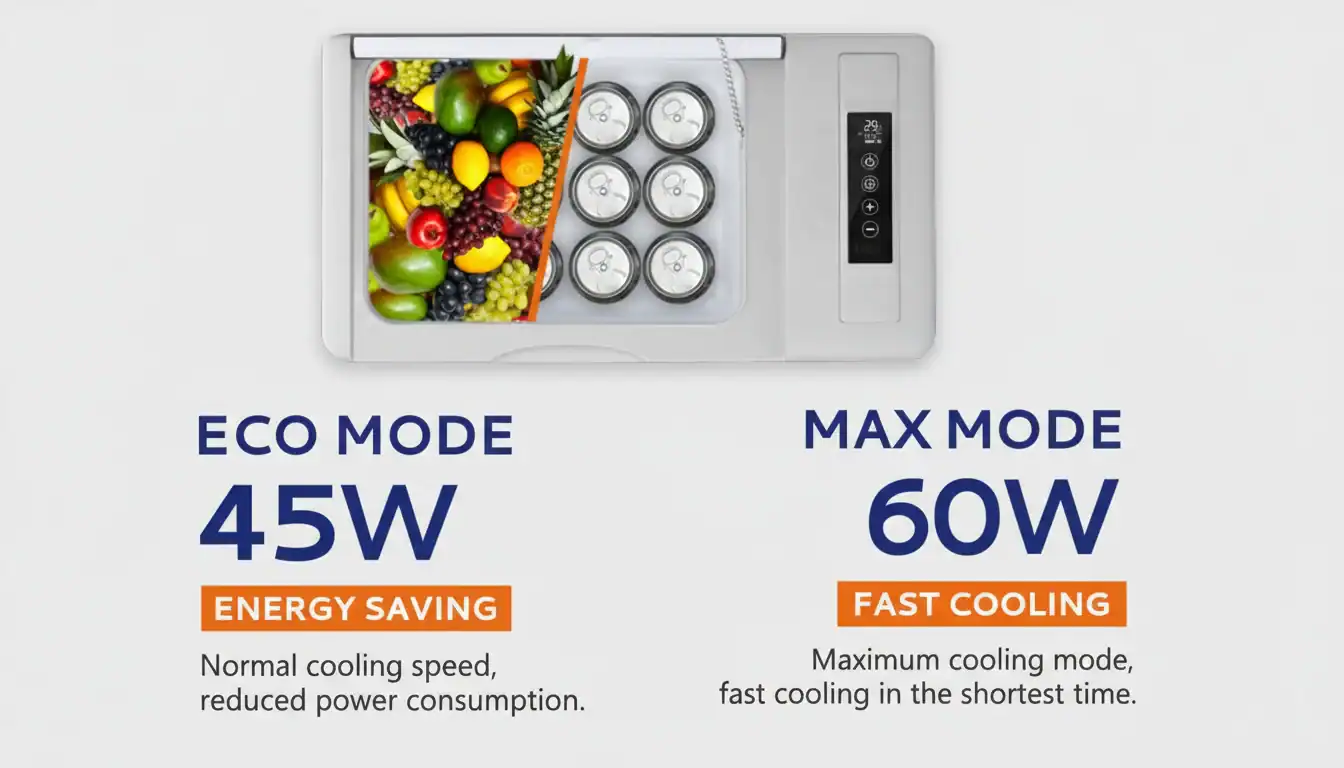
- Optimized for low power consumption, typically operating under 45W in Eco mode.
- Ensures consistent temperature precision across both compartments for food safety.
Energy Management for Extended Trips
For practical off-grid use, these dual-zone units feature smart power management systems. Features like selectable Eco and Max cooling modes allow the user to prioritize either energy savings or rapid cooling speed. A multi-stage battery protection system is also standard, automatically shutting the unit off if the vehicle’s battery voltage drops too low, which ensures the engine can always be started.
- Energy-saving modes reduce compressor activity once target temperatures are stable.
- Three-stage battery protection prevents draining the vehicle or portable power station.
- A shockproof design ensures the compressor performs reliably even when tilted up to 30 degrees.

Energy AI: Does It Auto-Dim the Freezer Zone When Not Needed?
Current Energy AI in dual-zone fridges focuses on optimizing compressor cycles for power efficiency, not on user-interface features like auto-dimming displays based on zone activity.
The concept of “Energy AI” in portable compressor fridges is often misunderstood. It doesn’t mean the appliance is self-aware, but rather that it uses intelligent algorithms to manage power consumption. This technology is practical and delivers measurable efficiency gains, primarily by controlling the core cooling hardware—the compressor.
AI-Driven Energy Optimization
Modern dual-zone refrigerators use AI-powered systems to learn your usage patterns. By analyzing data from smart sensors, the system dynamically adjusts compressor speed and defrost cycles to match real-time conditions. Instead of running at a constant speed in “Eco” or “Max” mode, the compressor modulates its output to use the least amount of energy required. Manufacturers report this can reduce power consumption by up to 10% compared to traditional control logic.
| Feature | Standard Compressor Control | AI-Driven Energy Optimization |
|---|---|---|
| Compressor Speed | Fixed or manual modes (e.g., Eco/Max) | Dynamically adjusts based on real-time load and usage patterns |
| Power Consumption | Consistent power draw within a set mode | Optimized for efficiency; reduces draw during low-use periods |
| Defrost Cycle | Operates on fixed, time-based intervals | Adaptive cycles triggered by sensor data and historical usage |
Adaptive Thermal Management
A key benefit of this technology is adaptive thermal control. Each cooling zone responds independently based on its contents and how frequently you access it. For example, if the freezer zone remains unopened for an extended period while the fridge zone is opened several times, the system will allocate cooling resources more efficiently. It avoids wasting energy to over-cool a stable, inactive compartment, focusing instead on maintaining a precise temperature where it is most needed.
Current Implementation and Limitations
While AI effectively manages the internal cooling hardware, its application to the user interface is still limited. Features like automatically dimming a specific zone’s display based on inactivity are not standard in the current market. The primary focus for energy-saving AI remains on optimizing the unseen components—the compressor and cooling system. Advanced user-interface optimizations like context-aware displays are a developing area in portable refrigerator technology and have not yet become a common feature.
Source Certified OEM Car Coolers Here

Removable Dividers: Hall Sensors and Auto-Switching to a Single Zone
Modern portable fridges use magnetic Hall-effect sensors to automatically detect if the internal divider is present, instantly reconfiguring the unit from two small zones to one large one.
A key feature in flexible dual-zone coolers is the removable divider. It allows a user to switch between needing two distinct temperature zones—like a fridge and a freezer—and needing one large, single-temperature space. By 2026, the standard for detecting this change is no longer a physical switch. Instead, high-end units rely on Hall-effect sensors for a seamless, automated transition that improves both usability and long-term durability.
How Hall Sensors Detect Divider Placement
Car coolers now use Hall-effect sensors for reliable, non-contact detection. This magnetic sensing technology instantly identifies when the divider is inserted or removed, triggering the control system to recognize the change in configuration without any physical contact. A small magnet embedded in the divider activates the sensor when it’s put in place. This provides immediate feedback to the fridge’s main processor to adjust cooling modes and is a far more reliable alternative to mechanical switches, which can wear out, get stuck, or fail from moisture and vibration.
| Detection Technology | Mechanism | Long-Term Reliability |
|---|---|---|
| Hall-Effect Sensor (Modern) | Non-contact magnetic field detection. No moving parts. | High. Immune to wear, moisture, and debris. |
| Mechanical Switch (Legacy) | Physical contact; a pin or lever is depressed. | Low. Prone to mechanical failure, sticking, and corrosion. |
Automatic Zone Reconfiguration
When the sensor detects the divider’s removal, the cooler’s firmware automatically merges the two smaller compartments into a single, larger temperature zone. The control unit switches from dual-zone to single-zone temperature management, deactivating the temperature settings for the second zone. The primary control then manages the entire space to a single setpoint. This automated transition ensures the cooler adapts to different storage needs without requiring any manual input from the user.
Energy Efficiency and Design Simplicity
This sensor-based approach improves energy efficiency. By deactivating one set of controls when the space is unified, it prevents wasted power. It also simplifies the cooler’s physical construction. A minimalist 2-wire sensor configuration reduces internal complexity and potential points of failure. The system uses low-power sensors with minimal energy consumption (often below 1µA) and avoids the cost and installation challenges of mechanical switches. Fewer moving parts ultimately lead to a more durable and reliable design fit for off-road use.

App Control: Monitoring Both Zones from the Driver’s Seat.
Remote monitoring is no longer a luxury; it’s an operational requirement that provides real-time temperature data and automated alerts to prevent costly spoilage before it happens.
Real-Time Temperature Tracking and Alerts
Modern monitoring systems give you a live view of both fridge and freezer compartments directly on a mobile app. This isn’t just about convenience; it’s about control. You can set specific temperature thresholds for each zone, and if a temperature strays outside your defined safe range, the system sends an immediate alert via email or SMS. This proactive warning system ensures you can address a cooling issue before the cargo is compromised.
- View live temperature data for each compartment from a single dashboard.
- Set custom temperature thresholds that trigger instant notifications.
- Use glycol-insulated probes for accurate cargo readings, which minimizes false alarms caused by frequent door openings.
Connectivity: Cloud vs. Local Network Systems
Two primary architectures dominate the market. Cloud-connected platforms offer the ability to check temperatures from anywhere in the world with an internet connection, though they often come with a subscription fee. In contrast, local-network systems operate independently without relying on the internet. These systems are ideal for off-grid use, providing high reliability and lower ongoing costs since there are no recurring charges.
- Cloud-based systems provide global access for constant fleet or cargo monitoring.
- Local network solutions offer a subscription-free alternative for reliable offline use.
- Systems can connect via Wi-Fi or wired connections to fit different vehicle setups and operational needs.
Data Logging for Trip History and Compliance
Automatic data logging creates a complete temperature history for every trip without any manual input. This feature is critical for verifying that food, medical supplies, or other sensitive goods were kept within a safe temperature range throughout their journey. For commercial operators, these logs provide the documentation needed to meet regulatory standards, such as those set by the CDC, and resolve any disputes about cargo integrity.
- Automatically record a complete temperature history for both zones.
- Review past data to confirm safe storage conditions were maintained.
- Generate logs necessary for compliance with industry or government standards.
Accessibility Across Multiple Devices
System oversight isn’t tied to a single, dedicated device. Most modern monitoring platforms are accessible through a standard web browser on any smartphone, tablet, or computer. This approach eliminates the need to install specialized software, simplifying setup and providing flexibility for multiple team members to check statuses without being tied to a specific piece of hardware. The installation is typically a straightforward plug-and-play process.
- Monitor temperatures from any device equipped with a web browser.
- No requirement to install and maintain dedicated software.
- Simple plug-and-play installation allows for immediate deployment.
Conclusion
Dual-zone fridges solve a classic travel problem with smart partitioning technology. Features like automatic zone switching and intelligent power management give users the flexibility to freeze and cool items simultaneously. This technology ensures reliable performance, whether for a weekend trip or a long-term journey.
If this dual-zone technology aligns with your product lineup, our latest catalog provides detailed specifications. We can also prepare samples for your internal testing and market evaluation.
Frequently Asked Questions
What is the best dual zone fridge for overlanding?
The best overlanding fridges are defined by their core technology and rugged construction. Look for models featuring high-efficiency, variable-speed compressors that ensure low power draw and quiet operation. Key characteristics include a vibration-resistant build for durability on rough terrain, superior insulation for temperature stability in extreme heat, and smart connectivity for remote monitoring. Top-tier brands consistently deliver on these performance and reliability metrics.
Can I turn off one zone to save power?
Yes, a core feature of modern dual-zone fridges is the ability to independently control or completely turn off one zone. This allows you to run the unit as a single-zone fridge or freezer, which significantly reduces the compressor’s workload and overall power consumption. This energy-saving mode is critical for extending battery life during long, off-grid expeditions.
How does the divider affect cooling performance?
The divider is essential for true dual-zone performance. A high-quality, well-insulated divider creates a strong thermal barrier, enabling the unit to efficiently maintain two distinct temperatures (e.g., freezer and fridge). If the divider is thin or poorly sealed, thermal bleed-through occurs, forcing the compressor to work harder to maintain the set temperature differential. This directly increases power consumption and reduces overall efficiency.
Does the app warn if one zone gets too warm?
Yes, smart connectivity features on modern fridges include robust mobile apps with configurable alerts. You can set custom temperature thresholds for each zone, and the app will send a push notification to your smartphone if a compartment’s temperature goes outside that range. This proactive warning system is invaluable for preventing food spoilage due to power issues or accidental door openings.

 English
  Español
  Français
  Deutsch
  Português do Brasil
  Русский
  한국어
한국어  日本語
日本語  العربية