 跳转到主要内容 跳转到页脚

ev accessory car fridge is the first checkpoint buyers should lock before they approve a supplier, budget, or production slot. A Ford F-150 Lightning owner camping off-grid for a weekend will see roughly 8 to 10 percent of their high-voltage battery consumed by a 60-liter compressor fridge if they run it through the AC inverter. Switch that same fridge to a direct DC connection, and the draw drops to about 2 percent. That gap — between 2% and 10% — is the difference between a well-integrated EV accessory car fridge and one that triggers range anxiety before breakfast on day two.
Most buyers evaluating a fridge for an EV accessory bundle focus on capacity or price first. The smarter move is to start with the power architecture. The standard 12V socket in most EVs has a 10-amp fuse, which caps continuous draw at roughly 120 watts. A quality compressor fridge averages around 45 watts, so it runs safely within that limit. Thermoelectric coolers, which pull closer to 60 watts sustained, sit right on the edge — fine in mild weather but risky when ambient temps force the unit to run longer cycles. For anyone building an EV accessory bundle with cooler options, specifying a low power compressor fridge isn’t just a nice feature; it’s the spec that prevents returns and complaints about dead auxiliary batteries.
Here is a three-point checklist you can use when evaluating suppliers for your next bundle. One — does the fridge specify average power draw at both 25°C and 32°C ambient? If they only quote one number, ask why. Two — can the unit run directly from a solar input between 12V and 24V without an additional regulator? Three — does the supplier provide duty-cycle data for their compressor in real-world camping conditions, not just lab benchmarks? If you get three yeses, you have a product worth sampling.
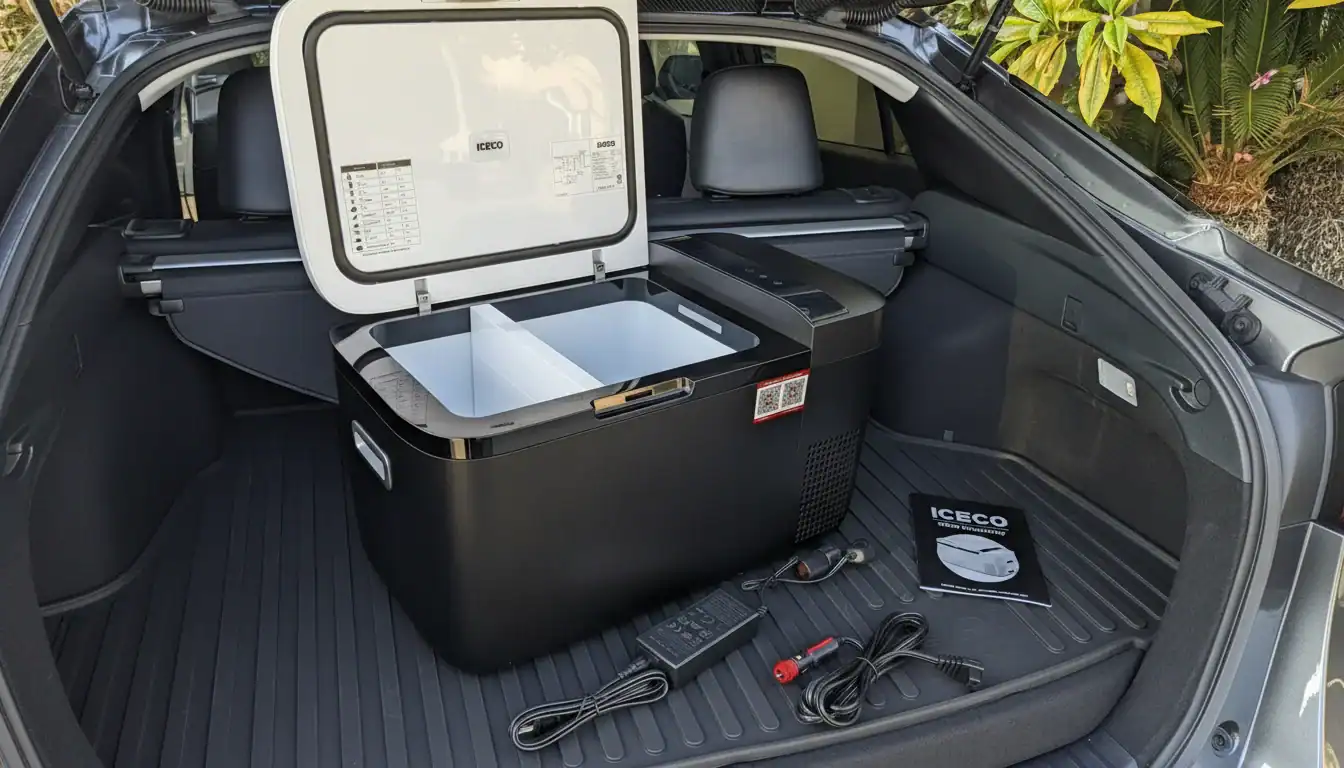
Matching Fridge Power Draw to EV Auxiliary Systems
A 45W compressor fridge draws 3.75A on 12V — well within a typical 10A auxiliary circuit.
Understanding DC-to-DC Converters and 12V Battery Capacity
Every EV has a DC-to-DC converter that steps the high-voltage traction battery (400V or 800V) down to 12V for the auxiliary system. That converter powers the lights, infotainment, and any accessory plugged into the 12V socket. But its output is not unlimited.
Most passenger EVs have a DC-to-DC converter rated between 1.5kW and 3kW continuous. A Ford F-150 Lightning uses a 2.2kW unit; a Tesla Model Y sits around 1.8kW. The converter also charges the small 12V lead-acid or lithium auxiliary battery — typically a 40Ah to 60Ah unit — that acts as a buffer for transient loads.
Here is where buyers get burned: the factory-installed 12V auxiliary battery in most EVs is not designed to run sustained loads like a fridge overnight without the DC-to-DC converter running. If you park, turn off the car, and plug a fridge into the accessory socket, you are draining only that small auxiliary battery — not the main traction pack.
Once that auxiliary battery hits low voltage (typically around 11.8V), the vehicle’s BMS will cut power to protect starting capability. The fridge stops. Food spoils. The customer blames the product.
Calculate Total Amp-Hour Budget for Overnight Camping
To avoid that scenario, you need to calculate amp-hour draw against available capacity. Start with the fridge’s average power consumption — not peak startup current.
Step one: Find the fridge’s rated average wattage at your target ambient temperature (typically measured at 25°C or 32°C). A quality compressor model like those produced by KelyLands’ partner factory in Ningbo averages around 45W . Divide by nominal voltage (12.8V) to get amps: 45W ÷ 12.8V = ~3.5A .
Step two: Estimate duty cycle — how often the compressor actually runs versus idling in eco mode. In moderate ambient (20–25°C), a well-insulated compressor fridge runs about 25–35% of the time at setpoint of +4°C. That gives an effective draw of 0.9–1.2A per hour , or 22–29Ah over a full night (24 hours) .
Step three: Compare against available capacity when parked without grid charging or EVSE connection trickle-charging via AC inverter.
-
- Direct DC from traction battery: If wired through an aftermarket DC-DC buck converter tapped directly to high-voltage bus, available capacity equals usable kWh of traction pack minus driving reserve — typically >90% of pack size.
- AC inverter from traction battery: Ford F-150 Lightning customers report a 60L compressor fridge consuming 8–10% of high-voltage battery per day . On extended-range pack (131kWh usable), that is roughly 10–13kWh/day . Using efficient DC wiring drops consumption to ~2% per day , according to owner forum data.
- Pure auxiliary battery only: The standard ~50Ah lead-acid auxiliary can sustain ~22Ah overnight draw for about half a night before BMS cuts power.
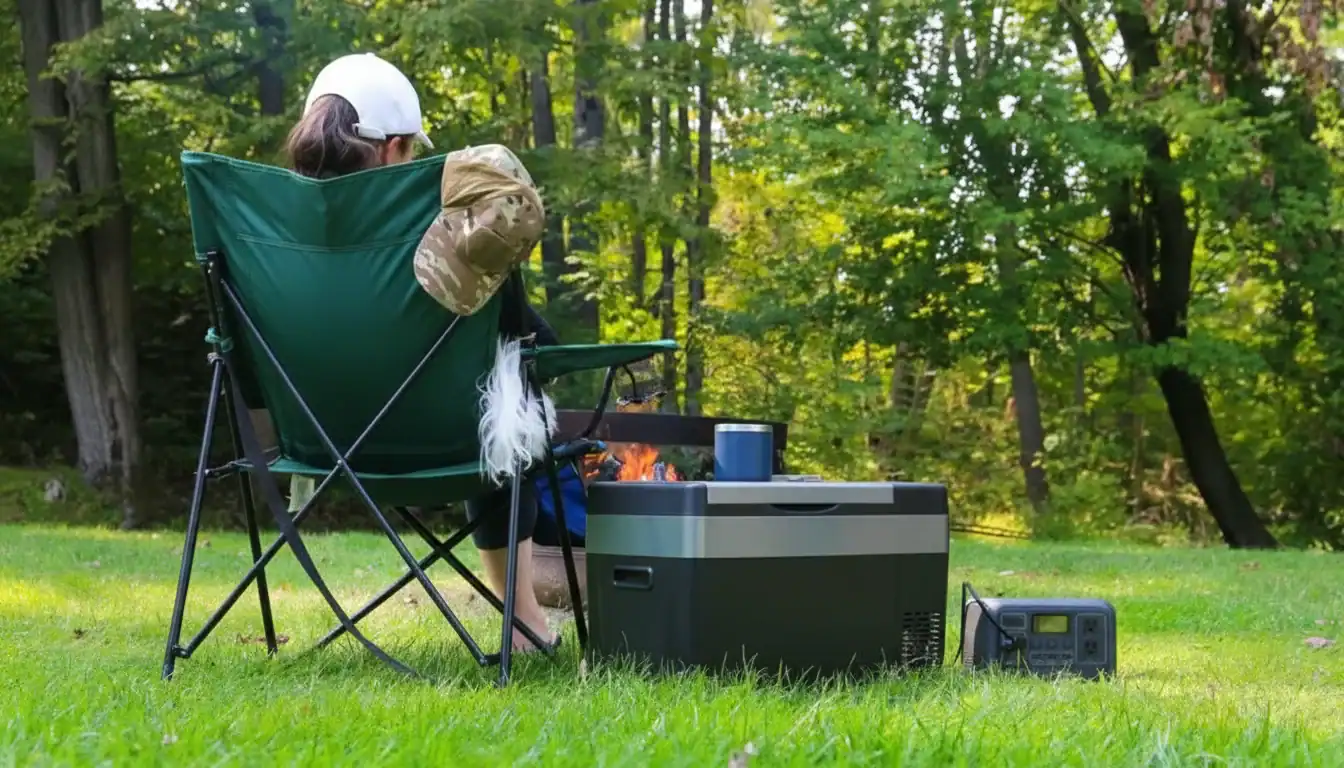
Feature Checklist for EV-Centric Retail Bundles
A 35L compressor fridge running on DC drains roughly 2% of a Ford F-150 Lightning’s battery per 24 hours.
Most EV owners plug a fridge into the 12V socket and assume it works. It does, until the auxiliary battery drops below the DC-to-DC converter threshold and the car throws a low-voltage warning. The problem isn’t the fridge—it’s the power path. A standard 12V socket is fused at 10A, capping continuous draw at roughly 120W. A compressor fridge averaging 45W sits well inside that limit. A thermoelectric model pulling a steady 60W runs borderline, especially if the car’s converter cycles off during parking.
Low Power Modes and Eco Settings That Extend EV Range
The difference between a good EV fridge and a bad one comes down to how aggressively it manages its compressor cycle. Entry-level coolers run the compressor until the internal sensor hits the set point, then shut off completely. That binary cycling wastes energy because the temperature drifts wider before the next kick-on. Better units use variable-speed Danfoss or Secop compressors that ramp down to maintain a narrow band around your target temp.
Look for fridges with an explicit “ECO” or “battery protection” mode that adjusts cut-off voltage thresholds. Most quality units offer three settings: Low (10.1V cut-off), Medium (10.7V), and High (11.4V). For EVs, set it to Medium or High regardless of what the manual says about deep-cycle batteries—you’re protecting your traction battery’s buffer, not a dedicated house bank.
-
- ECO Mode Effect: Reduces average power consumption by roughly 25-30% compared to max cooling mode in moderate ambient temperatures (20-25°C).
- Compressor Duty Cycle: $\lt$25% duty cycle in ECO mode vs $\gt$50% in max mode under same conditions—critical for overnight camping without triggering low-voltage alerts.
Real-World EV Camping Scenarios
Ford F-150 Lightning owners report a 60L compressor fridge uses 2% of battery via DC, vs 8-10% via AC inverter.
The gap between a marketing spec sheet and real-world power draw shows up fast when an EV owner plugs in a fridge for the first overnight trip. Rivian R1T owners running a 35L compressor fridge from the gear tunnel 12V outlet report a sustained draw of roughly 45W average with the compressor cycling at 25-30% duty cycle in moderate ambient temps (20°C). That translates to about 3.75Ah consumed over a 10-hour overnight period from the auxiliary battery — well within the Rivian’s 40Ah DC-to-DC supported capacity.
Tesla Model Y Camp Mode Reality
Tesla’s Camp Mode keeps the HVAC and cabin outlets live, but the single 12V socket in the center console is fused at 15A on newer models (some earlier builds had only a 10A limit). A compressor fridge averaging 45W pulls roughly 3.75A — safe on either fuse rating. The issue surfaces when owners add a second device like a CPAP machine or phone charging hub on the same circuit. We’ve seen forum reports where total draw hits 14A and the fuse holds, but voltage sag at the socket triggers low-voltage cutoff on sensitive fridges, shutting them down at 11.5V instead of the standard 10.5V threshold.
Ford F-150 Lightning: The AC vs DC Trap
Ford F-150 Lightning owners have documented one of the most instructive data points in this category. Running a 60L compressor fridge from the truck’s bed-mounted AC inverter (the Pro Power Onboard system) consumes roughly eight to ten percent of the high-voltage battery over a full day — that’s around eight to ten kWh drawn from a nominal usable pack size near one hundred kWh for an extended-range model. Switch that same fridge to efficient DC power via an aftermarket accessory connection wired directly to the auxiliary battery bus, and consumption drops to about two percent.

Conclusion
The difference between a fridge that drains an EV battery overnight and one that sips power is a matter of compressor type and duty cycle specs. A thermoelectric unit pulling 60W through a 10A fuse is a range-anxiety risk. A properly selected compressor model averaging 45W keeps the auxiliary system stable.
-
- Compressor fridges average 45W draw vs. thermoelectric at 60W.
- DC power uses only 2% of high-voltage battery per day.
- Bundling a fridge with charger installation adds $180 order value.
Benchmark your next purchase against the industry standard for low-power compressor fridges — aim for models with an average draw under 50W and a duty cycle below 35% at moderate ambient temps. That spec sheet number will tell you more about real-world performance than any marketing claim. Cross-reference it against the amp-hour budget of the EV models you target, then review current pricing on the KelyLands car fridge catalog page to compare stock and custom sourcing options.
Frequently Asked Questions
How much battery does a car fridge use in an EV?
A 60L compressor fridge running on DC draws roughly 2% of a Ford F-150 Lightning’s battery per day, versus 8–10% when using the AC inverter. The exact percentage depends on. Always test with your specific EV model before committing to a bundle.
What is the typical amp draw of a compressor fridge?
A typical 45W compressor fridge draws about 3.75A on a 12V system, which is well within the capacity of a standard 10A auxiliary circuit. Larger models like a 60L fridge may. Check your EV’s auxiliary circuit spec before finalizing the fridge SKU.
Can I run a car fridge overnight on an EV auxiliary battery?
Yes, most modern EVs have a 12V auxiliary battery that can support a fridge overnight, provided you calculate the amp-hour budget. For example, a 3.75A draw over 10 hours uses. Always leave a 20% buffer to avoid completely draining the auxiliary battery.
Do car fridges have eco modes for EVs?
Yes, many compressor fridges now include low-power or eco modes that reduce compressor cycling and extend battery life, often cutting power consumption by 15–30%. Look for models with programmable. Prioritize fridges with a dedicated eco mode when sourcing for EV accessory kits.
Are car fridges solar compatible for EV camping?
Yes, many modern car fridges are designed to accept solar input via a charge controller, allowing you to recharge the auxiliary battery during the day. Smart app monitoring. Confirm the fridge’s DC input voltage range matches your solar setup before bundle development.

 English
  Español
  Français
  Deutsch
  Português do Brasil
  Русский
  한국어
한국어  日本語
日本語  العربية