 跳转到主要内容 跳转到页脚

Sourcing a high-performance Multi-Sport / Universal electric pump is the only way to avoid the equipment failure common with single-stage retail units. Budget fans generate speed but lack the torque to overcome 1 PSI backpressure, causing motors to overheat before a drop-stitch board achieves rigidity. This deficiency leads to stalled inflation and forces users to revert to manual pumping during peak sessions.
This technical review benchmarks inflators using the Dual-Stage Intelligent Switch standard, moving from 350L/min volume to 20 PSI compression. We examine Active Cooling systems and nozzle compatibility to determine which units survive the demands of SUP, kayak, and kite inflation.
Single Stage vs. Dual Stage: How to Manage Speed Expectations at $50?
Single-stage fans stall above 1 PSI due to torque limits. For 20 PSI rigidity, our dual-stage system combines a rapid turbine for volume with a high-torque piston for pressure.
| Feature | Single-Stage (Mattress Pumps) | KelyLands Dual-Stage (SUP) |
|---|---|---|
| Max Pressure | < 1 PSI (Stalls easily) | 20 – 25 PSI |
| Mechanism | Centrifugal Fan Only | Fan (Stage 1) + Piston (Stage 2) |
| Airflow Speed | Consistent High Speed (Low Force) | 350L/min drops to 70L/min |
| Application | Pool Toys, Air Beds | Rigid Drop-Stitch Boards |
The Engineering Bottleneck: Why Single-Stage Fans Stall at 1 PSI
Most budget retailers confuse “high airflow” with “high pressure.” Single-stage pumps, typically found in air mattress inflators, use simple centrifugal fans. These fans move large volumes of air rapidly because there is zero resistance inside an empty balloon or pool float. But a drop-stitch SUP board requires significant force to expand its internal fibers.
Physics dictates that as internal pressure rises inside the board, the resistance against the pump increases. A single-stage fan lacks the torque to push against this backpressure. Once the board reaches just 0.5 to 1 PSI, the fan blades continue to spin, but the air simply recirculates inside the housing without entering the board. The motor overheats trying to overcome this resistance, and the board never becomes rigid enough to stand on.
The Intelligent Switch Solution: Optimizing 350L/min Airflow for 20 PSI Targets
To solve the torque problem without inflating the cost, KelyLands utilizes a Dual-Stage mechanism controlled by an internal pressure sensor. This system acknowledges that no single motor can efficiently handle both high-speed filling and high-pressure compression simultaneously. We split the workload into two distinct mechanical phases.
- Stage 1 (Volume Mode): A high-speed turbine operates at 350L/min. This rapidly fills the empty board with air, giving it shape in under 60 seconds.
- The Intelligent Switch: At approximately 1 PSI, the sensor detects resistance. The system automatically cuts power to the turbine and engages the heavy-duty DC motor.
- Stage 2 (Pressure Mode): A high-torque piston compressor takes over. While the speed drops to 70L/min, this mechanism has the force required to compress air up to 20-25 PSI, ensuring the board becomes rock hard.
This “shift in gears” prevents motor burnout and allows a $50 unit to achieve the same rigidity as commercial station pumps, just at a managed pace.
Noise Levels: Why Are Cheaper Pumps Louder Than Premium Ones?
Budget pumps rely on high-RPM undersized motors that scream to reach pressure. Premium models use heavy-duty motors and vibration dampening to keep operation smooth and under 85dB.
The Physics of Acoustic Insulation and Motor Strain
To reduce production costs (BOM), budget manufacturers frequently skip acoustic insulation around the compressor housing. This lack of dampening allows mechanical noise to escape directly through the thin plastic shell. The noise issue is further compounded by the motor specifications used in entry-level units.
- Undersized Motors: Cheaper units rely on smaller motors that must spin at significantly higher RPMs to achieve 20 PSI. This creates the characteristic high-pitched “whine” associated with low-end inflators.
- Internal Turbulence: Compact, cost-saving designs often pack components too tightly. This restriction increases internal air turbulence and amplifies vibration, turning the housing into an echo chamber.
Engineering Silence: Vibration Dampening and Optimized Airflow
At KelyLands, we address noise at the source by employing heavy-duty DC motors. These larger motors generate the necessary torque to reach high pressures without mechanical strain or excessive rotational speed, eliminating the “strained” sound profile of cheaper alternatives.
- Vibration Dampening: We install internal rubber vibration-dampening feet that absorb motor oscillations before they transfer to the outer ABS housing.
- Optimized Airflow: Our airflow channels are engineered to smooth out turbulence, ensuring that even at full power, noise levels remain strictly below the 85dB industry standard.
High-Performance 25PSI SUP Pumps Factory Direct

Connection Types: Why Do Budget Models Only Offer Cigarette Lighter Plugs?
The 12V cigarette lighter plug balances high-amperage delivery with low manufacturing costs, eliminating expensive lithium batteries while ensuring the motor receives sufficient power for 20 PSI compression.
The Economics of Universal Vehicle Compatibility
For B2B buyers and wholesalers, the primary appeal of the 12V corded connection is cost efficiency. Batteries are the single most expensive component in a portable pump, often accounting for 30-40% of the Bill of Materials (BOM). By tethering the unit to the vehicle, we strip away the need for lithium cells and the complex Battery Management Systems (BMS) required to prevent overheating or overcharging. This allows us to deliver a high-performance 20 PSI pump at an entry-level price point without sacrificing motor quality.
- Cost Reduction: Eliminates the expense of 4000mAh–10000mAh lithium batteries and associated BMS circuitry.
- Universal Infrastructure: Leverages the standard 12V accessory outlet found in virtually every vehicle globally, ensuring immediate usability.
- Simplified Logistics: Removes regulatory hurdles and Dangerous Goods (DG) fees associated with shipping lithium-ion products internationally.
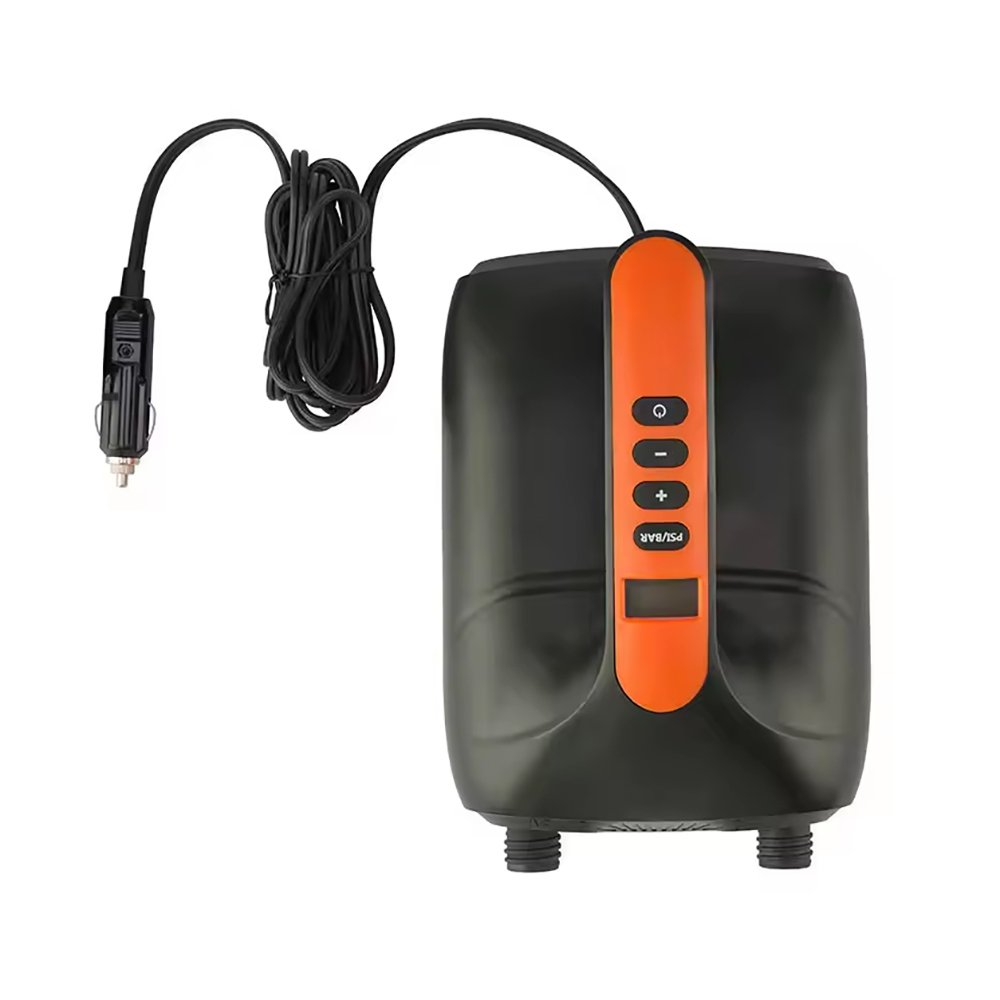
Powering the HT-782: Why 20 PSI Requires High-Amperage DC
Reaching 20 PSI is not about voltage alone; it is about amperage and sustained torque. Our Classic 12V Corded Pump (HT-782 Style) relies on a Heavy-duty DC Motor that demands significant current when the pump shifts from the high-volume first stage (350L/min) to the high-pressure second stage (70L/min). Standard 5V USB connections cannot supply the amperage required to drive this compression without massive voltage drops, which would cause the motor to stall or overheat before the board hardens.
- High-Amperage Delivery: Provides the consistent power flow needed to drive the Heavy-duty DC Motor to full 20 PSI pressure.
- Dual-Stage Stability: Supports the Intelligent Switch system without the power fluctuation risks common in low-wattage adapters.
- Unlimited Runtime: Ensures the HT-782 operates continuously for multiple boards without the downtime of recharging a battery.
Durability: Will a Budget Pump Last More Than One Summer Season?
A well-engineered budget pump lasts 3 to 5 years. While cheap retail units fail from heat or sand, industrial B2B models use active cooling and reinforced gears for longevity.
Why Generic Retail Pumps Fail Early
Compressing air to 20 PSI generates significant friction and internal heat. This is physics, not a manufacturing defect. The problem arises when low-cost retail units ignore this reality to save cents on the dollar. Most generic pumps on the market lack proper ventilation, which causes the motor to overheat and burn out after inflating just a single board.
- Internal Heat: Lack of airflow melts plastic components and fries the motor windings.
- Debris Intake: Without filters, abrasive beach sand enters the system and destroys the internal nylon gears.
- Single-Stage Stress: Cheap single-stage mechanisms must run at max capacity to reach pressure, wearing out much faster than dual-stage systems.
Longevity Factors: Active Cooling and Intake Filters
We engineered KelyLands pumps to solve these specific failure points. Instead of a disposable seasonal item, we build tools designed for the abuse of rental shops and schools. Our design includes an Active Cooling System with internal fans that actively dissipate heat, allowing the pump to handle 3 to 5 consecutive inflations without triggering a thermal shutdown.
- Active Cooling System: Internal fans keep the motor temperature stable for back-to-back use.
- Sand Filters: Built-in intake screens prevent sand from entering the compression chamber.
- Durability: Heavy-duty DC motors and impact-resistant ABS housings withstand rough handling.
- Extended Warranty: We cover core parts (Motor, Piston, PCB) for 18 months, significantly exceeding the 1-year industry standard.
Frequently Asked Questions
Can budget electric SUP pumps handle continuous use without overheating?
Most generic sub-$50 pumps lack active cooling and often shut down thermally after inflating just one board. KelyLands pumps utilize a specialized Active Cooling System with internal fans, which allows users to inflate 3-5 boards in a row without thermal failure. This durability is critical for rental shops and premium brands that need reliable “Club” level performance rather than disposable gear.
How loud is the pump during the high-pressure stage?
Compressing air to 20 PSI creates sound by physical necessity, but our designs keep noise levels below 85dB. We achieve this using rubber vibration-dampening feet and optimized internal airflow channels. While the operation is audible, it avoids the harsh, high-pitched mechanical whine found in standard single-stage inflators.
Will the nozzle fit every paddle board brand on the market?
Yes. Every unit ships with a universal nozzle set featuring the industry-standard Halkey-Roberts (HR) adapter. We also include a set of spare O-rings with varying thicknesses. These washers allow end-users to adjust the fit for specific board brands, such as Red Paddle or iRocker, which often have slight variations in valve depth.
How many boards can the cordless battery model inflate on one charge?
Our standard 6000mAh lithium model (HT-790 style) typically inflates 3 standard 10.6ft SUP boards to 15 PSI on a single charge. This capacity strikes the best balance between weight, portability, and utility for typical family outings.
Does the pump stop automatically to prevent over-inflation?
All our digital models feature “Set & Forget” auto-shutoff technology. The user sets the desired PSI (up to 20 or 25 PSI depending on the model), and the pump automatically powers down the moment that pressure is reached. This prevents board damage and removes the need for constant monitoring.
Final Thoughts
Sourcing budget inflators protects upfront cash flow but exposes your brand to high return rates when single-stage motors burn out under pressure. KelyLands’ Dual-Stage mechanics and Active Cooling systems ensure your inventory survives the abuse of rental fleets and consecutive high-pressure cycles. Reliability remains the only metric that effectively safeguards your long-term dealer margins.
Do not rely on spec sheets alone; validate our 20 PSI performance with your own testing. Request a sample kit today to verify the build quality and noise reduction features against your current lineup. Reach out to our engineering team now to secure your Q1 production slots before seasonal capacity tightens.

 English
  Español
  Français
  Deutsch
  Português do Brasil
  Русский
  한국어
한국어  日本語
日本語  العربية