 跳转到主要内容 跳转到页脚
Finding the best large electric cooler box is the critical step in preventing food spoilage and ensuring crew safety on remote job sites. For any field operation, relying on traditional ice chests creates a logistical burden of constant refills and wasted supplies. This failure isn’t just an inconvenience; it represents a direct risk to worker health and project timelines, where a single case of foodborne illness can halt progress.
This guide provides a technical breakdown of what matters for professional use. We analyze true usable capacity to see if these units can support a full team, not just a family picnic. We also test mobility features for moving a fully loaded cooler across worksite terrain and measure if advanced features like dual-fan systems provide rapid, reliable cooling. You’ll get a clear assessment of how to keep supplies organized with dividers and which models can handle the demands of a portable power station.
The “Picnic King”: Can It Fit a Whole Watermelon and 2L Bottles?
A cooler’s advertised capacity in quarts or liters is a raw volume metric; the actual usable space for bulky items is always smaller due to internal hardware, insulation thickness, and component placement.
Large capacity coolers, especially those in the 35 to 62-quart range, are defined by a constant trade-off between cooling power and uninterrupted internal space. Buyers often focus on the total volume, but the real-world utility depends on how that volume is shaped and if it’s obstructed by the technology that makes the cooler work.
Usable Interior Space vs. Advertised Capacity
The advertised capacity doesn’t account for the space consumed by the cooling system itself. Thermoelectric models have internal fans and heat sinks that protrude into the storage area. Compressor fridges often feature a “step” in the internal cavity to house the compressor unit. Thick insulation, critical for maintaining temperature, also reduces the internal length and width compared to a simple plastic box of the same external size. These design choices are necessary for performance but directly impact your ability to pack large, single items.
| Cooler Type | Primary Space Constraint | Practical Use Case |
|---|---|---|
| Thermoelectric Cooler | Internal fan & Peltier module housing reduces usable length. | Best for stacking uniform items like cans and food containers. |
| Compressor Car Fridge | Compressor “step” creates an uneven floor; wheel wells intrude. | Deep freezing requires packing around the compressor area. |
| Traditional Ice Chest | Requires up to 30% of its volume for ice or ice packs. | Offers maximum open space, but net capacity is much lower. |
Fitting Tall Items: The 2-Liter Bottle Test
A key benchmark for any family-sized cooler is whether it can hold 2-liter soda or wine bottles standing upright. Many models fail this test, forcing you to lay bottles on their side. This is inefficient, wastes space, and increases the risk of leaks. The internal vertical clearance is the only dimension that matters here. Lid design plays a major role; a deep lid recess can provide the extra inch needed, while a lid containing cooling components can reduce the available height. Always confirm the interior height dimension, not just the total capacity, to ensure your tall items will fit.
Accommodating Bulky Items: The Watermelon Challenge
Fitting a large, round item like a watermelon exposes the limitations of coolers with rigid internal structures. A long, narrow 50-quart cooler is far less useful for this than a cube-shaped one with similar volume. Dual-zone models are particularly challenging, as their central divider often cannot be removed to create a single large compartment. These coolers are excellent for separating food and drinks but fail when you need one big, open space. The shape of the cooler’s cavity is just as important as its total volume when planning for bulky cargo.
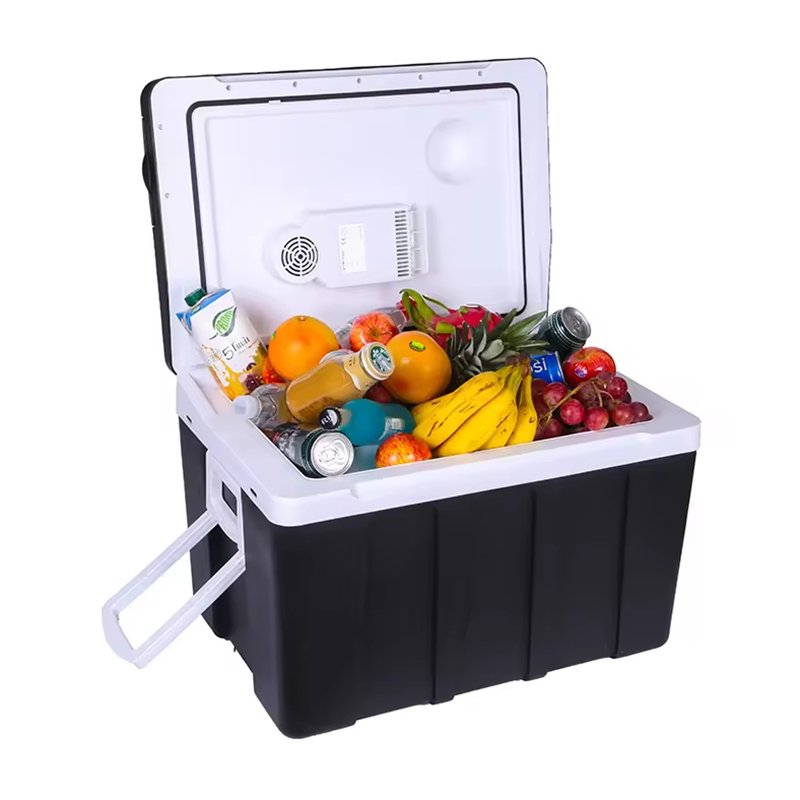
Wheels & Handles: How to Move a Fully Loaded 50lb Box?
Integrated wheels and handles are not just convenience features; they are engineered ergonomic solutions designed to meet the 50-pound safety threshold used in the professional moving industry, transforming a potentially hazardous lift into a safe, efficient rolling task.
When a large-capacity cooler is fully loaded with drinks and food, its weight can easily reach 50 pounds (about 23 kg). Moving such an object without proper equipment is inefficient and risks injury. The inclusion of durable wheels and a sturdy handle directly addresses this operational challenge, aligning the product with established industrial safety practices.
The 50-Pound Safety Standard
The logistics and moving industries use a 50-pound limit as a safety guideline for manual lifting. Integrated wheels and handles are engineered to comply with this standard, making it safer to transport heavy loads without needing separate dollies or carts. This design anticipates real-world use where users need to move a full cooler from their car to a campsite or event space.
- Aligns with established safety guidelines for manual box handling.
- Reduces the need for dollies or other mechanical aids for boxes at this weight limit.
- Helps prevent common strains and injuries linked to lifting heavy items.
Ergonomic Design for Reduced Strain
Wheels and handles function as practical ergonomic tools that significantly lower the physical stress of moving a full cooler. This design allows you to pull the weight rather than carry it, which reduces strain on the back, shoulders, and arms. It converts a difficult lifting operation into a simple rolling task.
- Turns a lifting task into a rolling task, minimizing physical effort.
- Promotes better posture during transport to help avoid injury.
- Makes repeated moving operations less tiring.
Improved Mobility and Efficiency
Built-in mobility makes it much more efficient to move heavy items, especially across longer distances or through difficult areas like hallways, parking lots, and grassy fields. This feature simplifies the entire process of transporting goods safely and quickly.
- Allows for smooth movement over different types of surfaces.
- Makes it easier to navigate tight spaces or corners where carrying a box would be awkward.
- Speeds up loading and unloading because each box is simpler to handle.
Your Premier OEM Partner for Car Coolers

Dual Fan Technology: Does It Cool Faster with Two Fans?
Dual fan systems in thermoelectric coolers prioritize acoustic performance and energy efficiency over a significant increase in raw cooling speed.
The addition of a second fan to a thermoelectric cooler often creates the expectation of a major boost in cooling power. The reality, however, is that the performance gains are modest. A dual-fan setup primarily refines the cooling process, making it quieter and more efficient rather than dramatically faster. It’s an engineering trade-off that favors lower noise levels and stable performance over brute-force temperature drops.
Minor Cooling Gains vs. Major Noise Reduction
Empirical tests show that at full speed, a dual-fan cooler only achieves a temperature drop of about 1.2 to 2.6 degrees more than its single-fan counterpart. While technically an improvement, this margin is small. The primary advantage is acoustic. To match the noise output of a single fan, two fans can reduce their speed by around seven percent, yet they still maintain better airflow. This design allows for more effective air distribution across the heatsink with lower overall energy consumption, making it ideal for environments where noise is a concern.
| Performance Metric | Single Fan System | Dual Fan System |
|---|---|---|
| Max Cooling Improvement | Baseline Performance | ~2.6°C better than single fan |
| Acoustic Performance | Higher noise level for equivalent airflow | Can run quieter while maintaining superior airflow |
| Primary Benefit | Simplicity and cost-effectiveness | Quiet operation and energy efficiency |
The Airflow Limitation
A dual-fan system’s effectiveness is entirely dependent on its access to fresh, cool air. In a confined space like a packed car trunk or a tight cabinet with poor ventilation, the system struggles. Without an adequate supply of cool air to pull from, the fans end up recirculating warm air. This can paradoxically increase the internal temperature of the cooler’s housing by as much as 5°C, negating any potential cooling benefits. For a dual-fan setup to outperform a single-fan design, it requires clear, unobstructed space for air circulation.
Conclusion: Optimized for Quietness, Not Speed
Dual fans are engineered for users who prioritize a quiet system that maintains solid cooling performance without generating excessive noise. The technology excels at operating efficiently at lower speeds. It is not designed to achieve the absolute fastest cooling times at maximum power. For B2B clients whose end-users value low noise in their vehicles, campers, or offices, the dual-fan system is a superior choice. If the primary requirement is rapid, aggressive cooling, the marginal benefits may not justify the added complexity and cost.
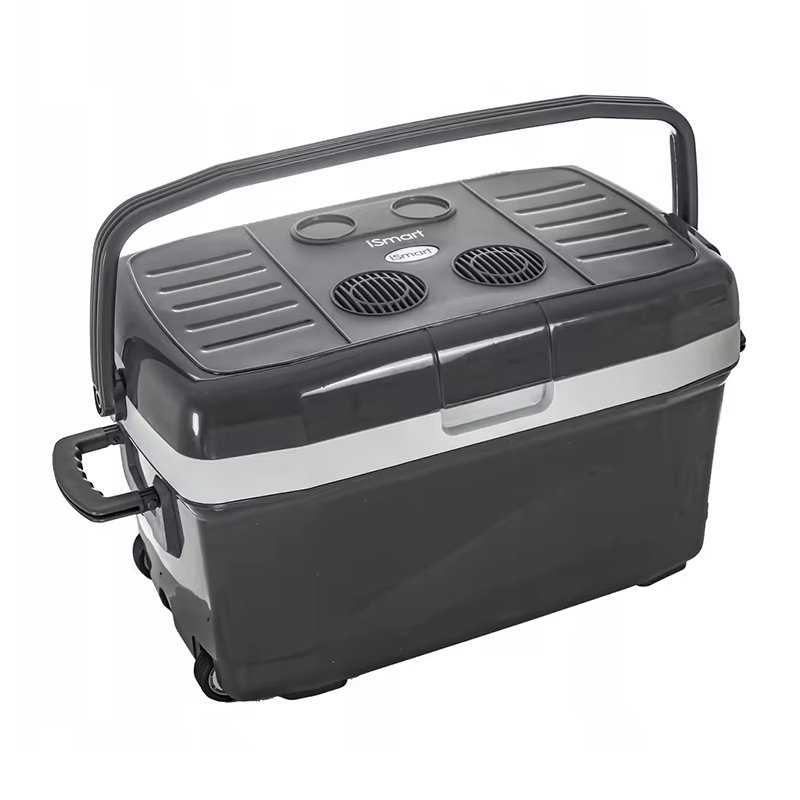
Dividers: Keeping Sandwiches Dry and Separate from Drinks.
Removable dividers have become a standard, non-negotiable feature for practical organization and food safety in portable coolers, not a premium add-on.
A Standard Feature for Organization
Removable dividers are a fundamental organizational tool in nearly all modern portable electric coolers, from compact 20-quart units to larger 34-quart models. Their widespread adoption shows they are considered an essential feature for separating contents, not a luxury. For any trip, the ability to keep perishable foods isolated from beverages prevents sogginess and damage to sensitive items like sandwiches.
- Separates delicate foods from heavy cans and bottles.
- Organizes contents for fast and easy access during travel.
- Their presence across multiple product tiers confirms strong market demand.
Enhancing Food Safety
A primary function of a divider is to prevent cross-contamination. This simple physical barrier is critical for maintaining hygiene when storing a mix of raw and ready-to-eat foods. Keeping uncooked meats physically separate from fresh produce or prepared meals reduces the risk of foodborne illness, a key consideration for camping and multi-day trips. This also contains spills from one section, protecting the rest of the cooler’s contents.
Adjustable and Specialized Designs
Divider implementation varies by model and manufacturer. Many coolers offer adjustable placement slots, allowing users to create custom-sized compartments based on what they are packing. More advanced designs integrate other functions, such as serving as a holder for a dedicated ice pack to improve thermal management in one specific zone. This design flexibility gives the end-user more precise control over how they organize and cool their goods, reflecting a market trend toward greater convenience.
Conclusion
Selecting the right large electric cooler comes down to practical design that meets customer expectations. Features like durable wheels for transport, effective dual-fan cooling, and smart dividers for organization are essential for a positive user experience. These details determine whether a 40L+ cooler is a convenient appliance or a difficult burden.
If these capabilities align with your product catalog needs, contact our team to discuss OEM solutions and private label opportunities. We can provide full specifications to help you select the right models for your market.
Frequently Asked Questions
What is the largest capacity 12v thermoelectric cooler available?
The largest consumer-grade 12v electric coolers typically offer up to 62 quarts (approximately 58 liters) of capacity. Models in this size class are designed for extended trips and often feature advanced functionalities like dual-zone cooling, allowing you to have separate refrigerator and freezer compartments. These units prioritize energy efficiency to maximize performance when operating on vehicle or portable power.
Which electric cooler with wheels is most durable?
The most durable electric coolers with wheels are those with roto-molded construction, which provides exceptional impact resistance and rigidity. Key features to look for are heavy-duty, solid (non-pneumatic) wheels on a single-piece axle, reinforced corners, and robust latches. Durability is less about a specific brand and more about these construction characteristics that protect internal cooling components from the rigors of outdoor use.
Is a lightweight large capacity car cooler better than a heavy Yeti?
The “better” option depends entirely on your use case. A lightweight electric cooler is superior for long trips with a power source, as it offers active temperature control and frees up 100% of its internal volume by not requiring ice. A heavy-duty passive cooler like a Yeti excels in scenarios demanding extreme durability and multi-day cooling without any power. It’s a trade-off between powered convenience and rugged, off-grid simplicity.
Can the 40L model run on a portable power station?
Yes, a 40-liter electric cooler is designed to run efficiently on a portable power station. To ensure compatibility, verify two key specs: the cooler’s power draw (typically 45-60 watts) and the power station’s capacity (in watt-hours). For example, a 500Wh power station can typically run a 40L cooler for 20+ hours, depending on the ambient temperature and duty cycle of the compressor. The power station must also have a 12V DC output port rated for at least 8 amps.

 English
  Español
  Français
  Deutsch
  Português do Brasil
  Русский
  한국어
한국어  日本語
日本語  العربية