 跳转到主要内容 跳转到页脚

Selecting the right mini fridge with freezer for rental properties directly impacts your maintenance budget. Choosing a unit based on price alone often leads to tenant complaints about noise and frost buildup, increasing service calls and operational overhead for property managers.
This analysis benchmarks models on their cooling technology—Direct Cool versus Frost-Free—and long-term reliability. We evaluate units against the 3.2 cubic feet industry standard to identify appliances that reduce tenant friction and minimize maintenance costs.
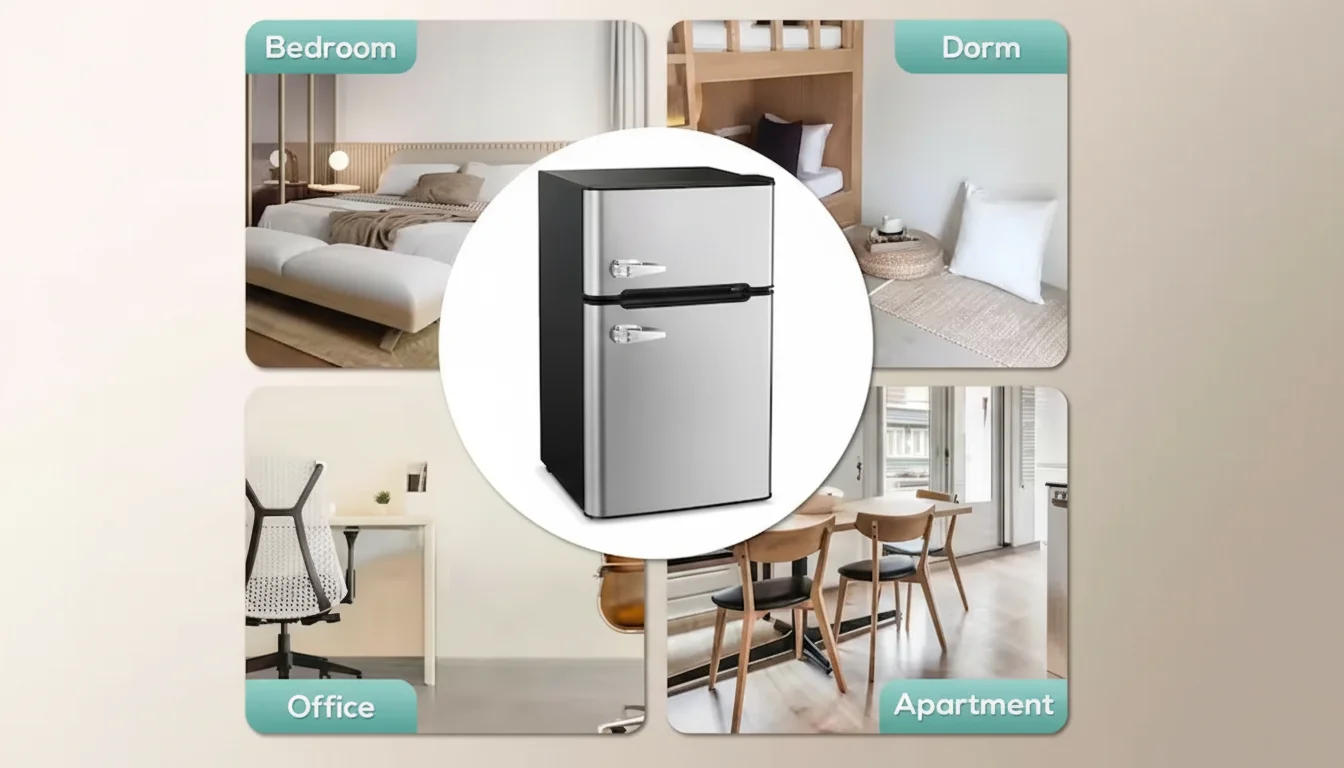
Single vs. Double Door: The True Cost of Tenant Complaints
Most tenant friction isn’t about fridge type; it’s about shared space and noise. A personal, silent-running mini fridge for bedrooms directly solves these common complaints.
Energy, Space, and Convenience Trade-Offs
For property managers, the choice between single and double-door refrigerators often comes down to cost and footprint. Single-door models are generally cheaper to run and buy. They consume less energy and fit easily into the compact kitchens common in smaller rental units or multi-family housing.
Double-door units provide better utility for tenants who cook often. The separate freezer compartment maintains a stable, low temperature, which reduces frost buildup and stops flavors from transferring between frozen and fresh foods. This separation means opening the fridge door doesn’t impact the freezer’s efficiency.
Solving Shared Space Issues with Personal Cooling
The biggest source of appliance-related complaints isn’t the main kitchen unit—it’s the friction between tenants over shared space. Providing a small, personal thermoelectric mini fridge as an amenity is a low-cost way to eliminate these problems before they start.
These units are built with Peltier modules instead of compressors, so they are practically silent. Our models run at just 28dB in Eco Mode, which is quiet enough for a bedroom or study space. They also use very little power, typically between 27W-35W, so tenants won’t see a meaningful jump in their electricity bill. This gives each resident dedicated, private storage for their own drinks, snacks, or skincare, cutting down on arguments over the main refrigerator.

Cooling Technology: Direct Cool vs. Frost-Free for Rentals
Direct Cool fridges are cheap but need manual defrosting. Frost-Free models are convenient but cost more. For rentals, the choice is a trade-off between upfront cost and tenant maintenance.
The Basics of Direct Cool and Frost-Free Systems
Direct Cool technology is straightforward. It uses natural convection to cool the interior. This process doesn’t distribute air evenly, so you can get warmer and colder spots. The main drawback is ice buildup, which requires you to manually defrost the unit periodically. On the plus side, these models are typically more energy-efficient and quieter because they don’t have fans.
Frost-Free systems use internal fans to circulate cold air throughout the entire compartment. This ensures a consistent temperature on every shelf. A heating element also cycles on and off to melt any frost before it accumulates. This automation makes them far more convenient and lower maintenance, but they cost more upfront and use more energy to run the fans and defrost system.
Thermoelectric Cooling: A Frost-Free Alternative
Our mini fridges don’t use either of those systems. We use a Semiconductor Peltier Module for cooling. This is a solid-state technology with no compressor, no freon, and no vibration. It’s designed for a specific job: ‘Beauty Preservation’.
This system cools to a range of 16°C to 20°C below the ambient room temperature. It’s engineered to keep skincare potent without ever reaching freezing temperatures that could damage the chemical structure of serums and creams. Because the unit always operates above 0°C, hard frost simply can’t form. The only byproduct is minor condensation, which is a sign of a good seal and can be wiped down in seconds. There’s no need for a complex, energy-hungry defrost system.
Launch Your Branded, Certified Mini Fridge Line

Defrosting Systems: Manual vs. Semi-Automatic Impact on Maintenance
Manual defrost systems are mechanically simple and reliable but demand regular physical labor. Semi-automatic systems reduce this effort by adding complex components that could require future maintenance.
Manual Defrost: Higher Effort for Mechanical Simplicity
A manual defrost system is a trade-off. You accept higher labor for greater mechanical reliability. The process involves turning the unit off completely and physically scraping or melting away ice buildup. While labor-intensive, the design is brilliantly simple. These units have fewer moving parts—no evaporator fans or heating elements—which reduces the number of components that can fail over time. This simplicity also leads to very stable internal temperatures, since the system isn’t running intermittent heating cycles that can cause fluctuations.
Thermoelectric Cooler Maintenance: Managing Condensation
Our thermoelectric coolers don’t have a traditional defrost system at all. They use a solid-state Peltier module for cooling, which creates minor condensation, not the thick frost you see in compressor units. Maintenance is straightforward: a simple wipe-down of the interior with a cloth about once a week is all that’s needed. The design of our units helps manage this. The Snap-Lock Handle ensures the door maintains a tight seal, which is critical for minimizing air leaks and reducing excess moisture buildup from the start.
Sizing for Profitability: Why 3.2 cu ft is the Standard
The 3.2 cu ft size hits a market sweet spot. It offers enough storage for dorms or offices without the high manufacturing and energy costs of larger units.
The compact refrigerator market isn’t one-size-fits-all. Profitability depends on matching the right capacity to the right customer. The standard 3.2 cubic feet model for general use and the niche 4-liter skincare fridge are perfect examples of how different sizing standards drive success in separate markets.
| Attribute | General Market (3.2 cu ft Standard) | Niche Skincare Market (4L Standard) |
|---|---|---|
| Target Use Case | Dorms, offices, break rooms, general storage | Skincare, cosmetics, personal use on vanities |
| Profit Driver | Low-cost mass production and supply chain scale | Specialized features (silent operation, portability) |
| Cooling Technology | Compressor-based with small freezer | Thermoelectric (Peltier), vibration-free |
| Energy Profile | ENERGY STAR compliant (~0.55 kWh/day) | Ultra-low wattage (~27W-35W) |
| Value Proposition | Bulk storage capacity (approx. 91 liters) | “Beauty Preservation” and portability (AC/DC) |
The General Market: Balancing Space, Function, and Cost
The 3.2 cubic feet size became the industry standard by hitting an optimal balance of cost and utility. Its dimensions, typically around 17-19 inches wide, are specifically engineered to fit within standardized furniture layouts found in dorm rooms, offices, and bedrooms. This size provides enough storage (about 91 liters) and includes a small freezer compartment, meeting basic consumer expectations without adding unnecessary bulk.
For manufacturers, this standardization is key to profitability. It allows for streamlined production tooling and a simplified supply chain, which drives down the cost per unit. The design also hits an important energy efficiency benchmark of around 0.55 kWh/day, making it easy to achieve ENERGY STAR certification and appeal to cost-conscious buyers.

Niche Markets: Why 4L is the Standard for Skincare Fridges
In specialized markets like beauty, profitability isn’t about capacity; it’s about purpose-built features. Our best-selling “Beauty Classic” is a 4L/6L unit designed to hold a standard set of skincare products, not groceries. Its compact design is tailored for placement in bedrooms, bathrooms, and even vehicles, thanks to included AC/DC power options.
Profit margins in this segment come from value-added technology. We use Thermoelectric cooling, which is vibration-free to protect the delicate formulations of expensive serums and creams. This also allows for silent operation at just 28dB, a critical feature for a device used in a bedroom. The core value proposition is “Beauty Preservation,” which extends the shelf life of cosmetics—a benefit that commands a premium over simple cold storage.
Frequently Asked Questions
Is the drip tray sufficient to prevent floor damage during defrost?
A drip tray is essential for catching most condensation but is not entirely sufficient for complete floor protection. It is recommended to place towels or an absorbent mat under the unit during defrosting to catch any potential overflow or water that might escape. Periodically checking the interior tray also helps prevent it from overflowing.
Can a freezer maintain 0°F (-18°C) to keep food safe indefinitely?
Yes, when a freezer consistently maintains 0°F or below, it keeps food safe to eat indefinitely by making bacteria, yeasts, and molds inactive. While the food remains safe, its quality, including flavor and texture, will decline over time. It is still important to follow recommended storage times for the best taste.
Are door gaskets tool-free to maintain and replace?
Basic maintenance is tool-free; you can wipe down gaskets with a soft cloth and mild detergent. Full replacement typically requires minimal tools. The most common type of gasket can be pulled out and pushed in by hand, though some styles may require a screwdriver to remove a retaining strip.
Final Thoughts
Standard compressor mini-fridges seem like a cheap solution, but their noise and maintenance often create more tenant complaints. Our thermoelectric units are engineered for silent operation (28dB) and require zero defrosting. This isn’t just another appliance; it’s a low-cost amenity that eliminates a common source of friction in rental properties.
Verify the silence and build quality for yourself. We recommend requesting a sample unit to test in one of your properties. Contact our team to get the full catalog or discuss custom branding options for your portfolio.

 English
  Español
  Français
  Deutsch
  Português do Brasil
  Русский
  한국어
한국어  日本語
日本語  العربية