 跳转到主要内容 跳转到页脚

The lack of lightweight mobility in a mini electric cool box is a critical design failure that directly leads to user fatigue and product abandonment. Most portable coolers prioritize raw cooling power with heavy compressor units, resulting in an empty weight of 12kg or more—a significant ergonomic burden for a parent trying to manage a family outing. This engineering oversight ignores the primary use case, where the ability to easily carry the unit from the car to the picnic spot is more important than achieving near-freezing temperatures.
This guide breaks down the specific design specifications that solve this problem. We will compare the 3kg net weight of a Peltier system against a 12kg compressor unit to quantify the difference. We will also analyze the handle ergonomics for genuine one-handed carrying, evaluate the utility of integrated cable storage, and assess whether a top-loader or front-loader design is better suited for outdoor convenience.
Weight Comparison: Why Is 3kg (Peltier) Better Than 12kg (Compressor)?
The premise is flawed; when normalized by cooling capacity, compressor systems are up to 5 times lighter and vastly more efficient than their thermoelectric counterparts.
Normalizing Weight by Cooling Capacity (Watts)
A direct 3kg vs. 12kg weight comparison is technically misleading because it ignores the actual cooling power of each system. Engineering data shows that when measured per 100W of cooling capacity, compressor-based systems are approximately five times lighter than Peltier systems. The performance of a thermoelectric (Peltier) cooler is rated by its ability to achieve a temperature drop below the ambient air, known as Delta T (ΔT). For example, it might cool to 20°C below the outside temperature. In contrast, a compressor fridge achieves a fixed, absolute temperature (e.g., -20°C) regardless of external conditions.
Thermodynamic Efficiency and Required Component Mass
Compressor systems leverage a highly efficient refrigerant cycle to transfer heat, requiring less energy and hardware to do so. Thermoelectric modules are far less efficient, converting a large portion of electrical energy into waste heat. This inefficiency demands massive heat sinks and powerful fans just to dissipate that waste heat, adding significant weight and bulk. To achieve the same cooling result, a Peltier unit needs 4-6 times more power than a compressor. This, in turn, requires heavier power components like AC adapters and internal circuitry to handle the increased load.
Physical Footprint vs. Internal Capacity
For the same cooling rating, a complete compressor system is about three times smaller than a Peltier system. This compact mechanical footprint allows compressor car fridges to be built with thinner walls and more robust insulation, maximizing the usable internal storage space for the same external dimensions. The bulk of a typical thermoelectric cooler is not its insulated chamber; it’s the large, finned heat dissipation system bolted to the outside.
Defining the Niche for Low-Capacity Peltier Coolers
Peltier technology does offer a weight advantage, but only in very specific, low-power applications under 100W. These units are not designed for freezing but for maintaining a moderate temperature drop, typically less than 15°C below ambient. This makes them suitable for keeping drinks cool on a mild day. Their simplicity and the small size of the Peltier chip itself make them ideal for compact designs like an 8L console cooler that fits between car seats, where a compressor and its plumbing would be physically too large to install.
Weight Breakdown of a True Compressor Freezer
The weight of a true compressor car fridge accounts for components engineered for reliable freezing performance down to -20°C. This includes not just the DC compressor unit and refrigerant lines, but also the thick, high-density PU foam insulation required to maintain sub-zero temperatures efficiently. Additional structural mass comes from value-added features critical for vehicle use, such as the 3-stage battery protection system to prevent draining the car battery and a shockproof design that allows the unit to function reliably at tilts of up to 30°. The total weight supports true, ambient-independent freezing capability.
Handle Ergonomics: Can It Be Carried with One Hand?
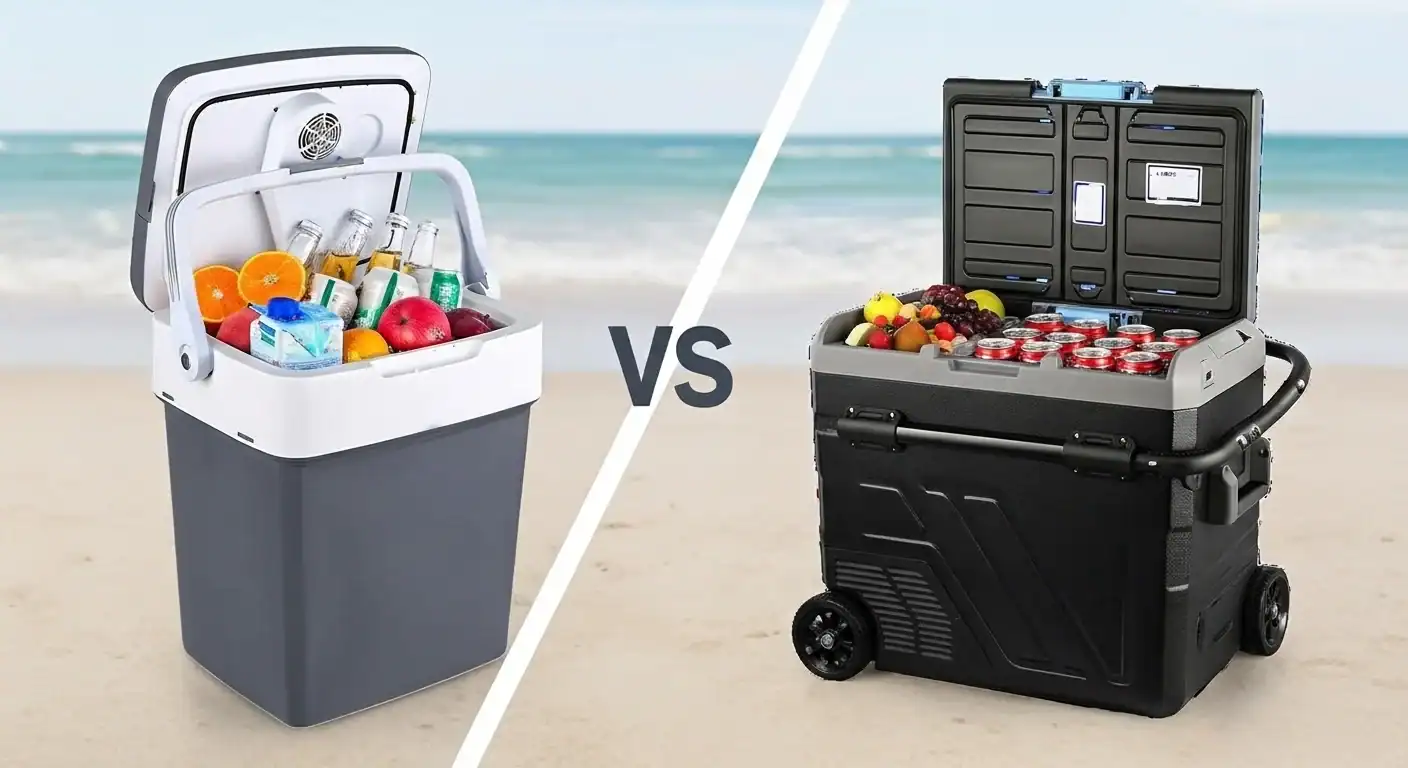
Handle design directly correlates with cooler capacity, scaling from single-hand grips on compact models to integrated wheels on larger units to manage weight effectively.
A portable cooler’s carrying method is not an afterthought; it’s a core engineering decision based on the unit’s volume, empty weight, and expected loaded weight. The design dictates how the end-user will move the product, whether it’s a quick trip from the car or a haul across difficult terrain. Different capacity classes demand fundamentally different ergonomic solutions.
Compact Models (8L–24L): Grab-and-Go Design
Models in this range are built for true portability. A small unit like an 8L console cooler is specifically engineered to be moved with one hand from a vehicle’s front seat to an office desk. As capacity increases up to the popular 24L thermoelectric size, the design standard is a single, top-mounted handle. This handle is often robustly integrated into the lid, frequently doubling as a self-locking mechanism that secures the lid when the handle is raised. This approach provides a reliable grip for the lighter loads typical of these coolers.
Mid-Capacity (30L–40L): Recessed Grips for Two-Handed Lifts
Once a cooler’s capacity exceeds 30L, its potential loaded weight makes a single top handle a structural and ergonomic liability. These units transition to integrated, recessed grips on the sides. This design provides a more stable, secure hold for a two-handed lift, which is necessary for loading the cooler into a vehicle trunk, boat, or RV. The weight distribution is optimized for this kind of maneuver, allowing one strong person or two people to manage the unit safely without excessive strain.
Large Fridges (40L+): Integrated Wheels and Handles for Mobility
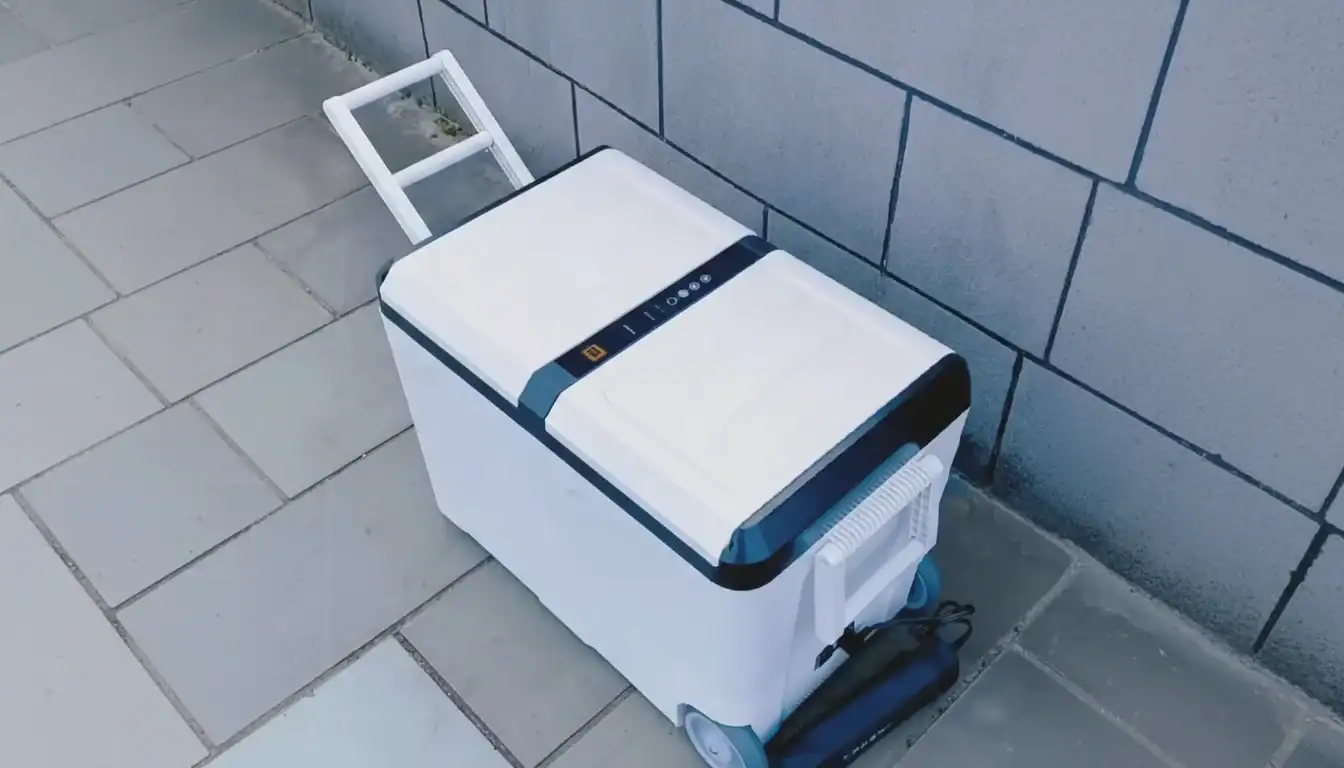
Large-capacity compressor fridges, which can weigh over 50 lbs even when empty, are far too heavy for single-person carrying once loaded. These models adopt a luggage-style mobility system. They incorporate rugged, oversized wheels and a durable, telescoping pull handle to allow for easy ground transport by one person. To manage lifts over obstacles or into a vehicle, they also include reinforced side handles. This hybrid approach ensures the fridge can be moved efficiently across flat surfaces while still providing secure grip points for necessary two-person lifts.
Source Globally Certified & Customized Car Coolers

Cable Storage: Are There Integrated Compartments for Cords?
Integrated cable storage is a critical design feature that prevents cord loss and damage, directly improving the unit’s field reliability and long-term value for the end-user.
Cable management is not a universal feature, but its implementation varies directly with the cooler’s technology and intended market. The design approach for a high-volume thermoelectric cooler is fundamentally different from that of a ruggedized compressor fridge. Understanding these differences helps B2B buyers select models that align with customer expectations for convenience and durability.
Lid-Recessed Storage in Thermoelectric Coolers
Most high-volume thermoelectric models, like our Classic 24L Cooler, feature a simple molded compartment recessed into the lid. This design is engineered to hold the attached 12V/24V DC power cord. By integrating storage directly into the lid mold, we minimize additional assembly steps and material costs, which is essential for competitively priced, mass-market units. This approach keeps the single essential power cord with the cooler at all times, reducing the chance of it being misplaced by the consumer.
Enclosed Compartments on Compressor Fridge Models
Portable compressor fridges, especially units 35L and larger, almost always include a dedicated, covered compartment for power accessories. Unlike the open recess in a thermoelectric lid, this is a fully enclosed space. It’s designed to protect both the 2.5m-3.5m DC power cord and the separate external AC power adapter from dust, moisture, and physical impact during transport. This robust solution is necessary for equipment intended for off-road and overland use where components are exposed to harsher conditions.
Design Impact on Durability and Convenience
Proper cable storage is a key reliability factor. For users in camping or off-road environments, losing or damaging a power cord renders the unit useless. Integrated storage prevents this common point of failure. The design also ensures that both DC and AC power options are always with the unit, improving the user experience significantly. When a user arrives at a campsite or hotel, they don’t have to search for a separate bag of accessories; everything needed for operation is self-contained. This thoughtful engineering reduces customer frustration and support inquiries.

Top-Loader vs. Front-Loader: Which Is Better for Picnics?
The choice between top and front-loading coolers is a direct trade-off between superior thermal efficiency and shelf-based organization, critically impacting food safety in high ambient heat.
Air Retention and Access Efficiency
Top-loading models have a significant thermodynamic advantage. Because cold air is denser than warm air, it naturally settles at the bottom of the cooler. When you open a top-loader’s lid, the bulk of this chilled air remains trapped inside the chest, minimizing temperature loss and reducing the energy needed to recool the interior. This design is inherently more efficient for maintaining cold temperatures during frequent access at a picnic or campsite.
Front-loading models offer better organization with shelves and door compartments, similar to a residential mini-fridge. But this convenience comes at a cost. Opening the vertical door allows the dense, cold air to immediately spill out and be replaced by warmer ambient air. This forces the cooling system to work much harder after each opening, increasing power consumption and making it more difficult to maintain a consistent internal temperature.
Guaranteed Cooling vs. Ambient-Dependent Cooling
Compressor-based models, whether top or front-loading, function as true refrigerators or freezers. They can reliably maintain a set temperature, such as 4°C for safe food storage or -20°C for deep freezing, regardless of the outside weather. This capability is critical for ensuring food safety when dealing with perishables on hot days, as performance is not compromised by high ambient heat.
Most front-loading portable coolers use thermoelectric technology, which operates on a Delta T (ΔT) principle. These units can only cool to a certain temperature below the ambient air, typically 15–20°C. On a 35°C summer day, the cooler’s internal temperature may only drop to 15°C, which is well within the food safety danger zone. This makes them unsuitable for anything other than keeping pre-chilled drinks cool for a short period.
Weight-to-Performance Ratio and Power Management
Contrary to common belief, compressor systems deliver a superior cooling capacity-to-weight ratio. Engineering data shows that for the same cooling output, a compressor unit is significantly lighter and more compact than a thermoelectric (Peltier) system. This is due to the higher thermodynamic efficiency of vapor-compression technology, which requires smaller components and less massive heat sinks to achieve true refrigeration.
Modern compressor fridges also incorporate sophisticated power management systems. Features like selectable Eco and Max modes allow users to prioritize either energy efficiency or rapid cooling speed. Critically, these units include 3-stage battery protection, which automatically shuts the fridge off if it detects the vehicle’s battery voltage has dropped to a critical level. This prevents the user from being stranded with a dead battery, a vital feature for the off-road and camping markets.
Conclusion
For buyers targeting the family market, the design choices of a thermoelectric cooler are significant. Its low weight, ergonomic handle, and clean cable storage provide the grab-and-go convenience that busy parents value. This practical approach makes it an easy choice for day trips, unlike bulkier compressor alternatives.
If this lightweight model aligns with your seasonal or family-focused product range, we can provide a complete spec sheet. Contact us to discuss OEM customization options for your brand.
Frequently Asked Questions
What is the exact net weight of the unit (empty)?
The provided research data does not specify an exact net weight. Instead, it offers a technical comparison, noting that modern compressor-based systems are approximately 5 times lighter than Peltier systems with equivalent cooling capacity. For example, a 550W compressor unit weighs less than a 303W Peltier cooler.
Does the handle fold flat for stacking?
The provided engineering documentation does not contain information regarding physical design features like the handle or its ability to fold for stacking. The research focuses on the weight and thermodynamic efficiency of the internal cooling technologies (compressor vs. Peltier).
Can it hold 2L soda bottles in an upright position?
Information regarding the internal storage capacity or dimensions for holding specific items like 2L bottles is not available in the provided technical comparison. The data does note, however, that compressor-based systems have a physical footprint that is approximately 3 times smaller than equivalent Peltier systems.
Is the lid latch child-friendly (easy to open)?
The research content does not include details on user-facing hardware features such as the lid latch mechanism or its child-friendliness. The documentation’s scope is limited to the performance and physical specifications of the cooling system technology itself.

 English
  Español
  Français
  Deutsch
  Português do Brasil
  Русский
  한국어
한국어  日本語
日本語  العربية