 跳转到主要内容 跳转到页脚
Marketing efficiency in the portable cleaning sector hinges on closing a 41% empathy gap among parents who control 85% of US household spending but feel overlooked by generic branding. For a “quick grab” tool to move beyond a gimmick, it must meet rigorous industrial thresholds—specifically maintaining air velocities above 20 m/s and enforcing a strict 140°F (60°C) thermal cap to protect internal pump components during localized extraction.
This analysis breaks down the regulatory and chemical requirements of “spot clean” usage, evaluating IICRC S300 and Green Seal GS-37 standards for pH-neutrality and soil removal. We also examine how manufacturers like Nilfisk and VAC-U-MAX utilize multi-stage HEPA filtration to maintain H-class safety, aligning these technical specs with the strategic roadmap of the Technical Product Manager.
Understanding the “Secondary Vacuum” Concept
Secondary vacuum systems use multi-stage HEPA filtration to capture hazardous particulates and protect motors, maintaining air velocities above 20 m/s to meet industrial safety standards.
Multi-Stage Filtration: The Role of Secondary HEPA Filters
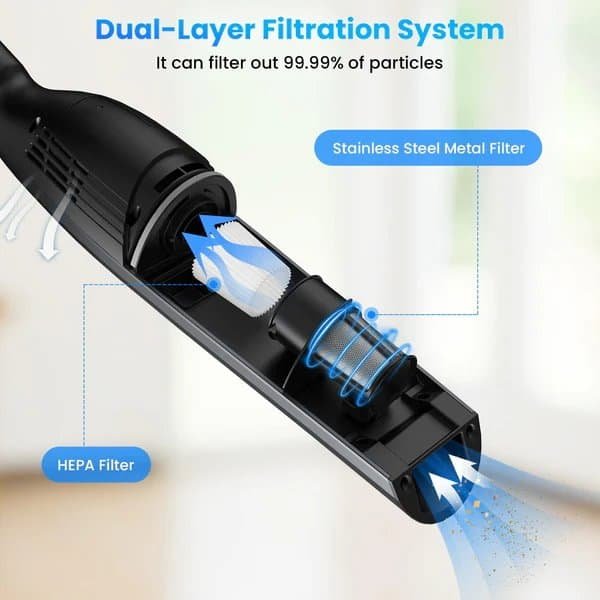
Industrial environments demand more than simple collection bags. Primary filters like cyclones or canisters trap bulk debris, but fine, hazardous dust often bypasses these initial stages. The secondary stage—a post-filter positioned downstream—captures microscopic particles that would otherwise return to the ambient air.
- Standard: EN 60335‑2‑69 / DS‑EN 60335‑2‑69
- Efficiency: HEPA H13 (99.95%) to H14 (99.995%)
- Industrial Rating: 99.97% efficiency at 0.3 μm
Manufacturers like Nilfisk and VAC-U-MAX integrate these secondary HEPA elements to ensure exhaust air meets strict occupational hygiene targets. This configuration keeps the finest particulates out of the facility and prevents contamination of the vacuum’s internal mechanical components.
Engineering Standards for Airflow and Filter Loading
Suction performance depends on maintaining constant air velocity rather than just raw motor power. If velocity drops, dust settles in the hose, creating clogs and potential safety hazards. Engineering standards dictate specific thresholds for H-class hazardous dust systems to prevent these failures.
- Minimum Air Velocity: ≥20 m/s in the suction hose
- Maximum Filter Loading: 200 m³/h of air per m² of filter area
- Fail-Safe Alarms: Mandatory signals if velocity falls below the 20 m/s threshold
Placing a secondary filter before the pump serves as a critical fail-safe. It protects the motor from dust ingress and manages pressure drops to keep the system compliant during high-volume tool extraction. This technical approach ensures the vacuum remains self-cleaning and safe throughout the production cycle.
Defining the Product Role
Technical Product Managers bridge the gap between business goals and engineering, prioritizing technical specifications, scalability, and architecture over general market adoption.
| Focus Area | Technical PM (TPM) | Standard PM |
|---|---|---|
| Primary Metrics | System stability, feasibility, performance | Market adoption, revenue, UX |
| Core Deliverables | Technical specs, API docs, architecture | User stories, GTM strategy, personas |
| Decision Drivers | Technical debt, scalability, security | Customer feedback, market trends |
Core Responsibilities and Strategic Objectives of the TPM
A TPM does not just manage a backlog; they ensure the engineering team’s output matches the long-term technical health of the organization. They translate high-level business objectives into specific, actionable engineering tasks while safeguarding the system against unsustainable technical debt.
- Requirement Definition: Translating business needs into granular technical specifications.
- Roadmap Alignment: Managing product timelines against technical milestones and resource feasibility.
- Architecture Oversight: Collaborating with developers to ensure the product meets established engineering standards.
- Risk Mitigation: Balancing the push for new features with the necessity of managing technical debt.
Technical Decision-Making, Scalability, and Performance Metrics
TPMs operate in high-complexity domains like backend systems and machine learning. Their success is measured by the robustness and efficiency of the infrastructure they oversee, rather than just frontend engagement or user growth.
- Trade-off Analysis: Evaluating system security, backend performance, and architectural scalability.
- Data Proficiency: Utilizing SQL queries and coding knowledge to conduct performance analysis and engineering estimates.
- Specialized Domains: Directing projects focused on APIs, data platforms, and complex backend integrations.
- Performance KPIs: Measuring success through technical stability and feasibility metrics distinct from market goals.
Why “Spot Clean” Usage is a Distinct Category
Spot cleaning uses targeted intervention and specialized chemicals—like pH-neutral agents and high-potency formulations—to meet industry standards like GS-37 and IICRC S300 without broad surface degradation.
Regulatory Certification and Legal Definitions
Regulatory bodies separate spot cleaning from general maintenance to allow for targeted, high-potency formulations. This legal distinction ensures chemicals meet performance needs without violating the safety mandates applied to high-volume cleaners.
- Green Seal GS-37: Explicitly classifies spot removers as a unique category, separate from general-purpose, restroom, glass, and carpet cleaners.
- Concentration Mandates: Carpet spot removers are exempt from the 1:16 dilution requirement, allowing the use of more potent, specialized chemistry for stubborn marks.
- Legal Standards: SEC filings and service contracts define the process as a specific sequence of removing non-permanent marks using a moist-then-dry cloth technique.
Technical Performance and Chemical Parameters
Technical standards prevent technicians from using aggressive broad-spectrum cleaners on delicate fibers. High-performance spotters require specific chemical limits to achieve results while avoiding permanent material damage or rapid re-soiling.
- IICRC S300 Standard: Mandates a strict pH-neutral range of 6.0–8.0 for upholstery spotting to protect fiber integrity and dye stability.
- ASTM D5343 Testing: Requires restroom-specific spot cleaners to achieve a soil removal rate of at least 75%.
- Carpet pH Thresholds: Specialized chemistry must remain between pH 3–10 and pass re-soiling resistance tests to ensure the area does not attract future debris.
Scale Your Brand with Custom-Built High-Performance Vacuums

Strategies for Busy Parents and Brand Strategists
Brands bridge the 41% empathy gap by segmenting child life stages and prioritizing efficiency for moms, who control 85% of US household spending.
Segmenting the Parenting Demographic to Close the Empathy Gap
Current data reveals a 41% empathy gap where parents feel brands fail to understand their daily time-management struggles. Moms remain the primary decision-makers, controlling 85% of US household purchases. They prioritize product effectiveness and speed over brand fluff.
To close this gap, marketers must move beyond a generic parent label and segment by specific child life stages:
- New Parents/Toddlers (0-3 years): These buyers focus on price and immediate product effectiveness due to tighter household budgets.
- School-age Kids (4-12 years): Marketing should address evolving pain points like product portability and safety.
- Teens (13+ years): Strategy shifts toward maintaining household standards as children gain more independence.
Implementing SMART Goals and AI-Driven Content Optimization
Campaign planning for cleaning accessories, such as portable car vacuums or spot cleaners, requires SMART goals. This framework ensures marketing efforts stay Specific, Measurable, Achievable, Relevant, and Time-bound. This structure prevents wasted spend on broad awareness campaigns that ignore the parent’s limited window for decision-making.
Digital execution relies on specific platform and content format choices to reach time-constrained audiences:
- Platform Targeting: Use AI-driven behavioral data to reach Millennial parents on Instagram and YouTube. Focus on Facebook for Gen X and Boomer demographics.
- Content Formats: Use short-form videos and checklists. These low-friction formats accommodate limited attention spans and the delayed purchase cycles common in busy households.
- Optimization: Prioritize mobile-optimized content. Most parents research and purchase during small windows of downtime on mobile devices.

“Spot Clean” Usage
Spot cleaning is a localized extraction process limited to 140°F water and 60mL chemical doses. It uses high-intensity suction and specific tool positioning to remove targeted stains.
| Operational Parameter | Technical Specification |
|---|---|
| Maximum Water Temperature | 140°F (60°C) |
| Chemical Dosing (2X Formula) | 60 mL per tank fill |
| Spray Nozzle Height | 2.5 cm (1 inch) above surface |
| Tank Capacity (Dual Scale) | 825 mL (Small) / 1.65 L (Large) |
| Motor Amperage | 5.7 A |
Operational Geometry and Localized Extraction Logic
Effective spot cleaning requires precise physical handling to prevent over-saturation. Technicians must maintain the tool nozzle exactly 2.5 cm above the soiled surface during the spray phase to ensure even distribution. Once solution is applied, extraction efficiency depends on firm downward pressure. You must continue suction passes until liquid is no longer visible in the clear nozzle.
Moisture control is managed through standardized water volumes. Machines use a dual-scale system for different stain sizes. Small area treatments require 825 mL of water, while large area spots utilize up to 1.65 L. These volumes ensure the machine remains light enough for portable use while providing enough fluid for deep fiber penetration.
- Hose Reach: Standard units feature a 2.2 m hose for localized mobility.
- Power Cord: A 20 ft cord defines the operational radius from the power source.
- Pressure Requirement: Manual downward force is mandatory to achieve rated moisture recovery.
Thermal, Chemical, and Electrical Safety Specifications
Thermal limits are strictly enforced to protect internal seals and pump components. Tap water must never exceed 140°F (60°C). Exceeding this limit risks warping the plastic tanks or damaging the 5.7 A motor. Chemical concentrations are equally rigid; 60 mL of 2X concentrated formula replaces 120 mL of standard alternatives to maintain the correct surfactant balance without clogging the spray tip.
Safety mechanisms prevent mechanical failure during extended use. The dirty water tank features a “MAX” fill line that triggers an automatic suction cutoff once reached. This prevents overflow and motor ingress. For UK-spec models, electrical compliance requires a BS 1363 non-rewireable plug fitted with a 13 A BS 1362 ASTA-approved fuse.
- Thermal Cap: 140°F (60°C) maximum allowable feed temperature.
- Formula Ratio: 60 mL (2X) or 120 mL (non-concentrated) per tank.
- Fuse Rating: 13 A BS 1362 ASTA-approved.
- Tank Capacity: Approximately 3/4-gallon (2.8 L) total system volume.
Conclusion: Positioning for the Quick Grab
Maximize throughput by pairing DGPS decimeter accuracy with A5–A7 duty hardware. Optimizing swing angles at 60–70° and using counterbalanced hoists slashes cycle times in high-volume dredging.
Optimizing Swing Efficiency and Spatial Accuracy
Precision prevents “double-digging.” Operators use DGPS and integrated motion sensors to localize seabed or stockpile bites with decimeter-level resolution. This spatial awareness ensures every grab cycle hits fresh material rather than wasting energy on previously cleared areas.
- Target Swing Angles: 60–70° where efficiency factors peak at 1.0–1.1.
- Repositioning Speed: Two-spud hull systems allow forward moves in 3–5 minutes between layers.
- Positioning Tech: Integrated DGPS and underwater bucket sensors for real-time localization.
Mechanical Duty Classes and Hoisting Dynamics
High-speed grab operations require hardware built for repetitive, high-load cycles. Engineers size these systems based on the Specific Energy of soil (SPE) and the digging curve to ensure motors and closing power match the material density.
- Crane Classification: FEM/ISO duty ratings A5–A7 for heavy industrial bulk handling.
- Hoisting Performance: Lifting speeds of 30–40 m/min with balanced counterweight mechanics.
- Wire Rope Specs: 16 wire ropes of φ60 mm to minimize energy consumption during rapid up/down cycles.
- Control Systems: Integrated dual-hoist position control to synchronize shell closure and maximize fill factors.
Industrial throughput relies on the physics of the “quick grab.” By modeling passive earth pressures and shear planes during the design phase, manufacturers deliver hardware that stabilizes the digging curve and reduces mechanical stress over thousands of cycles.
Final Thoughts
Technical precision beats broad-market appeal. Sacrificing generalist features for specialized HEPA filtration and localized ‘spot’ power secures compliance and loyalty from time-poor decision-makers.
Audit your current hardware against H-class safety standards immediately. Re-engineer ‘quick-grab’ tools to prioritize industrial motor protection and mobile-first content highlighting 60-second intervention capabilities.
Frequently Asked Questions
Is the unit balanced for overhead lifting without wrist strain?
No ISO certification for “overhead balance” exists. Designers follow ISO 11228-1 and ISO 11228-3 for ergonomic guidance. To prevent strain, industry targets limit total mass to ≤ 3–4 kg (6.6–8.8 lb) and keep the center of mass near the hand to minimize torque.
Does it include a specialized ‘Dusting Tool’ for delicate surfaces?
“Dusting tool” is a product-specific designation, not a regulated industry standard. These accessories typically feature soft bristles for blinds and lampshades. Availability depends on the specific SKU’s Bill of Materials (BOM). KelyLands kits often include multi-tool attachments for these applications.
Can we market this as a ‘Companion’ to a robot vacuum?
Yes. “Companion” is a marketing term, not a technical classification under IEC or ISO standards. Portable vacuums are standard companions to robot cleaners, as they address areas automated units cannot reach, such as stairs, upholstery, and high-level dusting.

 English
  Español
  Français
  Deutsch
  Português do Brasil
  Русский
  한국어
한국어  日本語
日本語  العربية