 跳转到主要内容 跳转到页脚

Sourcing the best ev charging accessories requires a technical audit to prevent premature equipment failure and operational downtime. The consumer market is filled with low-spec hooks that can’t handle a heavy cable’s weight, holsters that allow pin corrosion after a single season, and magnetic covers incompatible with modern aluminum vehicle bodies, creating hidden replacement costs and safety liabilities.
This analysis bypasses surface-level features to provide a sourcing framework based on material strength, environmental resistance, and specific failure points. We examine the load-bearing capacity of different steel hooks, the design elements that make a nozzle holster truly weatherproof, and the ROI of an overhead retractor in a professional setting, giving you the data needed to select components that protect your investment.
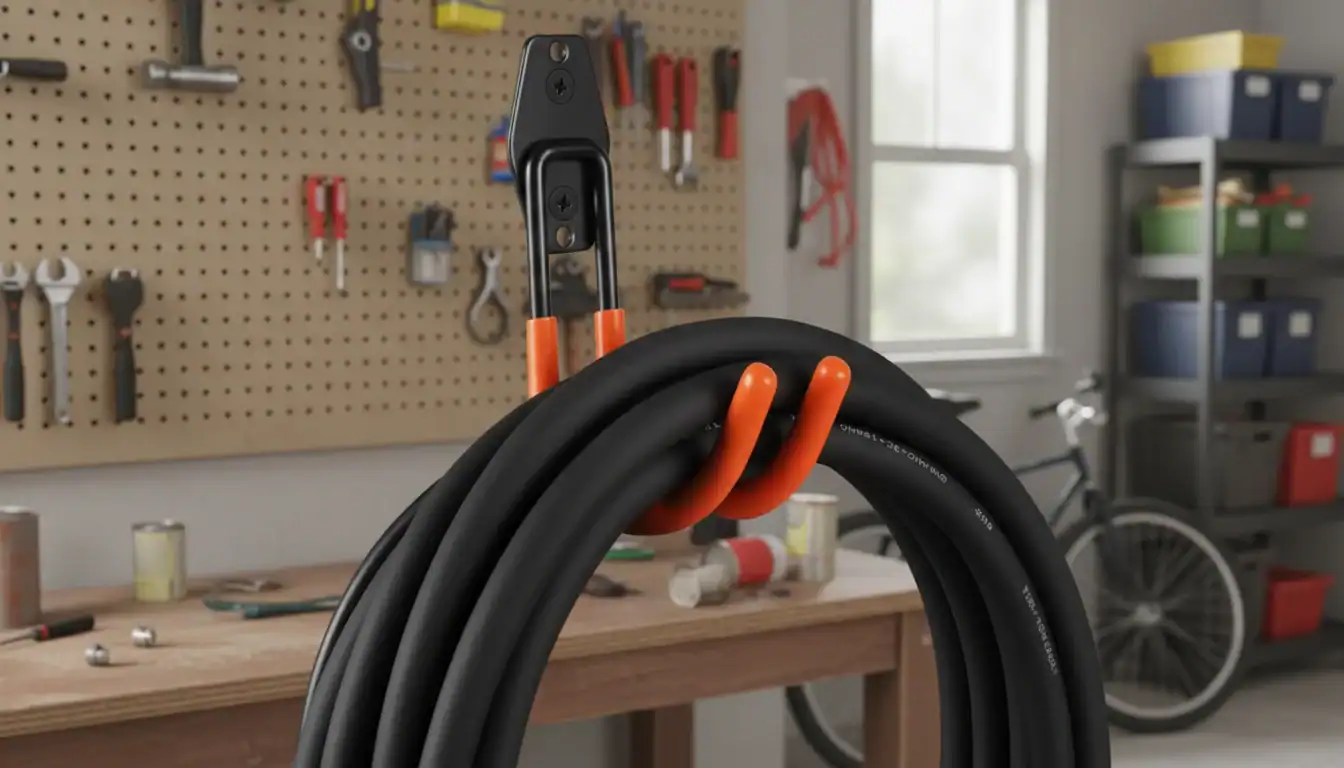
Heavy Duty Hooks: Which One Holds 50lbs Without Bending?
A hook’s 50 lb rating is only valid if it’s properly anchored; solid steel construction prevents bending, but incorrect mounting into drywall is the most common point of failure.
Key Types of 50 lb Hooks
The market for high-capacity hooks is split between robust garage hooks and specialized picture hangers. Both rely on solid steel to prevent deformation under a 50 lb load, but they achieve this through different designs tailored to their intended use.
- Garage and utility hooks are typically built from welded, powder-coated solid steel for maximum durability and corrosion resistance.
- Picture hanging hardware uses angled nail slots to distribute weight across a larger area of drywall, effectively using leverage to achieve a high weight rating.
- Steel is the core material for both types, as it provides the necessary tensile strength to resist bending when loaded.
Comparing Top-Rated 50 lb Hooks
Several manufacturers produce reliable 50 lb hooks, with designs optimized for either direct-to-stud mounting or engineered drywall applications. Your wall structure dictates the best option.
- Bedrock Garage Wall Hooks: These are solid steel hooks designed for deep storage. They must be installed directly into a wall stud to meet their capacity rating.
- Duck EasyMounts Heavy-Duty Hooks: This model is specifically engineered to hold 50 lbs on standard drywall without needing a stud, using a patented mounting system.
- Hillman Steel Picture Hangers: A reusable option for mirrors and art, these use an angled nail slot to secure into drywall effectively.
- Hyper Tough & Proslat: Both brands offer steel utility hooks designed to fit into modular wall panel systems, which are ideal for organizing workshops.
The Critical Role of Wall Anchoring
A hook’s material strength is useless without correct installation. The hook’s ability to hold 50 lbs depends entirely on it being secured to a surface that can handle the load.
- Most heavy-duty garage hooks require screwing directly into wood wall studs for safe and reliable support.
- For installations where no stud is available, you must use either a hook designed for drywall (like Duck EasyMounts) or a separate, appropriately rated heavy-duty drywall anchor.
- Failure is rarely the hook bending. It’s almost always the anchor pulling out of the wall, which happens from improper installation.
Nozzle Holsters: Which Dock Protects the Pins from Rain?
Effective nozzle holsters prevent pin corrosion by combining anti-rust materials like coated steel with enclosed plastic docks that physically shield the connector from direct rainfall.
Protecting the sensitive charging pins on a J1772 nozzle from moisture is critical for long-term reliability, especially in outdoor installations. Water ingress can lead to corrosion, poor connections, and eventual charging failures. The best docks are engineered not just to hold the nozzle, but to actively defend it against the elements.
Weather-Resistant Holster Designs
Several docks are built specifically to handle harsh outdoor conditions. They use a combination of durable materials and intelligent design to shield the nozzle and its pins from rain, snow, and ambient moisture. A secure latching mechanism is key to forming a protective seal when the charger is not in use.
- Models like the Lectron EV Charger Dock use heavy-duty, anti-corrosive steel to ensure weather resistance and structural integrity in outdoor settings.
- The Autel Holster combines a rustproof steel J-hook for cable management with a protective ABS plastic plug dock, a design specifically engineered for rain protection.
- Top-tier designs securely latch onto the nozzle, creating a tight fit that keeps it sealed and safe from the elements.
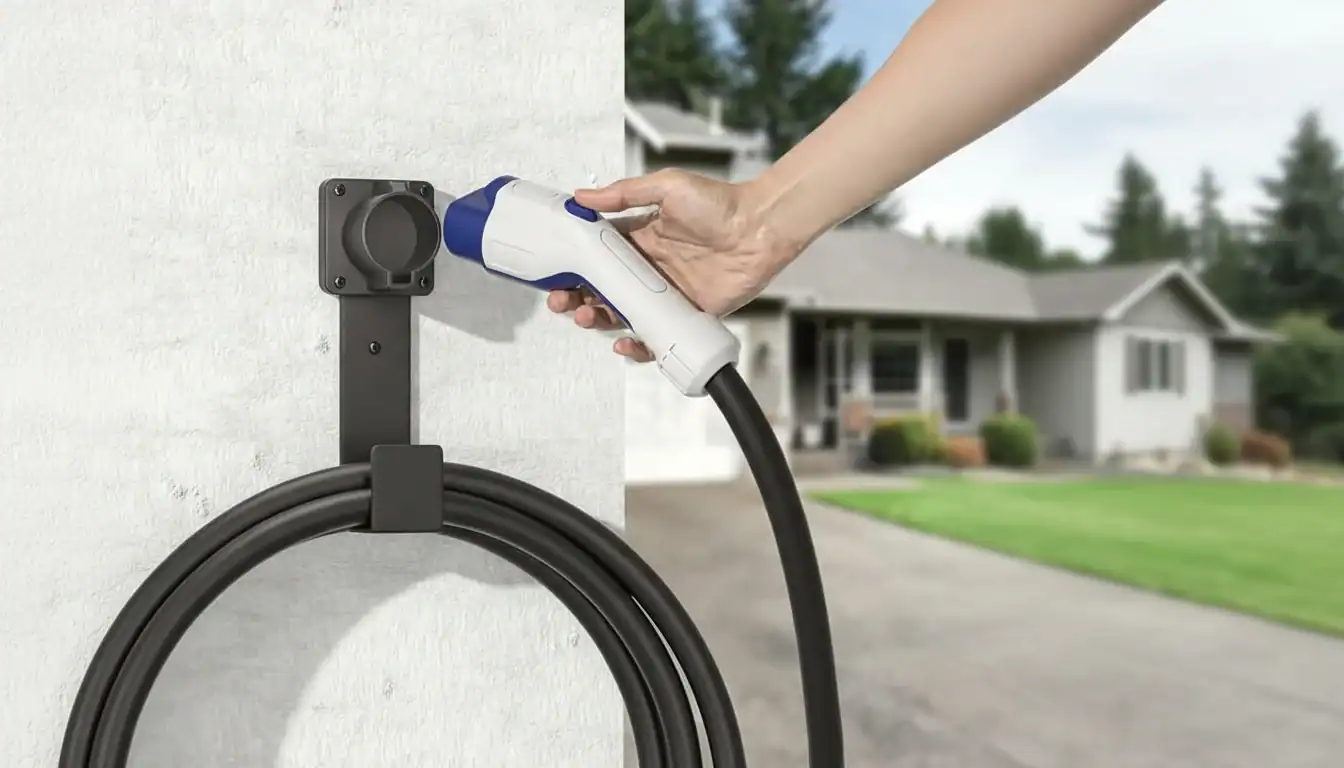
Key Features for Effective Rain Protection
The most effective holsters don’t rely on just one feature. They integrate multiple protective elements to provide comprehensive defense against water damage and corrosion over many seasons.
- Look for corrosion-resistant materials like powder-coated or anti-rust steel to prevent the holster itself from degrading over time.
- An enclosed dock design is crucial, as it physically shields the pins from direct water exposure, dripping, and splashing.
- A weather-resistant coating on all metal components adds an extra layer of durability against ambient moisture and humidity.
- Integrated cable management hooks keep the charging cable elevated, preventing it from sitting in puddles or snow on the ground.
Material and Construction to Look For
The choice of materials directly impacts a holster’s ability to protect the charging pins. A hybrid approach using strong, rustproof metal and durable plastic provides the best balance of strength, weather resistance, and electrical insulation.
- A heavy-duty steel frame or J-hook ensures the holster can support the cable’s weight and withstand physical impacts without failing.
- ABS plastic is frequently used for the plug dock itself because it’s wear-resistant, non-conductive, and effectively protects the connector head from moisture.
- The combination of a metal hook for the cable and a dedicated plastic dock for the plug offers a robust and functionally superior protective solution.
Expand Your Market with Custom EV Chargers
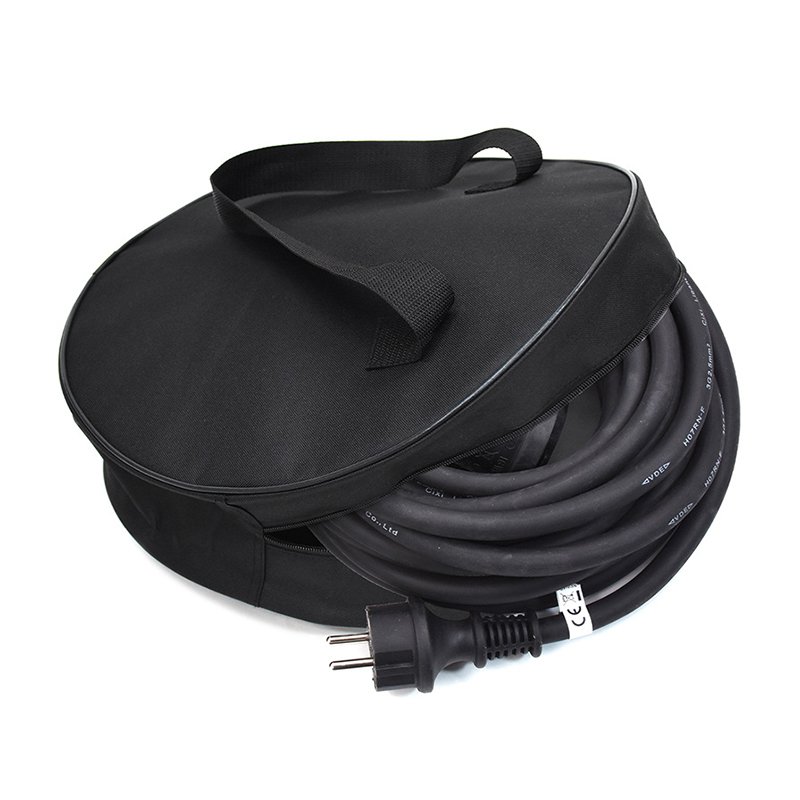
Cable Retractors: Is the “Overhead Reel” Worth the Money?
For professional and industrial settings, overhead cable reels are not a luxury; they are a justified investment in safety, equipment longevity, and operational efficiency.
How Retractors Extend Cable Life and Improve Safety
Suspending charging cables with an overhead reel is the most effective way to prevent the common damage that leads to premature failure. Keeping cables off the floor stops them from being dragged across abrasive surfaces, pinched by equipment, or bent into sharp kinks. This physical protection directly extends the cable’s operational lifespan and reduces the constant risk of personnel tripping over loose wiring in busy workshops or battery rooms.
- Prevents common damage like bending, pinching, and kinking by keeping cables suspended.
- Reduces long-term replacement costs by extending the total lifespan of charging cables.
- Eliminates tripping hazards in high-traffic areas, which cuts down on worker injuries and operational downtime.
- Decreases facility liability, especially in environments with existing chemical or electrical risks.
Key Technical Features to Look For
When evaluating a retractor, focus on specifications that guarantee durability and safe operation. The unit must match the demands of your specific charging cable and environment. Look for adjustable mechanisms and redundant safety features, as these are hallmarks of a professional-grade system built for repeated use.
- Sufficient capacity to support charger leads up to 10-12 feet long.
- Adjustable tension springs to precisely manage the cable’s retraction speed and force.
- Stroke-limiting devices that stop the cable at a preset, ergonomic height.
- Premium models with stainless steel ropes and a redundant suspension cable that prevents the unit from falling if the main spring fails.
Which Work Environments Benefit Most from Overhead Reels?
While not necessary for a simple home garage, overhead reels provide the best return on investment in professional and industrial settings. Any environment with high foot traffic and repetitive cable use, such as manufacturing plants or commercial garages, will see immediate gains in safety and efficiency. The cost is justified when you combine the material savings with improved productivity.
- Ideal for manufacturing plants, workshops, commercial garages, and forklift battery charging rooms.
- Automatic retraction saves significant time during daily setup and breakdown processes.
- Improves workflow efficiency for tasks like forklift charging by providing consistent, ergonomic cable access.
- The investment is recovered through a combination of lower maintenance costs, better safety records, and tangible productivity gains.

Winter Covers: Which Magnetic Port Cover Stops Ice?
Magnetic EV port covers provide a decent barrier against ice and snow, but their effectiveness is entirely dependent on your vehicle having ferrous metal panels around the charge port; they are useless on aluminum or plastic bodies.
Winter charging presents a unique challenge: freezing rain and snow can seal a charge port door shut or clog the connector itself. Magnetic covers are a common solution designed to prevent this, but their performance hinges on one critical factor.
How Magnetic Covers Protect Your Charging Port
Magnetic covers create a physical barrier around the charging port door. They attach directly to the car’s body panels, forming a seal that blocks snow and freezing rain. This prevents ice from building up inside the port or, more commonly, from freezing the door’s hinge mechanism. A frozen hinge can make it impossible to close the port door after charging until it thaws.
- Most designs use strong metal strips embedded within a durable fabric to attach to the car.
- The primary goal is to form a weather-resistant seal around the entire port door assembly.
- A key function is to stop the port door hinge from freezing shut, a common problem in icy conditions.
The Key Limitation: Vehicle Material Compatibility
The biggest weakness of magnetic covers is their complete reliance on the vehicle’s body material. Magnets only stick to ferrous metals like steel or iron. Many modern EVs use aluminum, plastic, or other non-ferrous composite panels around the charging port to save weight. This makes magnetic covers ineffective for a growing number of popular models.
- Magnets require an iron-based metal surface to create a secure connection.
- Vehicles like the Ford Mustang Mach-E have aluminum panels around the charge port, so magnets will not stick.
- You must test your vehicle’s body material with a simple magnet before purchasing one of these covers.
Alternative Solutions for Non-Magnetic Vehicles
If your car has aluminum or plastic panels, other options can still provide winter protection. The most common alternative uses suction cups to attach the cover to the vehicle’s body. This approach provides a similar barrier against ice and snow without needing a magnetic connection, making it a viable solution for nearly any EV.
- Suction cup-based covers are the primary alternative for vehicles with non-magnetic surfaces.
- Some designs bypass the car body and focus on sealing the charge port itself.
- These options ensure that drivers with aluminum or polymer-bodied vehicles can protect their charging ports.

Final Procurement Verdict: Securing Your EV Accessory Supply Chain
Sourcing EV accessories based on price alone exposes your brand to significant risk from installation failures and long-term weather damage. The technical details—from anchor integrity on a 50lb hook to the material science of a rain-proof holster—are what define a product’s real-world value. Choosing certified, purpose-built components is a direct investment in customer satisfaction and protects your reputation against costly warranty claims.
We engineer our full line of EV charging accessories, from IP67-rated holsters to commercial-grade cable management reels, to meet strict market certification standards. Request our complete OEM catalog to review the technical specifications and discuss how we can build a reliable accessory program for your customers. Let’s ensure the hardware you supply meets the demands of any installation environment.

 English
  Español
  Français
  Deutsch
  Português do Brasil
  Русский
  한국어
한국어  日本語
日本語  العربية